“Can You Fix My Brother’s Bag?” She Asked—The Marine Took One Look at the Name and Froze…
“Can You Fix My Brother’s Bag?” She Asked—The Marine Took One Look at the Name and Froze…
Cold December rain lashed the old brick streets of Staunton, Virginia. It was 4:45 in the afternoon, and the light was already dying, gathering beneath iron streetlamps and running in thin, freezing streams past the glowing shop windows.
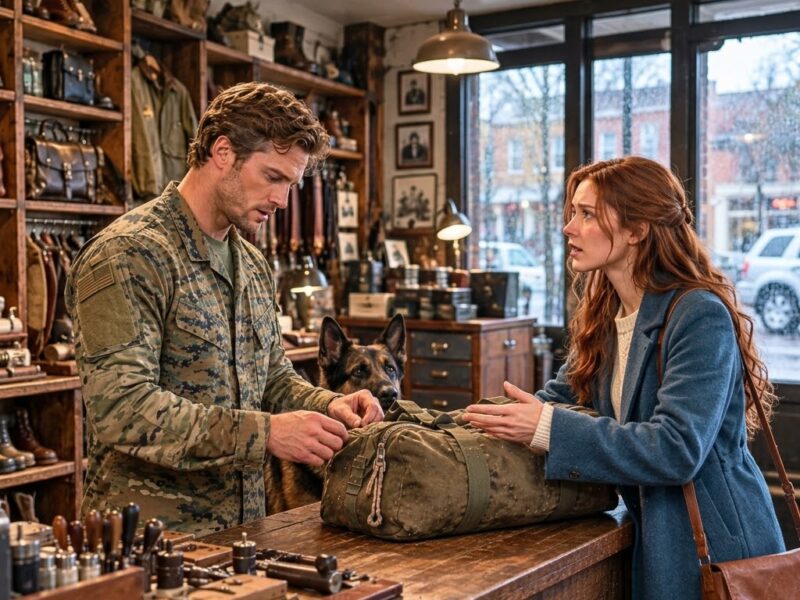
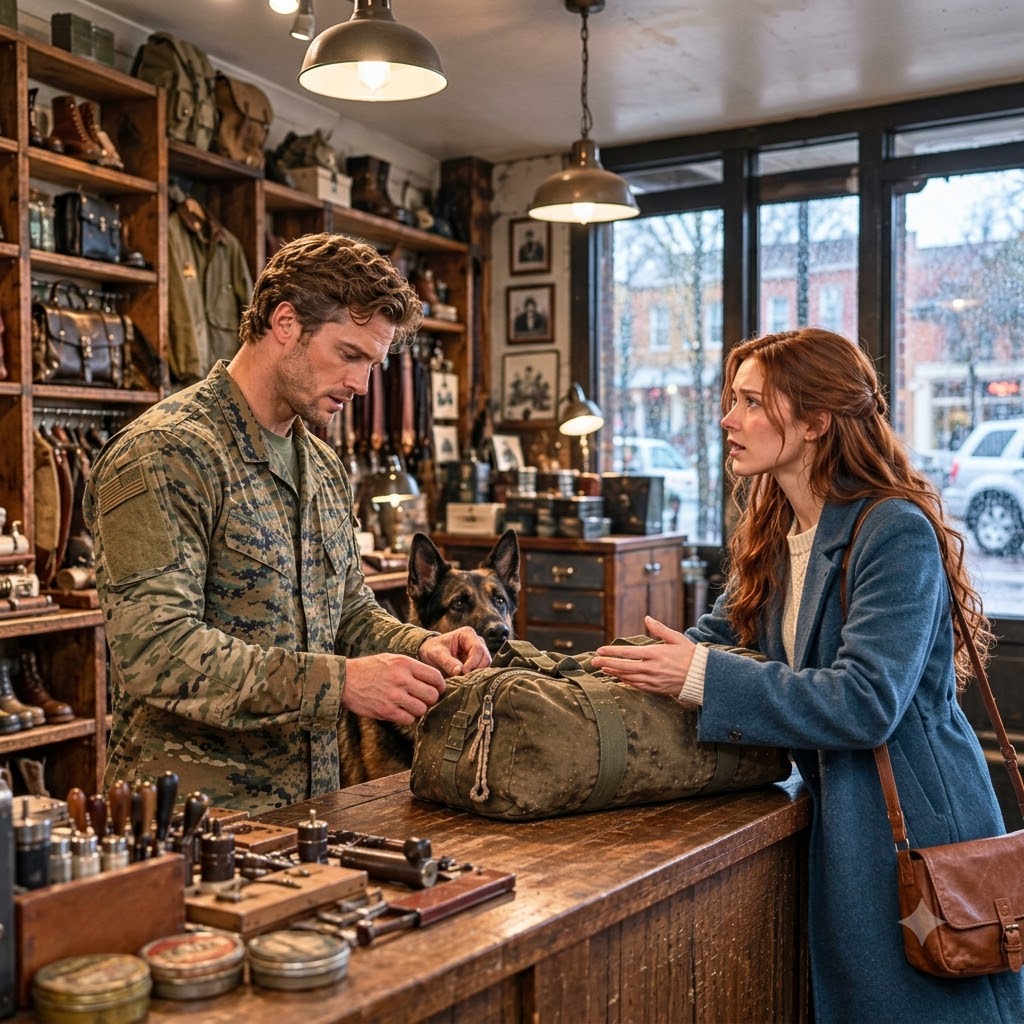
Inside Halden Leather and Field Repair, the air smelled of beeswax, neatsfoot oil, and old dust. Reese stood behind his scarred oak workbench, finishing the stitching on a weathered leather rifle case. At thirty-two, he was still serving in the United States Marine Corps Reserve, having transitioned from active duty years prior. He had just returned from a drill weekend, still wearing his woodland MARPAT blouse and trousers, an olive-drab undershirt visible at his throat, his tan combat boots planted squarely on the plank floor.
He was a man built of quiet, controlled lines. Standing a little over six-foot-two, he was lean rather than bulky, with naturally broad shoulders and the rigid posture of a man whose body remembered military discipline even when his mind wandered. His dark ash-blonde hair was cut close at the sides, his jaw clean-shaven, his hazel-green eyes unusually calm.
Near the rear counter lay Mako.
Mako was a nine-year-old black-and-tan German Shepherd. His powerful frame had aged, but he had not become frail. Gray had only just begun to dust the dark fur around his muzzle, giving him a distinguished, weary look. His deep brown eyes remained alert. Even when he appeared asleep, his erect ears tracked the small noises of the street outside. Mako was a retired military working dog. He belonged wholly to Reese, possessing the effortless, unbreakable loyalty of a creature that had survived the worst things a man could survive, right by his side.
Reese tied off the final stitch on the leather case and reached for his shears.
The brass bell above the front door rang, a sharp, clear sound that cut through the drone of the rain. Mako’s eyes opened first.
A young woman stepped into the shop, bringing the chill of the street with her. She pushed the heavy wooden door closed with her hip, careful to secure the latch against the wind. Against her chest, shielding it from the rain, she carried an old, olive-drab canvas military duffel bag.
She was perhaps twenty-seven, slender and naturally graceful. Her fair skin was flushed pink from the biting cold, and her eyes were a striking, deep amber-brown. Long copper-auburn hair fell in loose waves over the shoulders of a muted teal wool coat, the ends darkened by the rain. She was beautiful, but there was a profound fatigue resting just behind her composed expression—the specific, heavy exhaustion of someone who had spent too many days deciding which pieces of a dead person’s life to keep and which to throw away.
“Sorry,” she said, her voice soft but steady. “Are you still open for a few minutes?”
Her gaze dropped briefly to his uniform, processing the camouflage, before returning to his face. “Are you Mr. Halden?”
“Reese is fine,” he said, his voice a low, even baritone.
“My name’s Serene. Serene Aldridge.”
The surname struck somewhere deep in Reese’s chest, a phantom impact that stopped his breath for a fraction of a second. Aldridge. But he gave no outward reaction. It was not an uncommon name. He anchored himself in that probability.
Serene approached the workbench and lowered the heavy duffel onto the scarred wood as if setting down fragile glass. “I was hoping you could help me. A leather-reinforced strap is badly cracked near the attachment point. The canvas is faded, softened from storage.”
She smoothed her hand over the dark green fabric. “My mother died several months ago. I live in Richmond, but I’ve been clearing out the family house to sell it. I found this inside an old trunk. It belonged to my older brother. He was a Marine. He died six years ago.”
Reese stared at the bag. The air in the shop suddenly felt too thick to breathe.
“There’s a section inside,” Serene continued, “that looks like it was stitched closed by hand. I didn’t want to cut it open myself and ruin it. I don’t need it to look new, Reese. I just… I don’t want it falling apart. Can you fix my brother’s bag?”
Before Reese could formulate a reply, the faint scrape of heavy claws against hardwood echoed through the shop.
Reese turned his head. Mako was standing.
The German Shepherd did not bark. He did not wag his tail. He crossed the shop slowly, his dark nose working the air. But instead of investigating the stranger in the teal coat, Mako walked directly to the workbench. He ignored Serene completely. He stood on his hind legs, resting his massive front paws against the edge of the wood, and buried his nose into the canvas.
“Mako,” Reese said, a quiet, sharp warning.
The dog ignored him. He shifted his head toward the heavy brass zipper of the duffel. Tied to the metal pull was a short, faded piece of olive paracord. Mako touched it with his wet nose, inhaled deeply, and then caught the cord gently between his front teeth. He gave one small, familiar tug.
Reese went completely still. It wasn’t just a scent. It was the knot.
He knew that knot. Years earlier, in the sweltering heat of a desert deployment, during the endless, agonizing hours of waiting between movements, Corporal Nolan Aldridge used to tie scraps of paracord to his gear in that exact configuration. Three turns, a tight fold, then the short tail tucked beneath. Nolan used to let a much younger, more energetic Mako tug at them in a game of tug-of-war. Nolan had once laughed, his teeth white against the grime of his face, saying that Mako could recognize his knots faster than half the Marines in their unit.
Mako tugged the cord once more, let it drop from his jaws, and looked directly at Reese.
The rain against the windowpane seemed to vanish.
“Is something wrong?” Serene asked, noticing the sudden, total paralysis of the man across from her.
Reese slowly reached for the duffel. His large, calloused fingers moved beneath the damaged leather strap, turning it carefully toward the lamplight. On the underside, scratched into the leather with the point of a combat knife, were two initials: N. A. Below them were three short, hand-cut marks.
Reese knew those, too. Nolan’s habit. Marking his gear so it wouldn’t get mixed up in the chaotic piles of transit.
“My brother marked everything he owned,” Serene said softly, watching the color slowly drain from Reese’s face. “His name was Nolan.”
Reese’s hand remained frozen on the strap. Nolan Aldridge.
Six years of deliberate, meticulously constructed silence collapsed into a name spoken by a woman who shared his surname, and who possessed the exact same amber steadiness in her eyes.
Serene studied his pale face, the trembling tension in his jaw, and the German Shepherd sitting at attention beside the bag. “You knew him?”
Reese looked at her. He had imagined meeting Nolan’s family a thousand times in his nightmares. He had rehearsed apologies. He had planned journeys to their front door, only to find a reason to turn his truck around every single time. Now, Nolan’s sister was standing three feet away, smelling of winter rain and grief. There was nowhere left to run.
“He saved my life,” Reese whispered.
Serene did not move. Outside, the sweeping headlights of a passing car sliced through the December rain, casting shifting shadows across the shop walls. Her fingers slowly curled around the edge of the workbench. She had come to Staunton looking for a craftsman to mend torn canvas. Instead, she had found a ghost—a Marine who looked at her brother’s bag as though he had been waiting six years for it to finally come home.
Chapter 2: The Space Between Words
By nine o’clock the next morning, the storm had broken. Staunton lay beneath a pale, washed-out December sky. Puddles of rainwater shone between the cobblestones outside the shop, and weak winter sunlight stretched its golden fingers across the plank floor.
Serene Aldridge had slept perhaps two hours. Every time she closed her eyes in her hotel room, she heard the same four words echoing in that deep, restrained voice: He saved my life.
For six years, Nolan’s death had existed within her family as a collection of careful, sterile phrases provided by men in dress blues. Support operation. Civilian evacuation. Structural failure. Fatal injuries. The official casualty report had given them just enough terminology to understand that her brother was gone, and absolutely nothing to help them understand his final hours. Her mother had kept a folded copy of the report in her nightstand drawer until the paper softened and tore along the creases from being handled so often.
Yet, nowhere in those pages, nowhere in the letters from the commanding officers, had there ever been a mention of a Staff Sergeant Reese Halden, a German Shepherd named Mako, or any suggestion that Nolan’s death had become the permanent dividing line in another man’s soul.
When Serene pushed open the door to Halden Leather, the bell chiming brightly, Reese was already at work. He still wore his woodland MARPAT uniform, crisp and sharply kept. His hair was slightly damp from the morning chill. Mako lay near the wood stove, his head resting on his paws, watching her with those dark, intelligent eyes.
The olive-drab duffel remained exactly where Serene had left it the night before. untouched.
Reese glanced up. The tightness around his eyes told her he had expected her to return.
“Yesterday,” Serene said, stepping up to the counter, leaving her coat on, “you said my brother saved your life. But you didn’t tell me how.”
A muscle feathered along Reese’s clean-shaven jaw. He set down his awl. “Because I’m not sure you’ll want to hear the answer.”
Serene wanted to be angry. She wanted to remind him that Nolan had been her brother long before he had been Reese’s brother-in-arms. But she watched him lower his gaze to the damaged canvas, saw the profound, suffocating weight pressing down on his shoulders, and she understood that forcing the door open violently would only make him brace harder against her.
So, she stayed. She pulled up a wooden stool near the counter and simply watched him.
As the morning moved around them, Serene began noticing things that contradicted the tragic picture she had painted during her sleepless night. Reese Halden was not a shattered man who had collapsed after Nolan’s death. He was highly functional. Customers came through the door, and he greeted them by their first names. An elderly man came to collect a pair of repaired hunting boots, and Reese remembered to ask how the man’s wife was recovering from her hip surgery. A delivery driver dropped off a package, and Reese exchanged an easy nod and a quiet joke. His phone chimed with a reserve unit message; he read it, replied promptly, and went back to work.
He had not abandoned the world. He had built a business, maintained his military obligations, cared deeply for his dog, and learned how to move through ordinary days with a quiet, undeniable competence.
Nolan, Serene realized, was simply the one room in Reese’s sprawling house whose door remained permanently padlocked.
Without asking, Reese walked to a drip coffee maker in the back, poured a mug of black coffee, and placed it on the counter near her elbow. Serene wrapped her cold hands around the ceramic, offering a tired, grateful smile.
Mako eventually rose from his spot by the stove. He disappeared behind the rear counter and returned a moment later carrying a battered, saliva-slicked red rubber ball. He padded over to Serene and dropped it deliberately against the toe of her leather boot.
She looked down, surprised. She picked up the damp ball and tossed it gently toward the back of the shop. Mako bounded after it with a sudden, explosive speed that belied his nine years. He caught it on the first bounce, spun around, and trotted back.
But he did not bring it to Serene. He walked directly past her and deposited the ball at Reese’s boot.
Serene stared after the dog, crossing her arms. “Seriously?”
Reese laughed.
It was a brief sound, low and startlingly genuine, but it changed the entire architecture of his face. The rigid lines of discipline vanished. For one fleeting, brilliant second, Serene saw the younger man who must have existed before the tragedy—the man who might once have laughed in the desert beside her brother, instead of carrying his memory like a tombstone.
“Apparently, you failed the evaluation,” Reese said, a ghost of a smile lingering on his lips.
Serene glared playfully at the dog. “I threw the ball perfectly.”
“He has rigorous standards,” Reese replied.
The ordinary moment lasted only a few seconds, but when it passed, the air in the room no longer felt quite so guarded. The ice had cracked.
Reese’s hands stopped moving. He had reached the hand-stitched section inside the duffel bag. The stitching was heavy-duty, strong but uneven—clearly not the work of a factory machine. Reese studied the spacing of the thread and the way the heavy canvas had been folded inward to conceal whatever lay beneath.
“Someone added this compartment after the bag was issued,” Reese murmured, tracing the thread. “Most likely Nolan.”
Serene moved closer, leaning over the workbench. Yesterday, she had been terrified that opening it would destroy the last piece of her brother. Now, standing beside the man who had known him at the end, she was more afraid of leaving it closed.
“Can you open it without ruining the bag?” she asked.
“I can preserve the canvas. I’ll just cut the added thread.”
Serene took a deep breath. “Do it.”
Reese selected a small, razor-sharp seam ripper. He worked beneath each stitch individually, rather than dragging the blade blindly through the fabric. His hands moved with a patient, reverent precision. He was treating the duffel not as a piece of military surplus, or a mystery to be solved, but as something another person had trusted him not to harm.
The final stitch popped. Reese folded the hidden canvas flap back.
Inside the dark pocket lay three objects: a compact, black digital field recorder, a small brass key stamped with the number 214, and a folded piece of yellowed paper.
Serene reached for the paper first. Her hands trembled as she unfolded it. Written across it in Nolan’s familiar, messy scrawl was an address in Staunton, Virginia, accompanied by a date from shortly before Nolan’s final deployment.
Reese looked at the paper. “I know that place. It’s a private veterans’ workshop across town. Nolan used to go there to use the woodworking tools.”
Serene looked at the brass key, turning it over in the light, and then her eyes fell to the digital recorder.
Reese saw the decision forming in the set of her jaw before her thumb even reached for the power button. “You don’t have to listen to it today,” he said gently. “You can take it back to Richmond. Listen when you’re ready.”
But Serene had spent six years living with the silence of everything she had never been told. She pressed the button.
The tiny screen flickered weakly to life. She pressed Play.
Static hissed from the small speaker first. Then, the ambient sound of a room. Male voices. Someone in the background was loudly complaining about the terrible quality of the coffee. Another voice laughed—a deep, booming sound. A chair scraped harshly across a hard floor.
Then, Nolan spoke.
“Alright, testing this thing out. If you’re hearing this, it means I actually figured out how to turn it on without breaking it.”
Serene stopped breathing. Six years of grief had subtly smoothed and altered her memory of her brother’s voice. She had not realized how much she had forgotten until the real sound filled the quiet leather shop. It was warmer than she remembered. Younger. Careless and vibrant in a way that dead people were never allowed to remain inside framed photographs.
For a terrifying, beautiful instant, she was transported back to her mother’s kitchen, hearing Nolan tease her from the hallway. Her eyes filled with hot tears before she could blink them away.
On the recording, Nolan yelled something teasing to someone nearby. “Hey, keep it down, I’m making history here!” Laughter followed, and then, a sharp, piercing, two-note whistle.
Mako’s head snapped up.
The German Shepherd scrambled to his feet, his claws scrabbling on the wood floor, and rushed to the workbench. His ears were pinned forward, his body rigid with sudden attention. When the whistle sounded a second time from the speaker, Mako released a soft, high-pitched whine through his nose and stared intensely at the black plastic recorder.
Serene looked at Mako, and then slowly turned her tear-filled eyes to Reese.
The dog’s reaction was too immediate, too visceral to misunderstand. Reese’s jaw was locked tight, his eyes fixed on the device. He was finally confirming what he had withheld. Mako had not just served alongside Nolan. The dog had been with them.
Suddenly, Mako’s reaction to the paracord knot made devastating sense. Reese, Nolan, and Mako had all belonged to the exact same chapter of a story Serene had never been permitted to read.
Reese’s hand slowly curled into a fist against the edge of the workbench, his knuckles turning white.
Serene noticed the agony in his posture, but she did not ask him to stop. She looked back at the recorder screen. The first file ended. Automatically, the second file clicked over and began to play.
Static whispered again.
Then Nolan’s voice returned. It was quieter this time. There was no laughter in the background. It sounded hollow, recorded in a different space.
“Halden. If you ever hear this—”
Reese’s hand shot across the workbench. He slammed his finger onto the stop button.
The sudden silence was deafening.
Serene stared at his hand covering the device. She slowly raised her eyes to meet his.
“Halden,” she whispered.
Reese did not move. He looked like a man standing before a firing squad.
“He meant me,” Reese said, his voice barely audible.
Serene looked down at the recorder trapped beneath his hand. Until that exact moment, she had believed they were listening to random fragments Nolan had happened to leave behind for his family. Now, an entirely new, deeply unsettling reality settled over her.
At least one of the files in that bag had been left explicitly for the Marine standing across from her.
Chapter 3: Locker 214
By early afternoon, the winter sky over Staunton had turned the bruised color of dull steel. A dry, biting wind moved through the narrow historic streets as Reese, Serene, and Mako walked the three blocks beyond the downtown district.
The address on Nolan’s note belonged to the Staunton Veterans Workshop. It was a privately operated, non-profit space established decades earlier. It existed for veterans and local service members who needed access to tools, woodworking benches, storage lockers, or simply a quiet place to exist among people who understood the weight of military life without requiring any explanations.
Its brick facade had faded and chipped with age, but a small brass plaque beside the heavy oak door was polished to a brilliant shine.
Reese recognized the building immediately. The memories came unbidden. Nolan had brought him there once, during a two-week leave period shortly before their final deployment to the Middle East. Reese remembered very little about that specific afternoon, except Nolan complaining loudly about the ancient percolator coffee and insisting the place had the best lathe and woodworking bench in all of Virginia. At the time, the rows of numbered storage lockers in the basement had meant nothing to Reese.
Now, walking up the steps, the brass key marked 214 felt unexpectedly heavy in Serene’s coat pocket.
Inside, the air smelled of sawdust, machine oil, and old paper. They were met at the front desk by Arthur Bell, the workshop’s administrator. Arthur was a sixty-eight-year-old Army veteran with a compact, sturdy build, close-cropped silver hair, and a neatly trimmed gray mustache. Years of managing combat veterans had given him an incredibly patient manner and a finely tuned instinct for knowing exactly when questions should remain unasked.
He listened quietly to Serene’s explanation, examined the brass key through reading glasses, and then nodded, disappearing into the back records office.
The wait lasted nearly twenty minutes. Reese spent most of it standing rigidly near a hallway wall covered with framed, faded photographs of service members from different decades—Vietnam, Korea, Desert Storm. Mako sat perfectly still at his left heel.
Serene sat on a wooden bench, watching Reese without appearing to. Since the recorder had spoken his name that morning, Reese had retreated into himself. He was quieter, yes, but not evasive in the same way he had been yesterday. Yesterday, he had looked like a man trying to hide a secret. Today, he looked like a man desperately trying to hold his own ribcage together.
Arthur finally returned carrying a heavy, leather-bound ledger and a sealed manila envelope.
“Locker 214 was indeed registered to Corporal Nolan Aldridge,” Arthur said softly, resting the ledger on the counter. “After he… after the payments stopped six years ago, the locker went into arrears. Our policy requires that unclaimed property belonging to a deceased service member be inventoried, sealed, and retained in the archives indefinitely, rather than discarded.”
Arthur looked at Serene with sympathetic eyes. “Because Nolan listed no family emergency contact on the original locker agreement—only a unit address that was later dissolved—the contents were transferred to archival storage. We had no way to find you.”
No one in the Aldridge family had ever known it existed.
Serene produced her driver’s license and the official military documents establishing her relationship as next-of-kin. Arthur checked each page carefully, signed a release form, and then gestured for them to follow him downstairs.
The archival storage room was in the basement. It smelled of old pine, metal shelving, and deep, undisturbed dust. Arthur navigated a labyrinth of chain-link cages until he located a shelf in the back corner. He pulled down a rectangular, military-green Pelican storage case labeled with a white stencil: 214.
He set it on a metal folding table under a buzzing fluorescent light. “Take all the time you need,” Arthur said quietly, and walked back up the stairs, leaving them alone.
Serene stepped up to the table. Her hands were shaking. She inserted the brass key into the padlock. It turned smoothly, opening with a loud click on the first try.
For six years, she had tortured herself imagining that there must be some grand, dramatic secret surrounding Nolan’s death—a conspiracy, a cover-up, something that would make the agonizing loss make sense. Standing over the heavy case, unlatching the clasps, she realized she had half-expected some cinematic revelation to be waiting inside.
She threw open the lid. There wasn’t a revelation. There was only Nolan.
The case was a time capsule of a young man’s life. Inside were several stacks of printed photographs bound with rotting rubber bands. A worn Leatherman multi-tool. Two black Moleskine notebooks filled with handwriting. An old, frayed unit deployment patch. A cracked ceramic coffee mug wrapped carefully in a t-shirt. A rugged, rubberized external computer hard drive.
And beneath all of it, coiled in the corner, was a faded, olive-drab nylon working collar with a scratched metal identification plate riveted to it.
Mako moved before Reese did.
The German Shepherd approached the open case, stood on his hind legs, and rested his paws on the edge of the metal table. He lowered his graying head and inhaled deeply along the length of the collar. His ears immediately shifted backward, pressing flat against his skull. He sniffed it again, slower this time, a long, trembling intake of air.
Then, Mako dropped back to the concrete floor. He circled twice and settled onto the cold ground directly beneath the table, resting his muzzle on his paws, his eyes fixed on the faded strap hanging over the edge.
Serene watched the dog, and felt her heart shatter into a thousand pieces behind her ribs. Mako could not speak English. He could not explain the memories locked in his mind. He did not need to.
Reese slowly reached into the box and picked up one of the photographs.
Serene looked over his shoulder. In the picture, Nolan stood in full desert combat gear, his arm slung around the neck of a much younger, jet-black Mako. Nolan was smiling broadly, laughing at something just outside the frame. And there, visible near the edge of the photo, was Reese.
Serene had never seen that version of her brother—so entirely in his element, so alive. But more shockingly, she had never seen that version of Reese. He was smiling. A wide, unguarded, boyish grin.
“You were happy,” Serene whispered, touching the edge of the photograph.
Reese kept staring at the image, his eyes tracing the lines of Nolan’s face. “We were young.” It was a statement of fact, not quite an answer.
They took the rugged external hard drive upstairs. Arthur allowed them to connect it to an old, bulky computer in a private office.
Most of the folders contained mundane digital detritus: hundreds of photographs from deployments, equipment manifests, training schedules, and backed-up audio files from the field recorder. There was nothing classified. Nothing that resembled the dark secrets Serene’s imagination had prepared her for.
Then, Reese’s hand stopped moving the mouse. He stared at the screen.
He saw a folder labeled with a specific date. Six years ago. The date of the operation.
His entire posture changed. His spine went rigid, his shoulders locking into place as if bracing for a physical blow. Serene noticed the shift in his breathing immediately.
“That one,” she said softly.
Reese did not double-click the folder. His hand hovered over the mouse. Instead, after a long, suffocating silence, he finally turned his chair to face her. The dam broke. He gave her what she had asked for since walking into his shop. He gave her his version of the end of her brother’s life.
“Our team had been tasked with helping evacuate civilians from a badly damaged multi-story structure,” Reese began, his voice flat, stripped of all emotion, a tactical debrief delivered to a ghost. “It had taken indirect fire. It was unstable.”
He looked at his hands, resting on his knees. “Mako alerted to severe instability inside the load-bearing walls. I remember the dog becoming increasingly frantic, insistent. I remember looking at the cracks in the masonry, knowing the building was a death trap. But people were still being brought out of the basement. So we moved deeper.”
He swallowed, his throat clicking. “Then came the second collapse.”
Everything after that moment, Reese explained, lived inside his head not as a continuous memory, but as violent, shattered fragments of a nightmare.
“Dust so thick I couldn’t see the light on my own rifle,” Reese said, his eyes unfocused, staring at the floor. “Mako barking somewhere through the debris. The ceiling coming down. And then… Nolan appearing in the smoke. Appearing where he never should have been. I was pinned. He shouldn’t have come back. But there was a violent impact. The wall gave way. Nolan grabbed me by the vest and shoved me backward, toward the doorway, toward safety.”
Reese looked up at Serene. His eyes were red, shining with unshed tears. “I survived. He didn’t.”
For six agonizing years, Reese had reduced those horrific fragments into a simple, punishing equation. Guilt preferred simple equations. Mako had warned him. Reese had ignored the warning and continued. Because Reese was trapped, Nolan came back for him. Nolan died getting him out. Cause and effect.
“I made the call to keep moving,” Reese said quietly, the confession finally out in the open. “He came back because I was still in there. Because of my order.”
Serene felt the breath leave her lungs. She finally understood. She understood why Reese had never contacted them, why he had never come to the funeral, why he lived in a quiet shop surrounded by broken things. He had vividly imagined standing in her mother’s living room, looking her mother in the eyes, and explaining that her brilliant, brave son had died saving a man who believed he should have known better.
So, he had done nothing. And each year that passed in silence made the silence harder to break, until the shame of his absence became just another reason to stay away.
Serene looked toward the doorway. Mako was lying there, his head resting on his paws, watching Reese.
Then, Serene reached past Reese and double-clicked the dated folder.
Inside was a single audio file, copied from the field recorder.
Reese stiffened, his breath hitching, when Nolan’s voice filled the small office.
The recording had clearly been made prior to the breach, sitting in the staging area. Nolan spoke casually at first, reviewing his breaching equipment, joking about Mako whining and being impatient to work.
But then, Nolan’s tone changed. The humor vanished.
“Halden isn’t going to like this,” Nolan’s voice crackled through the computer speakers. “Mako alerted twice during the exterior perimeter assessment. The south wall is buckling. Halden wants to hold the line, wait for structural engineers.”
Reese’s head snapped up. He stared at the computer screen.
The recording continued. “But I just saw a woman pulled from the rubble screaming that her kid is still in the basement. I’m not waiting on engineers. If Mako confirms there’s a live scent down there, I’m going in. Even if Halden orders me to stay put. I’m going back.”
The file ended. The speaker hissed with static.
Serene turned her chair toward Reese.
He had gone completely, horrifyingly still. The color had vanished from his skin.
Nolan’s voice had been calm. Unmistakable. It had not been Reese giving a reckless order to advance. It had not been Nolan describing a frantic plan to run back into a collapsing building to retrieve a trapped Staff Sergeant.
It was Nolan making a calculated, defiant decision of his own. Nolan had gone in for a civilian.
Reese reached forward with a trembling hand and clicked the mouse, closing the audio player. The sudden silence in the office felt physically crushing, like the pressure at the bottom of the ocean.
He stared at the darkened computer monitor for ten endless seconds. His mind was violently attempting to rewrite six years of established neurological pathways.
Then, without a word, Reese pushed his chair back, stood up, and walked out of the office. He climbed the basement stairs, pushed through the heavy front doors, and walked outside into the bitter cold.
Serene did not try to stop him. She knew he needed the air.
Mako remained sitting beside the desk for several seconds. The German Shepherd looked toward the empty doorway through which Reese had vanished. Then he looked back at Serene, as if asking a question. Finally, Mako rose to his feet. He trotted up the stairs, following his handler.
Outside on the sidewalk, Reese stood alone beneath the gray, uncaring Virginia sky. He dragged the freezing air into his lungs, but it felt entirely incapable of reaching deep enough to give him oxygen. He braced his hands on his knees, leaning forward, fighting the urge to vomit.
For six years, every morning he woke up, he had believed that soul-crushing guilt was the required payment for surviving Nolan Aldridge.
Now, standing on the brick pavement, he was facing something infinitely more terrifying than guilt. He was facing the earth-shattering possibility that he had spent six years destroying his own life, punishing himself daily, for a version of the past that had never been true.
Chapter 4: The Archive of Truth
Morning came to Staunton beneath a clear, brilliant, bitter sky. Frost whitened the roofs of parked cars and clung to the edges of the old brick sidewalks, sparkling like crushed glass in the early sun.
Before eight o’clock, the yellow lights were already burning brightly inside Halden Leather and Field Repair.
Reese had been at his workbench for nearly an hour. He was mechanically repairing a torn canvas rifle sling that did not require a fraction of the concentration he was aggressively forcing upon it. His movements were jerky, driven by nervous energy. He had not slept. After leaving the veteran’s workshop yesterday, he had walked for miles in the cold. Nolan’s archived voice had followed him through the dark streets, repeating the same impossible, world-altering truth over and over.
I’m not waiting on engineers… I’m going back.
Mako rested near the wood stove, enjoying the radiant heat. But every few minutes, the old dog raised his graying muzzle toward the front door, his ears swiveling.
When the brass bell finally sounded, Mako was already standing.
Serene entered. She was carrying Nolan’s black field recorder and a manila envelope containing printouts from the archive files. Her copper hair fell loosely over her teal coat, and the morning cold had brought a vibrant, healthy color into her cheeks.
Yesterday, she had allowed him to walk out into the cold alone. She had given him the grace of space. She was not allowing him to leave today.
She walked straight to the workbench and placed the recorder firmly on the scarred wood.
“I’m going to finish listening to my brother,” Serene said, her voice resolute, refusing to be dismissed. “You can stay, or you can go in the back room. But I’m playing it.”
Reese stared at the small black device. His throat was tight. He looked at Serene’s eyes, seeing the unyielding strength in them. Slowly, he reached under the counter, pulled out a wooden chair, and sat down opposite her.
“Play it,” he said.
The remaining audio files and digitized notes did not offer a perfect, cinematic explanation. War rarely provides perfect narratives. There were disjointed timestamps, short tactical field notes, mundane equipment checks, and fragments of rushed conversation.
But as Serene arranged the printouts chronologically on the table, and as they listened to the sequential audio files, the timeline of that horrific day—the sequence Reese had carried in broken, bloody pieces for six years—began systematically putting itself back together.
Mako had warned them that the structure was unstable. Reese had remembered that correctly.
But then came the missing piece. The piece that trauma and guilt had buried beneath miles of psychological rubble.
Mako had detected someone alive behind a partially collapsed interior wall in the basement. A little girl.
As the audio played the sound of Mako’s frantic scratching and high-pitched barking, the leather repair shop seemed to dissolve around Reese. He could smell the acrid, choking scent of pulverized concrete again. He could taste the copper of blood and dust. He saw Mako, rigid near a narrow opening in the rubble, his nose working frantically through the powder before turning toward the two Marines with unmistakable, absolute certainty.
Someone is alive in there.
Then, Reese remembered looking at Nolan. Through the dust-choked air, they had locked eyes. There had been no order given. Reese had not commanded Nolan to advance. Nolan had made the decision himself. He was going into the breach for the child.
And Reese, as his squad leader, as his brother, chose to go in with him.
The memory continued playing in Reese’s mind now, free from the suffocating dark matter of self-blame. They squeezed through the breach. They reached the trapped girl. She was terrified, covered in white dust. Nolan freed her leg from beneath a beam while Reese frantically used his entrenching tool to widen the narrow passage back out to the street.
Then, the structure groaned. The deep, agonizing sound of steel rebar snapping. The second collapse was beginning.
Nolan shoved the little girl through the safe opening first. Mako, following his training, scrambled out right behind her to guide her to daylight.
Nolan had not yet cleared the debris field when Reese turned back to help him.
For six years, Reese’s traumatized brain had remembered Nolan running back into the building to save Reese. Now, the fog lifted. He remembered the truth. Reese had run back for Nolan.
Reese had reached into the blinding dust, caught Nolan’s arm, and pulled desperately. But Nolan had looked upward. He saw the ceiling failing in a massive sheet of concrete. Before Reese could comprehend the physics of the collapse, Nolan planted his boots, drove both hands violently into Reese’s chest armor, and shoved Reese backward, launching him beyond the collapse line just as the ceiling came down.
The impact. The blinding dust. Mako barking somewhere outside the debris. Then, darkness.
Reese had woken up hours later in a medevac helicopter, concussed, ribs shattered, alive.
Nolan never woke up.
The sounds of the street outside the shop slowly filtered back into Reese’s ears. The winter sunlight lay in neat squares across the floorboards. Serene sat across the table, her hands resting quietly in her lap, watching the tears stream silently down Reese’s face. Mako had moved close, pressing his heavy body against Reese’s leg, offering the grounding weight of his presence.
Reese looked down at his own trembling hands.
The memories had never been entirely false. That was what had made them so impossibly dangerous. Mako really had warned them. Reese really had gone inside the building. Nolan really had shoved him clear of the falling concrete. Nolan really had died.
But the missing context changed the entire architecture of the tragedy.
Reese had not caused Nolan to return to the building. Nolan had chosen to risk his life to rescue a child. And Reese had risked his own life trying to bring Nolan out.
For six years, the agonizing thought I couldn’t save him had slowly, insidiously mutated in the dark into I caused his death.
Now, that sentence no longer fit the truth. The math was wrong.
Serene did not reach across the table to comfort him. She did not tell him how he should feel or offer hollow platitudes about heroism. She simply reached out and pressed play on the final recording.
Nolan’s voice came through the small speaker one last time. He sounded tired, younger, and almost painfully ordinary. He joked about Reese obsessively checking their magazines twice, laughing at his own remark.
Then, his voice softened. The bravado dropped away.
“Hey. If anything happens to me on this run… somebody keep an eye on Halden, alright? The guy’s stubborn as hell. He can bring everybody home except himself.”
The recording clicked off.
Silence settled between them, heavy and sacred.
Yesterday, Reese had walked away. Today, he stayed in the chair. He wiped his face with the back of his hand, took a ragged breath, and finally began speaking.
He told Serene everything. He told her there had been no dramatic breakdown, no substance abuse, no screaming fits in the years after Nolan died. He simply vanished into routine. He continued serving in the Reserves. He opened his leather shop every morning at eight. He paid his invoices on time. He repaired broken boots and stitched canvas bags. He remembered his customers’ names, and he took Mako home to a quiet house every night.
From the outside, he was the picture of a well-adjusted veteran. He had simply built a highly functional life around a tomb.
He declined invitations to old unit reunions. When Nolan’s name was brought up by other Marines, Reese found a tactical excuse to leave the room. He never contacted the Aldridge family because he could not stomach the thought of looking into a grieving mother’s eyes while believing he was the architect of her agony.
Reese’s gaze moved across the walls of his shop. Shelves lined with boots bearing new soles, stitched canvas tents, old leather saddles cleaned and repaired instead of discarded.
“There’s a bitter joke in here somewhere,” Reese whispered, his voice hoarse. “I’ve spent six years meticulously repairing things that other people believed were worth saving… while quietly deciding I wasn’t one of them.”
Serene looked at the repaired bags on the wall. She understood that sentiment more than she wanted to admit. Because she had done the exact opposite.
“I was angry with him,” Serene said softly.
Reese looked at her, startled.
Serene had never said those words aloud to anyone. Not to her mother, not to her friends. “I loved Nolan. I idolized him. But after the officers came to the door… after the funeral… part of me deeply resented the way he lived his life. He always moved toward the fire. Toward whoever needed help.”
She stared down at the black recorder. “Sometimes it felt like strangers in a country thousands of miles away got the bravest, best parts of my brother. While his family was left with a folded flag, some photographs, and an official report that told us nothing.”
Her mother had never blamed Nolan for his choices; her mother had simply faded away from the grief. But Serene had been angry. And after her mother died a few months ago, Serene responded to that anger by moving relentlessly fast. Boxes appeared throughout the Richmond house. Clothes were hastily donated. Papers were sorted with cold efficiency. A realtor was contacted within weeks.
She had told herself she was being practical. She was moving forward. In truth, she had been trying to make the past smaller. She had been trying to erase the ghost of the brother she was angry at for leaving her.
But now, the exact same truth that was actively releasing Reese from his prison of guilt was changing the way Serene viewed her brother.
Nolan had not run back into that collapsing building because his family mattered less to him. He had run back in because he knew a terrified little girl was trapped in the dark, and Nolan Aldridge simply could not exist in a world where he walked away from that. That was his nature. That was his grace.
For several long minutes, neither of them spoke. The winter sun climbed higher, warming the wood floor.
Then, Reese stood up. He walked behind the counter, retrieved a small key from his pocket, and unlocked a narrow, hidden drawer beneath the cash register. He reached inside and pulled out a small piece of metal on a beaded chain.
He walked back to the table and placed it gently in front of Serene.
It was a single military dog tag. Stamped into the dull metal was the name: ALDRIDGE, NOLAN.
The metal rested on the table as though six years had added physical weight to it. It was a spare tag Nolan had tossed to Reese in the barracks shortly before their final deployment—one of those small, superstitious, practical exchanges between Marines that neither man had considered important enough to dwell on at the time.
After Nolan died, Reese could have mailed it to the Aldridge family. He never did. Facing Nolan’s mother had felt impossible. And as the grueling years passed, the small piece of metal became something else entirely. It became a talisman of his punishment, a daily reminder of his failure, and perhaps, the absolute last piece of Nolan that Reese believed he was allowed to keep.
He picked it up and placed it gently into Serene’s open palm.
She stared down at her brother’s name. Her thumb moved slowly, tracing the raised, worn letters. For a moment, she thought about the big, empty house in Richmond and everything still inside it. The photographs her mother had lovingly framed. Nolan’s favorite books on the shelf. His dress uniforms carefully stored in garment bags. The handmade birthday cards nobody had ever been able to throw out.
Her family had Nolan. Not all of him, of course. No family ever gets to keep all of a person. Some pieces of a life inherently belong to the people who shared the darkest, brightest moments with them in the mud and the sand.
Serene looked up at Reese. His eyes were unguarded, vulnerable.
She reached out, placed the dog tag back into Reese’s large, calloused palm, and gently closed his fingers around it.
“He left enough of himself with us in Richmond,” Serene said, her voice thick with emotion but steady. “Maybe this part was always meant to stay with you.”
Reese stared at his closed fist. He said nothing. For once, his silence did not feel like a bunker he was hiding inside. It felt like reverence.
Mako rose from the floor. The old German Shepherd crossed the space between them and sat heavily against Reese’s leg, leaning his weight into the man. Gray had spread entirely around the muzzle that had once been jet black on that horrific day in the desert.
Mako had been there when Nolan died. The dog had heard the terrifying roar of the collapse. He had sat in the dust and waited for a man who never came out of the rubble. And Mako had survived, too. He had grown older, carrying the trauma of that day inside him, without ever treating his own survival as a betrayal of the man he lost.
Mako slowly lifted his chin and rested his heavy head directly on Reese’s knee, looking up with soulful brown eyes.
Reese looked down at the dog. His fingers tightened once around Nolan’s dog tag.
And finally, after six years, the dam inside his chest gave way entirely.
It was not the memory of Nolan that broke him. It was not the grief, which would always remain. What broke was the iron-clad belief that suffering in silence was the rent he owed the universe for being alive.
His broad shoulders shook once. Then again. He buried his face in his hands.
Nolan was still dead. Reese still missed him with a ferocity that stole his breath. Nothing Serene had brought into the shop, no audio file or revelation, could magically change that reality. But grief did not need the parasite of guilt to prove that Nolan had mattered.
For the first time in six years, Reese allowed the grief to simply be grief. He allowed that to be enough.
He bowed his head over the workbench, Nolan’s dog tag enclosed in one hand, Mako pressed fiercely against his knee, and Serene sitting quietly across from him, bearing witness. And when the tears came—deep, ragged, and violent—Staff Sergeant Reese Halden did not turn his face away in shame.
Chapter 5: Spring and Stitches
Early spring returned to the Shenandoah Valley beneath a mild, forgiving March sky. New, vibrant green began showing along the roots of the old oak trees lining the brick streets of Staunton. Afternoon sunlight poured warmly through shop windows that had spent the last four months reflecting nothing but freezing rain, frost, and gray clouds.
Three months had passed. They had not miraculously transformed Reese Halden into a completely different man. He still served proudly in the Marine Corps Reserve. He still arrived to unlock the door of Halden Leather and Field Repair at exactly seven-forty-five every morning. He still kept his awls, mallets, and needles arranged with an almost unreasonable, military precision on his workbench. And he still became quietly, noticeably irritated when careless customers left dripping wet umbrellas leaning against finished, oiled leather goods.
Some mornings were incredibly easy. He woke feeling lighter, the air in his lungs clean. Other mornings were not. The ghost of the desert still visited him. Nolan’s name could still catch unexpectedly in his throat like a fishhook.
The profound difference was that Reese no longer treated the bad days as definitive proof that he was a failure who didn’t deserve to move forward. The bad days were just weather. You weathered them.
He had attended a weekend gathering with several men from his old active-duty unit at a bar in Norfolk. He had promised himself he would only stay for twenty minutes out of obligation. He stayed for four hours, drinking beer, telling stories that made him laugh until his ribs ached, and allowing himself to remember the good times without apologizing for surviving to tell them.
A week after that reunion, one of the Marines had mailed Reese an old, severely cracked leather duty belt belonging to a mutual friend who had died in combat years earlier, asking if it could be salvaged for a shadow box. Reese spent three evenings painstakingly restoring the leather, hydrating it, and re-stitching the binding. He mailed it back and refused to accept payment.
Word spread quietly through the veteran network. Soon came a pair of battered combat boots from a Gold Star mother. Then a faded canvas field bag from a widow.
Reese didn’t advertise. There was no newly formed foundation, no flashy sign hung above his door, and no grand, publicized project bearing Nolan Aldridge’s name. Reese simply began setting aside a few hours every Tuesday and Thursday evening after the shop closed to restore selected military keepsakes for bereaved families. Families who wanted the items preserved with dignity, rather than replaced with shiny replicas.
He repaired torn seams. He reinforced weakened straps. But he made a conscious choice not to hide every single scar on the fabric or leather. It was work his hands already knew exactly how to do. Only now, his heart understood exactly why the work mattered.
Serene had changed the trajectory of her plans, too, though not by abandoning them entirely.
The family house remained in Richmond, but she took it off the aggressive real estate market. She postponed the sale until the late summer and began the emotional work of sorting through her mother’s and Nolan’s belongings slowly, deliberately, instead of trying to violently empty the rooms as quickly as possible to escape the memories.
Photographs were tenderly sorted and scanned into digital archives. Nolan’s old voicemails were backed up. Boxes were labeled with care and reverence, rather than desperate urgency.
Because Nolan’s physical archive at the Staunton workshop still required weeks of cataloging and digitizing, Serene decided to rent a small, sunlit studio apartment in the historic district of Staunton, rather than making the exhausting two-hour drive from Richmond multiple times a week.
It was a temporary lease. Six months. Neither she nor Reese pretended otherwise.
That built-in honesty, the lack of pressure to define the future immediately, made what naturally developed between them vastly easier to navigate.
There were quiet morning coffees shared beside the workbench while Reese opened the shop. There were late lunches eaten at two in the afternoon because Reese had hyper-focused on a repair and forgotten the time, and Serene had brought sandwiches from the deli down the street.
Sometimes, she sat at the counter and helped him identify faces in the background of the photographs from Nolan’s hard drive. More often, however, they talked about things that had absolutely nothing to do with her brother or the Marine Corps.
They debated the merits of terrible local diners. They argued good-naturedly about books Serene loved and Reese found overly dramatic. They shared quiet amusement over eccentric customers who visited the leather shop. They debated whether Mako actually understood every single word spoken in the English language and simply chose, like a stubborn old man, when to acknowledge people.
In the evenings, as the spring air warmed, they walked Mako together through Staunton’s older, hilly streets, watching the dog sniff the blooming dogwood trees.
No one formally named what was growing between them. They did not need to rush to put a label on a flower that was just breaking through the soil.
One Tuesday afternoon, Serene arrived at the shop carrying a cardboard tray of coffees. She found Mako waiting for her near the front door. The German Shepherd had his battered, disgusting red rubber ball clamped firmly in his jaws.
She set the coffees down and bent forward, resting her hands on her knees. “Are you still judging my throwing arm, old man?”
Mako stared at her unblinkingly, giving the rubber ball a slight squeak.
Reese continued hand-stitching a heavy leather saddle strap at his bench, not looking up. “His standards haven’t changed, Serene. Perfection or nothing.”
Serene rolled her eyes, took the slobbery ball from Mako’s mouth, and threw it with a sharp flick of her wrist toward the back storeroom hallway.
Mako launched himself after it. He was noticeably slower than he had been in the photos from the desert, the gray frost spreading further around his black and tan muzzle, but his old, intense working drive remained unmistakable. His claws scrambled on the floorboards. He snatched the ball out of the air on a bounce, spun around, and started trotting back toward the front of the shop.
Serene stood up, fully expecting the dog to walk right past her and drop the ball at Reese’s feet, as he had done every single time for the past three months.
Mako trotted past the display shelves. He approached Serene. He stopped directly in front of her. He opened his jaws, and the red ball dropped with a wet thud against the toe of her boot. He sat down and looked up at her, waiting.
Serene looked down at the ball, stunned. Then, she looked over at Reese.
Reese had stopped stitching. His hands rested on the saddle leather. For a moment, he simply watched his dog sitting faithfully beside the sister of his best friend, Mako’s tail thumping a slow, steady, approving rhythm against the floor.
Then, Reese met Serene’s eyes, and he smiled. A full, genuine, unburdened smile.
Nothing needed explaining. Mako had accepted her into the pack.
Serene smiled back, picked up the ball, and threw it again.
Chapter 6: Scars That Hold
Later that same afternoon, as the golden hour approached and the shop emptied of customers, Reese meticulously cleared the center of his workbench. He swept away the scraps of thread, capped the dyes, and wiped down the wood.
He walked to the back room and returned carrying Nolan’s olive-drab canvas duffel bag. He laid it gently in the center of the clean bench.
Serene had seen the bag sitting on a back shelf many times over the previous months, but she had never seen the finished product. She walked over and stood beside Reese.
The heavy, damaged leather strap had been expertly re-sewn and conditioned, strong enough to hold fifty pounds of gear again. The weakened, frayed sections of the canvas bottom had been reinforced from the inside with fresh, heavy-duty patches, invisible from the exterior but providing decades of structural integrity.
And the hand-sewn hidden compartment inside—the one Nolan had made to hide his recorder—had been reconstructed. Reese had sewn it so carefully, using matching vintage thread, that Nolan’s original, slightly uneven craftsmanship remained honored and visible.
Reese had also preserved the short, faded piece of paracord tied to the brass zipper, leaving Nolan’s distinctive knot exactly as he had found it.
He had preserved the deep scratches in the leather. He had not dyed the canvas to hide where the sun had bleached it white in the desert. And on the underside of the strap, he had preserved the scratched initials N. A. and the three small tally marks.
Serene reached out and ran her fingertips lightly over the faded green canvas. The bag was fully repaired. It was functional. But it was unmistakably, profoundly still Nolan’s bag. It looked like it had lived a hard life and survived.
“Why didn’t you make it look new?” Serene asked softly, though she suspected she already knew the answer.
Reese rested his large hand lightly against the old canvas, his thumb brushing the leather strap.
“Because repairing something doesn’t mean erasing what happened to it,” Reese said, his voice quiet, rumbling deep in his chest.
Serene looked up at him. Three months earlier, if he had said that to a random customer, the sentence might have sounded like a simple philosophy from a craftsman talking about an old piece of luggage.
Now, standing shoulder to shoulder in the quiet shop, neither of them heard it that way.
Reese had not needed to erase Nolan’s memory to begin living a life beyond the day he died. The dog tag remained safe in the locked drawer beneath the register, but the drawer was no longer a place Reese feared opening. It was a place of honor, not a place of shame.
Serene had learned a strikingly similar lesson regarding the house in Richmond. Moving forward with her own life did not require staring at empty white walls, or hastily signing closing papers on a house before her heart was ready to let it go. Some things could be kept forever. Other things could be released into the world. Neither choice was a measurement of how deeply she had loved the people attached to them.
She lifted the duffel by its newly repaired leather strap. She gave it a firm tug. It held flawlessly.
She slung the heavy bag over her shoulder. “It’s perfect, Reese. Truly. How much do I owe you for the labor?”
Reese looked at the bag resting against her teal coat for a long second. His eyes moved across the shop toward Mako, who was now resting contentedly in a warm patch of late-afternoon spring sunlight near the front window. Then, Reese looked back into Serene’s amber eyes.
“Your brother already paid me,” Reese said softly.
Serene understood immediately. Her breath caught in her throat. Six years ago, Nolan Aldridge had shoved Reese clear of a collapsing ceiling, giving his life for his friend. Reese was no longer calling that sacrifice a crushing, unpayable debt. He was simply, finally, acknowledging the life that Nolan’s sacrifice had made possible. He was accepting the gift.
Serene did not argue about the bill. She adjusted the canvas strap on her shoulder and walked toward the front of the shop.
Her hand reached the brass handle of the door before she stopped and turned back around. Outside, the sunlight had begun turning a rich, honeyed gold, casting long shadows along the brick storefronts of Staunton.
“Have you eaten yet?” Serene asked.
Reese glanced up at the old naval clock ticking on the wall. It was past six. He looked back at Serene, a slow smile spreading across his face.
“Dinner?” he asked.
There was nothing overtly dramatic in the question. There was no sweeping, cinematic declaration of romance. There was no heavy promise about her eventual return to Richmond, or him staying in Staunton. There was no frantic attempt to map out what they might become to each other six months or a year from now.
It was just dinner. It was just the next right step.
Reese looked around his quiet shop. Once, the endless, meticulous work of fixing broken things had given him an airtight excuse to remain hidden behind that wooden counter when the rest of the world outside felt far more complicated and dangerous than damaged leather and broken stitching.
There would always be another broken bag, another torn boot, another frayed strap waiting for him tomorrow. But for the first time in six years, the work did not mean he had to stay in the dark.
“Yeah,” Reese said, his voice clear. “Dinner sounds perfect.”
Reese reached up and untied the knot of his heavy canvas work apron, pulling it over his head and hanging it on its peg. He switched off the bright brass lamp over the workbench, casting the rear of the shop into comfortable shadow. He collected his keys from the counter and walked to the front door, stepping out onto the sidewalk beside Serene, pulling the heavy door shut and locking the deadbolt behind them.
Mako immediately took his familiar, disciplined position beside Reese’s left leg, his tail giving a single, contented wag. Serene fell into step on Reese’s right side.
Together, the three of them started down the old brick street, walking into the soft, golden light of the early spring evening.
Behind the locked shop window, rows of boots, leather belts, and weathered canvas bags waited patiently on the wooden shelves for tomorrow morning. Some of them would still carry deep scratches in their hide even when Reese finished conditioning them. Some seams would always show a faint, uneven ridge where they had once been violently torn apart.
But as Reese walked away from the shop, listening to Serene laugh at something he said, that truth no longer felt like a failure of his craftsmanship.
Not everything that has been broken needs to become exactly what it was before. Sometimes, being repaired simply means you are strong enough to carry the weight again. It means you are ready to keep going.
Perhaps the grand miracle in this story was never that the past could be altered. Nolan could not come home from the desert. The physical and emotional scars could not magically disappear from the skin. And six long, lost years of grief could not be refunded by time.
Perhaps the true miracle was much quieter. It was that grace places the exact right people in each other’s path at the precise moment they are finally ready to stop carrying their heaviest burdens alone.
Healing rarely arrives with the roar of thunder or a blinding sign from the heavens. It arrives quietly. It comes in a tentative conversation you spent years avoiding. It comes in the form of a hand that refuses to pull away when you show it your darkest corners. It comes in an old, terrifying memory you finally find the courage to turn around and face. Or sometimes, it simply comes in the form of a faithful, gray-muzzled dog, dropping a red rubber ball at your feet, reminding you that surviving the worst day of your life is not a sin you need to be forgiven for.
Whatever heavy, frayed canvas bag you are carrying today, remember the arithmetic of the repair. Being healed does not mean magically transforming back into the untouched person you were before the world broke you.
Sometimes, it simply means finding the quiet strength to keep walking forward, unashamed of the scars that held you together.









