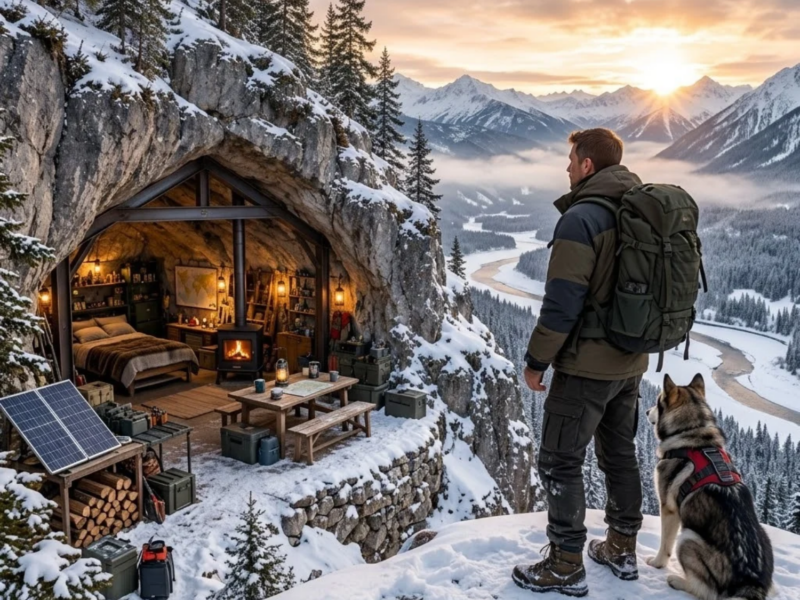
A Navy SEAL Built a Home Inside a Mountain—Then His Dog Warned Him Before the Storm
A Navy SEAL Built a Home Inside a Mountain—Then Hi…
A Navy SEAL Built a Home Inside a Mountain—Then His Dog Warned Him Before the Storm
The sky over northern Montana had a clean, bright cruelty to it. The blue was so pale it looked scraped thin, as if winter had tried to sand the color out of the world and hadn’t quite finished. Pines stood shoulder-to-shoulder like old soldiers who had forgotten how to relax. Snow lay in sheets across the hills, broken only by the dark seams of rock and the dull silver of a creek that refused to freeze all the way.
A pickup truck crawled along the last stretch of County Road, its tires hissing over packed powder. Inside, Griffin Hale drove with both hands on the wheel, not because the road demanded it, but because some habits were welded straight into bone.
He was thirty-five years old, about six feet tall, lean, and built like a tool meant to be used daily rather than displayed. He had the quiet, unassuming strength of someone who’d learned early that being heavy wasn’t the same as being strong. His face was clean-shaven down to the discipline of the razor, without stubble to soften it. His jaw looked squared by decision, his cheekbones sharp enough to catch the winter light. His skin was fair, but weathered and wind-burnished in the way the north did to anyone who spent time outside long enough to be noticed by it.
His eyes—gray, green, and steady—had the calm of a man who had already watched the world do its worst tricks and had survived the applause afterward.
In the passenger footwell, a German Shepherd lifted her head when the truck slowed for a bend. Sable. Six years old. A sable coat shading from cream to gray to black like smoke over ash. She watched the trees with amber eyes that missed almost nothing. The dog wore a black harness edged with a deep, muted red that looked warmer against the cold—the way a coal looked warm even before it caught fire. One ear cocked, then the other, as if listening to a conversation the forest was trying not to have.
Griffin glanced down and exhaled through his nose. “Yeah,” he muttered, his voice low, almost amused. “I see it, too.”
Sable did not wag. She didn’t need to. The dog’s stillness was her language: measured, precise, like a hand signal in a place where speaking could get you killed.
Kettle Ridge appeared around the bend without ceremony—a small town tucked into the edge of the timberline. It looked like it had been built out of sheer stubbornness and left there as a dare: a diner, a hardware store, a gas station with one flickering sign, and homes that sat hunched against the cold as if they were trying to make themselves smaller targets.
Griffin didn’t come for charm. He came for distance. And distance had always been easier to explain than the truth.
For years, Griffin had carried a photograph folded so many times that the edges had turned soft. It showed a younger version of himself sitting beside an older working dog named Flint—the dog who had taught him that a quiet warning deserved as much respect as a shouted command. Griffin kept the photograph inside a waterproof envelope in his glove compartment. He rarely took it out.
Sable had never met Flint, but Griffin sometimes caught himself listening for a second set of paws when only hers were there. He had bought the hill with savings meant for a different future. The land represented no dramatic escape, only one place where he might practice making careful decisions without someone else paying for his haste.
He parked near the sheriff’s office—a squat building that looked more practical than proud—and stepped out into air that tasted like iron and clean wood. His boots crunched over gravel glazed with ice. The tactical combat shirt he wore, olive gray, faded and softened by too many washes, hung comfortably on his frame. The cuffs and shoulders were worn thin in places, as if the fabric had carried more than its share of weight. Under it, a dark red thermal layer peaked at the collar and wrists—a small ember of color against winter’s strict palette.
His combat pants were old, too: earth brown with a hint of moss green, knees scuffed, cargo pockets sagging slightly from habit, as if they remembered carrying tools even when empty. A beaten-up military watch sat on his wrist, the scratched face catching a sliver of light.
Sable hopped down after him, her paws landing softly, then sat at Griffin’s heel with an obedient patience that still felt like a choice.
The door opened before Griffin reached it. Sheriff Mara Cincaid stepped out and met him like she’d been expecting trouble and was mildly disappointed to find paperwork instead. She was in her late forties, broad-shouldered, and carried herself with the straight-backed authority of someone who had learned the hard way that hesitation invited chaos. Her hair, dark with streaks of gray, was pulled into a low, practical knot. Her face held the kind of lines that came from squinting into weather and watching people lie.
Her eyes, a cool brown, took in Griffin’s posture, his hands, his dog, and the careful calm on his face.
“You’re Hale,” she said. It wasn’t a question.
“Yes, ma’am.” Griffin kept it respectful without bending too far. He’d learned the difference between politeness and submission.
Mara’s gaze dropped to Sable. And that was Sable.
Sable looked at her once—brief, assessing—then returned her attention to the street like she had better things to do than charm local law enforcement. Mara’s mouth twitched into not quite a smile.
“Dog’s got manners better than mine,” Griffin said, and for half a second, the air between them warmed with something like humor.
But a second figure appeared in the doorway behind her: Deputy Colin Reyes, in his mid-twenties, lean, with a fresh face that hadn’t yet been fully introduced to the town’s tragedies. His uniform looked newer than Mara’s, his boots less scuffed, his dark hair cropped short, a faint shadow of stubble on his jaw, and a cautious skepticism in his eyes. He looked like a man who’d read enough stories to suspect Griffin might be one of them.
Colin’s gaze snagged on the dog first, then the tactical clothing, then Griffin’s eyes. “Sir,” Colin said, not unfriendly, but careful. “You the one buying land up by the limestone slope?”
Griffin nodded once. “That’s me.”
Mara shifted her weight. “We can talk inside.”
The warmer inside smelled like coffee that had been reheated too many times and paper that had lived in drawers. Griffin filled out the last of the forms—permits, property boundaries, and safety acknowledgements—because he hadn’t come to the north to start a fight with bureaucracy. He’d fought enough things that bled; he could handle ink.
Mara signed where she needed to, then leaned back in her chair. “Your plan,” she said, tapping the paperwork, “is to renovate that old cut in the hillside. It’s an abandoned storage tunnel. Old mining days.”
“I’m not digging deeper,” Griffin replied. “I’m reinforcing what’s there. Drainage, ventilation, and a proper exit. I won’t use it as a home until the inspections are complete.”
Colin’s eyebrow rose. “Most folks build cabins.”
Griffin’s eyes didn’t flinch. “Most folks like paying to heat the sky.”
That earned him a short, involuntary laugh from Colin—more surprise than amusement, like the deputy hadn’t expected Griffin to have a sense of humor. Mara didn’t laugh, but her tone softened by a hair. “People will talk.”
“They always do,” Griffin said.
He left the sheriff’s office with papers in hand and the strange relief of having something official to hold. Outside, the sun had shifted, the light sharper now. As Griffin walked toward his truck, a woman crossed the street toward him with careful steps on the slick pavement.
June Calder looked like someone who belonged outdoors, even when she was forced into town. In her early thirties, tall and wiry with wind-reddened cheeks and hair the color of chestnut bark braided down her back beneath a knit cap. Her eyes were bright hazel and curious, and when she spoke, it carried the steady confidence of someone used to explaining complicated things to people who didn’t know they cared.
“You’re the new guy,” she said, not accusatory, but observant.
“Depends who’s asking.”
June smiled. “June Calder. I teach earth science and help maintain the town’s geological records. I heard you bought the limestone slope.”
Griffin paused. “That news travels fast.”
“This town doesn’t have much entertainment,” she said. “We make do.”
Sable leaned forward slightly, sniffing the air around June. Not aggressive, just thorough. June didn’t reach out to pet the dog like tourists did; she held still, letting the animal decide the terms.
“I’m not here to scare you off,” June added. “I’m here to tell you the rock up there is complicated.”
Griffin studied her. “Complicated? How?”
June tilted her head toward the treeline. “Karst limestone pockets. Voids. It can be stable for decades and then shift when water finds a new path. If you’re reinforcing an existing tunnel, do it right. Drainage matters. Venting matters.” She hesitated, then shrugged. “The ground remembers.”
Griffin felt that phrase land somewhere old inside him. “I plan to do it right,” he said.
June nodded once, as if satisfied. Then her gaze dropped to the worn fabric at Griffin’s shoulder. “You were military. People here don’t always know what to do with that,” she said, her voice gentle, not pitying. “They’ll either make you a hero or a threat. Neither is fair.”
Griffin’s mouth pulled into something that wasn’t quite a smile. “Fair isn’t really the north’s hobby.”
June laughed at that—light, quick—and waved as she stepped away, leaving behind the faint scent of pine and cold air.
Griffin drove out of town and up toward his land. The road narrowed into a dirt track. Snow thickened. The world grew quieter, as if the trees absorbed sound like cloth absorbed water.
When he finally stopped, the limestone slope rose ahead of him: pale rock banded with darker streaks, its face rough and patient. The entrance to the old tunnel sat half-hidden beneath a ledge rimmed with moss and pale lichen. Someone long ago had framed it with stone. Griffin had already planned to add a steel door, a simple overhang to prevent snow buildup, and reflective markers for storms—practical things, human things.
Sable jumped down and approached the opening, then stopped. The dog’s body went rigid, not in fear, but in focus: ears forward, tail still, nose lifted slightly as if tasting the air.
Griffin’s hand drifted to the strap of Sable’s harness. “What is it?” he whispered.
Sable didn’t look back. She stared into the shadowed mouth of the tunnel like she could see through stone. Griffin’s chest tightened in a way he hated because it felt too familiar.
Somewhere far away in memory, a different dog had done something similar—gone still, signaled wrongness—and Griffin had waved it off because the radio said the building was clear, because the intel said the route was safe, because he’d been in a hurry to finish the job. He had learned what it cost to ignore an animal that had no reason to lie.
The old mistake had never been a single reckless act. It had been a series of reasonable-sounding shortcuts: a delayed request for a second inspection, a superior’s confidence repeated as his own, and a warning he had heard but dismissed. The structure failed after the team entered. The working dog, Flint, survived the initial collapse, but one of Griffin’s teammates never returned home.
The review found many contributing failures. Griffin remembered the one decision he might have made differently: he had written to the teammate’s family and received a compassionate answer he could scarcely bear to read. Forgiveness offered by another person had not yet become forgiveness he could offer himself.
Now, watching Sable stand motionless at the limestone entrance, he recognized the choice. He could hurry toward the life he wanted, or listen carefully enough to deserve it.
A small gust of wind moved down the tunnel and breathed cold air into Griffin’s face. It carried dampness, mineral-sharp, and something else—faint, metallic, like old tools or old blood. Though Griffin refused to give that thought a home, he forced himself to breathe evenly.
“Okay,” he said softly, like speaking to both the dog and the part of himself that wanted to flinch. “We’ll check it.”
Griffin pulled out a flashlight and swept the beam across the entrance. The light caught rough stone, a shallow bend, and the glimmer of water deeper in. Nothing jumped out: no fresh tracks, no movement.
But Sable remained still as Griffin stepped closer. The dog finally moved one slow pace forward, then abruptly turned her head toward the trees behind them—not toward the town, not toward the road, but toward the dense, dark line where the forest began.
Sable gave a single low huff—not a bark, not a growl, a warning too subtle for anyone who didn’t know the dog’s language. Griffin followed the dog’s gaze. Between two pines, half-buried in snow, something pale caught the light for just a second, like a small shard of glass or reflective tape. Then the wind pushed a veil of powder across it, and it vanished.
Griffin stood perfectly still, hearing only the quiet drip from somewhere inside the limestone. He felt the old, instinctive itch at the base of his skull—the sense that the world had just blinked and dared him to pretend he hadn’t noticed.
Sable looked up at him once, amber eyes steady, not afraid, not angry, just asking the same question she always asked in the only way she could: Are you going to listen this time?
Griffin swallowed. His humor tried to surface and failed like a match in wet wind. “All right,” he murmured, and the words sounded like a promise. “We listen.”
He didn’t go chasing ghosts into the trees. Not yet. He marked the spot mentally—the way you marked a suspicious door in a hallway. He turned his attention back to the tunnel entrance, because whatever lay ahead—home, trouble, or both—this was where he had chosen to plant his life.
Related Articles

They Mocked the Widow’s Dirt Cellar—Then the Freeze Left Every Cabin Cold but Hers Warm
They Mocked the Widow’s Dirt Cellar—Then the Freeze Left Every Cabin Cold but Hers Warm…

A Homeless Veteran and His German Shepherd Inherited a Ridge No One Wanted — 35 Feet In, They Found
Chapter 1 / 7 A Homeless Veteran and His German Shepherd Inherit… A Homeless Veteran…

Neighbors Laughed When He Built A Cabin Inside An Old Barn—Until It Kept His Home 35 Degrees Warmer
Chapter 1 / 8 Neighbors Laughed When He Built A Cabin Inside An… Neighbors Laughed…

His Sod House Had No Woodpile in January – Until the Trains Stopped and the Town Came Begging
Chapter 1 / 10 His Sod House Had No Woodpile in January – Until t……

She Built Her Cabin Over the Woodshed and Never Burned Wet Wood Again
Chapter 1 / 8 She Built Her Cabin Over the Woodshed and Never Bu… She…

The Duke Abandoned Her on Their Wedding Day—Years Later, He Discovered What He Had Lost
Chapter 1 / 7 The Duke Abandoned Her on Their Wedding Day—Years… The Duke Abandoned…

He Wedged a Tiny A Frame Into a Crevice Before Winter and His Family Slept at 75°F While Town Hit
Chapter 1 / 7 He Wedged a Tiny A Frame Into a Crevice Before Win……

He Was Too Old to Ride—So He Bought the Ruined Ranch and Found the Room Behind the Fireplac
Chapter 1 / 5 He Was Too Old to Ride—So He Bought the Ruined Ran……

Settlers Laughed at His Underground Heat Recovery Duct — Until It Kept His Cabin 71°F Warmer
Chapter 1 / 9 Settlers Laughed at His Underground Heat Recovery… Settlers Laughed at His…

Settlers Mocked His Hillside Cabin But His Family Stayed Warm While Neighbors Froze
Chapter 1 / 6 Settlers Mocked His Hillside Cabin But His Family… Settlers Mocked His…