A Navy SEAL Built a Home Inside a Mountain—Then His Dog Warned Him Before the Storm
The Unchecked Room
The storm did not announce itself with thunder. It arrived like a quiet correction.
By late afternoon, the sky had dulled from bright blue to a heavy white-gray—the kind that flattened distance and made the ridge look closer than it was. Snow began again, not violent, not theatrical, just steady, deliberate flakes that layered over the slope Griffin had spent days reinforcing.
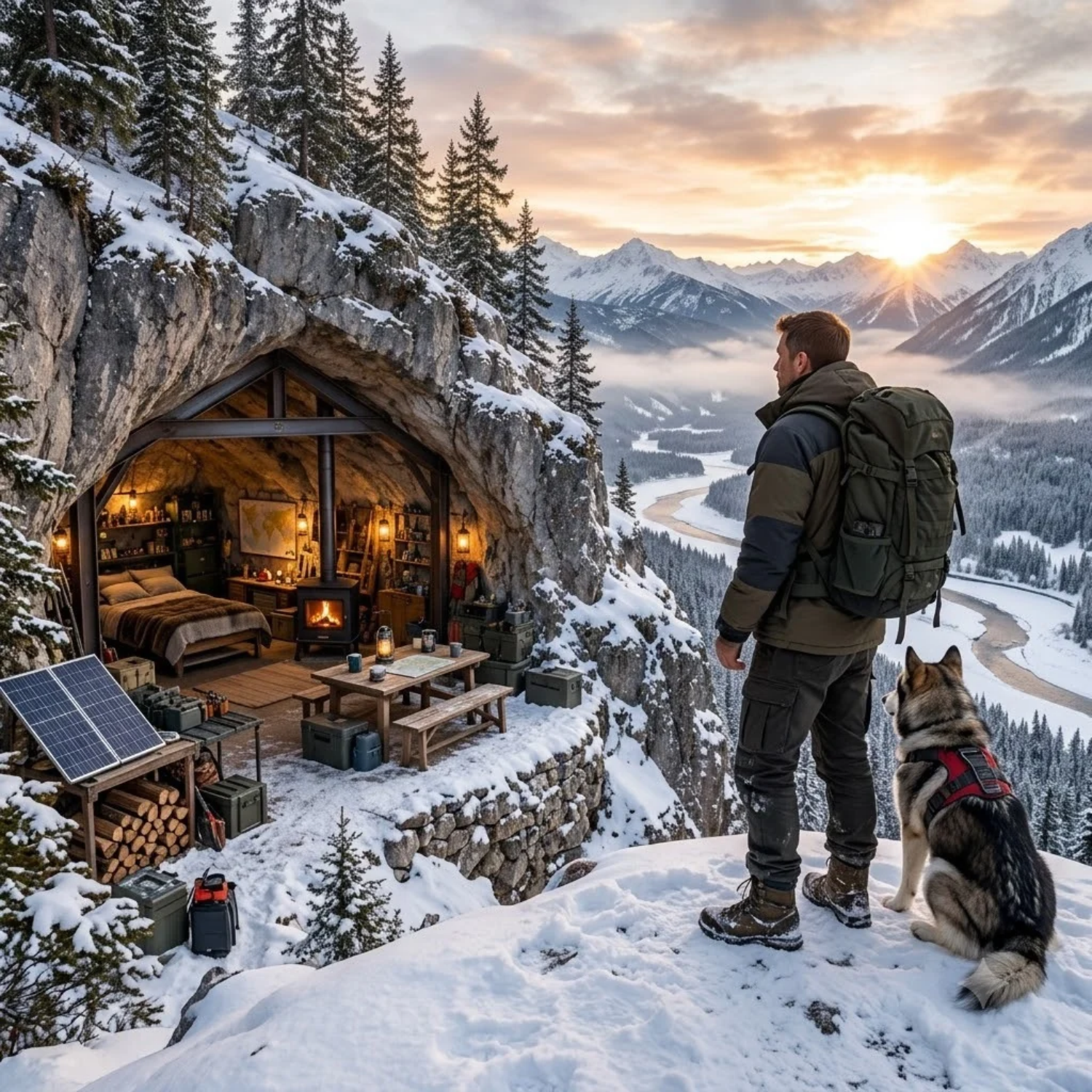
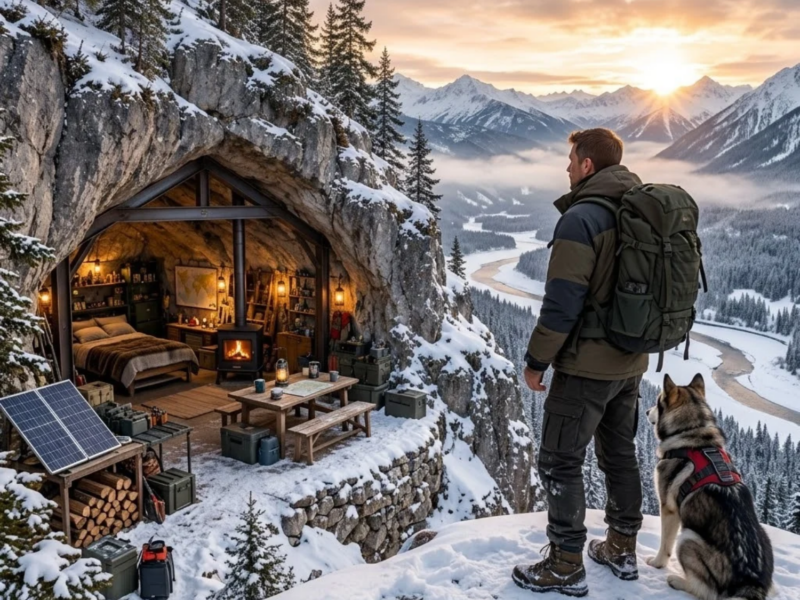
Inside the limestone chamber, battery lantern light cast warm amber across steel supports and clean drainage lines. Griffin stood near the entrance, listening to the subtle change in wind direction.
Sable was already there before he moved. The German Shepherd sat at the threshold, her body angled outward, her sable coat catching stray light in layered shadow. The red-trimmed harness was visible beneath drifting snowflakes that clung briefly to her fur before melting from body health. Her ears flicked twice.
Griffin stepped outside. The wind had shifted north. Snow fell thicker now. He scanned the ridge above: no visible movement, no widening fractures. The trenches were channeling water effectively. But the storm was different. The air carried weight.
His phone vibrated. Sheriff Mara Cincaid did not waste time. “We’ve got a problem,” she said.
“What kind?”
“The only road south is blocked. Minor slide from the eastern shoulder. Not huge, but enough to shut it down.”
Griffin’s jaw tightened. “Injuries?”
“Not yet. But snow’s picking up.”
“How bad?”
“Enough.”
He ended the call and crouched beside Sable. “We move.”
The drive into town took longer than usual. Snow gathered along the road in uneven ridges. By the time Griffin reached Kettle Ridge’s main street, plows were already struggling to keep pace. At the edge of town, the road curved past the gas station and narrowed into the single route out.
Once the problem was visible, a section of hillside had slid downward—a combination of wet snow and loosened soil, not catastrophic, not a mountain collapsing, but heavy enough to pile across the asphalt in a thick, uneven barrier.
Sheriff Mara stood near a cruiser, her collar turned up against the wind. Deputy Colin Reyes worked with two town volunteers to direct vehicles back toward town center. Snow accumulated quickly over the fresh slide, masking its edges.
Evan Ror was there, too, his sleeves rolled despite the falling snow, a shovel already in hand. His copper beard was dusted white, his usual rough humor replaced by quiet focus.
“You think it’ll go again?” Evan asked bluntly.
“Maybe,” Griffin answered honestly. “Depends on how much more the slope gives.”
Evan nodded once and didn’t argue.
They organized quickly, redirecting traffic toward town square, moving elderly residents closer to buildings with backup generators. The diner owner, Mrs. Talbot—a round-faced woman in her late fifties—had lived in Kettle Ridge long enough to remember every winter that had tried to erase the main street. Her late husband had built the diner’s backup pantry shelves. After a week-long outage, she still kept extra blankets in a cupboard, a handwritten list of neighbors’ medication needs beside the register, and a battered kettle that seemed capable of boiling through the end of the world.
When the sheriff arrived, Mrs. Talbot handed over that list without being asked, Griffin noticed. Preparedness here did not always wear a uniform; sometimes it wore an apron and knew exactly who took tea without sugar. With flour-dusted hands and a temperament that could scold grown men into silence, she opened her doors without hesitation.
“Hot coffee,” she declared. “No arguments.”
As snow thickened, more townsfolk gathered inside the diner. Voices were low, controlled. Fear was not loud here; it moved quietly between people, settling in shoulders and jawlines.
Griffin stood near the entrance, his boots leaving wet tracks on the tile floor. His olive-gray tactical shirt bore faint streaks of dried snow, but the red thermal beneath it glowed faintly when the overhead lights flickered. Sable lay near his boots, her chin resting on her paws, her amber eyes half-lidded yet alert. She had slept in intervals, not deeply, her black harness remaining secured. She had not been taken off duty.
Sheriff Mara approached him quietly. “Power flickered again around 4:00,” she said. “Backup generator at the clinic’s holding.”
Griffin nodded once. “We relocate residents who need reliable heat and access to backup power.”
Mara didn’t ask what he meant.
Within an hour, a small caravan of townspeople began making their way toward the limestone slope. The decision had not been ceremonial; it had been practical. It had also been questioned before it was approved, as Mara had no intention of exchanging one hazard for another. A county engineer checked the updated photographs and the entrance supports; June walked the hillside to verify the marked drainage route; and the clinic nurse reviewed who could safely make the short transfer.
The alternative buildings remained open. The limestone chamber was reserved for a handful of residents who needed a quieter, well-insulated waiting area and who could be escorted back immediately if conditions changed. Two radios and a written evacuation plan went in with the group.
Griffin placed Sable’s water bowl beside the emergency exit and looked at the door until he was certain it opened without obstruction. Griffin’s reinforced tunnel was not large enough for everyone, but it was insulated, stable, and away from sagging rooftops.
June Calder walked beside him up the ridge, her braid tucked beneath her hood, her cheeks wind-flushed but steady. “You sure about this?” she asked quietly.
“It’s not ideal,” Griffin said. “It’s controlled.”
Behind them came Evan Ror, carrying two heavy bags of supplies across broad shoulders, his copper beard stiff with frost. Colin followed with a portable radio unit and extra batteries, his jaw tight but focused. At the back of the line walked Mrs. Talbot and Margaret Hensley, guiding two elderly residents, Frank and Ida Morrison.
Frank Morrison was seventy-eight, thin as wire, but stubborn as the old timber mill that once stood outside town. His white mustache bristled against his pale skin. Ida, his wife, moved carefully beside him, petite, silver-haired, her hands gloved and folded together. She lived with mild asthma and walked slower than the rest.
When they reached the limestone entrance, Griffin paused. The trench system held. The rock face above bore no new dark lines. Snow rested but did not sag. He exhaled quietly.
Inside, battery lanterns were already lit. Steel supports glinted in the warm light. The air was cool but stable, lacking the bite of open wind.
Griffin directed movement carefully. “Anyone who needs extra assistance inside first. Keep pathways clear. Stay near walls.”
Sable remained near the entrance, her head turning slowly as each person passed. She watched posture, breathing, scent. Frank Morrison paused before entering and looked up at the rock ceiling skeptically. “Never thought I’d take shelter in a hole,” he muttered.
Griffin met his gaze evenly. “It’s reinforced.”
Frank studied him a second longer, then nodded once and stepped inside.
The chamber filled gradually with only the small group approved for temporary shelter. Clear aisles, proper ventilation, and a headcount were maintained throughout the stay. June organized seating; Colin positioned the radio near the inner wall; Evan stacked supplies neatly without instruction.
Griffin moved between groups, checking safe battery-powered lighting and the heated air supplied by a vented unit outside the chamber. No open flame was used in the enclosed shelter.
Sable shifted inside after the last resident entered, and she stood near the center of the chamber, still listening.
The cave felt different now—not empty stone, but occupied shelter. The air held the layered sense of wool, leather, metal, coffee, and human nerves. Griffin leaned briefly against a support beam and closed his eyes for half a second. He felt the weight of responsibility settle, not as panic, but as pressure measured in decisions.
He remembered another enclosed space long ago: dust thick in the air, a radio cutting through silence, a dog’s rigid posture that he had dismissed.
Not this time.
“Griffin.”
He opened his eyes. It was Tyler Brooks. The young man stood awkwardly near the entrance. Snow was still melting from his boots without the edge of last night’s frustration. He looked younger, uncertain, searching for where to stand.
“You need help with anything?” Tyler asked.
Griffin studied him briefly. Tyler’s father’s mill had closed when Tyler was fifteen, and the shutdown had hollowed out more than employment; it had hollowed out direction.
Tyler hesitated, then admitted that he owed Griffin an apology for the way he had spoken beside the blocked road. Griffin tightened a strap on a supply shelf before answering.
“I’ve said worse things when I was scared. What matters is what you do after.”
Tyler carried the crate without another word.
Later, he helped Frank Morrison adjust a chair and quietly asked June how to identify a safe drainage route. No grand transformation announced itself. Only a man discovering that usefulness could be a way back into a community.
Grab that water crate, Griffin said. Stack it along the far wall.
Tyler nodded quickly and obeyed.
The chamber settled into low conversation. Outside, wind shifted again. Sable’s ears twitched. She lifted her head sharply.
Griffin felt it immediately. Not fear. Alert.
He stepped toward the entrance and peered outside. Snow fell lighter now, but wind carved drifts unevenly along the slope. The world looked muffled.
Behind him, the wall seemed to hum.
Then a secondary shift occurred. A fresh wave of heavy wet snow slumped downward from higher on the shoulder, spilling across the already blocked road in a thicker mass—not a roaring avalanche, just gravity asserting itself, but enough to bury the front bumper of Tyler’s truck deeper.
Tyler stared at it, stunned.
Griffin’s voice cut through the moment. “Back inside. Now.”
They moved quickly, Griffin guiding Tyler by the elbow. Sable trotted at their side, her eyes still scanning the slope.
Inside the diner—no, inside the stone chamber—Mrs. Talbot handed Tyler a mug before he could protest. “Sit,” she ordered.
He obeyed. Outside, snow continued steadily. Tyler sat with his hands wrapped around his mug, staring into the rising steam. After a minute, he admitted that he had been trying to reach a friend beyond the blocked road, someone who had not answered his phone.
Mara made a call over the emergency radio and confirmed that the friend was safe on the other side. The news drained the fight out of Tyler’s shoulders.
Griffin pulled up a chair, but did not lecture him. He told him only that impatience often sounded like courage right up until somebody else had to bear the consequences. Tyler glanced toward Sable, then asked if he could help. Instead of waiting to be rescued, Griffin pointed him toward Evan, who needed a second pair of hands sorting supplies.
The blocked road was now impassible without heavy machinery. Sheriff Mara stepped inside, brushing snow from her jacket. “That’s it,” she said. “We’re officially closed off.”
Griffin nodded. “Power’s holding for now.”
Colin reported from near the counter, radio in chest. “County plows delayed another hour.”
Griffin scanned the room. Elderly couples whispered softly. Evan stood by the door, arms crossed, but alert. This wasn’t catastrophe; it was containment.
“🥣We’ll rotate watch shifts,” Griffin said calmly. “Keep the road clear of additional buildup near the town edge. No one drives alone.”
Mara studied him for a second, assessing leadership—not declared, but demonstrated. “You’re taking point,” she asked.
“I’m assisting,” he corrected. But they both understood the weight of that distinction.
The night deepened. Wind rattled windowpanes; snow pressed against glass. Griffin stepped outside once more near midnight, Sable beside him. The road beyond town lay buried beneath layered white and dark soil. The ridge above loomed silent. No further movement, just stillness, thick as wool.
Sable inhaled deeply and exhaled, the tension easing slightly. Griffin rested a hand along her back. “You felt it before we moved,” he murmured.
The dog leaned subtly into his leg.
He looked back toward the limestone slope in the distance, faintly visible through the snowfall. The trench work held. The ridge had not failed. The only road out was blocked, but the town remained intact. For now, that was enough.
Inside, lights flickered once more, then steadied. Griffin turned toward warmth—toward people gathered not in panic, but in patience. The storm was not finished, but neither were they.