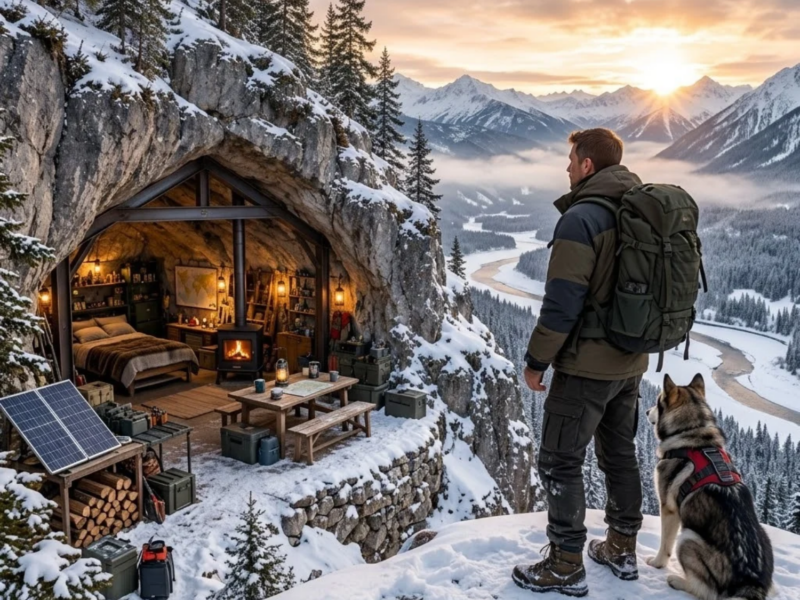
A Navy SEAL Built a Home Inside a Mountain—Then His Dog Warned Him Before the Storm
The Ground Remembers
He spent the next hour unloading gear: basic tools, tarps, a stove, storage bins, working with the calm rhythm of someone who found peace in tasks with clear steps. Sable paced the perimeter, circling, sniffing, pausing at the treeline again and again as if keeping time with something under the snow.
By late afternoon, the sun lowered and the cold sharpened. Before putting away the tools, Griffin tied a length of red survey ribbon to a safe branch well clear of the unusual reflective scrap. He photographed the slope from several angles and recorded the locations in a small notebook.
Sable watched the methodical routine from beneath a pine, her ears tracking every scrape of his pencil. He had once thought preparation meant never being surprised. Now he knew it meant leaving room for the unexpected without pretending the unexpected was harmless.
The photograph of Flint stayed in the truck. But for the first time, Griffin thought of moving it somewhere he might actually see it.
Griffin set up a temporary camp just outside the entrance, not inside yet. He made coffee that tasted like survival more than comfort. When Sable finally lay down near his boots, the dog did not fully relax; one ear stayed up.
That night, when the sky turned black and the stars burned hard and bright, Griffin heard footsteps crunching up the slope.
He stood, his hand near his flashlight, his posture quiet but ready. Sable rose without a sound.
An old man came into view carrying a lantern. Curtis Bellamy looked carved from winter in his late seventies: tall but stooped, his beard white and bristled, his skin weathered into a map of creases. His eyes were pale and sharp—the kind that had spent a lifetime watching rock and learning when it lied. He wore a heavy coat patched at the elbows and gloves stained with work.
He stopped a few feet away and looked from Griffin to Sable, then nodded once as if confirming something to himself.
“You’re the one fixing the old cut,” Curtis said, his voice gravel warmed by fire.
Griffin kept his tone respectful. “Yes, sir.”
Curtis lifted the lantern, the light wobbling over the limestone entrance. “Folks in town will tell you that tunnel is nothing but an old storage hole. That’s what they say when they don’t want to remember.”
Griffin didn’t interrupt. He’d learned that men like Curtis spoke in layers.
Curtis’s gaze settled on Sable. “That dog of yours. Looks like it knows the difference between quiet and safe.”
Sable stared back, still as a statue. Curtis lowered the lantern slightly and looked Griffin in the eye. “Listen to me,” he said. “Limestone is polite. It holds its tongue until it doesn’t. The ground up here has pockets, voids, places water can disappear into and come back wrong. You can build a home in it. You can. But you don’t get to treat it like a dead thing.”
Griffin felt the truth of that. Curtis took one slow breath, then delivered the warning that would brand itself into Griffin’s memory: “Son, the rock doesn’t care who you used to be. It only cares whether you listen. Because limestone never stays completely still.”
Curtis turned and began the slow walk back down the slope, the lantern light bobbing like a tired star.
Griffin watched until the glow disappeared into the trees. Then he looked at Sable, and in the dog’s amber eyes, he saw something that felt uncomfortably like fate: patient, watchful, and not easily impressed.
The night held its breath, and Griffin, for the first time in a long time, chose to hold his too, just long enough to hear what the earth might say next.
Morning arrived without drama—just a slow whitening of the ridge as light sifted through pine needles and touched the limestone face in pale bands. Frost clung to the rock like a second skin.
Griffin Hale stood outside the limestone entrance with a mug of coffee cooling between his hands, studying the slope the way he used to study a map before stepping into unknown ground. The tactical shirt he wore, faded olive-gray, bore faint mineral streaks from yesterday’s work. The red thermal beneath it caught in the light when he moved. His combat pants were damp at the knees from repeated kneeling, and his boots were crusted with frozen mud.
Sable sat a few yards upslope, watching the treeline. The dog had been different since the search—not anxious, not restless, but attentive in a deeper way, like a compass adjusting to a magnetic field no one else could sense. Her amber eyes tracked meltwater sliding down bark, tracked the subtle creaks of timber, adjusting to temperature shifts.
Griffin didn’t speak. His silence was not emptiness to him; it was information waiting to be noticed. He set the mug down and crouched near the entrance. The limestone felt colder than the air, damp along the edges where condensation gathered. He traced the rock’s texture with his gloved fingers: fine-grained in some sections, porous in others. Karst. June had been right.
June Calder arrived shortly after sunrise, her boots crunching up the slope with brisk purpose. She carried a weathered weathered field bag slung across her shoulder and a collapsible walking staff in one hand. Her braids swung against the back of her forest-green jacket. She moved with the confident gait of someone accustomed to uneven ground—neither hesitant nor careless.
“You’re up early,” she said, her breath fogging faintly.
“So are you.”
June smiled slightly. “Rock doesn’t mind waiting. People do.”
She knelt near the entrance and brushed frost from the limestone wall. From her bag, she removed a small geology hammer, a hand lens, and a folded topographic map laminated against weather. Her fingers were nimble and deliberate, her nails short, her hands weathered from years outdoors.
“This formation,” she said, tapping lightly against the stone, “has micro-fractures. Nothing catastrophic by itself. But when snow melts unevenly, water slips into the smallest seams. It freezes again overnight, expands, contracts. It doesn’t take much.”
Griffin listened, his eyes tracking the slope above them. “You think it’s unstable?”
“I think it’s patient,” she replied. “That’s worse.”
Sable moved again—slow, controlled steps—positioning herself not at the entrance, but slightly to Griffin’s right. He noticed immediately that she was triangulating, listening not just to what was in front of them, but above.
A faint cracking sound reached them. Not sharp, more like a low internal shift.
Mara inhaled slowly. “That’s not comforting.”
Griffin didn’t answer. His eyes scanned upward. Along the ridgeline, a small section of snow detached from an upper ledge and slid downward in a soft rush, breaking apart before reaching them. Minor. Insignificant.
Except it wasn’t the snow that concerned him. It was what lay beneath it.
Without warning, Sable stepped directly between Griffin and the tunnel entrance and pressed her shoulder lightly against his leg. Not pulling him away, not pushing forward, just anchoring. Griffin felt the contact like a current. He followed her line of sight.
For a brief, almost imperceptible second, the limestone face above the entrance seemed to ripple—not visibly shifting, but darkening in a narrow line where meltwater traced a new path along a fracture that had not been wet the day before.
June saw it, too. Her breath caught. “That’s new,” she whispered.
The dark line widened slightly as water seeped through. Not a collapse, not a slide—just a warning written in liquid.
Griffin’s mind moved quickly, calculating angles, runoff direction, the load weight of the snowpack above. “We redirect more water,” he said calmly. “Now.”
Mara nodded immediately. “What do you need?”
“Volunteers, shovels. We widen the trench. Divert flow before the freeze tonight.”
Mara pulled her radio without hesitation. Within half an hour, three townspeople arrived. June’s call to the county engineer came through on a crackling connection; from their photographs, he urged them to stay below the established exclusion line and concentrate on surface diversion rather than digging beneath any unstable overhang. Mara repeated those limits to every volunteer before a shovel touched the ground.
Evan Ror was among them, his beard glinting copper in the sun, his sleeves rolled despite the cold. His usual sarcasm had softened into practicality after the search and rescue. “You think it’s sliding?” Evan asked bluntly.
“Not yet,” Griffin replied. “We’re making sure it doesn’t.”
Evan didn’t argue. They worked in coordinated rhythm, carving deeper channels along the slope’s base to guide meltwater away from the entrance. June directed placement with precise gestures, calculating natural drainage patterns. Deputy Colin arrived later with additional sandbags from town storage. He looked more serious today, less boyish.
“Sheriff said we’re preventing future paperwork,” he muttered as he hauled a bag into position.
Griffin almost smiled.
By midafternoon, the warmth peaked. Snow along the ridge above visibly sagged. Water trickled steadily down the limestone face. The dark fracture line remained thin but present. Sable maintained her post, her eyes scanning constantly.
As the sun dipped lower, temperatures began their gradual fall. The trickle slowed. Water in the trenches flowed cleanly away from the entrance, redirected into safer channels along the slope. The dark fracture line stopped widening.
June crouched near it once more as the air cooled. “It’s holding,” she said quietly.
“For now,” Griffin replied.
Mara stood beside him, hands on her hips, watching the ridge with thoughtful silence. “You’re not panicking,” she observed.
“Panic wastes oxygen,” he said.
Mara exhaled faintly through her nose, a sign of approval.
By dusk, the volunteers dispersed. Evan clapped Griffin once on the shoulder before heading down the slope. “Guess that rock picked the wrong week,” Evan said gruffly.
Griffin didn’t answer. He knew rock didn’t pick weeks; it responded.
Sable finally relaxed slightly as cold reclaimed the slope. Her tail rested against the snow; her ears still pivoted, but slower. Griffin stepped inside the tunnel entrance and lit the lantern. Warm light washed over the interior walls, reinforcing the temporary braces he had installed. He ran his hand along one steel support: solid.
Outside, the final meltwater droplets froze into thin icicles along the ledge. Griffin returned to the entrance and looked up one more time. The ridge stood quiet again, but it had spoken—not loudly, not violently, just enough to be heard by those willing to listen.
He crouched beside Sable and rested his forehead briefly against the top of her head. “You felt it before we saw it,” he murmured.
Sable blinked slowly, calm.
He didn’t thank her. He didn’t need to. The lesson wasn’t about heroics; it was about timing, attention, trust built slowly and tested often.









