Everyone Mocked His Buried Chimney—Then His Fire Heated Twice as Much As Normal Stoves
Nebraska Territory, February 1884
The wind did not merely blow across the Great Plains; it hunted.
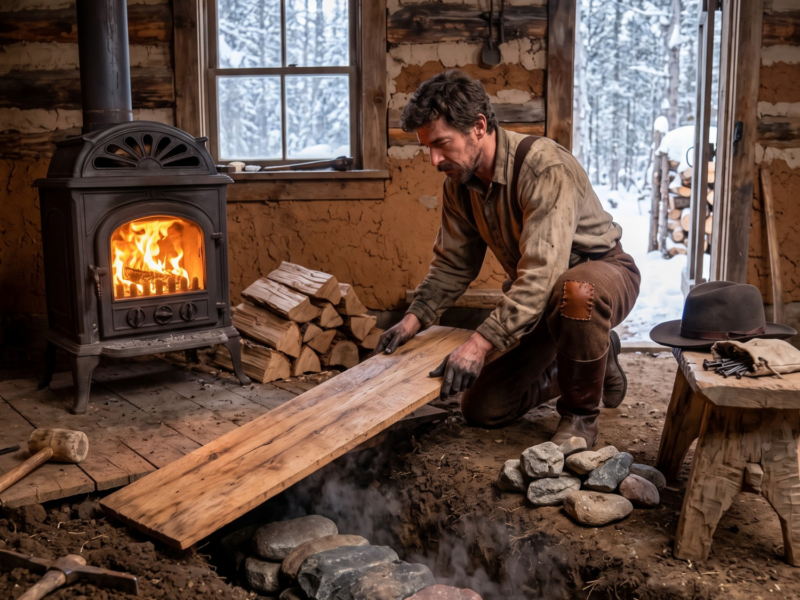
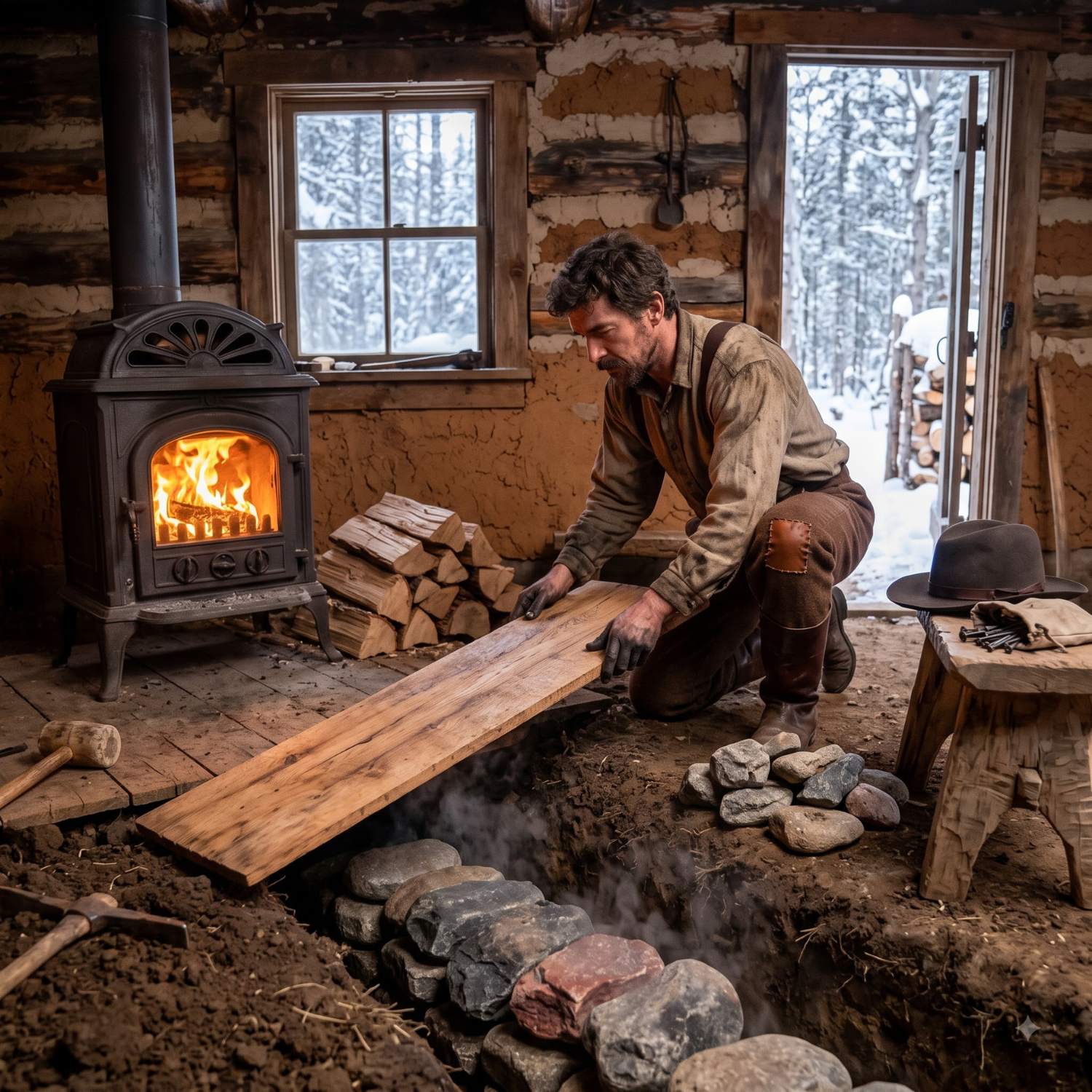
Thomas McKay sat wrapped in a heavy wool blanket, his back pressed against the cast-iron woodstove, listening to the shrieking gale batter the exterior of his cabin. He was a Scottish stonemason by trade, a man who understood the weight of the earth and the stubbornness of rock, but he had never known a cold quite like this. It was a living, breathing entity that searched for every gap, every minute fissure in the tight log walls he had so carefully erected.
Four feet away from the roaring stove, his galvanized water bucket sat frozen solid.
McKay let out a breath, watching it plume into white vapor in the ambient air of his own home. He had done everything exactly as the guidebooks commanded. The manuals from Kansas City and Omaha, the sage advice of the eastern settlers—it all pointed to the same design. Build with tight log walls. Raise a stone chimney straight up through the center. Connect a cast-iron stove with a direct flue. Stack cordwood high.
It was trusted. It was proven. And in the Nebraska winter, it was a death trap.
He rose, his joints aching from the deep, penetrating chill, and threw another heavy log of driftwood into the iron belly of the stove. The flames roared, greedy for the oxygen, and a tremendous draft pulled the smoke up the tall, straight stone chimney. He could hear it—the vicious whoosh of his precious heat being sucked directly up into the black, freezing Nebraska sky. The chimney was working exactly as designed, creating a massive draft. But out here, where the land was flat as an anvil and the sky offered no windbreaks, the chimney didn’t just vent smoke. It vacuumed the warmth right out of the room.
By March, McKay had burned through three full cords of driftwood. His hands were blistered from the axe, his back strained from hauling, and yet he woke every morning to interior temperatures hovering around fifteen degrees.
He was not alone in his misery. A mile to the east, the Johnson family burned through four cords, shivering in the dark. In town, Mrs. Anderson, the wife of the region’s most prominent builder, complained to anyone who would listen that she could see her breath while frying eggs in her kitchen.
Something had to change. The frontier was punishing the wisdom of the East, and McKay knew that if he merely followed the rules, the prairie would eventually claim his life. He began to look at the stones of his hearth not just as a pathway for smoke, but as a vault. If the cold was going to wage war, Thomas McKay would have to build a fortress.
CHAPTER TWO: The Supply Barn Council
Summer 1885
The local supply barn in town was more than a mercantile; it was the parliament of the prairie. Smelling of saw dust, oiled leather, and chewing tobacco, it was where homesteaders gathered to trade lies, share miseries, and dispense advice.
“It’s a fool’s errand, McKay,” Mr. Anderson said, leaning against a barrel of nails. Anderson was a broad-shouldered man whose reputation rested on the dozens of conventional cabins he had built across the Platte River region. He trusted what he knew. “You start burying your flue underground, you’re going to trap moisture. You’ll build up creosote, and one night that cabin of yours is going to go up in a ball of fire.”
McKay ran a calloused thumb over the edge of a steel trowel he was inspecting. “The current way isn’t working, Anderson. The ground is freezing four feet deep. It’s a heat sink. Every fire we build is just fighting the frozen earth and losing.”
“It works fine if you chink your logs right and keep your axe swinging,” a farmer named Miller chimed in, though he looked just as exhausted as the rest of them.
But McKay had not spent the spring merely swinging an axe. He had been listening. He had spoken to Johan Miller, a German immigrant who reminisced about the Kachelofen of Bavaria—massive masonry stoves with labyrinthine passages that trapped the heat before the smoke escaped. He had shared a fire with Eric Svenson, a Swede who knew the bitter winters of Minnesota and spoke of raised foundations and crushed rock.
Most importantly, he had forged a quiet friendship with a Lakota carpenter named White Pine.
White Pine didn’t rely on cast iron from Chicago foundries. He showed McKay the traditional winter lodges of the Plains—partially excavated floors lined with flat stones that drank in the heat of a small fire during the day and bled it back out into the air all night. They used the earth itself as a shield, piling berms against the lodge walls to deflect the biting wind.
“I’m laying a trench,” McKay said quietly, looking up at Anderson. “I’m going to run the exhaust beneath the floorboards before it hits the chimney.”
Anderson laughed, a booming, dismissive sound. “Well, when you freeze to death or choke on your own smoke, we’ll make sure to bury you in that trench, Thomas.”
The room chuckled, but McKay merely paid for his trowel. He had work to do.
CHAPTER THREE: The Cold Beneath
Winter 1886
The excavation had taken weeks of backbreaking labor during the summer. McKay had dug a trench fifteen feet long and eight inches wide directly beneath his cabin floor. He lined it with carefully selected fieldstones, creating a horizontal pathway for the hot exhaust gases of his stove to travel before finally rising to the chimney. He packed the excavated earth and crushed stone around it, desperate to create thermal mass.
Now, as the winter of ’86 bared its teeth, McKay stood in the center of his cabin, holding a mercury thermometer he had bartered from the local doctor.
He stared at the silver line.
The air temperature at waist height was a tolerable forty-five degrees. But when he knelt and pressed the thermometer against the floorboards, the mercury plummeted. Thirty degrees.
McKay sighed, his breath pluming slightly. The underground flue was capturing some heat, yes. His wood consumption was down slightly. But the floor itself was an enemy. Traditional frontier cabins laid their floors directly on packed earth or simple timber sleepers. With the Nebraska soil frozen solid to a depth of over four feet, it was like trying to heat a room while resting it on a block of ice. The earth was continuously sucking the energy downward, stealing roughly eighty percent of his heating energy.
A knock at the door broke his concentration. It was Eric Svenson and Red Bear, a Lakota elder who occasionally traded in town.
They stepped inside, stomping the snow from their boots. Red Bear immediately crouched, pressing his bare, weathered palm against the floorboards. He moved his hand over the buried flue, then to the corners of the room. He looked up at McKay, his dark eyes carrying generations of prairie survival.
“The stone holds the fire’s spirit,” Red Bear said, his voice a low rumble. “But the deep earth is greedy. It steals the spirit before it can touch you.”
Svenson nodded in agreement. “In my homeland, Thomas, we do not let the floor touch the deep earth. We build a thermal barrier. Six inches of crushed stone. It breaks the cold connection.”
McKay looked at the floor, his mind racing, visualizing the thermodynamics beneath his boots. The single trench wasn’t enough. He needed to weaponize the entire foundation. He needed to build a sponge for the heat, and a shield against the cold.
CHAPTER FOUR: The Labyrinth
Summer 1887
By the time the prairie grasses turned golden the following summer, McKay had torn up his entire cabin floor.
It was a staggering undertaking. He excavated the area to a depth of eight inches. Following Svenson’s advice, the bottom layer became four inches of crushed limestone and fieldstone, compacted to form an insulating barrier against the deep freeze. Above that, he laid two inches of packed earth mixed with smaller stones—a dense thermal mass.
But he didn’t stop at the floor. Combining Johan Miller’s Bavarian Kachelofen concepts with his own masonry skills, McKay built a low stone wall, three feet high, running along the north interior side of the cabin. He extended his buried flue so that the exhaust gases wouldn’t just travel under the floor, but would wind their way through the interior of this low stone bench before finally reaching the chimney.
He was essentially building an engine of stone.
When the winter of 1887 hit, plunging the territory into a brutal deep freeze, McKay conducted his measurements with the nervous anticipation of a scientist. At dawn, with the fire reduced to mere embers, he checked the thermometer.
Air temperature: 50 degrees. Floor temperature: 45 degrees.
McKay took off his boots. He stepped onto the floor in his bare feet. It wasn’t freezing; it held a gentle, lingering warmth. He walked over to the low stone wall and placed his hand against it. It was radiating heat like a living creature, hours after the fire had died down.
He checked his woodpile. He had burned roughly one and three-quarter cords—a drastic reduction from his first winter.
But as McKay sat in the warm glow of his cabin, he noticed a new, sinister draft. He mapped the room with his thermometer and found a massive problem. The floor was 45 degrees, but the ceiling was 35 degrees. The hot air from the stove was rising, hitting the cold, single-thickness log walls, cooling rapidly, and rushing back down, creating a convection current of cold drafts.
His family was still crowding around the stove because the exterior walls were radiating the sub-zero temperatures of the prairie. In the corners, where the logs met, white frost glittered menacingly.
He had won the battle for the floor. But the walls were still surrendering to the winter.
CHAPTER FIVE: The Fortress Envelope
Summer 1888
White Pine stood outside McKay’s cabin, a bundle of split cedar bark in his hands.
“Clay and moss will crack when the ice comes,” the Lakota man explained, demonstrating how to wedge the resilient cedar bark between the logs. “But the wind will still bite through wood. You must make the earth swallow the wind.”
White Pine showed him how to build earth berms. Working together, they piled soil and stone two feet high against the north and west exterior walls of the cabin, extending them three feet out. They planted wild prairie grass on the slopes, allowing the roots to anchor the soil. It created a dead-air space, a natural windbreak that would stop the icy gales from directly striking the lower logs.
Inside, McKay embarked on his most ambitious masonry project yet. He constructed an interior stone lining, four inches thick, along all the exterior walls. Using precisely fitted limestone blocks and lime mortar, he added four thousand pounds of thermal mass to the cabin’s interior.
Behind this new stone skin, he left a narrow, four-inch gap. He connected this vertical gap to his underground flue system. Now, the hot exhaust from the stove would travel under the floor, through the low bench, and then rise up behind the walls before finally exiting the chimney.
His cabin was no longer just a wooden box; it was a continuous thermal circuit.
When winter returned, the transformation was miraculous. Morning air temperatures held at 58 degrees. The stone walls wrapped the room in a gentle, radiant embrace. Even during a January blizzard that dropped temperatures to minus 15 degrees, McKay’s family sat comfortably against the far walls, reading and mending clothes, no longer hostages to the immediate radius of the cast-iron stove. His wood consumption plummeted to a mere cord and a half.
But as March arrived, bringing the chaotic, shifting weather of the Plains spring, the impossible happened.
McKay woke up in the middle of the night, sweating profusely. He threw off his blankets, gasping. Outside, the air was a crisp 15 degrees. Inside, the cabin was a stifling 65 degrees. He opened a window, watching his hard-earned heat vanish into the night.
The system was too good. The four thousand pounds of stone were fully charged with thermal energy, and they didn’t care that the season was changing. They just kept radiating heat. Without a way to control the flow of the exhaust, McKay was trapped in a stone oven of his own making.
CHAPTER SIX: Taming the Dragon
Summer 1889
To control a monster, one needed reins.
McKay spent the summer designing a mechanism to master the thermodynamics of his home. A straight chimney had only one mode: on. He needed a transmission.
Drawing once more on the wisdom of Carl Fischer, a Bavarian neighbor, and the dual-flue designs of Lakota lodges, McKay dismantled his chimney and built a twin-exit system.
He constructed two separate pathways to the sky. One was small, six inches in diameter, designed to create a slow, moderate draft that would force the smoke through the entire labyrinth of floors and walls during the bitterest cold. The second was a massive ten-inch exit—a bypass.
He fabricated heavy cast-iron damper plates operated by iron levers. With a pull of a handle, he could shut off the thermal mass labyrinth entirely, routing the exhaust straight from the stove to the ten-inch bypass chimney. He could now cook in the dead of summer without heating the stone walls.
Furthermore, he installed an eight-inch square register door at the base of the thermal wall, venting directly outside. If the stones got too hot, he could open the hatch and bleed the excess heat into the Nebraska breeze. Finally, he built a two-foot horizontal offset at the very top of the chimney, preventing the vicious prairie downdrafts from freezing the flue shut.
He had built a machine. A perfectly calibrated, environmentally responsive thermal engine.
Now, all he had to do was wait for the prairie to test it.
CHAPTER SEVEN: The White Death
Winter 1890
They called it the Arctic Blast. It did not arrive like a storm; it descended like a heavy, suffocating blanket of absolute zero, locking the Great Plains in a death grip for ten consecutive days.
The telegraph office recorded sustained temperatures of minus 30 degrees Fahrenheit for three running nights. The daytime highs never breached minus 10. The wind howled at thirty miles per hour, turning the air into a barrage of invisible icy razors.
Society paralyzed. The railroads stopped running; the locomotive boilers literally froze from the outside in despite the frantic shoveling of coal. Supply chains vanished. Homesteaders were entirely on their own.
A mile away, the Johnson family burned through three cords of wood in just ten days. They hacked apart their wooden fences, their outbuildings, and finally, their own dining chairs, desperate to feed their stove. Despite this, their interior temperature plummeted to 38 degrees.
Mrs. Anderson huddled her children in a single room, hanging heavy wool blankets over the doorways to create a micro-climate, rationing their last half-cord of wood while frost crept up the inside of their windows. Even Eric Svenson, the hardened Minnesotan, watched in horror as his floor dropped to 22 degrees, forcing his family to sleep on piles of straw to stave off frostbite.
At the McKay homestead, Thomas sat in his armchair, a cup of hot tea resting on the stone bench beside him.
Outside, the wind screamed, shaking the rafters. Inside, it was a quiet 49 degrees. The thermal mass wall registered 68 degrees to the touch. The floor was a comfortable 46 degrees. He had fired the stove once that evening, shut the heavy iron bypass damper, and routed the heat through the labyrinth. The stones drank the fire, and now, they were protecting his family.
He didn’t need to stay up all night tending the fire. He didn’t need to chop his furniture. Over the entire ten-day crisis, McKay consumed a meager one and three-quarter cords of wood.
On the fourth day of the freeze, there was a frantic pounding at the door. McKay opened it to find Mr. Harris, the owner of the supply barn, wrapped in three layers of buffalo hide, his beard caked in solid ice.
“My stove… cracked,” Harris chattered, stumbling into the room. He stopped, peeling off his frozen gloves, his eyes widening as he felt the ambient warmth of the room. He looked at McKay’s stove, which was burning low, not roaring. He looked at the stone walls. “How… how in God’s name are you doing this, Thomas?”
“Take off your coat, Mr. Harris,” McKay said softly, pulling up a chair. “Feel the wall.”
For two days, Harris refused to leave, not just for survival, but out of sheer disbelief. He borrowed McKay’s thermometer. He mapped the room. He checked the woodpile, tracking the firing schedules. He sat on the floor in his stocking feet, shaking his head as the warmth radiated up through his soles.
“You’ve broken the rules, McKay,” Harris whispered one night, looking at his ledger of measurements. “Everything we know about building out here… it’s wrong.”
“Not broken,” McKay corrected, looking into the gentle embers of the stove. “Just borrowed from those who knew better.”
EPILOGUE: Embers of a New Age
Spring 1891 and Beyond
When the thaw finally came, revealing a battered and traumatized prairie, the legend of Thomas McKay’s cabin spread faster than a grass fire.
Fuel costs were the difference between life and death, between holding a claim and abandoning it to the banks. McKay’s 75 percent reduction in wood consumption was an economic miracle.
At the annual meeting of the local settler association, Mr. Anderson—the builder who had once laughed at McKay’s trench—sat in the front row, a notebook in hand, listening intently as the Scottish stonemason unfurled his technical drawings. McKay did not seek a patent. He did not ask for a dime. He explained the Bavarian flues, the Scandinavian crushed rock, and the Lakota earth berms.
By the winter of 1892, three families within five miles had retrofitted their cabins. By 1895, the handbooks in Omaha had been rewritten. The straight chimney and the direct flue were abandoned to history, replaced by underground trenches, brick thermal walls, and dual-damper systems.
Thomas McKay walked out onto his porch on a crisp November morning in 1899. The wind was picking up, carrying the familiar, sharp scent of coming snow. He looked out over the vast, flat expanse of the Plains. It was a harsh, unforgiving land, but it was no longer an unconquerable enemy.
He turned back, stepping into the radiant, welcoming warmth of his home, and closed the door against the wind.









