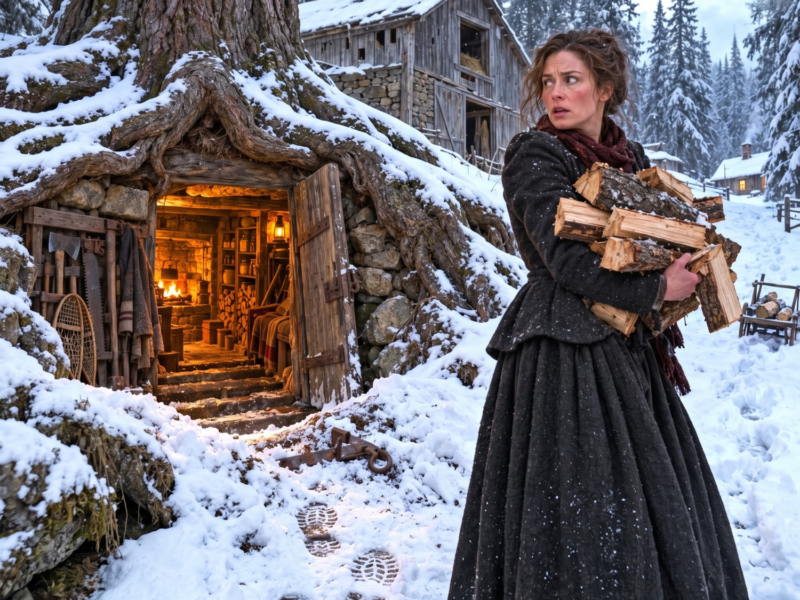
Hauling Firewood, a Widow Found a Hidden Cellar Beneath the Barn — Winter Proved Its Worth
Hauling Firewood, a Widow Found a Hidden Cellar Beneath the Barn — Winter Proved Its Worth
The wind that swept across the sprawling, unbroken plains of the Dakota Territory in the late 19th century was not merely a meteorological movement of air. It was a relentless, physical entity that possessed a cold and bitter will of its own. It was a massive, invisible antagonist, born of northern ice and vast, empty distances—a force that seemed to view any human structure rising above the grass as a personal insult to its ancient dominion.
In the deep winter, this wind did not simply blow. It scoured.
It carried fine, crystalline snow that acted like abrasive, frozen sand. It stripped the paint from heavy wagon wheels, polished the raw timber of corral fences down to the grain, and found every microscopic weakness in the walls of the homes built by those desperate and audacious enough to settle there.
The cold on the prairie was not a passive absence of heat. It was an aggressive, invading presence. It sought out the warmth of living things with a predatory, calculating hunger, sinking its teeth into the marrow of the bones and turning the very act of drawing a breath into a sharp, painful labor. To live in this landscape during the dark months was to engage in a constant, exhausting, terrifying siege against an enemy that never slept, never tired, and never offered a moment of quarter.
The settlers who populated the scattered community of Blackwood relied on a collective, hard-won—yet fundamentally flawed—frontier wisdom to survive these brutal months. Their entire survival strategy was rooted in brute force and sheer volume.
They built their homes entirely above the unforgiving earth, constructing cabins of thick, raw timber and heavy planks, attempting to create a wooden fortress against the crushing weight of the sky. To heat these drafty wooden boxes, the men harvested massive quantities of timber during the brief, merciful summers, building towering, monolithic piles of firewood that stood beside their cabins like looming monuments to their own anxiety.
The centerpiece of every single home in Blackwood was a tremendous iron stove. It was a black, hungry, cast-iron beast that demanded constant, waking attention and endless feeding. The conventional wisdom of the settlement dictated that safety lay entirely in the size of the fire. The hotter the stove burned, the safer the family would be. It was a frantic philosophy of endless consumption—a desperate race to burn fuel faster than the environment could physically steal the heat away.
Yet, this common practice betrayed a profound, fatal misunderstanding of thermodynamics. It was a flaw that cost them dearly in comfort, and sometimes in lives.
The massive iron stoves, roaring with burning oak and pine, operated on a principle of combustion that required vast amounts of oxygen. As the fire aggressively consumed the air within the small cabin, it created a powerful, roaring updraft. The heated air, buoyant and energetic, rushed violently upward, escaping through the tin chimney, through the imperfectly sealed roof joints, and through the invisible gaps in the upper log walls.
This rapidly escaping air created a massive vacuum within the living space—a negative pressure that physically had to be equalized. To replace the air roaring up the chimney, the stove relentlessly pulled frigid, sub-zero outside air into the cabin through the floorboards, beneath the doorframes, and through the shrinking mud chinking in the lower walls.
The result was a cruel and inescapable paradox of frontier living: the hotter a family stoked their fire, the more aggressively the stove sucked freezing drafts across the floor.
A man could sit in his favorite chair, his face flushed and sweating profusely from the intense, localized radiant heat of the glowing iron, while his boots rested in a layer of air so profoundly cold that his toes would go numb. The homes became turbulent, violent zones of extreme temperature variations, completely lacking any capacity to store or stabilize the massive amounts of heat they so desperately generated.
When the fire inevitably burned low in the deep, dark hours of the night as the exhausted father slept, the thin wooden walls offered almost zero thermal mass. The accumulated heat in the air vanished into the screaming wind outside within minutes, leaving the inhabitants shivering violently beneath piles of heavy wool and stiff animal hides, desperately praying for the dawn.
Among these shivering, exhausted optimists lived a woman named Ara Vance.
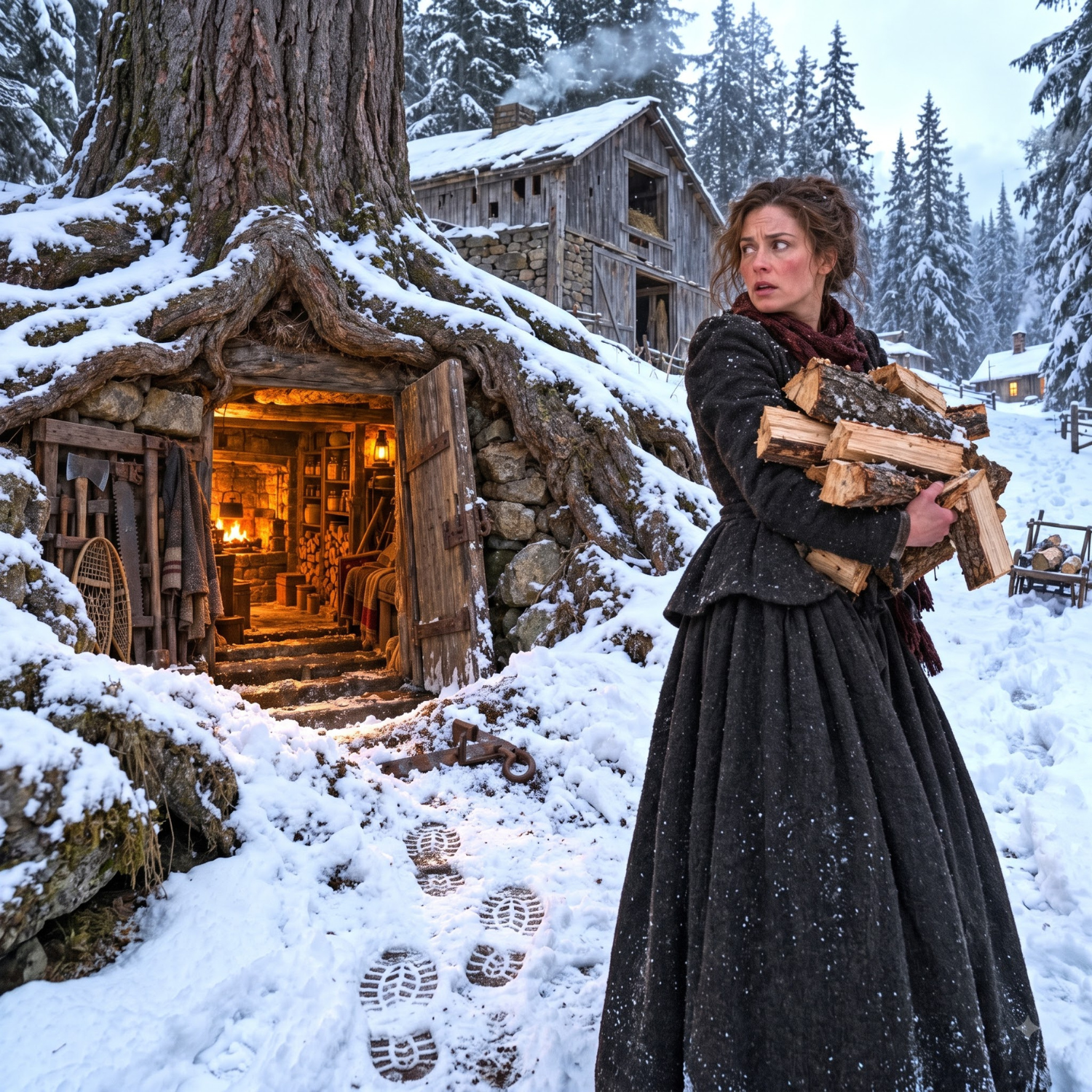
CHAPTER TWO: The Old World Mind
Ara Vance was a widow. Her quiet, unwavering resilience was often mistaken by the men of Blackwood for simple, feminine stubbornness.
She had lost her husband, Thomas, to a sudden, vicious bout of pneumonia two winters prior, leaving her to manage their modest, isolated homestead on the absolute edge of the community entirely alone. She was a woman of deliberate, careful action, possessing a mind that naturally sought out the underlying patterns and silent mechanics of the world around her.
While her male neighbors gathered around the potbelly stove at the mercantile in town to loudly boast about the cords of wood they had split, or the terrifying size of the fires they maintained to fight the frost, Ara listened in absolute silence.
She was an outsider in many ways. She carried with her the distinct memories of her grandfather, a quiet man who had immigrated to America from the old, rocky, unforgiving landscapes of Eastern Europe. He had been a man of the soil—a builder who understood implicitly that the earth was not merely a flat surface to walk upon or plow, but a massive, stabilizing force. It was a thermal battery of unimaginable, quiet power.
Ara clearly remembered the stories her grandfather told by the fire when she was a little girl. He spoke of ancient cellars and subterranean dwellings in the old country—spaces carefully carved deep into the hillsides that remained miraculously cool in the blazing summers and stubbornly, comfortably warm in the bitterest alpine winters.
She possessed a practical, inherited knowledge of the physical world that stood in stark, silent contrast to the reactive, brute-force methods of her American neighbors. She knew that below the frost line—roughly four feet down in the Dakota dirt—the earth maintained a steady, unwavering ambient temperature of roughly fifty degrees Fahrenheit, regardless of the meteorological chaos raging in the atmosphere above.
This was not magic. It was not superstition. It was a simple, profound law of physics. The Earth was a massive, infinite sponge for thermal energy, moving heat incredibly slowly, resisting sudden atmospheric changes, and offering a sanctuary of absolute stability.
It was late in the autumn, during the frantic, panic-laced final weeks of preparation for the coming freeze, that Ara made the discovery that would permanently alter the course of her survival.
She was working in her large, weathered barn, a sturdy structure that had stood on the property since before she and Thomas had arrived. She was engaged in the arduous, exhausting task of hauling split firewood indoors, dragging heavy sledges of seasoned hickory across the packed dirt floor to stack against the interior walls to keep them dry.
The work was grueling. Her shoulders ached with the repetitive strain, and her breath plumed white in the crisp, rapidly cooling November air as she maneuvered a particularly dense, gnarled log toward the dark back corner of the barn.
As she stepped backward, taking the weight of the log, the ground beneath her leather boot heels felt strangely hollow.
Ara paused. It was a subtle difference in the acoustic resonance of the earth, a slight, almost imperceptible “give” in the packed soil that shouldn’t have been there.
She dropped the log, wiping the sweat from her brow with the back of a canvas-gloved hand. She stamped her foot firmly against the dirt. A dull, empty thud echoed faintly upward.
Intrigued, she set her gloves aside, walked to the tool wall, retrieved a heavy iron pry bar, and began to aggressively scrape away the top layer of hardened earth, dried manure, and scattered straw in the corner.
The ground yielded easily—far too easily. It crumbled away to reveal heavy, rotting oak planks buried just inches beneath the surface.
With measured, deliberate effort, she wedged the flat end of the iron bar beneath the edge of a massive plank and heaved downward with her body weight. The old wood groaned in protest, splintered loudly, and finally gave way, revealing a rectangular shaft descending into absolute, pitch-black darkness.
She had uncovered a hidden cellar.
It was a forgotten excavation, likely dug by the original, long-gone claimants of the land who had abandoned the property before Ara and Thomas bought it.
Lowering a lit brass lantern into the void by a rope, Ara peered into the depths. It was a substantial, impressive space, perhaps twelve feet square and fully eight feet deep, carved directly into the dense, heavy clay soil. The walls were uneven, roughly shored up with decaying timbers that had long since surrendered to rot and pressure. The floor was a jumble of collapsed earth and debris.
It was a ruin. It was a dangerous, collapsing pit that any sensible, practical person would have immediately filled to the brim with fieldstones and dirt to prevent a draft horse or a wandering child from breaking a leg.
But Ara did not see a hazard.
As she knelt on the edge and stared down into the cool, still darkness, she felt a faint, steady breath of air rising from the depths, brushing against her face. It was an exhalation from the earth itself, carrying the distinct, rich, clean scent of deep soil and undisturbed minerals. Even on this chilly autumn afternoon, the air rising from the deep hole felt noticeably warmer than the ambient temperature of the drafty barn.
In that single, quiet moment, the disparate pieces of her grandfather’s old-world wisdom aligned perfectly in her mind.
She looked past the collapsed dirt and the rotting wood. She saw a vessel. A thermal sanctuary, waiting patiently to be reclaimed.
She decided then and there, standing over the dark hole, that she would not fill it in. She would rebuild it. Not as a simple, dark storage space for rotting root vegetables, but as an impenetrable refuge against the coming winter.
CHAPTER THREE: The Architecture of the Earth
The labor that followed was monumental. It was a quiet, methodical crusade undertaken alone in the fading light of the rapidly shortening days.
Ara began by clearing the decades of debris. She hauled bucket after heavy wooden bucket of loose earth, collapsed clay, and rotted, fungal wood up a makeshift wooden ladder she built from scrap lumber. Her hands grew heavily calloused, her knuckles bruised and battered against the rock, but she worked with a relentless, rhythmic determination that left her completely exhausted by nightfall.
Once the massive space was finally cleared to its original dirt floor, she faced the terrifying challenge of stabilization.
She knew that simply leaving the bare dirt walls exposed would invite a catastrophic collapse, especially as the moisture in the upper layers of the soil froze and violently expanded during the winter. She needed retaining walls that could bear the weight of the earth and absorb heat.
She turned to the abundant, heavy fieldstone that littered the edges of her property—stones that had been cursed by generations of farmers trying to plow the land and breaking their blades. For Ara, these nuisance stones were the crucial, foundational component of her entire design.
Fieldstone possesses incredible thermal mass. It is remarkably dense, heavy, and physically capable of absorbing, storing, and very slowly releasing large amounts of heat.
She spent three agonizing weeks hauling these heavy stones, one by one, using a heavy leather sling and a block-and-tackle system of pulleys she meticulously rigged to the barn’s heavy roof rafters.
She began at the very bottom of the cellar, carefully laying the heavy stones in a traditional dry-stack method. She interlocked their irregular shapes with meticulous precision, trusting gravity and friction over cement. She deliberately did not use mortar, knowing intuitively that the slight, natural flexibility of a dry-stacked wall would allow it to shift and settle safely with the subtle, microscopic freezing movements of the earth without cracking catastrophically.
As she built the stone walls upward, sweating in the cool earth, Ara implemented a critical, deeply misunderstood physical principle: the cold sink.
She did not build the entrance as a simple, flat door at the top of the stairs, which would allow cold air to pour directly into the room. Instead, she excavated a deeper, secondary trench leading down to the cellar floor, creating a pronounced, U-shaped vestibule at the bottom of the stairs before the main doorway.
The physics behind this design were elegant and absolute. Cold air is significantly denser and heavier than warm air. It behaves much like water, flowing downward and pooling relentlessly in the lowest available spaces.
By creating a deep trench before the actual entrance to the living space, Ara ensured that any freezing air that entered through the upper barn doors and fell down the stairs would cascade into the vestibule and pool harmlessly at the bottom of the “U,” rather than flowing over the threshold into the main chamber. The warm air within the cellar, being lighter and more buoyant, would remain trapped securely in the upper portion of the room, completely undisturbed by the freezing currents pooling below its feet.
Next, she engineered a passive ventilation system. Recognizing that a perfectly sealed underground room would quickly become damp, stagnant, and deadly with carbon dioxide, she needed the room to breathe.
She drove two heavy iron pipes horizontally through the earth to the surface outside the barn walls. One pipe was angled to extend all the way down to the floor of the cellar; this was designed to draw in heavy, fresh outside air. The other pipe terminated near the highest point of the cellar ceiling, serving as an exhaust for the lighter, stale air and human moisture.
She capped the exterior of the upper exhaust pipe with a rotating, wind-driven metal cowl she bartered for in town. The wind spinning the cowl created a slight negative pressure in the pipe, gently and continuously pulling stale air up and out of the space without creating the violent, heat-stealing floor drafts caused by a roaring iron stove. The earth would temper the incoming air before it ever reached her.
While Ara toiled in the quiet, dusty shadows of her barn, the community of Blackwood observed her strange actions with a mixture of confusion, amusement, and eventually, highly vocal skepticism.
CHAPTER FOUR: The Patriarch’s Warning
The loudest, most prominent voice of doubt in the valley belonged to Mr. Elias Thorne.
Thorne was a pragmatic, wealthy, highly respected farmer who served as the unofficial patriarch of the settlement. He was a man who believed implicitly in visible strength and volume. His log cabin was the largest in the valley; his woodpile the most massive; his iron stove the most expensive, ornate, and fuel-hungry model available from the Eastern Sears & Roebuck catalogs.
He represented the absolute, unquestioned pinnacle of conventional frontier wisdom. He was a man who fought the winter with sheer, overwhelming, brute force, and he expected everyone else to do the same.
When word spread through the mercantile that the Widow Vance was spending her crucial, fleeting autumn days digging a hole in the dirt and hauling rocks instead of splitting more firewood, Mr. Thorne felt morally compelled to intervene.
He rode out to her homestead on a brisk November afternoon. His breath steamed in the crisp air, his heavy, expensive wool coat buttoned tight against the deepening chill.
He found Ara emerging from the barn doors, her clothes covered in pale clay dust, her face smudged with dirt, looking physically exhausted but deeply focused.
Mr. Thorne leaned heavily on the leather pommel of his saddle, looking down at her and shaking his head with a patronizing, heavy sigh.
“Mrs. Vance,” Thorne said, his voice booming across the quiet yard. “I feel it is my Christian duty to tell you that you are wasting your time. You are building a monument to freezing.”
He gestured expansively toward the barn. He explained, with the absolute, unshakeable confidence of a man entirely ignorant of his own physical errors, that the earth was a damp, miserable, dark place. He assured her that without a massive, roaring fire, she would succumb to the damp chill and pneumonia within a week underground.
“When the deep freeze comes, Ara, the ground will turn to solid iron,” Thorne warned, his tone shifting from patronizing to grim. “It will trap the cold inside your little stone box. You are digging a literal grave for yourself. I will send my strong sons over tomorrow to help you chop more wood. Perhaps your grief has clouded your judgment, leading you into this foolish, desperate labor.”
Ara listened to Mr. Thorne with quiet, infuriating patience. She offered absolutely no argument. She raised no defense.
She did not attempt to explain the mechanics of thermal mass, the fluid dynamics of a cold sink, or the constant ambient temperature of the deep earth. She knew, from long experience with men like Mr. Thorne, that they could not be swayed by theories that contradicted their lived experience—no matter how fundamentally flawed that experience might be.
She simply wiped her hands on her apron, thanked him politely for his concern, declined his offer of help, and turned back to the barn to return to the quiet, methodical work of hauling stone.
Mr. Thorne rode away, shaking his head in disgust. He told the rest of the community at the store that they should keep a close eye on the widow’s chimney, for she would surely need rescuing when the real winter finally arrived.
CHAPTER FIVE: The Deep Freeze
The turning point—the ultimate, terrifying, undeniable test of Ara’s unconventional labor—arrived without mercy in the second week of January.
It did not come as a gradual cooling. It came as a sudden, violent atmospheric collapse.
The sky, which had been a pale, brittle, cloudless blue for days, suddenly turned the color of bruised, heavy iron. The ever-present wind ceased its usual howling and dropped into an eerie, suffocating silence that made the livestock restless.
And then, the temperature began to plummet with terrifying speed.
Within a matter of hours, the mercury in the glass thermometers nailed to porches across the valley dropped past zero, plummeted past negative ten, and kept diving down into the unimaginable, lethal depths of negative forty degrees Fahrenheit.
This was not a normal winter storm. It was an existential threat. It was a deep freeze that possessed the raw power to shatter cast iron, split living trees straight down the middle with the sound of a gunshot, and extinguish exposed human life in a matter of minutes.
When the wind finally returned, it did not howl; it screamed. It came with the force of a hurricane, driving a blinding, horizontal sheet of fine, granular snow that erased the landscape entirely, creating a total whiteout. The Great Blizzard had arrived, laying siege to the valley with an intensity that none of the settlers had ever experienced.
Inside his formidable, above-ground cabin, Mr. Elias Thorne found his entire philosophy of survival violently collapsing around him.
He stoked his massive iron stove until its cast-iron belly glowed a dull, angry cherry red, feeding it cord after cord of his prime, seasoned oak. But the harder he pushed the fire, the more violently the physics of his home turned against him.
The tremendous, roaring updraft created by the stove pulled the negative-forty-degree air through every microscopic seam in the cabin’s wooden walls. The wind outside was so powerful that it actively forced its way through the dried mud chinking, creating literal, visible streams of freezing air that cut across the room like invisible blades.
The massive heat generated by the stove was instantly swept upward and sucked out the chimney, leaving the vast majority of the living space bitterly, dangerously cold.
Mr. Thorne, his wife, and his sons huddled in the exact center of the room, wrapped in every quilt and heavy animal hide they owned. They watched in horror as their breath froze in the air just feet away from the blazing iron stove. The log walls of the cabin cracked and groaned agonizingly in the wind, sounding as though the structure itself were being torn apart by giant hands.
As the first day of the blizzard bled into a terrifying, endless, howling night, the situation in the Thorne cabin grew desperate.
The massive woodpile, which had seemed so infinitely large and reassuring in November, was dwindling at an alarming rate. Thorne was burning fuel twice as fast as he had calculated. The cold was seeping deep into their bones, bringing a creeping, heavy lethargy that whispered deceptively of sleep and death.
Mr. Thorne realized with a sickening knot of dread that if the storm lasted another full day, they would run entirely out of fuel. They were burning their defenses faster than they could sustain them, fighting a losing battle against a universe that was infinitely colder and far more patient than they were.
In the darkest, coldest hour of the second night, driven by a desperate, lingering sense of community responsibility, Mr. Thorne’s panicked thoughts turned to the Widow Vance.
If his heavily insulated, massive cabin and his roaring, expensive stove were failing so spectacularly to keep his family safe, he could only imagine the horrific, frozen fate that must have befallen the frail woman living in a damp hole in the ground.
Believing it was his moral duty to at least attempt a rescue—though he privately feared he would only find a frozen corpse to bury in the spring—Mr. Thorne bundled himself in multiple layers of wool. He tied a heavy wool scarf tightly across his face, leaving only a slit for his eyes, grabbed a lantern, and ventured out into the howling white void.
CHAPTER SIX: The Descent
The journey of less than half a mile to Ara’s homestead was a nightmare of disorientation and physical agony.
The wind battered him relentlessly, trying to knock him off his feet. The cold burned his lungs with every ragged breath, and the driving snow blinded him completely. He navigated entirely by memory and blind luck, stumbling through waist-deep drifts until he finally, miraculously collided with the solid, weathered side of Ara’s barn.
He found the main sliding door, forcing it open against the wind with the absolute last reserves of his strength, and collapsed onto the packed dirt floor inside.
The barn was pitch dark, filled with the deafening, howling noise of the storm tearing at the cedar shingles of the roof. But it offered a momentary, vital reprieve from the abrasive, killing wind.
Mr. Thorne dragged himself upright, his hands numb, fumbling in his heavy coat pockets for a match. He struck it against the wall. The tiny, flickering flare of yellow light revealed the massive stack of firewood Ara had left against the wall—largely untouched.
He moved deeper into the barn, expecting to find the trapdoor to her cellar frozen shut with ice. He expected to find the terrifying silence of a tomb.
He located the heavy wooden hatch that covered the entrance to the cellar. Grasping the iron ring with his thick gloves, he heaved it open.
He braced himself for a blast of damp, freezing air, expecting the smell of frost and wet, rotting earth.
Instead, as he leaned his frozen face over the opening, a wave of profound, unbelievable warmth washed over him.
It was not the aggressive, localized, burning heat of an iron stove that scorched the skin while leaving the back freezing. It was a gentle, ambient, all-encompassing warmth. It carried the faint, comforting scent of dried herbs, clean soil, and baking bread. It was the exact temperature of a mild spring evening, rising steadily and silently from the darkness below.
Stunned, his mind struggling to comprehend what his frozen senses were reporting to him, Mr. Thorne slowly descended the wooden stairs.
He stepped down into the deep trench of the cold sink at the bottom of the stairs. Instantly, he felt the sharp, heavy chill pool around his boots, exactly as Ara had engineered it. The heavy cold air from the open hatch had fallen and trapped itself in the trench.
But as he stepped up and out of the U-shaped vestibule, pushing aside a heavy canvas curtain to enter the main chamber, he entered a different world entirely.
The cellar was bathed in the soft, golden, steady light of a single oil lantern.
The heavy fieldstone walls, which Ara had so painstakingly stacked by hand, radiated a steady, comfortable heat. The stones had absorbed the ambient warmth of the deep earth, and the heat from the small, highly efficient masonry heater she had built in the corner.
This heater, unlike Mr. Thorne’s massive iron monster, burned only a handful of small twigs and branches at a time. The heat it generated was routed through a serpentine maze of stone channels, transferring nearly all its thermal energy directly into the masonry before the exhaust gently vented outside. The stone captured the heat and slowly, evenly released it into the room.
Ara sat comfortably in a wooden rocking chair in the center of the room. She was wearing a simple knitted shawl over her shoulders, her fingers deftly working a pair of knitting needles.
She was not shivering. She was not huddled under piles of hides. She looked up as Mr. Thorne entered, her expression completely calm, showing no surprise at his sudden, dramatic, snow-covered appearance.
Mr. Thorne stood frozen in the center of the warm room, his heavy, snow-crusted coat suddenly feeling oppressively, uncomfortably hot. He began to sweat.
He looked at the small masonry heater, consuming a fraction of the wood his own stove demanded. He looked at the dry, comfortable, solid stone walls. He felt the air, which was perfectly balanced—neither too dry nor too damp—constantly refreshed by the slow, passive draw of the ventilation pipes.
He realized, in a moment of profound, humiliating, and humbling clarity, that absolutely everything he knew about survival in this landscape was fundamentally wrong.
He had spent his entire life aggressively fighting the environment, trying to overpower the cold with fire and timber. Ara, sitting quietly in her subterranean refuge, had simply stepped out of the cold’s path, using the immense, passive power of the earth itself to shield her.
“Mr. Thorne,” Ara said quietly, her voice steady and warm in the quiet room. “You look terribly cold. Please, take off your coat and sit down.”
He could not speak.
The arrogance, the certainty, the loud, boisterous frontier wisdom he had championed for years dissolved completely in the gentle, undeniable warmth of that room. He stripped off his frozen, heavy coat, his hands trembling with relief, and sank onto a small wooden stool.
He stared at the fieldstone walls, understanding for the very first time the silent, massive engine of thermodynamics that Ara had harnessed. She had not built a grave. She had built a sanctuary. A fortress of applied physics that made a total mockery of his roaring iron stove and his towering, dwindling woodpile.
CHAPTER SEVEN: The Gospel of Stone
When the Great Blizzard finally broke three days later, leaving the valley buried beneath mountainous, impenetrable drifts of white, the community of Blackwood emerged battered, exhausted, and fundamentally changed.
Several wooden cabins had suffered severe damage, their roofs compromised by the snow load, their inhabitants suffering from severe frostbite and deep exposure. The woodpiles across the settlement were decimated, burned in a frantic, inefficient panic to stave off the freezing drafts.
But when the panicked neighbors finally managed to dig their way to Ara Vance’s isolated homestead, expecting the absolute worst, they did not find a frozen tragedy.
They found Mr. Thorne standing in the doorway of the barn, looking rested, warm, and deeply, profoundly contemplative.
It was Mr. Thorne, the former patriarch of brute force, who became the fiercest, most vocal advocate for Ara’s unconventional methods. He did not simply admit he was wrong to the men at the store. He preached the gospel of thermal mass and earth-sheltering to anyone who would listen.
He stood in the mercantile, in the exact spot where he had once mocked the widow, and described in vivid, awestruck detail the physics of the cold sink, the constant temperature of the deep earth, and the incredible efficiency of masonry heaters. He explained how the heavy stones captured the heat, how the passive ventilation moved the air without stealing the warmth, and how the earth itself was the greatest ally they had in the fight against the winter.
The quiet triumph of Ara’s competence over the loud, established doubt of the community initiated a profound shift in the way the settlers lived.
They stopped building vulnerable wooden boxes on top of the freezing ground. Following Ara’s meticulous example, they began to dig. They learned to excavate deep cellars, to line them with thick, heat-absorbing fieldstone, to engineer U-shaped cold sinks at their entrances, and to build slow-burning masonry heaters that utilized every ounce of thermal energy from their wood.
They learned to work with the landscape. They learned to sink their lives into the protective, ancient embrace of the earth, rather than standing exposed upon its surface, fighting a war they could never truly win.
Ara Vance did not boast. She did not lecture the men who came to ask her for advice. She simply showed them her cellar, explained the physics as her grandfather had explained them to her, and let the warmth of the room speak for itself.
The legacy of that brutal winter was not one of tragedy, but of adaptation. The community of Blackwood thrived, turning the harsh Dakota plains into a home not by conquering the wind, but by understanding that true resilience requires the wisdom to seek shelter in the very earth that sustains us.









