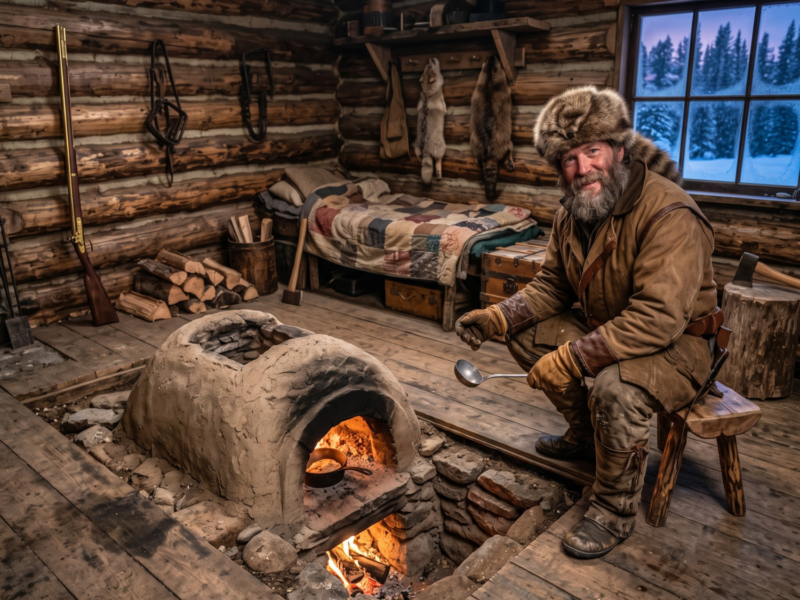
He Built a “Dumb” Heating System Under His Floor — It Kept His Cabin Warm for 6 Days
He Built a “Dumb” Heating System Under His Floor — It Kept His Cabin Warm for 6 Days
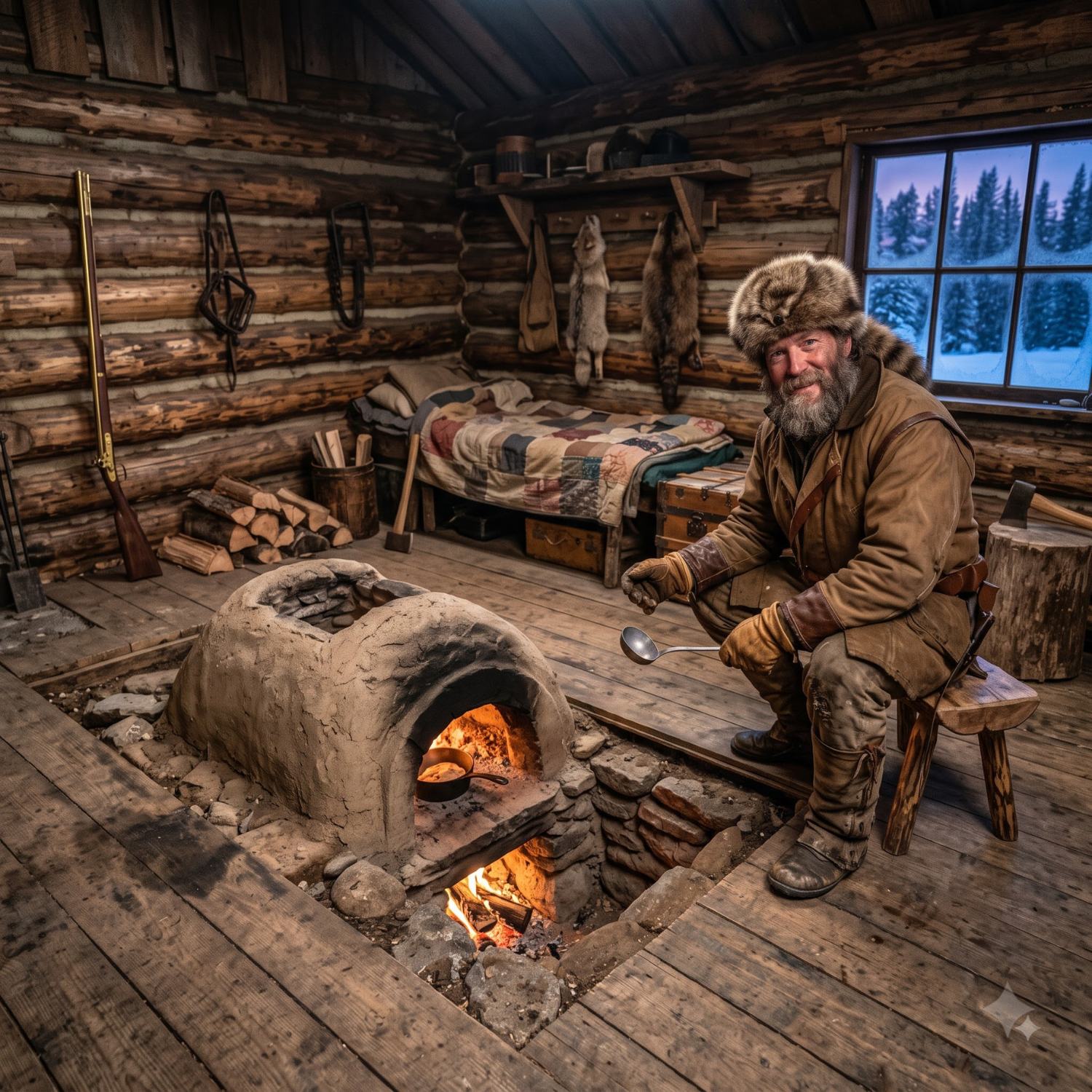
The fire had been dead for three days. Not a single ember glowed; not a wisp of smoke drifted up the chimney. Yet, Marcus Webb stood in the center of his cabin wearing nothing but a thin wool shirt and suspendered trousers, as comfortable as a man sitting in the golden haze of mid-July.
Outside the thick timber walls, the Teton Valley was locked in the brutal, suffocating grip of deep winter. The temperature had plummeted to fifteen below zero. The wind screamed through the pines, a sound like tearing canvas.
Inside, the floor beneath Webb’s bare feet radiated a profound, living warmth.
The heavy, rhythmic crunch of boots on snow broke the silence of the valley. Someone was coming. Webb walked to the small, frost-rimmed window and rubbed a circle in the condensation. A figure was fighting his way up the ridge, post-holing through knee-deep snow. It was Coleman, a neighboring trapper who lived two hours down the valley.
Webb unlatched the heavy oak door as Coleman reached the porch. The trapper practically fell inside, accompanied by a swirling vortex of blinding white snow. Webb forced the door shut against the gale and dropped the iron latch.
Coleman stood shivering, snow caked in his thick beard, his breath pluming in the air. But as he wiped the ice from his eyes, his shivering slowly stopped. The air in the cabin wasn’t just warm; it was thick with an even, radiant heat that seemed to possess no single source.
Coleman looked at the stone fireplace. It was dark, swept clean, utterly lifeless.
He had made the agonizing trek specifically to see if the rumors were true. Down in the settlement, the mountain men traded tall tales over watered-down whiskey. They said the Norwegian-blooded Ohioan up the ridge had built a magic floor. They said he could light a fire on Monday and sleep in his shirtsleeves on Friday. They said he was burning a tenth of the wood everyone else was hauling. Coleman had dismissed it as frontier exaggeration.
But standing here now, the heat was undeniable. It was soaking through the thick soles of his boots.
Coleman dropped to his knees. He pulled off his leather mitten and pressed his bare, calloused palm flat against the rough-hewn wooden floorboards.
He gasped, yanking his hand back. It was hot. Not just pleasantly warm—it was hot enough to be uncomfortable if held there for more than a few seconds.
He looked up at Webb, his eyes wide with a mixture of profound confusion and something hovering dangerously close to fear.
“There’s no fire,” Coleman whispered, his voice cracking.
“Hasn’t been for three days,” Webb replied smoothly.
“The floor… it’s hot.”
“It is.”
“How?”
Webb smiled. It wasn’t a boastful smile, nor was it mocking. It was the quiet, weary smile of a man who had endured a season of being called crazy, stupid, and wasteful. It was the smile of a man who had just been proven right by the undeniable laws of physics.
He gestured to the floorboards beneath them. “Under this wood, Coleman, sits about four tons of river stone. I heat those stones once every six or seven days. They take the heat, and they give it back slow. Real slow. Keeps the cabin warm without burning through cords of wood like you’re doing.”
Coleman shook his head, his mind rejecting the concept. “That’s not possible. Stone doesn’t hold heat that long. I’ve camped on warm rocks before. They go cold by midnight.”
“These don’t.”
“I’ve never heard of such a thing.”
Webb walked to a small timber table and poured two cups of coffee from a cast-iron pot that sat on the stone hearth. The coffee was steaming hot, drawing its temperature directly from the stones below. He handed a cup to the bewildered trapper.
“Most folks haven’t,” Webb said, taking a sip. “The Romans knew about it. Ancient empires built whole heating systems around hot stones and hot air flowing under the floors of their bathhouses. I read about it in a dusty book back in Ohio. Figured I’d try it here.”
Webb looked out the window at the howling blizzard. “Took me all summer to build. Everyone who rode past said I was wasting my time. Said I was dumb for hauling four tons of rock when I could have just built a normal dirt-floor cabin and been done in two weeks.”
Coleman took a sip of the scalding coffee, the warmth spreading through his chest. “Four tons?”
“About that. Maybe a bit more. I didn’t have a scale to weigh it exact.”
“And you heat them? Without burning the floor down? Show me.”
Webb set his cup down. “Come here.”
He led Coleman to the far corner of the cabin. A section of the heavy wooden floor had been constructed with removable planks, held in place by wooden pegs rather than iron nails. Webb knelt, removed the pegs, and pulled up three thick boards.
Coleman leaned over the gap. The heat radiating from the dark void below hit him in the face like a physical blow.
He could see them now. Massive, smooth river stones, weighing anywhere from fifty to a hundred pounds each, fitted together in meticulous, interlocking layers. The stones were literally shimmering, the air above them warping with thermal energy.
But it wasn’t just a pile of rocks. Between the massive stones, Coleman could see deliberate, winding channels—empty gaps where air could flow freely. They looked like the veins of a giant beast, leading directly from the base of the fireplace and spreading outward in a complex, branching pattern.
“When I build my fire,” Webb explained, his voice echoing slightly in the hollow floor, “I build it hot. Real hot. Hardwood. I let it roar for four to six hours. The draft pulls the hottest air down into those channels. The heat travels through the maze, warming the entire four-ton mass. When the fire finally dies, the stones act like a battery. They keep giving the heat back for days. Sometimes a full week, if the weather is mild.”
Coleman stared into the glowing abyss of the floor, silent for a long time. The implications were staggering.
“How much wood do you burn in a month, Webb? In deep winter?”
“Maybe two cords,” Webb said flatly. “Three at the absolute most, if the wind doesn’t stop.”
Coleman looked at his own blistered, sap-stained hands. “I burn four cords every three weeks. I spend half my daylight chopping, hauling, and splitting.”
“I know. Most folks do.”
“And you’re warmer than I am.”
“I am.”
Coleman stood up, looking around the cabin with entirely new eyes. It was larger than his own, the log walls thick, the mud chinking flawless. But that floor… that floor was a miracle of engineering. It was the difference between merely surviving a Rocky Mountain winter, and actually living through it in comfort.
“Will you show me how you built it?” Coleman asked, all pride stripped from his voice.
“I will,” Webb said, replacing the floorboards. “But I’ll tell you now, Coleman. It’s a brutal amount of work. It’ll break your back before it warms your feet. Most folks won’t want to put in the effort.”
“I want to.”
“Then come back when the snow melts. I’ll show you everything.”
Coleman left the cabin an hour later, his mind churning as he waded back into the blizzard. He had come to debunk a frontier myth. Instead, he had discovered a revolution.
Marcus Webb’s floor wasn’t just about rocks and fire. It was about a fundamental shift in understanding the world. It was about working with natural principles instead of constantly fighting against them. But most importantly, it was about the profound courage required to do something entirely different, even when the whole world called you a fool for trying.
CHAPTER TWO: The Agony of the First Winter
Marcus Webb wasn’t born a mountain man, and he wasn’t anyone special.
Born in Ohio in 1803, he had spent his youth covered in limestone dust, working as an apprentice to a master stonemason. It was grueling, exact work that taught him the patience of the earth and the unyielding laws of gravity and weight. But the Ohio Valley felt too small, too tame for a young man with a restless heart. In 1828, at the age of twenty-five, unmarried and possessing a stubborn streak that could rival a pack mule, he headed west.
He joined a trapping brigade bound for the jagged teeth of the Rockies. He spent his first three years up to his waist in freezing streams, learning the brutal trade of the beaver pelt, learning the unforgiving land, and learning exactly what it took to stay alive when nature wanted you dead.
By 1831, he had saved enough coin to break away. He filed a claim in the Teton Valley, in what would later become the Idaho Territory. The valley was a trapper’s paradise: teeming with game, rich with fresh water and thick timber, and geographically shielded from the absolute worst of the northern gales.
His first cabin was a monument to standard frontier construction. He felled the pines, notched the corners, packed the gaps with mud and river grass, and built a wide stone fireplace. The floor was packed dirt, beaten hard by his boots. He built it in three exhausting weeks during the short summer of 1831, moving his few possessions inside just as the first dusting of snow hit the peaks.
That first winter nearly killed him.
It taught him the agonizing lessons every mountain man eventually learns: a standard cabin is merely a wooden tent. The brutal cold found every microscopic gap in the chinking. The fire in the hearth was a ravenous beast that demanded constant feeding. But the worst offender was the floor.
The packed dirt was a thermal vampire. It conducted heat away from his body, sucking the warmth out of the room and straight into the frozen earth. Even when the fire roared so hot it scorched his face, his back and feet remained freezing.
Webb burned six cords of wood that first winter. He spent hours every single day swinging a heavy splitting maul until his hands were cracked and bleeding, his muscles screaming in protest. He would wake at two in the morning, his breath pluming in the dark, his body shivering uncontrollably because the fire had burned down to embers.
His cabin didn’t feel like a home. It felt like a wooden box where he was permitted to survive, one chopped log at a time.
When the spring thaw finally came, turning the valley into a sea of mud and blooming wildflowers, Webb did not immediately set out with his traps.
He sat on a stump outside his door, staring at the cabin. He thought about heat. He thought about how it moved, where it went, and why a roaring fire couldn’t keep a small room warm overnight.
His mind drifted back to Ohio. His old master stonemason had possessed a small, dusty library, and Webb had spent his evenings reading everything he could get his hands on. One massive, leather-bound tome had detailed the engineering of the ancient Roman Empire.
He remembered a word: Hypocaust.
The Romans hadn’t heated their massive stone bathhouses and villas with simple fireplaces. They had built raised floors. They channeled the hot exhaust gases from a roaring furnace through a network of hollow spaces beneath the floorboards and through the walls. They understood a fundamental law of thermodynamics centuries before the word was invented: You don’t heat the air. You heat the mass.
Air is fickle; it holds nothing and escapes through the smallest crack. Mass—stone, brick, earth—absorbs heat and releases it slowly, steadily, efficiently.
Webb spent the entire month of May sketching in the dirt with a stick. He couldn’t build a true Roman hypocaust; it required specialized fired bricks and complex masonry arches he couldn’t replicate in the wilderness. But he could adapt the principle. He could build a massive thermal battery under his floor.
The challenge was immense. He needed to heat the mass effectively without burning the cabin down, and he needed a floor that would allow the heat to radiate upward while remaining structurally sound.
He needed stones. Thousands of them.
CHAPTER THREE: The Fool’s Errand
He started the first week of June.
Half a mile from his cabin site ran a wide, shallow creek, its bed choked with centuries of glacial runoff. Webb walked the freezing water, selecting his ammunition carefully. He didn’t want jagged, broken rock; he wanted smooth, heavy river stones, weighing between fifty and a hundred pounds each. The water had shaped them over millennia, rounding their edges so they would fit together tightly, maximizing the transfer of heat from one rock to the next.
Every single day, from sunrise to sunset, Webb waded into the creek. He hoisted the massive, dripping stones into his wooden wagon until the axles groaned. He urged his two mules up the ridge to the cabin, unloaded the cargo by hand, and drove back down for more.
His muscles ached with a deep, systemic fatigue. His fingernails cracked. His boots rotted.
It wasn’t long before he caught the attention of the valley.
A French-Canadian trapper named Dubois, a man who had spent twenty years in the mountains and considered himself an authority on survival, rode past on a roan gelding. He reined in, watching Webb wrestle a ninety-pound boulder out of the wagon.
“What in God’s name are you doing, Webb?” Dubois called out, his accent thick. “You building a castle?”
“Building a floor,” Webb grunted, dropping the stone.
Dubois frowned, looking at the growing mountain of rocks in the yard. “With stones? Why not pack the earth like everyone else? Dirt is free, and it doesn’t break your spine to lay it.”
“These are going under the floor boards,” Webb said, wiping his brow. “They’re going to hold the heat.”
Dubois laughed, a harsh, barking sound. “Hold heat from what?”
“From the fireplace. I’m going to channel the fire through them. They’ll keep the cabin warm for days.”
Dubois shook his head, looking at Webb as if the man had contracted a brain fever. “That is not how heat works, my friend. Heat goes up. Always up. Your chimney takes it to the sky. Stones under the floor won’t do a damn thing but give the mice a place to hide.”
“We’ll see,” Webb said calmly.
“You are wasting your summer!” Dubois yelled, turning his horse. “You should be trapping! The beaver is prime, and the pelt prices are high. You are digging a grave for your own time, mason.”
Dubois rode away, and he didn’t keep his mouth shut.
The story spread rapidly through the scattered trapping community. The Ohio stonemason was building a floor out of boulders. He claimed he could trap the fire in the rocks. The consensus was swift and merciless: Marcus Webb had spent too much time alone. The isolation had cracked his mind. He had gone soft in the head.
Webb heard the rumors when he visited the trading post. He saw the smirks. He heard the whispered jokes.
He ignored them all. He just kept hauling stones.
By mid-July, the pile in his yard was staggering. He calculated he had moved over four tons of solid granite and basalt.
Now, the real work began.
CHAPTER FOUR: The Architecture of Fire
Webb began by excavating the interior of his cabin. He dug down two full feet into the hard-packed earth. This was brutal, agonizing labor, hacking through ancient pine roots and stubborn clay to create a perfectly level pit. The excavation alone took two weeks.
Next came the foundation. He spread a thick, four-inch bed of coarse gravel over the excavated dirt, creating a drainage layer to ensure no groundwater could seep up and chill his thermal mass. Over the gravel, he laid a tight, interlocking layer of flat stones. This was the basement of his battery.
Then came the critical, masterful part of the engineering.
He began building up layers of the heavy river stones, but not randomly. He built them with profound intention. He created flues—deliberate, winding, empty channels through the rock. These channels started at the base of where his fireplace would sit and spread out through the mass like the branching roots of a great tree, winding back and forth to maximize the surface area the hot air would touch.
It was a three-dimensional puzzle of staggering complexity. Each stone had to fit in relation to all the others. The mass had to be tight enough to conduct heat rock-to-rock, but the channels had to remain perfectly clear of obstruction.
As the stone mass rose, Webb used a long, straight pine board and a spirit level he had carried all the way from Ohio. A level mass would support the wooden floor evenly; an uneven mass would create weak points that would eventually snap the floorboards. Every few courses, he checked, adjusted, and shimmed.
By late August, the stone mass stood eighteen inches high. It filled the entire footprint of the cabin, the empty channels threaded through it like veins. It was, without question, the most unusual foundation any mountain man had ever laid eyes on.
But Webb wasn’t done. The heart of the machine had to be built.
He constructed his fireplace in the center of the northern wall. The firebox itself was standard, built of carefully fitted firestone to contain the roaring flames. But behind and directly below the firebox, he constructed a masterpiece of masonry: the Heating Chamber.
This was a sealed stone box built directly into the floor mass. It connected to the back of the firebox via a series of angled, downward-sloping flues.
The physics were simple but revolutionary. When he built a fire, the natural draft of the chimney would pull the smoke up. But Webb built a heavy iron damper into the main chimney. When the fire was roaring and generating maximum heat, he would partially close the main chimney damper and open a lower draft vent at the far end of the floor channels.
This created a powerful vacuum. The violently hot exhaust gases—air heated to hundreds of degrees—would be sucked downward from the firebox, into the heating chamber, and forced to travel through the maze of channels under the floor before finally exiting through a secondary exhaust pipe outside.
As the super-heated air traveled the maze, it violently scrubbed against the river stones, transferring its thermal energy into the four-ton mass.
Webb also installed a damper system within the floor itself—flat stones attached to iron rods that he could slide open or shut to control which channels the hot air flowed through. If he wanted the sleeping corner warmer, he opened the left flue. If he wanted the kitchen area warmer, he opened the right.
The final challenge was the floor itself.
He laid thick, solid oak support beams directly across the top of the stone mass. The beams were spaced sixteen inches apart. For the floor surface, he used split logs, planed perfectly flat on the top surface with a drawknife. He fitted them tightly together to create a solid, beautiful living surface.
But here was the secret: he left the underside of the floorboards rough and unfinished, and he ensured there was a precise, two-inch air gap between the top of the stones and the bottom of the wood.
That air gap was the crucial final step. The stones would heat the air in the gap through convection and radiation, and that trapped hot air would gently, evenly warm the wooden floorboards above. It prevented the wood from catching fire, but turned the entire floor of the cabin into a massive, low-temperature radiator.
By the first week of September, the cabin was complete. The roof was on, the chinking was flawless.
Everything was ready for the test.
CHAPTER FIVE: The First Embers
The first real cold snap hit the Teton Valley in early October of 1831. The temperature plummeted to ten below zero over a single night, frosting the pines in brittle white ice.
Down in the valley, trappers cursed, stoking their fires, hauling wood, preparing for the long, dark battle against the freeze.
Marcus Webb stood in his cabin, a pile of dry, seasoned oak and hickory stacked by the hearth. He felt a flutter of deep, anxious anticipation in his chest. He had spent his entire summer, his savings, and his reputation on a theory from a dead empire. If it failed, if the draft didn’t pull downward, he would choke on smoke and freeze to death.
He struck a flint. The sparks caught the dry pine tinder. The fire breathed to life.
He didn’t build a massive, chaotic fire. He built a hot, bright, fiercely burning fire of dense hardwood. For the first thirty minutes, he let the main chimney draft normally, warming the flu to establish a strong upward current.
Then, he took a deep breath, grabbed the iron rod of the main chimney damper, and pushed it half-closed.
Simultaneously, he pulled the lever that opened the draft to the subterranean heating chamber.
For a terrifying five seconds, the smoke billowed outward, curling into the cabin. Webb coughed, his heart sinking. Dubois was right. Heat goes up. It won’t pull down.
But then, the physics took over.
The cold air rushing out the secondary vent outside created a vacuum. Inside the firebox, the flames suddenly bent backward, pulled at a sharp angle. The smoke vanished, sucked violently downward into the stone box beneath the hearth.
Webb let out a shout of triumph. The draft had caught.
He fed the fire steadily for four hours, keeping the blaze running at maximum temperature. He could feel the system working. The stones forming the hearth grew hot to the touch.
As the hours passed, he walked the floorboards in his stocking feet, tracking the progress of the invisible heat. The wood nearest the fireplace warmed first—a gentle, comforting radiation. Slowly, the warmth crept outward, moving through the invisible stone mass below like hot water soaking through a heavy blanket.
After four hours, the entire floor was alive with heat. It wasn’t burning hot; it was a profound, pervasive warmth that enveloped the room from the ground up.
Then, Webb did the unthinkable.
He stopped feeding the fire. He let the flames die down to red coals. He let the coals turn to gray ash. He closed all the dampers, trapping the heat in the stones.
By evening, the hearth was completely dead. Outside, the wind howled, pushing the temperature down to twenty below.
Inside, Webb stripped down to his wool undershirt.
He lay in his bed, listening to the storm scream against the log walls. But beneath him, the floor was radiating a continuous, gentle wave of thermal energy. He felt like he was floating on a sun-warmed boulder in the middle of July.
He slept deeper and more soundly than he had in two years.
When he woke the next morning, the cabin was still warm. The biting chill that normally greeted a mountain man in the morning was entirely absent. He didn’t have to scramble with frozen fingers to spark a fire. He walked to the hearth and placed his coffee pot on the stones; the residual heat from the masonry warmed the water enough to brew a pot without a single flame.
On the second day, the cabin began to cool, but at an agonizingly slow rate. The four-ton mass had absorbed so much thermal energy that it was releasing it in a microscopic trickle, keeping the interior temperature hovering comfortably around sixty degrees.
By the evening of the third day, the floor was no longer hot, but it was still noticeably warmer than the air.
On the fourth day, Webb finally struck a flint and built a new fire.
He sat at his table, opening a small leather journal. He dipped his pen in ink and began to record the data. He tracked the hours of burn time, the amount of wood consumed, and the duration of the radiating heat.
The results were a triumph.
In the absolute coldest, most brutal depths of the Rocky Mountain winter, Webb only needed to heat his stones once every six days. During the milder weeks of early spring, he could go nine days without lighting a match.
His total wood consumption for the entire winter of 1831 was two and a half cords. He had cut his labor by more than half, and he was living in a state of absolute, unprecedented comfort.
The system worked exactly as the ancient Romans had designed it, adapted by a stubborn Ohio stonemason for the wild frontier. He had built a thermal battery. He charged it, and it powered his life.
But more importantly, the system gave him the most valuable commodity in the mountains: Time.
While other trappers were slaves to their axes and their hearths, tethered to their cabins by the constant need to feed the fire, Webb was free. He could leave his cabin for three days to run a distant trap line, knowing he would return to a home that was still warm enough to keep his water bucket from freezing.
CHAPTER SIX: The Great Winter
Word of Webb’s success spread slowly at first. Mountain men are notoriously stubborn, clinging to tradition because tradition is what kept their grandfathers alive.
When spring arrived and the trappers gathered at the rendezvous to trade pelts and stories, Webb’s cabin became the subject of intense debate.
Dubois, the French-Canadian skeptic, dismissed it completely. “He spent three months hauling rocks! By the time he saves enough wood to make up for that labor, he will be a ghost!”
Others were intrigued but intimidated by the sheer scale of the engineering required. A few, like Coleman, had made the trek to see it, touch it, and feel the truth of the hot floor.
The true reckoning, the event that would forever cement Marcus Webb’s legacy, arrived five years later.
The winter of 1836-37 was an apocalyptic event. It entered the lore of the mountain men as “The Great White Death.”
Temperatures plummeted to forty below zero and stayed there for agonizing weeks. The snow did not stop falling for twenty days. It buried the valleys, choked the passes, and tested the structural integrity of every cabin, every preparation, and every man’s will to live.
Standard cabins failed. The desperate trappers burned through their firewood reserves at terrifying rates, throwing logs into their fireplaces just to keep the ambient temperature above freezing. When their woodpiles ran dry, they were forced to venture out into the waist-deep, forty-below whiteout to fell green timber, risking frostbite, exhaustion, and death.
Several cabins caught fire when desperate men built their hearths too hot for too long, cracking the stone chimneys and igniting the dry log walls.
Marcus Webb’s cabin performed flawlessly.
The ability to heat his four-ton stone mass once a week meant that even in the apocalyptic cold, the system absorbed the shock. Webb made careful notes in his journal by candlelight. In the absolute worst weeks, when the outside air would freeze boiling water before it hit the ground, his cabin interior never dropped below forty-five degrees, even on the fifth day without a fire.
When he did ignite his hearth, the cabin warmed to a luxurious seventy degrees. He burned exactly four cords of wood that entire winter.
Down in the valley, Dubois burned fourteen cords. He lost two toes to frostbite while chopping wood in January.
When the spring thaw finally broke the grip of The Great Winter, the mockery against Marcus Webb ceased entirely and forever.
No one called his floor dumb. No one joked about his summer of hauling rocks. The evidence was carved into the frostbitten faces of the men who had doubted him.
CHAPTER SEVEN: The Legacy of Stone
The first man to adopt the system was Coleman.
When the snow melted in the spring of 1837, Coleman rode up the ridge to Webb’s cabin. He didn’t ask for a demonstration; he asked for a shovel.
Webb shared his knowledge freely. He spent a week down in the valley helping Coleman excavate his floor, teaching him the critical importance of the drainage gravel, the exact width of the flues, and the masonry tricks to build the downward-drafting heating chamber.
Coleman’s system wasn’t as elegant as Webb’s—he lacked the formal stonemasonry training—but the physics didn’t care about elegance. The thermal mass absorbed the heat, the channels distributed the air, and Coleman’s wood consumption plummeted. He became a fierce evangelist for the technique.
Over the next decade, variations of the “Webb Floor” began appearing throughout the trapping communities and early settlements of the Rockies.
Human ingenuity, once sparked, takes on a life of its own. Builders adapted the system to their specific needs and environments. Men who couldn’t find large river stones used densely packed clay and bricks. Some trappers built smaller, localized thermal masses just beneath their sleeping platforms, creating permanently heated beds.
A pair of brothers from Pennsylvania, arriving in the 1840s, took Webb’s design and expanded the heating chamber to include a massive, sealed masonry bread oven, using the thermal mass to bake food while simultaneously heating the floor.
The most brilliant adaptation came from a settler family named Morrison in 1845. They built a massive cabin for their family of eight. They scaled Webb’s stone mass up to seven tons. But the patriarch, a former plumber from the East Coast, added something Webb hadn’t envisioned.
He ran a continuous loop of sealed copper piping directly through the center of the stone mass, connecting it to a water barrel. In the winter, the pipe sat empty. But in the summer, he pumped cold spring water through the pipes. The massive stone foundation, cooled by the earth, chilled the water, creating a primitive form of air conditioning. In the autumn, when the fires began, the water in the pipes was heated by the stones, providing the family with continuous, radiant hot water without needing to boil pots on the stove.
It was a breathtaking evolution of the concept, proving that the basic principle of thermal storage was a canvas for limitless innovation.
The social impact of Webb’s “dumb idea” was immeasurable.
The ability to maintain a warm cabin without constant fire maintenance changed the rhythm of frontier life. Women and children were no longer exposed to the dangerous, plunging temperatures that accompanied a dying fire in the middle of the night. Respiratory illnesses—the scourge of the damp, drafty frontier cabin—dropped significantly in homes utilizing the thermal floors.
Children in the Morrison family had a warm, comfortable space to study and read during the darkest months of winter, receiving an education that would have been impossible in a freezing, standard cabin.
CHAPTER EIGHT: The Enduring Flame
Marcus Webb lived in his Teton Valley cabin until 1868.
He was sixty-five years old, his beard white as the mountain snow, his hands gnarled with arthritis. He had spent thirty-seven years walking on the floor that everyone had called a fool’s errand.
When he finally moved to a booming settlement down south to live with his daughter’s family, he left the cabin standing.
In his later years, young builders and architects heading west would seek out the old stonemason, asking for the secret of the legendary warm floors.
Webb would sit on his daughter’s porch, whittling a piece of pine, and give them the exact same advice every time.
“Don’t be afraid to look like a fool,” he would say, his voice rough as granite. “Most folks do things a certain way just because that’s how their daddy did it, and his daddy before him. But ‘always been done’ doesn’t mean it’s the best way to do it. If you understand the why of a thing—why fire burns, why stone holds heat, why air moves—you can build a better world.”
He would point his knife at the young men. “It took me one entire, backbreaking summer to haul those rocks. Dubois laughed at me every day. But I spent one summer building it right, and I saved myself thirty-seven years of freezing labor. The world wants you to build fast. I say, build for your lifetime.”
Marcus Webb died in 1883 at the age of eighty.
He had lived to see the end of the mountain man era, the decline of the fur trade, and the violent, rapid settlement of the American West. His obituary in the local paper praised his skill as a stonemason and his early days as a trapper. It made no mention of his heating system. To the journalists of the modern, industrializing age, a dirt-floor cabin trick was hardly newsworthy.
But the people of the mountains knew.
They knew that the warm cabins they slept in, the cords of wood they didn’t have to chop, the children who survived the brutal winters—all of it traced back to the stubbornness of one man who remembered a dusty book about the Roman Empire, and who had the absolute courage to haul rocks while the world laughed at him.
Webb’s original cabin stood until 1892. When it was finally dismantled by a logging company expanding a road, the workers were stunned to find the massive, four-ton stone foundation perfectly intact. The stones showed no deterioration; the flues were still clear of soot. The system, engineered by hand in 1831, could have functioned flawlessly for another century.
Today, in the modern era of sustainable architecture, the principles Marcus Webb applied are considered cutting-edge.
Architects building multi-million-dollar “passive solar” homes utilize polished concrete floors to act as thermal mass, absorbing the sun’s energy during the day and radiating it at night. Modern radiant floor heating, pumping heated water through subfloor tubing, operates on the exact same thermodynamic reality Webb harnessed with a wood fire and a pile of river rocks.
We live in a world where comfort is outsourced to thermostats and central heating grids. We flip a plastic switch and expect warmth, completely disconnected from the elemental realities of heat, cold, and energy. We have forgotten how to read the draft of the wind, how to feel the storage capacity of stone, how to negotiate with nature rather than simply burning fossil fuels to fight it.
Marcus Webb didn’t have a computer. He didn’t have an engineering degree from MIT. He had a shovel, a pair of mules, and an unshakable belief in the laws of physics.
He looked at a problem—the brutal, killing cold of winter—and he refused to accept the standard answer. He reframed the question. He didn’t ask, How do I keep a fire burning longer? He asked, How do I capture the fire so it never truly dies?
The floor that people mocked became the floor that people copied. The technique that seemed wasteful became the technique that saved thousands of hours of human labor.
It stands as a timeless monument to the power of independent thought. Because sometimes, the idea that everyone calls dumb is simply a stroke of genius waiting for the winter to prove it right. And when the snow falls, and the temperature drops to fifteen below, the only thing that matters is who is left shivering in the dark, and who is standing in their shirtsleeves, warmed by the stubborn, brilliant stones beneath their feet.









