Kicked Out at 22, She Bought a $10 Lockmaster’s House—What Was in the Gate Room Changed Her Lif
Kicked Out at 22, She Bought a $10 Lockmaster’s House—What Was in the Gate Room Changed Her Lif
PROLOGUE: THE TEN-DOLLAR DEED
The rain over western Maryland did not fall so much as it drifted across the ridges, settling into the limestone folds of the Potomac Valley like a wet shroud. On a raw Tuesday morning in April, twenty-two-year-old Fay Landis stood on the porch of a small, cramped bungalow on the outskirts of Hancock, holding a cardboard box containing three sweaters, a stack of veterinary clinic logbooks, and a framed photograph of a grandfather who had been dead for ten years.
There had been no shouting. Poverty in the small towns wedged between Tanoay Hill and the river rarely announced itself with drama; it arrived quietly, through arithmetic and lack of options. Tara’s belly was rounding toward November. The guest room, where Fay had slept on a narrow cot for three years while paying three hundred dollars a month from her kennel-assistant wages, was scheduled to become a nursery.
“I’m sorry, Fay,” Curtis had said, his eyes fixed on the steering wheel of his truck, his palms red and calloused from drywall work. “It’s just temporary space until we figure something out.”
“It’s fine, Curtis,” Fay had replied. Her voice had the flat, unscentimental cadence common to women raised by home-health aides and rivermen. “I already figured it out.”
She had walked away with a duffel bag, a canvas work jacket, and ten crisp dollar bills folded inside the emergency pocket of her grandfather’s old canal map—a water-stained, India-ink-drawn linen chart that had survived the great flood of 1924. She did not head toward the highway, nor did she check the listings for room rentals in town. Instead, she turned her boots toward the tow path, following the long, shallow ditch where the Chesapeake and Ohio Canal had once run.
Ten dollars. That was all the Washington County surplus clerk had asked for the stone cottage at Lock 53.
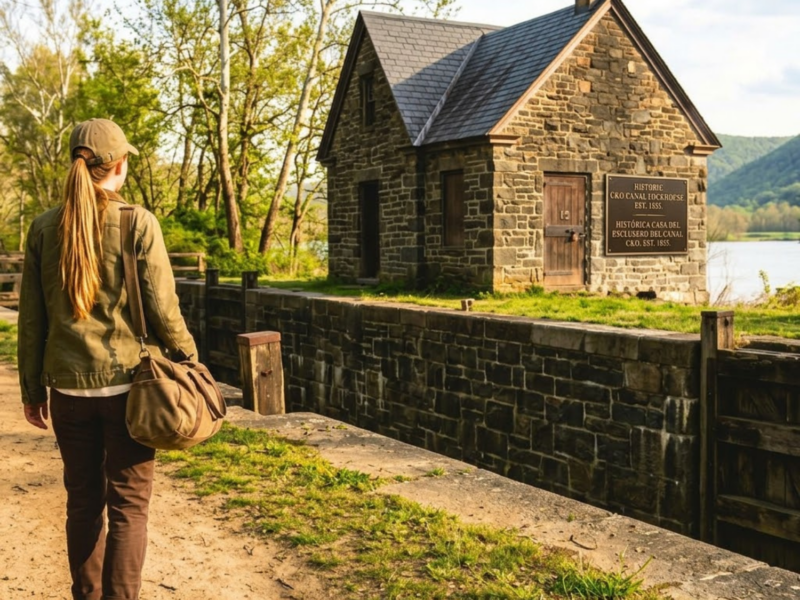
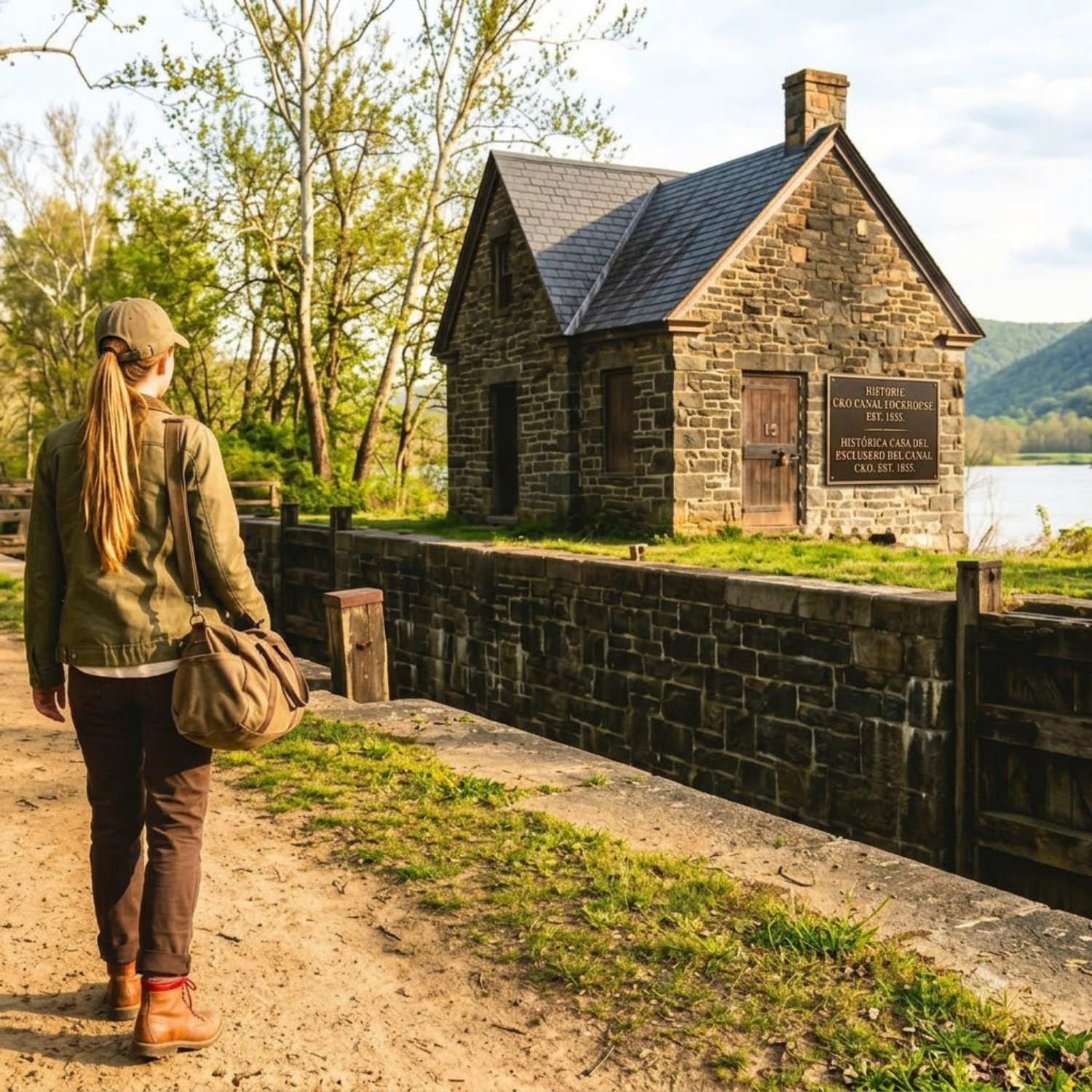
The building had been abandoned since the park service de-accessioned it in 2009, sitting silently behind its iron hasp and brass padlock since 1971. For over a century, its limestone walls had darkened with river damp, and the county had tried to give it away for the price of a cheap lunch. No one else wanted a box of wet slate and old mortar with no electricity, no running water, and access restricted entirely to a dirt trail once walked by mules.
But as Fay unlocked the heavy oak door with an iron key that felt cold enough to burn, she was not looking at an abandoned ruin. She was stepping back into the only geography of her life that had never lied to her. And hidden in the stone niche of the basement gate room, behind an iron winding wheel that had not turned in one hundred years, lay two brass crank handles, a German-American lockmaster’s handwritten maintenance log, and a secret that would anchor her soul to the river forever.
CHAPTER 1: THE ROAD BETWEEN THE RIDGE AND THE RIVER
Hancock was a town defined by its claustrophobia. Wedged so tightly between the Potomac River and the long, steep slope of the ridge that a person standing in the middle of Main Street could see the green shadow of the hill in one direction and the gray, unhurried flow of water in the other, it smelled permanently of damp earth, woodsmoke, and old coal dust.
The C&O Canal had shaped every foundation in the valley. Beginning in 1839, it had served as the economic artery of Western Maryland, dragging Cumberland coal down to Georgetown on mule-drawn barges through seventy-four hand-operated stone locks. Then came the Great Flood of March 1924—a wall of black water that tore through the valley, ripping out gates, scouring away embankments, and turning the multi-million-dollar commercial ditch into an archaeological relic almost overnight.
Fay’s grandfather, Emmett Landis, had been eleven years old when the flood hit.
He had spent his boyhood on his father’s seventy-foot wooden freight barge, the Agnes L, hauling twelve tons of coal through locks that smelled of wet oak and horse sweat. After the canal died, Emmett spent the rest of his long life in Hancock as a carpenter and small-boat builder, but his true vocation was memory.
From the time Fay was four years old, Emmett had walked her down the mile-and-a-half dirt tow path from the edge of town to Lock 53. He did not walk fast. He walked at the rhythm of an old man who knew that the earth remembers everything it is asked to hold.
“Look at the stone, Fay,” Emmett would say, stopping his heavy work boots beside the massive rectangular chamber of Lock 53, where the oak gates still stood frozen in their iron hinges. “This wasn’t built by a company. It was laid by men with sore backs and cold hands. A German immigrant named Halped laid eleven locks between here and Cumberland in the 1830s. He carved his initials into the back of a single stone in each lock, where only the water could see them.”
For three years, Fay had run her small, cold fingers over the cut limestone blocks of Lock 53, searching for Halped’s hidden letters. She never found them. But in the searching, she learned to read the masonry—to tell the difference between the warm gold limestone of the Tonoloway formation and the blue-gray quartzite of the upper locks, to feel with her fingertips whether the mortar between two blocks was original or patched, old or new, laid with care or laid in haste.
Emmett had shown her things he showed no one else. When she was nine, he led her around the riverside of the lockmaster’s limestone cottage to a low, heavy wooden door tucked into the basement level, invisible from the tow path.
“That’s the gate room,” Emmett whispered, his breath pluming in the February frost. “The lockmaster’s office. Inside there is an iron wheel connected to a drive shaft that goes straight through the masonry into the lock walls. Josiah Grath operated that wheel for forty-two years. During the big ice storm of 1919, when my father’s barge was the only boat moving, Josiah opened the lock from inside the house so he wouldn’t have to walk out into the freezing wind. My father said it was the most beautiful piece of engineering ever built in the valley.”
The navigation chart had hung on the wall of their rented house for as long as Fay could remember—a large, water-stained, India-ink linen map showing every aqueduct, wide-water, and lock from Georgetown to Cumberland. When Emmett died quietly on a Tuesday morning in March when Fay was twelve, her mother, Dileia, had been sitting at the kitchen table with that map spread out before her, unable to fold it back up.
Dileia was a home-health aide who worked twenty-six hours a day to keep food on the table after Fay’s father, a long-distance trucker, stopped returning from his runs. She was practical, unscentimental, and silently tolerant of Emmett’s canal obsession. She understood, without ever needing words, that the evening walks to Lock 53 were doing something for Fay that no schoolteacher or therapist could manage.
After Emmett’s death, Fay walked the path alone. She walked it through middle school, through high school, and through the two years she spent working as a receptionist and kennel assistant for Dr. Staley at the Hancock veterinary clinic.
Dr. Staley had often told Fay she possessed an uncanny diagnostic eye—an intuitive ability to notice when a dog’s gait had shifted overnight or when a cat’s breathing rate had increased by a fraction. Neither of them knew that this diagnostic vision was not something Fay was born with; it was a habit of attention built evening by evening on the tow path, where Emmett had taught her to look at a thing slowly enough to see what had changed since the last time she looked.
Then Dileia died of breast cancer at nineteen. The rented house was sold. Fay moved in with her brother Curtis and his new wife, Tara, paying three hundred dollars a month for a guest room that smelled of cedar boxes and old guest towels. For three years, Fay kept her head down, worked her clinic hours, and walked to Lock 53 every single evening.
Until the pregnancy announcement in February ended the arrangement with mathematical precision.
CHAPTER 2: THE KEY TO LOCK 53
The Washington County courthouse in Hagerstown smelled of floor wax, damp wool, and municipal indifference. Mrs. Klene, a clerk in her fifties with bifocals balanced precariously on her nose, looked over the top of her frames at the young woman standing before her in a canvas work jacket.
“You want the lockmaster’s house at Lock 53?” Mrs. Klene asked, her pen hovering over a ledger that looked older than the republic. “The county’s had that listed for ten dollars since 2011. It has no power, no well, no septic, and you can’t get a vehicle within a mile and a half of it. The roof hasn’t been shingled since the Nixon administration.”
“I know,” Fay said, placing a ten-dollar bill on the counter.
Mrs. Klene stamped the deed with a wet, satisfying thump, then slid a heavy brass ring across the mahogany wood. “The large key is the front door. The medium key is the basement gate room. The small key is the coal cellar. Try not to freeze to death before November, Miss Landis.”
Fay walked the mile and a half from the nearest service road down the packed dirt of the tow path that very afternoon, her duffel bag slung over one shoulder, her boots kicking up tiny clouds of dry grit from the canal bed.
When she turned the key in the front door of the lockmaster’s house, the heavy oak slab groaned against a century of swollen wood. Inside, the single ground-floor room was enveloped in a profound, mineral silence. The limestone walls were coated with a fine silt of river dust; a stone fireplace dominated the northern wall, flanked by a narrow set of wooden stairs leading to a half-loft bedroom under the eaves.
Fay set her duffel bag on the bare plank floor, walked to the small window overlooking the dry canal bed, and breathed in. The air tasted of cold lime, damp stone, and ancient river mud. It was the smell of her childhood, distilled to its purest essence.
With the medium-sized key clutched in her hand, she descended the four narrow stone steps at the back of the ground floor, leading down into the riverside basement.
The gate room was an eight-foot square of damp masonry. A single narrow slit of a window looked out toward the empty stone lock chamber. Against the far wall, bolted into heavy iron brackets anchored directly into the native limestone, stood the gate winding mechanism.
It was a masterpiece of industrial archaeology: a heavy iron wheel, roughly three feet in diameter, connected to a complex array of gears and a thick iron drive shaft that vanished directly into the masonry toward the lock gates.
Fay stepped closer, her heart performing a slow, heavy thud against her ribs. She placed both palms flat against the cold iron of the wheel. She did not try to turn it; she simply stood there in the subterranean dark, imagining Josiah Grath standing in this exact spot during the howling ice storm of February 1919, turning this wheel to save a freezing boatman the trouble of stepping out onto the ice.
As her fingers traced the iron housing where the drive shaft entered the masonry, she noticed something odd.
The limestone blocks immediately surrounding the shaft opening were different from the rest of the wall. They were dry-laid—fitted with immaculate precision, but entirely devoid of mortar. A stonemason’s secret pocket.
With her fingernails, Fay worked at the edge of the first block. It shifted with a dry scrape of stone against stone. She wiggled it free and set it on the floor. A second block slid out easily, followed by a third.
Behind them lay a stone niche, fourteen inches wide and ten inches high, cut deep into the core of the lock wall.
Inside sat three items:
-
Two matched brass crank handles, eighteen inches long, featuring heavy hexagonal shafts and turned wooden grips darkened by decades of human skin oils and linseed.
-
A tightly rolled cylinder of heavy linen paper covered in faded India ink.
-
A folded letter, written in a meticulous, elegant German-American cursive hand.
With trembling fingers, Fay carried the objects up the stone steps into the fading afternoon light of the ground-floor room, sat down on the wooden floorboards, and unfolded the letter.
CHAPTER 3: JOSIAH’S LEGACY
To whoever finds these handles,
My name is Josiah Grath. I have been the lockmaster at Lock 53 on the Chesapeake and Ohio Canal from the spring of 1882 until this morning, the 29th of March, 1924.
I am sixty-two years old. The river is flooding. The water is already above the gate tops for the first time in my forty-two years here. The canal company has sent word from Georgetown that commercial operations are suspended indefinitely, and in my heart, I know they will never resume.
I am removing the gate crank handles from the lock posts this morning and sealing them inside the wall of the gate room. I cannot allow them to be torn away by the flood, nor can I allow them to be hauled off as scrap iron by men who see only metal where history lived.
These handles have been in my hands for forty-two years. They are not scrap. They are the tools that opened and closed the gates of this lock approximately eighteen thousand times across the working life of this watercourse. The rolled document beside them is my own hand-drawn cross-section diagram of the gate winding mechanism, drafted in 1886 because I realized the company kept no blueprints of the internal shafts, and if I did not record how it worked, no one ever would.
I have maintained the mechanism according to this diagram twice every year, spring and fall, greasing the main bearings and clearing the pins. It still turns. It will turn for the person who finds this niche, provided she has the patience to grease the bearings and replace the drive shaft key pin.
I do not know who will find this. I am an old man standing in a flooded cellar with no certainty that the walls I am sealing will survive the night. But these stones were laid in 1838 by men who knew their trade. I believe the walls will hold. And I believe that someday, someone will walk into that gate room, put her hands on the iron wheel, and notice that the stones around the drive shaft are unmortared.
The handles are yours. The diagram is yours. Grease the bearing. Replace the pin. Turn the wheel. Open the gate.
— Josiah Grath, Lockmaster March 29, 1924
Fay sat in the gathering dusk of the abandoned cottage for a long time, the letter flat across her knees, the brass cranks catching the amber slants of evening light through the dusty window. She did not cry. Grief and solitude had long since taught her that some moments required neither celebration nor sorrow, only witness.
She stood up, walked to the doorway, and looked out over the dry, weed-choked stone basin of Lock 53.
“Thank you, Mr. Grath,” she said softly to the empty air and the rolling dark of the Potomac. “I’ll turn the wheel.”
CHAPTER 4: THE AWAKENING OF THE LOCK
The restoration of Lock 53 did not begin with grand machinery; it began with a shovel, a cold chisel, and an aching back.
For six weeks, Fay lived like a monastic scholar of mud. A century of accumulated silt, rotting oak branches, and dense leaf mold had filled the lock chamber to a depth of three feet at the downstream end. Worse still, the massive iron hinges of the lower gates were buried beneath a layer of river sediment that had hardened over decades into the consistency of industrial concrete.
Working from dawn until the mountain shadows swallowed the river, Fay shoveled out the muck bucket by bucket, hauling it up the stone steps and dumping it along the berm. Using an old cold chisel from Emmett’s toolbox, she chipped away the calcified mud encrusting the hinge pins, applying a liberal coating of rendered lard she bought at the Hancock general store.
By late May, the chamber was cleared down to its original dressed limestone floor.
On a Saturday morning when the dogwood was in full, blinding bloom, Fay walked down to the lower gate, carrying one of Josiah Grath’s heavy brass crank handles. She fitted the hexagonal end into the corresponding socket on the iron gate post, braced her boots against a block of granite, and threw her weight against the wooden grip.
Nothing happened. The mechanism was locked tight by a century of cold friction.
Fay did not force it. She remembered Josiah’s maintenance notes from the linen diagram: Grease main bearing spring and fall. Replace drive shaft key pin every 10 years.
She descended into the basement gate room, hauled out her small toolkit, unbolted the main bearing housing, and spent three hours scraping out black, fossilized grease from the iron races before packing them fresh with modern lithium grease she had carried down in a plastic bucket. She replaced a sheared steel pin in the primary gear train with a high-tensile bolt she had purchased at the hardware store in town.
Then she returned to the top of the lock wall, inserted the brass crank once more, and leaned her entire body weight into the handle.
A sound rang out across the Potomac Valley—a deep, metallic groan that started as a dry screech, rolled down the length of the stone chamber like thunder, and echoed off the steep ridge of Tonoloway Hill.
The heavy iron and white-oak gate trembled.
With a slow, magnificent momentum, as if waking from a century-long sleep, the downstream gate swung outward on its restored hinges, parting the green current of the river for the first time since the morning of March 29, 1924.
Fay stood on the stone wall, the brass crank in her hand, watching the white water swirl past the open timber. She did not cheer. She simply stood very still, feeling the cool river breeze dry the sweat on the back of her neck, knowing that somewhere beneath the sod of the Hancock cemetery, her grandfather was nodding in approval.
CHAPTER 5: THE SEASONS OF THE TOW PATH
By her second summer at Lock 53, the cottage had transformed from a damp ruin into a spare, beautiful refuge.
She slept on a narrow iron cot in the half-loft under the sloping slate roof, cooked her meals on a two-burner propane camp stove in the alcove, and installed a modern composting toilet in the stone-vaulted coal cellar. The gate room remained untouched, save for Josiah Grath’s linen diagram mounted in a simple oak frame beside the iron wheel.
The C&O Canal Trust, noticing the sudden, inexplicable clearing of Lock 53 and the restoration of its operational mechanics, sent an inspector down from Cumberland in July. The man, a senior historian named Dr. Aris Thorne, spent four hours examining the grease points, testing the gate swing, and reading Josiah’s original letter.
By August, Fay was officially hired as a part-time trail steward and site interpreter for the National Historical Park corridor, responsible for maintaining a five-mile stretch of the tow path and managing educational tours around Lock 53.
Her life settled into a rhythm as old and reliable as the river itself.
She walked the tow path every morning at dawn, checking for fallen sycamore limbs, greeting cyclists riding the 184-mile trail from Georgetown to Cumberland, and stopping to let curious hikers turn the iron wheel in the basement gate room.
One Saturday in October, a retired Army Corps of Engineers colonel drove all the way from Chambersburg just to inspect the winding mechanism. After spending an hour turning the wheel and examining the internal drive shaft, he stepped out into the sunlight, took off his cap, and shook Fay’s hand with profound reverence.
“Miss Landis,” he said, his voice ringing across the lock wall. “I have studied industrial engineering from the Erie Canal to the Panama Canal. This is the only fully intact, interior-operated C&O lock mechanism surviving east of the Alleghenies. You are sitting on a national treasure.”
“Mr. Grath kept it clean,” Fay replied simply.
Her family visited in the autumn. Curtis walked down the tow path carrying his five-month-old daughter on his hip, his work boots grey with tow-path dust. He stood at the open lower gate, looking out over the wide, gleaming expanse of the Potomac where the river curved toward the mountains.
“Grandpa would have lost his mind over this,” Curtis murmured, shifting the baby to his other arm.
“He didn’t miss it,” Fay said softly, watching the sunlight catch the baby’s fine blond hair. “He just saw it closed.”
EPILOGUE: THE HOME THAT CANNOT BE SOLD
On a crystal-clear evening in late September of her twenty-fifth year, Fay sat on the stone coping of Lock 53, her legs dangling over the empty, weed-matted floor of the upper chamber where the masonry glowed gold in the declining light.
The downstream gate stood wide open, framing the emerald ribbon of the Potomac as it flowed steadily toward the Chesapeake. Behind her, the limestone cottage was dark except for the warm, amber glow of a propane lantern shining through the ground-floor window.
She thought about her grandfather Emmett, who had walked this exact path with her when her legs were too short to keep up without trotting. She thought about Josiah Grath, standing in the dark cellar fifty years before she was born, sealing his life’s work into a stone wall because he believed someone, someday, would care enough to find it. And she thought about the ten-dollar bill she had handed Mrs. Klene in the county courthouse three years ago—the best investment ever made in human history.
The world outside the valley had spent its time shifting beneath her feet. Her parents were gone. The rented house of her childhood had been sold to strangers. Her brother’s guest room had vanished into nursery wallpaper and crib mobiles.
Every human structure she had ever inhabited had proven temporary, contingent on leases, mortgages, and the shifting arithmetic of other people’s lives.
Except for this.
The tow path was the same packed dirt she had trodden as a four-year-old child. The limestone blocks of Lock 53 were the same stones laid by German masons in 1838. The river was the same ancient, brown water moving past the same green ridge.
A walk taken a thousand times does not merely lead somewhere; it becomes a place in its own right. It becomes a home built not of drywall and nails, but of memory, repetition, and endurance—a home that no landlord can evict you from, that no bank can foreclose upon, and that no family emergency can crowd out.
Fay reached down and touched the cold stone of the lock wall, feeling beneath her palm the smooth, patient grain of limestone that had outlived empires, floods, and the passage of careless centuries.
A lock gate closed for a hundred years was still a lock gate. And any gate could be opened, provided you had the brass cranks, the patience to grease the bearings, and the courage to lean your full weight into the iron.









