She Said: “I Only Need Seed for Spring”… The Rancher Replied: “Then Stay Until the Harvest”
She Said: “I Only Need Seed for Spring”… The Rancher Replied: “Then Stay Until the Harvest”
The mud on the road to the Callahan ranch was not simply wet dirt; it was a living, breathing adversary. It was the kind of thick, Nebraska spring gumbo that sucked at the soles of your shoes with an audible smack, threatening to pull the boots right off your feet with every agonizing step.
Clara Whitlock had walked six miles through it on that bitter March morning in 1875, her fingers locked tightly around the small, cold hand of her son. Samuel was eight years old, thin as a split-rail fence, his trousers soaked to the knees in freezing brown sludge. Yet, he had not complained once. He walked with his jaw set, his eyes fixed forward. He understood, with the terrifying, silent intuition that children of hard years possess, that this walk mattered. He knew that the flour barrel at home echoed when tapped, and that pride was a luxury they could no longer afford.
At the bottom of the Callahan porch steps, Clara paused. She released Samuel’s hand and brushed frantically at the heavy mud clinging to the hem of her faded wool skirt. It was a futile gesture, only driving the stains deeper into the fabric. Her heart hammered against her ribs like a trapped bird. She had rehearsed the words the entire six miles, whispering them to the wind, but now, staring up at the imposing oak door of the largest ranch house in the county, every syllable vanished from her mind.
Before she could raise a trembling knuckle to the wood, the door swung inward.
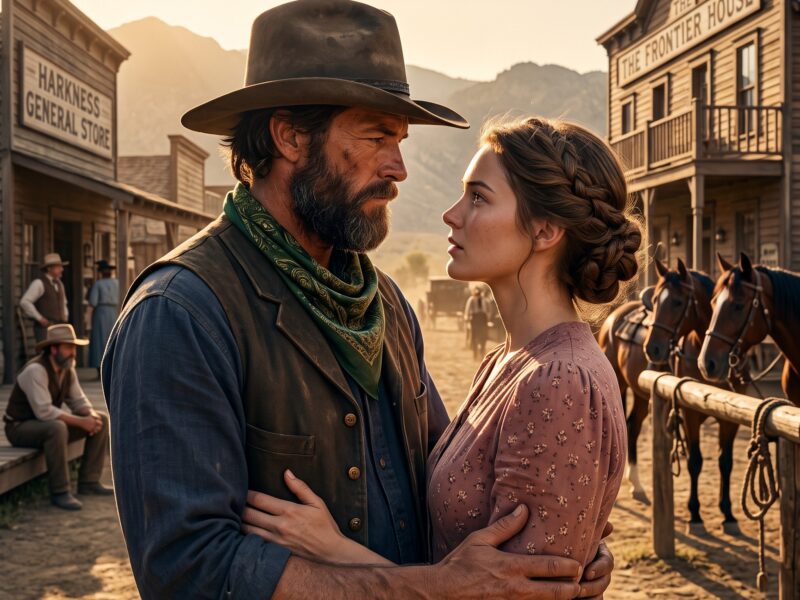
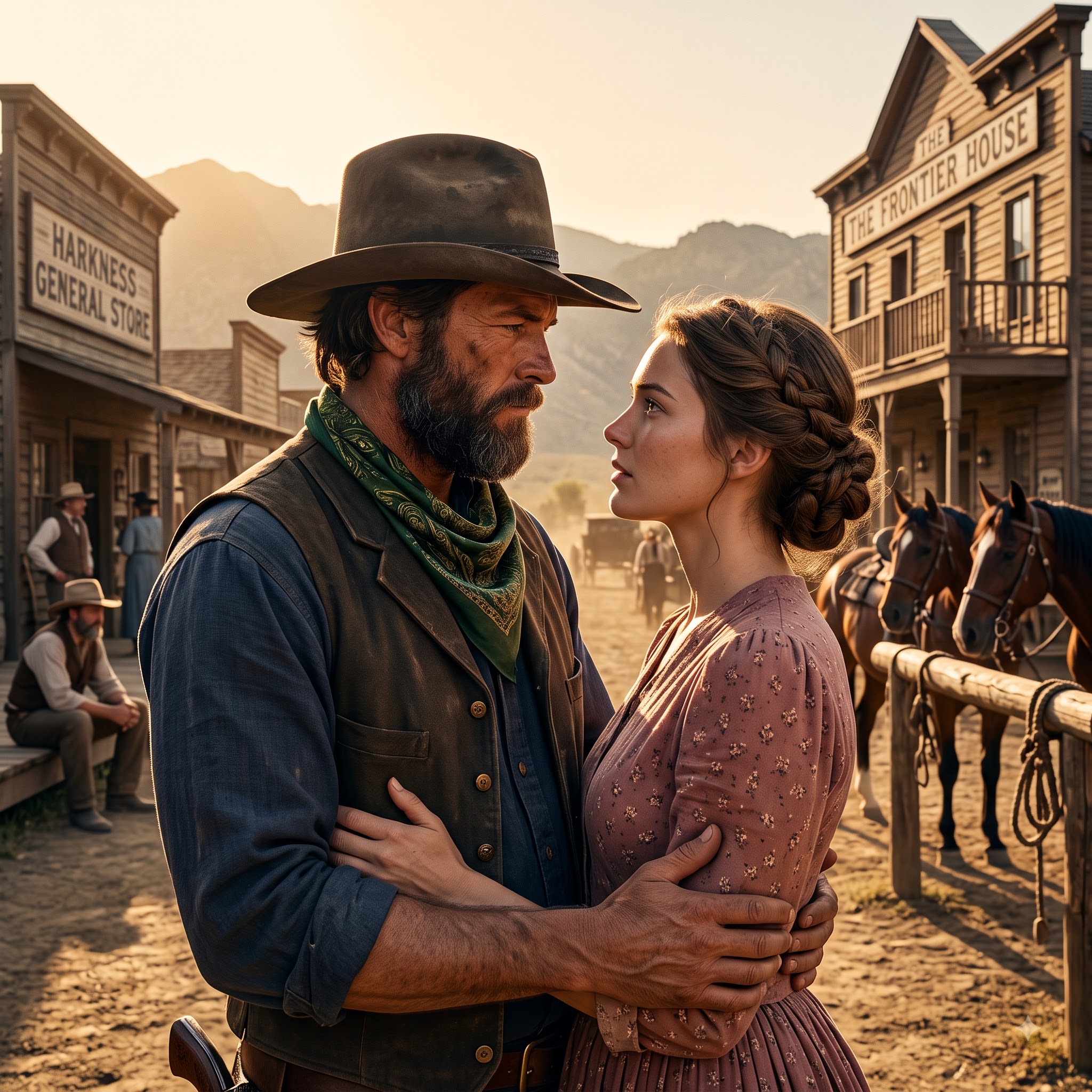
Wade Callahan filled the frame. He was a man built on the scale of the land itself—tall and broad-shouldered, with a sun-leathered face that looked as though it had been carved from prairie sandstone. But it was his eyes that gave people pause. They were gray, flinty, and infinitely older than the rest of him. Folks in Willow Bend whispered that Wade Callahan hadn’t smiled in three years, not since the fever took his wife and infant daughter in a single, merciless night.
He stood there, a towering shadow against the lamplight of the house, and looked down at them.
“Mrs. Whitlock,” he said. It wasn’t a question. Everyone in the county knew the young widow holding out on the Cedar Draw claim.
Clara lifted her chin. She had decided long ago that if the prairie was going to make her poor, she would not allow it to make her ashamed. She forced her spine straight and met those cold, gray eyes.
“Mr. Callahan, I haven’t come for charity,” she said, her voice ringing clear in the crisp morning air. “I’ve come to work. I can cook. I can wash. I can mend harness. And I can keep ledger books better than most men in this county.” She placed a hand on her son’s thin shoulder. “My son can muck stalls and carry water.”
She swallowed hard, the dryness in her throat a stark contrast to the mud at her feet. “I am not asking for money. I only need seed for the spring planting.”
For a long, agonizing moment, the rancher said nothing. The wind whistled through the eaves of the porch. He looked at her. Then, his gaze shifted downward to the boy—at the mud caked on Samuel’s knees, at the defiant way the child stood a half-step in front of his mother, his narrow shoulders squared as if he meant to protect her from the giant in the doorway.
Then, Wade Callahan said something that Clara Whitlock would remember for the rest of her life.
“Then stay until the harvest.”
Clara felt a flush of heat rise to her cheeks. She thought she understood what he meant—the dark, unspoken arrangement lone men on the frontier sometimes proposed to desperate widows. She was wrong. And before that year was over, those five words would save a family from ruin, expose a buried lie that threatened to steal her future, and bring a man who had sworn off God back to his knees.
But to understand why he said those words, and why Clara stayed, one must look back. Back to a dark sod house on the endless grass, and to a winter that nearly took everything Clara Whitlock had left.
CHAPTER ONE: The Promise of Cedar Draw
Four years earlier, the world had been defined by hope and the rhythmic creak of wagon wheels.
Clara and her husband, Daniel, had come west from Ohio in the spring of 1871. They were armed with the fierce optimism of the young, bringing a heavily loaded wagon, two plodding oxen, a steel breaking plow, a noisy crate of Plymouth Rock chickens, and a heavy, brass-clasped family Bible that had belonged to Daniel’s grandmother.
Under the Homestead Act, a man could claim one hundred and sixty acres of government land. The soil was free, but it was not a gift. It demanded a blood price. To truly own it, you had to live on it for five continuous years, build a dwelling, and farm the wild earth. Only then could you “prove up” and receive the deed sealed by the government in Washington.
“Five years,” Daniel used to say, standing on the wagon seat with the wind whipping his dark hair, looking out over the sea of grass. He said it like a sacred vow. “Five years, Clara, and nobody can ever take it from us. It’s a kingdom for our boy.”
They chose a quarter-section along a shallow, winding waterway called Cedar Draw, eight miles north of the little town of Willow Bend. It was a beautiful, desolate place. With no timber to speak of, Daniel did what all homesteaders did: he cut the earth itself. He used a specialized plow to slice the thick, deep-rooted prairie sod into ribbons, chopping them into blocks and stacking them like bricks to build their home.
The “soddy” was dark, smelling perpetually of damp roots and crushed grass. Dirt sifted down from the ceiling into their soup when the wind blew hard across the roof, and snakes sometimes nested in the walls. But it was theirs.
Daniel broke thirty acres that first brutal summer. The ancient, matted prairie roots snapped under the steel plowshare with a sound like tearing rope. Behind him, four-year-old Samuel followed down every freshly turned brown furrow, his small hands dropping kernels of corn into the earth, counting them out loud in a bright, piping voice.
For two years in that little sod house, the Whitlocks were profoundly happy. The work was backbreaking, but the soil was rich, yielding enough to survive. Every Sunday morning, Daniel would wash his face, Clara would brush the dust from her best blue dress, and they would hitch the wagon to drive the eight miles into Willow Bend for church services.
Willow Bend was barely a town—a cluster of false-front buildings clinging to the edge of the frontier. But it had a heartbeat. There was the small white frame church that Pastor Elias Mercer had built mostly with his own blistered hands. Pastor Mercer was a slight, gray-bearded former schoolteacher who never pounded the pulpit or shouted of hellfire. He spoke quietly, reasonably, and people leaned forward in their hard wooden pews to listen.
After the service, Clara would always stop at the general store owned by Martha Doyle. Martha was a stout, sharp-tongued widow who knew everybody’s business and wasn’t afraid to share it, but who secretly slipped peppermint sticks into the pockets of every child who came through her heavy oak door. There was also Doc Abernathy, a man who smelled of carbolic acid and whiskey, who carried a little black leather book where he recorded every birth and death in the county. A land office, a small brick bank, and a few dozen families all betting their very lives on the arrival of the rain.
Then came April of 1873.
It had been unseasonably warm that Easter week. The prairie had tricked them with soft breezes and blooming crocuses. It was warm enough that Daniel had gone out in just his shirtsleeves to mend a broken section of fencing at the far northern edge of their claim.
Around noon, Clara stepped out of the soddy to throw wash water into the yard and paused. The northwest sky had turned a heavy, bruised, yellowish-gray. The air tasted suddenly of copper and ice.
By mid-afternoon, the temperature plummeted fifty degrees in an hour. The first snow did not fall; it drove horizontally across the prairie, riding a screaming wind that tore the very breath from the lungs. It would be remembered across Nebraska and Kansas for a generation as the Great Easter Blizzard.
It raged without ceasing for three days and three nights.
Daniel never made it back to the house.
Clara had kept a kerosene lamp burning in the small glass window for three agonizing nights. She piled every piece of furniture she could spare into the stove to keep Samuel from freezing, and she stood by the door, singing hymns into the howling, pitch-black dark at the top of her lungs, praying her voice would act as a beacon. Abide with me, fast falls the eventide…
But the wind swallowed her songs.
When the storm finally broke and the sun rose on a blinding, silent white world, the men from Willow Bend rode out to help her search. They found Daniel. He was curled at the base of a snowdrift, frozen solid, less than two hundred yards from his own front door. The blinding whiteout had spun him around in his own yard until he had simply collapsed from exhaustion and the killing cold.
Doc Abernathy knelt in the snow, his hands trembling, and wrote the date in his little leather book, the way he always did. Pastor Mercer read the burial service over ground so hard they had to use pickaxes to break it open.
And just like that, Clara Whitlock, twenty-seven years old, became a widow with a six-year-old son, a dark house made of dirt, and a claim that still demanded three more years of blood and sweat before it would ever truly be hers.
People in town, meaning well, told her to sell. A woman alone could not farm a hundred and sixty acres, they whispered. It was madness. It was suicide.
But Clara had sat by the hearth for three days after the funeral, reading the Homestead Act pamphlet from the land office until she had memorized it. Under the law, a widow could keep her husband’s claim and prove it up herself. She had made Daniel a promise, kneeling beside his frozen body in the snow before they carried him away. She had pressed her cheek against his icy forehead and sworn she would finish what they started.
So, she stayed.
CHAPTER TWO: The Silver Cloud
That first year alone was a masterclass in suffering. Clara learned the brutal mechanics of survival. She learned to harness the oxen, her hands blistering and bleeding until they calloused over like hard leather. But by some divine mercy, the summer of 1873 was a fair one. With the help of a neighbor boy she paid in freshly baked bread and mended shirts, she managed the plow. She brought in enough wheat to eat, and crucially, enough to save seed for the following year.
She stored the precious seed wheat in heavy canvas sacks, hanging them high from the thick rafters of the sod house, safe from the mice that scurried across the floor at night.
“That’s our future,” she told Samuel, lifting him up so he could touch the rough canvas. “As long as we have seed, Sammy, we have next year.”
She did not know yet that next year was coming for all of them, carrying a plague out of the pages of the Old Testament.
The summer of 1874 started beautifully. It was a deceptive, golden paradise. The rains came perfectly timed, gentle and soaking. The wheat stood tall, waving like a green ocean, and the corn was already higher than Samuel’s head by early July. Clara let herself, for the first time since Daniel’s death, feel the dangerous warmth of hope. One more good harvest, she thought, standing on the porch, wiping sweat from her brow. Just one more, and I might even have a little money put by in the bank when I finally prove up.
Then, on a suffocatingly hot afternoon late in July, the wind died completely. The air grew eerily still and heavy.
Samuel came running in from the cornfield, his eyes wide with panic. “Mama!” he shouted, stumbling over the threshold. “Mama, come look at the sky!”
Clara stepped outside, wiping flour from her hands onto her apron. She looked to the west. There was a cloud building on the horizon. But it wasn’t a thunderhead. It wasn’t gray or purple with rain. It glittered. It shimmered at the edges, catching the fierce afternoon sun in flashes of silver and white. And it was moving against the prevailing wind.
Then she heard it.
It was a sound like hail hitting a tin roof, soft at first—a distant, rustling static—then growing louder and louder until it became a deafening, mechanical roar.
Grasshoppers. Rocky Mountain locusts.
Millions upon millions of them, a swarm so impossibly vast that they physically eclipsed the sun, plunging the bright afternoon into an eerie, twilight gloom. They fell from the sky like a living, biblical rain. They hit the roof of the soddy with a continuous splatter. They bounced off the fence posts. They tangled in Clara’s hair, crawling down the collar of her dress, their spiky legs scratching at her skin. The ground itself seemed to writhe and boil.
And they ate.
They ate with a horrifying, singular purpose. Clara watched in paralyzed horror as the green wheat was stripped to barren stubble in hours. The towering cornstalks were devoured down to the roots. They ate the vegetable garden—the carrots, the beans, the pumpkins. They ate the wool blankets Clara had left hanging on the clothesline, leaving only the ropes. They ate the sweat-soaked wooden handles of Daniel’s pitchforks, craving the salt.
Desperate, weeping with frustration, Clara dragged her heavy winter quilt out of the house and threw it over her last row of cabbages. The locusts swarmed it, and before her eyes, they ate holes straight through the thick fabric, devouring the cabbages beneath.
Samuel was running through the yard, sobbing hysterically, beating at the air and the ground with a broom until the broom straw itself was chewed away. Clara grabbed him, pulling him into her arms, shielding his face, and dragged him inside the dark house, sealing the door against the onslaught.
It lasted two full days. Two days of the sound of a million jaws chewing, the scraping of armor-plated bodies against the windows.
When the wind shifted and they finally moved on, flying eastward, the silence they left behind was apocalyptic. Clara stepped out of the house. The vibrant, green world she had built with her sweat was gone. The landscape was utterly denuded, stripped brown and barren. Even the leaves on the few scrub trees by the creek had vanished.
Clara walked out into the middle of her ruined wheat field. She did not cry. She was too tired, too hollowed out to cry. She simply sank to her knees in the dust, bowed her head, and the only prayer she could find in the vast emptiness of her soul was one word.
“Please.”
CHAPTER THREE: The Vulture and the Seed
That winter was the hardest of her life.
The plague of locusts had spared no one. Some families, their spirits finally broken by the prairie, packed their wagons, abandoned their claims, and left for the East, never to return. The ones who stayed, the stubborn and the destitute, lived on relief barrels. Churches back in Ohio and Pennsylvania sent barrels of cast-off clothing, dried beans, and flour by rail. Pastor Mercer would load them into his wagon and drive from farm to farm through the snow, his face drawn with sorrow as he handed out the meager rations.
It wasn’t enough.
By January of 1875, Clara had nothing left to trade. By February, the flour barrel was scraped so clean she could see the wood grain at the bottom. She was boiling water with a single, wizened turnip just for the illusion of soup.
One night, the cold particularly bitter, Samuel woke her up. He crept into her bed, his small body shivering uncontrollably against her side.
“Mama,” he whispered, his voice thin and reedy. “I’m so hungry it hurts. My stomach is biting me.”
Clara pulled him tight against her, wrapping them both in a frayed blanket, humming a lullaby until his exhausted body finally surrendered to sleep. But Clara lay awake for a long time, staring into the oppressive dark.
Eventually, she got up. The floor was freezing beneath her bare feet. She lit the small kerosene lamp, turning the wick low to save fuel, and looked up at the thick rafters.
There hung the heavy canvas sacks. The seed wheat.
That’s our future.
She knew exactly what it meant if she took them down. To a farmer, eating seed grain is the ultimate surrender. It is a slow suicide. It meant there would be no crop to plant in the spring. It meant no harvest in the fall. It meant that the land she and Daniel had broken, the land that had killed him, would sit empty and weed-choked, and the five-year promise to the government—and to her husband’s ghost—would slip away from her forever.
But a promise to a dead man could not be allowed to cost the life of a living child.
With trembling hands, Clara dragged a stool beneath the rafters, reached up, and untied the first sack. She hauled it down, the weight of it feeling like a tombstone in her arms. She ground a portion of the hard kernels in the hand-cranked coffee mill, mixed it with melted snow water, and cooked a thick, rough porridge over the dying embers of the fire.
When she woke Samuel, the smell of warm grain made his eyes widen. He ate two bowls in rapid succession, practically inhaling the food. It was the first time in a week Clara had seen color return to his pale cheeks. She watched him eat, a tear finally slipping down her face, salting the porridge she ate herself.
Over the next six weeks, as the winter dragged its heels, they systematically ate every grain of seed she had saved.
It was in the middle of that bleak, starving winter that Horace Pruitt first came to call.
Pruitt was the local agent for a land and loan company headquartered in Omaha. He was a smooth, round-faced man who smelled faintly of bay rum and cigar smoke. He wore a heavy wool suit that had never seen a day of hard labor, a thick gold watch chain draped aggressively across his waistcoat, and a smile that never, ever reached his flat, calculating eyes.
He sat at Clara’s rough plank table, looking entirely out of place in the dirt-floored soddy, his face arranged in an expression of deeply rehearsed sympathy.
“Mrs. Whitlock, I am a man of business, so I will be plain,” Pruitt said, steepling his soft, clean fingers. “You have had a terrible time of it. Tragic, really. Nobody in this county could possibly blame a young, delicate woman for wanting a fresh start back East where it is civilized. My company is prepared to offer you a fair sum for your relinquishment of this claim today. Enough for train fare back to Ohio for you and the boy, and a little left over besides.”
He named a sum. It was a gross insult—barely a fraction of what the improved land was worth. But to a woman who had just eaten her last handful of seed grain, it was more cash money than Clara had seen in a year.
Clara sat across from him, her hands folded tightly in her lap. “And if I don’t want to relinquish it, Mr. Pruitt?”
Pruitt’s smile didn’t move an inch, but something cold and sharp shifted behind his eyes.
“Then I’m afraid you’ll need to put in a massive crop this spring, and keep living in this… dwelling… through next year to finally prove up. And forgive me, Mrs. Whitlock, but it is common knowledge in town that you have no seed saved, and absolutely no credit left at the mercantile.”
He stood, brushing an invisible speck of dust from his sleeve, and placed his bowler hat carefully on his head. “Think about it, ma’am. The prairie is an unforgiving place for the stubborn. And my offer won’t last forever.”
Clara watched his buggy roll away through the snow. She didn’t understand, not yet, why a wealthy company in Omaha cared so much about a chewed-up, locust-ravaged quarter-section of prairie on Cedar Draw. But she understood a vulture when she saw one.
CHAPTER FOUR: Closed Doors
The first week of March brought a slight thaw, turning the roads to a treacherous, sucking muck. Clara bundled Samuel up and walked the eight miles into Willow Bend. Her pride had held out as long as her stomach, but the flour was gone again. She went straight to Martha Doyle’s general store.
The bell above the door jingled cheerily. The store smelled of coffee beans, oiled leather, and spices—a smell of abundance that made Clara’s stomach cramp violently.
She had never asked for credit before. Daniel had abhorred debt. But desperate times required the bending of iron principles.
She stood at the wooden counter, her hands gripping the edge, and quietly laid out her situation to Martha. She asked for enough flour, salt pork, and beans to see them through the spring planting, promising to pay the moment the harvest came in.
Martha listened without a word, her usually bustling demeanor completely still. She polished a glass jar with a rag over and over again. When Clara finished, Martha looked down at the counter for a long, agonizing moment. When she finally spoke, her voice was strangely stiff, devoid of its usual booming warmth.
“I can’t do it, Clara. I’m sorry. I just can’t carry any more credit on the books this spring.”
Clara stared at her, stunned. It felt as though she had been slapped. Martha Doyle had given credit to half the county. Everyone knew Martha had once given a struggling family of Swedish immigrants a whole winter’s worth of groceries on nothing but a firm handshake and a promise.
“Martha, please,” Clara whispered, looking around to ensure the store was empty. “Just a sack of flour. I’ll work it off. I can sew for you—”
“I said I can’t.” The older woman turned her back sharply and began rearranging tins of peaches on a shelf that did not need rearranging. Her shoulders were rigid.
Then, blindly, she reached backward and pushed a small, brown paper sack across the counter without turning around. “Here. For the boy.”
Clara picked up the sack. It was heavy with peppermint sticks. She walked out into the gray, freezing afternoon, her face burning with a mixture of profound humiliation and deep, confusing betrayal. Why would Martha cut her off?
She could not bear the thought of walking the eight miles back to the dark sod house empty-handed. Instead, she walked up the muddy hill to the little white church.
She found Pastor Mercer in the small back room that served as his office, sitting by a potbelly stove, repairing a battered hymnal with a pot of glue and heavy thread. He looked up, took one look at her pale, stricken face, and pulled up a chair for her.
He listened to everything. The starvation, the eating of the seed, Pruitt’s visit, and finally, Martha’s inexplicable refusal.
When she finished, pouring out the last of her despair, the old pastor sat for a long moment, looking out the frosted window at the rolling, gray prairie.
“There’s one man in this county who came through the grasshoppers with grain to spare,” Pastor Mercer said at last, his voice thoughtful. “He built a deep stone cellar dug directly into the hillside behind his ranch house. Keeps his feed corn and seed wheat down there in the dark. The hoppers couldn’t get at it.”
Clara already knew who he meant. Everyone in the county knew.
“Wade Callahan,” she said, her voice dropping. “Pastor, you can’t be serious. He doesn’t even come to church anymore. They say he barely speaks to anyone. He runs off drummers and salesmen with a shotgun.”
“That’s true,” said the pastor, meticulously gluing a page edge. “It’s been almost three years since he spoke more than ten words to anyone in town.” He paused, looking over his spectacles at her. “Do you know why, Clara?”
Clara shook her head. She had heard rumors, but Daniel had never been one for gossip.
“In the spring of 1872, before you and Daniel came to our services, there was a vicious fever that went through the county. Diphtheria,” Mercer said, the word heavy with old sorrow. “Wade’s wife, Anna, took sick. She was a lovely woman. Bright as a new penny. Their baby daughter took sick with her.”
Mercer set the book down, his eyes distant. “Wade rode to town in the middle of a torrential thunderstorm in the dead of night to fetch Doc Abernathy. And then… while the Doc was out at the ranch doing what little he could, Wade came here. He sat in the very front pew of this church all night long, his clothes soaked through, praying. Begging God. I sat with him until dawn.”
The old man’s voice grew thick. “They died the next morning. Both of them. Within an hour of each other. Wade came back to the church, walked straight down the aisle, looked at the cross on the altar, and walked out. He has not walked back in since.”
Clara sat in stunned silence. The image of the giant, terrifying rancher weeping in a pew shattered the myth of the monster she had imagined.
“He’s not a cruel man, Clara,” Pastor Mercer said softly. “He’s a deeply wounded one. Wounded men sometimes build massive stone walls around themselves to survive, and then, eventually, they forget they’re the ones holding the bricks. They trap themselves inside.”
Mercer rose, walked over, and placed a gentle, ink-stained hand on her shoulder. “Go and ask him. The worst he can do is say no, and you are no worse off than you are right now. But I have a feeling the Lord isn’t finished with Wade Callahan yet.” He smiled faintly. “Maybe He isn’t finished with you, either.”
And so, the next morning, Clara had taken Samuel’s hand and walked the six grueling miles through the mud to the Callahan ranch.
CHAPTER FIVE: A Bargain Struck
“Then stay until the harvest.”
Clara stood on the porch, the words hanging in the cold air between them. The blood rushed to her ears. She knew what men on the frontier sometimes meant when they offered a destitute widow a place to “stay.”
She straightened her back, her pride flaring hot and fierce, banishing her fear.
“Mr. Callahan, I will work for you from sunup to sundown,” she said, her voice shaking with quiet fury, “but I will not live under your roof. I have a son, and I have my good name, and I will starve before I surrender either one.”
For the first time, something moved in the rancher’s hard, weathered face. The rigid muscles around his eyes twitched. It wasn’t quite a smile—it was more like a tectonic shift of stone—but it was close.
“You misunderstand me, ma’am,” Wade said, his deep voice softening just a fraction. “I’m not asking you to stay here. I’m asking you to stay there. On your claim.”
He stepped out onto the porch, oblivious to the cold, and looked down at her. “Don’t sell out to Horace Pruitt. I know he’s been circling. Don’t give up on it.” He came down one step, closing the distance, towering over her. “You’ve got one more season to prove up the homestead. Isn’t that right?”
Clara, completely derailed by the shift in the conversation, nodded slowly.
“Then here’s my offer,” Wade said, all business now. “I’ll give you seed wheat and seed corn. Good grain. Enough for your entire forty acres. I’ll send my plow team over with my hired man, Eli, to break the ground and help you put it in right.”
He paused, crossing his arms over his broad chest. “In return, you’ll keep my ranch books. I’m a rancher, not an accountant, and I can’t make heads or tails of the mess they’re in. You’ll also cook supper for my ranch hands three days a week so Eli can focus on the herds. Your boy can help with the calves this spring, earn his keep.”
Wade looked her dead in the eye. “And when the harvest comes in this autumn, you pay me back for the seed out of your crop cash. No interest.” He paused again, the silence stretching. “Stay until the harvest, Mrs. Whitlock. Stay and finish what you and your husband started.”
Clara could not speak. Her throat tight, tears threatening to spill over her lower lashes. She had walked six miles expecting to be turned away, or at best, offered a few cups of grain out of pity. She had not expected someone to fight for her land as if her dream actually mattered.
“Why?” she finally managed to choke out. “Why would you do this for us? You don’t even know me.”
Wade looked away, out across the brown, empty fields of his sprawling ranch, toward the small family plot surrounded by an iron fence on the distant hill.
“Because my wife would have,” he said quietly, the words carrying the weight of an anvil. “And because somebody in this godforsaken territory ought to beat the grasshoppers.”
Behind Clara, Samuel tugged frantically on her wool sleeve.
“Mama,” he whispered, entirely too loudly for the quiet porch. “Does this mean we get to eat bread again?”
Wade Callahan, the man who folks swore hadn’t smiled in three years, looked down at the mud-covered boy. And he laughed. It was a short, rusty, grating sound—like a heavy iron gate that hadn’t been opened in a very long time swinging on dry hinges. But it was undeniably a laugh.
“Son,” Wade said, reaching out to ruffle Samuel’s dirty hair. “I believe it does.”
CHAPTER SIX: The Ledger of the Heart
Spring came slowly to Nebraska that year, a hesitant thawing of the frozen earth, and then it arrived all at once in an explosion of green.
True to his word, Wade sent his plow team. Eli, Wade’s freckled, lanky hired man from Missouri, talked to the massive draft mules like they were old friends he met at a tavern, and he sang badly—loud, off-key hymns—the whole time he drove the plow. Clara walked tirelessly behind him, a canvas bag slung over her shoulder, sowing the precious Callahan wheat by hand. Samuel followed with a hoe, covering the seed, his small face set with solemn purpose.
Wade came himself to help with the corn planting. He rode over on a massive bay horse, bringing extra tools. He said very little, working alongside them with a relentless, mechanical rhythm. But Clara noticed the small things. She noticed how he always made sure the water jug was placed near Samuel’s row. She watched from the corner of her eye as he knelt in the dirt, took Samuel’s small hands in his massive, calloused ones, and showed the boy how to judge the depth of a furrow by the feel of the soil under his boot.
Three days a week, Clara and Samuel made the trek to the Callahan ranch. Clara would cook massive pots of stew, bake dozens of biscuits, and scrub the kitchen clean. Then, while Samuel was out in the corrals helping Eli feed the calves, Clara would sit at the large oak desk in Wade’s study and attack the books.
Wade had not been exaggerating; the books were a catastrophic disaster. He kept receipts stuffed in old Arbuckle coffee cans. Promissory notes were scribbled in pencil on torn feed sacks. Bills of lading from the railroad were shoved haphazardly into desk drawers.
Clara brought order to the chaos. Armed with a sharp pencil and a ruler, she built neat, precise columns of numbers.
“You’ve been losing money on your hay contract with the stage line,” she told Wade one evening late in May, tapping a column of figures as he walked into the study, smelling of horse sweat and leather. “They’ve been shorting you on the weight when they pick it up. Nearly forty dollars since last fall.”
Wade walked over, peering over her shoulder at the immaculate ledger. He smelled faintly of pine soap. “Where did you learn to do that?”
“My father kept a dry goods store back in Ohio,” Clara said, not looking up, though she was acutely aware of his proximity. “I was doing his accounts and inventory by the time I was twelve.”
“Then my ranch is in better hands than it’s been in years,” Wade said softly.
It was a simple sentence, a statement of fact. But Clara found herself replaying it in her mind, thinking about the low timbre of his voice, all the way home in the wagon.
Of course, Willow Bend noticed the arrangement. A small town is an organism designed to notice things. It noticed, most of all, that Wade Callahan had been seen actually conversing with Martha Doyle at the mercantile, and had been heard laughing out loud while buying a large bag of peppermints for a certain eight-year-old boy.
Tongues began to wag with predictable malice.
One Sunday after services, Clara was shaking out her shawl when she overheard two women standing by the church door.
“Working his books,” one woman said with a harsh, knowing sniff, adjusting her bonnet. “Is that what they’re calling it now? A widow practically living at a single man’s ranch.”
Clara felt her face burn, hot tears springing to her eyes. She turned quickly to hurry to her wagon, but Pastor Mercer caught up with her, stepping neatly into her path.
“Pay them no mind, Clara,” the old pastor said, his eyes crinkling in a warm smile. “Gossip is just the devil’s wind. It blows over. Besides, I’ve noticed something else they haven’t.”
“What’s that, Pastor?”
“Wade Callahan has driven past this church in his wagon three Sundays in a row during services. He slows the horses down every time. Last week, he stopped the wagon completely for almost a full minute, just sitting there listening to the singing, before he drove on.”
Clara looked at him in surprise. “He did?”
“The Lord works in very small steps, Clara,” the old pastor said gently, looking out at the road. “Sometimes, the first step back toward Him is just slowing down.”
CHAPTER SEVEN: Through the Rivers
It was in early June, with the wheat beginning to form heavy green heads, that Clara found the Bible.
She was in Wade’s study, searching the bottom of a heavy wooden trunk for an old water rights deed she needed to reconcile a boundary dispute on the ledger. Beneath a stack of yellowed maps, she found a bundle wrapped carefully in a woman’s faded woolen shawl.
Curious, she folded back the wool. Inside lay a small, black leather Bible, the edges worn soft and rounded from years of handling. She opened the cover. On the inside flyleaf, written in beautiful, looping handwriting, was a name: Anna Marie Callahan.
Tucked delicately between the pages of the Old Testament were a few faded, pressed wildflowers, brittle as glass, and a small slip of paper with a verse written on it. Clara recognized it at once. It was from the book of Isaiah, chapter 43.
“When thou passest through the waters, I will be with thee; and through the rivers, they shall not overflow thee: when thou walkest through the fire, thou shalt not be burned.”
She was still holding the book, her thumb tracing the faded ink of the verse, when she heard the heavy thud of boots on the pine floor behind her.
Wade stood in the doorway. He had just come in from the branding pens. When he saw what was in her hands, he stopped dead. For a terrifying moment, his face was so full of raw, unguarded pain that Clara wanted to look away, feeling like an intruder in a holy place.
“I’m so sorry,” she said quickly, her heart in her throat, holding the book out. “I wasn’t prying, Wade. I swear it. I was looking for the creek deed for the ledger.”
He didn’t yell. He didn’t snatch it from her. He crossed the room slowly, the floorboards creaking beneath his weight, and took the Bible gently from her hands. He looked down at the name on the cover for a long time, tracing the embossed cross with a calloused finger.
“She read to me from this every single night,” Wade said, his voice dropping to a rough, gravelly whisper. “Even after a sixteen-hour day in the saddle, when my eyes couldn’t stay open. Even when I fell asleep in the chair in the middle of a chapter, she’d just keep reading aloud. And when I woke up the next morning, she’d smile and tell me the parts I’d missed.”
He opened the book, staring at the slip of paper.
“That verse was her favorite,” he said. “Through the rivers, they shall not overflow thee. I sat in the front of that church the night she and the baby were burning up with fever, and I said that verse over and over and over until my throat bled. I claimed that promise. And then… the river overflowed anyway. It took them both.” He looked up at Clara, his eyes glassy. “Why would God promise a man he wouldn’t drown, and then hold his head under the water?”
Clara did not answer right away. She thought of the desperate kerosene lamp she had kept burning in the frosted window during the blizzard. She thought of Daniel, her strong, smiling Daniel, lying frozen in the snow just two hundred yards from the warmth of his home.
“I sang hymns the night my husband died,” she said softly, stepping closer to him. “Three nights. Standing by the door, singing as loud as I could into the wind until I lost my voice. Hoping he would follow the sound home. He never heard me.”
She met Wade’s agonized eyes. “I was angry with God for a long time, Wade. I hated Him for that storm. Maybe I still am angry, some days. But I’ve had a lot of time to think in the dark.” She reached out, her fingers lightly touching the leather cover of the Bible he held. “I don’t think that verse ever promised that the terrible water wouldn’t come. I think it promised we wouldn’t have to be alone in it.”
Wade stared at her. The silence in the study was profound, broken only by the ticking of the grandfather clock in the hall. He looked down at the book, then back at her. He didn’t say anything, but he didn’t put the Bible back in the dark trunk.
That evening, when Clara packed up her ledgers and rode the wagon home, she looked back through the window. The small black Bible was sitting squarely on the table beside Wade’s favorite chair, right next to the reading lamp.
CHAPTER EIGHT: The Debt
By July, the wheat on Cedar Draw stood waist-high, a vast, rippling ocean of emerald green. The terrifying, glittering silver cloud of locusts never came. Clara watched the skies daily with a knot in her stomach, but the heavens remained clear.
What came instead was Horace Pruitt.
Pruitt drove his polished black buggy right up to the edge of Clara’s wheat field. This time, he did not bother to take off his bowler hat when she approached.
“Mrs. Whitlock,” Pruitt said smoothly, climbing down and surveying the magnificent crop with greedy eyes. “I see you found yourself a benefactor. The whole town is talking about Mr. Callahan’s… generosity.”
“I’ve found myself honest work, Mr. Pruitt,” Clara snapped, wiping dirt from her hands. “There’s a difference.”
“Of course, of course.” Pruitt reached into the breast pocket of his expensive coat and drew out a folded piece of heavy paper. “However, I’m afraid I’ve come on less pleasant business today. In going through our Omaha office’s older records, we discovered this.”
He unfolded it and held it up, keeping it just out of her reach. “A promissory note. Signed by your late husband, Daniel Whitlock, for three hundred and fifty dollars, borrowed against the future improvements on this very claim. It is due in full at harvest time this year.”
Clara felt the solid earth violently tilt beneath her boots. The blood rushed from her head.
“That’s impossible,” she gasped. “Daniel never borrowed a cent from anyone. He hated debt more than anything in the world. We paid cash for our plow!”
“Men keep secrets from their wives, ma’am,” Pruitt said, offering a condescending smirk. “It happens more often than you’d think in this wild country. Men get desperate. They make poor choices to keep their families fed.”
Pruitt carefully folded the paper and tapped it against his palm. “If the debt is not paid with interest by the end of the harvest, my company will be forced to take the matter to circuit court. And I think you’ll find that a judge will look very unkindly on a widow who refuses to pay her husband’s lawful debts. The court will seize the crop. At the very least, it will cloud your title so badly you will never, ever be able to prove up and claim the deed.”
He smiled, a reptilian curving of the lips. “Of course, my original offer still stands. Relinquish the claim to me today, and we’ll consider the entire debt forgiven. You can walk away clean. Good afternoon, Mrs. Whitlock.”
He climbed into his buggy and snapped the reins, leaving Clara standing in the dust.
Three hundred and fifty dollars. It was an astronomical sum. Even if the wheat came in beautifully, even if the price per bushel was high, she would never see a third of that amount. The farm was lost. Daniel’s dream was dead.
That night, for the first time since the grasshoppers had blotted out the sun, Clara knelt by her bed and prayed with more than one word. She didn’t pray for money. She prayed for the truth. And she prayed, though she wasn’t entirely sure why, for Wade Callahan.
She rode to the ranch the next day and told Wade everything. He was sitting at the oak desk. He took one look at her ashen face, set down his coffee cup, and listened.
When she finished, her voice shaking with unshed tears, he was quiet for a long time. His jaw muscles worked. Then, he asked a question she hadn’t expected.
“Did Pruitt let you see the date on that note?”
Clara blinked, trying to recall the image of the paper fluttering in the wind. “Only for a moment. He held it away from me. But… yes. It was in the spring. April, I think. April of 1873.”
Something sharp and dangerous shifted in Wade’s gray eyes. He sat forward, his massive hands resting flat on the desk.
“April of 1873,” he repeated slowly, tasting the words. “Yes,” Clara said. “The month of the Easter blizzard.” “Yes.”
“Clara,” Wade said, standing up. And it was the first time he had ever used her Christian name. The sound of it in his deep voice sent a sudden, inexplicable shiver down her spine. “I’m going to ask you to trust me. Completely. Do not sign anything Pruitt brings you. Do not say a single word to him or anyone in town. Just go home, keep your head down, and keep that wheat growing.”
CHAPTER NINE: The Wall of Fire
The wheat kept growing. It turned from green to a rich, heavy gold. But in the middle of August, the rain stopped abruptly.
For three brutal weeks, not a single drop fell. The prairie sun baked the earth to ceramic. The tall prairie grass outside the cultivated fields turned brown and brittle as ancient paper. Every farmer in the county went to sleep fearing the same thing—the one monster they feared even more than the locusts.
Fire.
It came on a dry, fiercely windy night near the end of the month. A freak, dry thunderstorm rolled across the plains, lightning flashing without a drop of rain. A bolt struck the open, untamed range about five miles west of Clara’s claim.
Clara woke to the smell of burning sage. By the time she ran out to the porch, the whole western sky was glowing an apocalyptic, terrifying red. The wind was howling, and a solid wall of flame, taller than a man on horseback, was racing across the prairie. Driven by the gale, it was moving at the terrifying speed of a galloping horse, heading directly toward Cedar Draw. Toward her golden wheat.
“Samuel! Get up!” Clara screamed, dragging the terrified boy from his bed.
She ran to the rain barrel, soaked a heavy burlap gunny sack in the remaining water, and ran desperately toward the edge of her field. She knew, even as she ran, that it was utterly hopeless. One woman, a boy, and a wet sack could not stop a prairie fire that spanned miles. They were going to lose it all.
Then, she heard the thunder of hoofbeats over the roar of the wind.
Out of the smoke and the dark rode Wade Callahan. He was on his massive bay horse, riding like a demon. Right behind him came Eli, driving a wagon loaded with water barrels and pulling the heavy breaking plow. And behind Eli came a miracle.
Wagons and riders were pouring in from all over the county. Men and women with buckets, shovels, and wet feed sacks. Doc Abernathy was there in his nightshirt and boots, wielding a pitchfork. Even Martha Doyle arrived in a buckboard, tossing down a massive stack of soaked wool blankets.
And from the direction of Willow Bend, faint but steady over the terrifying roar of the approaching inferno, came the frantic, continuous clanging of a church bell. Pastor Mercer was ringing it again and again, pulling the rope until his hands bled—the old frontier signal that called the whole county out when the fire demon was loosed.
“Firebreak!” Wade shouted, his voice cutting through the chaos like a whip crack. “Eli! Cut me a deep furrow right along her west line! Two of them, twenty feet apart! The rest of you, set a backfire between the furrows! We burn it black before the main line gets here! Beat out anything that jumps the line!”
They worked like people possessed. They were a frantic, soot-stained army fighting for Clara’s survival. They set small, controlled fires between the plowed lines, burning a careful strip of land bare so the massive fire would find nothing left to eat when it arrived. Samuel ran water buckets from the creek to the men on the line until his arms gave out, and then he kept running anyway, crying from the smoke.
Clara fought on the line, beating at the flames with her wet sack. She lost sight of Wade in the thick, choking black smoke.
When she saw him again, the main fire was hitting the break. The heat was a physical wall, so intense Clara felt her eyebrows singeing. For a terrible moment, the flames rose up so high, caught by a gust of wind, that Clara was certain they would leap straight over the plowed dirt and land in her wheat.
A tongue of flame jumped the gap. It landed in the dry grass just feet from the edge of Clara’s crop, instantly sparking a new blaze.
Wade was there. He leaped from his horse and threw himself at the flames. He beat at the fire with his wet sack until the sack caught fire. He threw it aside and smothered the flames with his own heavy canvas coat. When the coat began to smolder, he tore off his shirt and used that, beating the ground with his bare hands and the fabric until the sparks died.
The main fire hit the burned-out backfire zone just after midnight. Starved of fuel, it roared in frustration, splitting around the Whitlock claim like a fiery river parting around a stubborn stone, racing north and south to burn itself out in the empty badlands.
When the sun finally rose, red and angry through the haze, the prairie was a blackened, smoking wasteland for miles in every direction. But in the center of the devastation, Clara’s wheat still stood, a square of golden triumph in the dawn.
Wade Callahan sat heavily on the charred ground at the edge of the field. His face was black with soot, his chest bare and streaked with ash. His large hands were wrapped thickly in strips of clean white cloth where Doc Abernathy had carefully bandaged the severe burns.
Clara walked over and knelt in the black ash in front of him. She didn’t care who was watching. She didn’t care about the gossip.
“Your hands,” she said, her voice breaking as she looked at the bandages.
“They’ll heal,” Wade said, his voice raspy from smoke. He looked past her, staring at the golden wheat, and then up at the pale morning sky.
“You know what I kept thinking about all night long out there in the smoke?” he asked quietly. “That verse in Anna’s Bible. When thou walkest through the fire, thou shalt not be burned. It’s the very next line after the one about the rivers.”
He swallowed hard, his Adam’s apple bobbing. “I haven’t thought about that next line in three years, Clara. I was so angry, I stopped reading right at the part about the drowning water. I never let myself read the rest of the promise.”
Clara reached out, gently laying her soot-stained hands over his bandaged ones.
“Maybe it’s time to keep reading, Wade,” she said.
The following Sunday, the little white church in Willow Bend was fuller than it had been in a decade. The fire had brought the whole county together, a reminder of their shared fragility, and people had come to give thanks that the town had been spared.
Pastor Mercer was halfway through the opening hymn when the heavy oak doors at the back of the sanctuary creaked open.
Heads turned. The singing faltered, rippling into stunned silence.
Wade Callahan stood in the doorway. He held his hat awkwardly in his bandaged hands. He was wearing a clean white shirt and an old, tailored black suit coat that no one had seen him wear in three years. He hesitated there, shifting his weight, as if the ghosts of the past were pushing against his chest, urging him to turn around and walk back out to his solitude.
Then, Samuel Whitlock slipped out of his mother’s pew in the third row. The boy walked purposefully down the center aisle, reached up, took the giant rancher gently by his bandaged hand, and led him to the empty seat beside Clara.
Pastor Mercer’s voice trembled with sudden, fierce emotion when he started the hymn again. It was Come Thou Fount of Every Blessing.
Clara heard Wade’s voice beside her. It was low, rough from disuse, and a little off-key, singing words of praise he had cursed the night his world ended. By the time they reached the last verse, half the congregation, including Martha Doyle, was wiping their eyes.
CHAPTER TEN: The Reckoning
The harvest came in the second week of September, and it was bountiful. After the blizzard, the grasshoppers, the drought, and the fire, a heavy harvest felt like a literal miracle pulled from the dirt. The same neighbors who had fought the fire returned with scythes and wagons to help Clara bring it in.
There was enough grain to repay Wade’s seed loan in full. There was enough to sell for winter supplies, and enough to safely hang from the rafters for spring.
But there was still the shadow of Horace Pruitt’s note.
Pruitt arrived on the final day of the harvest, his buggy wheels crunching over the stubble, just as he had promised. This time, he did not come alone to intimidate a widow. He brought the county sheriff, a tired, gray-mustached man named Hollis Brand, who sat in the buggy looking as though he deeply regretted the errand.
“Mrs. Whitlock,” Pruitt said loudly, stepping down and holding up the folded promissory note so the lingering harvest hands could see. “The harvest is complete, and the debt is officially due. Three hundred and fifty dollars with interest. Can you pay it?”
Before Clara could answer, a deep voice rang out from behind a loaded grain wagon.
“Before she answers that, Horace, I’d like Sheriff Brand to take a very close look at the date on your note.”
Wade Callahan stepped forward from the shadow of the wagon. With him came Pastor Mercer, Doc Abernathy clutching his little black leather book, and, to Clara’s utter astonishment, Martha Doyle, looking pale but resolute.
Pruitt’s confident smile flickered, a crack appearing in his polished veneer. “The date is perfectly clear. April the 18th, 1873. A lawful contract.”
“Doc,” Wade said, his gray eyes locked onto Pruitt. “Would you be so kind as to read out exactly what you wrote in your medical ledger that spring?”
Doc Abernathy adjusted his spectacles, opened the worn leather notebook, and cleared his throat.
“Entry for April the 14th, 1873,” the doctor read, his voice carrying across the quiet field. “Called to the Whitlock claim, Cedar Draw, following the severe blizzard. Found Daniel Whitlock deceased in the snow, approximately two hundred yards northwest of his dwelling. Death from exposure, likely occurring on the evening of the 13th.”
He closed the book with a definitive snap. “I recorded it the very same day. The pastor was with me when we found the body.”
“I was,” Pastor Mercer said quietly, stepping up beside the doctor. “And I performed his burial service and laid him in the ground on the 16th.”
Sheriff Brand stepped down from the buggy. He walked over, took the note from Pruitt’s trembling hand, and looked at it for a long time.
“Mr. Pruitt,” the sheriff said, his voice dropping to a dangerous baritone. “This paper claims that Daniel Whitlock signed for a loan four days after he froze to death, and two days after he was buried under six feet of frozen earth.”
The color drained entirely from Pruitt’s round, sweaty face. He looked like a cornered rat. “A… a clerical error! That’s all it is. My clerk copied the date wrong when transferring the ledger. The loan was made earlier, in March, and—”
“There’s more, Sheriff,” a woman’s voice interrupted.
Everyone turned. Martha Doyle stepped forward, wringing her apron in her hands. The shopkeeper was terrified, but her chin was high.
“Last winter, Mr. Pruitt came privately to my store,” Martha said, her voice shaking but carrying clearly. “His company in Omaha holds the mortgage on my building. He told me, to my face, that if I extended Clara Whitlock even one cent of credit for food or seed this spring, he would instantly foreclose on my note and I would lose my store and my home.”
She turned to Clara, her eyes overflowing with tears. “I am so sorry, Clara. I was a coward. I was so afraid of being put out in the street. I should have told you then. I have been ashamed of myself every single day since I pushed those peppermints across the counter.”
“Why?” Clara demanded, stepping toward Pruitt, her anger boiling over. “Why do this to me? Why target my claim? It’s just a quarter-section of dirt!”
It was Wade who answered.
“Because of the railroad,” Wade said, pulling a folded map from his coat. “I thought Pruitt’s sudden interest in Cedar Draw smelled rotten, so I took a train to Omaha this summer and did some asking around the surveyor’s offices. There’s a major branch line planned to come up this valley in the next three years. The surveyors marked out the route last fall. And the only place flat enough, with enough reliable water for a steam depot and a town expansion, is right along Cedar Draw. Dead center on your land, Clara.”
Wade looked at Pruitt with open, blistering contempt. “Whoever holds the deed to this claim when the Union Pacific comes calling will be able to name their own price. Hundreds of thousands of dollars. He didn’t want your land for what it is, Clara. He wanted to steal it for what it’s going to be. He was trying to starve you out to get it cheap.”
Sheriff Brand slowly folded the forged promissory note and tucked it securely into his vest pocket. He unhooked the leather strap over his holster.
“Horace Pruitt,” the sheriff said heavily. “I think you and I had better take a ride into town and have a long, serious conversation with the county judge about fraud and extortion.”
Pruitt was gone from Willow Bend in cuffs before sunset. To avoid a massive public scandal and a federal investigation into their agents, the Omaha land company quietly released Martha Doyle’s mortgage entirely.
Martha drove out to the claim a week later with a wagon piled high with flour, coffee, sugar, and a massive glass jar entirely full of peppermints. She tried, weeping, to apologize to Clara again.
Clara wouldn’t let her. She met Martha at the wagon and pulled the older woman into a fierce embrace.
“You were afraid, Martha,” Clara said, resting her chin on the woman’s shoulder. “So was I, for most of this terrible year. I don’t hold it against you. We’ve all needed a second chance at something.”
CHAPTER ELEVEN: Until the Harvest
On a cool, golden evening after the last bushel of wheat had been sold and the money safely banked, Wade Callahan drove his wagon over to the Whitlock claim.
Clara was sitting outside the sod house on a wooden bench, watching the brilliant orange sun go down over the vast expanse of the stubble field. Wade tied his horse, walked over, and sat down quietly beside her.
For a long while, neither of them said anything. They just watched the colors shift across the prairie sky, comfortable in a silence that felt earned.
Finally, Wade reached into his coat pocket and pulled out a small, black book. Anna’s Bible.
“I’ve been reading it every night,” he said, staring down at the worn leather. “I read the whole book of Isaiah. Then I started on the Psalms.” He turned it over gently in his large, scarred hands. “I think Anna would have liked you, Clara. I think she’d have liked the way you stood on my porch, covered in mud, and told me you’d keep your good name no matter what.”
Clara laughed softly, a sound that danced on the evening breeze. “I was terrified that morning. I thought you were going to turn the dogs on me.” “You didn’t look terrified. You looked like Joan of Arc.”
He was quiet for a moment, the air growing still around them.
“Back in March,” Wade said, his voice dropping to that low, serious rumble that made Clara’s heart beat faster. “I told you to stay until the harvest.”
Clara looked out at the cut field. “Yes,” she whispered. “You did. And the harvest is in.”
“Then I’d like to ask you to stay after the harvest,” he said, turning to look at her, his gray eyes intense and clear. “And the one after that. And every single one after that, for as long as the good Lord gives us breath.”
He reached out, his bandaged hands gently taking hers. “I’m not asking you to leave your land, Clara. I know what it cost you. You’ve earned it with blood and grief, and it’s yours. I want you to prove up next spring, just like you promised Daniel you would. But after that… if you’re willing… I’d be honored if you and Samuel would let me be a part of the rest of your harvests. We can build a real house right here on the Draw. A house with windows and a wooden floor.”
Clara Whitlock looked at the giant man sitting beside her. She looked at his scarred, healing hands that had beaten back a wall of fire to save her. She looked at the Bible he held, returning to the faith he had abandoned. She looked out at the field of black earth and gold straw, where exactly one year ago there had been nothing but chewed-down roots and absolute ruin.
She thought of the freezing night she had taken down the last sack of seed, weeping because she thought she had just eaten her son’s future. She thought of that single, desperate word she had prayed while kneeling in the middle of the locust-devastated field.
Please.
She had asked God for a handful of seed to survive. He had given her a harvest.
“Yes,” she said, her voice steady and full of joy, squeezing his hands. “Yes, Wade. We’ll stay.”
EPILOGUE: The Seed of the Future
Clara Whitlock proved up on her claim in the spring of 1876, five years to the exact month after she and Daniel had first stepped off their wagon into the tall grass of Cedar Draw. She received her official deed from the government at the land office in Willow Bend. She framed it in heavy oak and hung it proudly on the wall of her sod house.
Three weeks later, she and Wade Callahan were married in the little white church on the hill.
Martha Doyle sat in the front pew and cried happily through the entire ceremony. Samuel, wearing a new suit, stood proudly beside Wade as his best man, holding the gold ring so tightly in his sweaty fist that it left a permanent, happy memory-mark on his palm. Pastor Mercer beamed as he pronounced them man and wife, his eyes lingering on the cross at the altar.
When the Union Pacific railroad finally came up the valley four years later, it did exactly what Wade had predicted: it stopped at Cedar Draw. Clara, a shrewd businesswoman who had learned to read a ledger, sold a narrow strip of land for the depot to the railroad barons at a very fair, but very high, price.
She did not keep the money. She put every single penny of it into building a grand, brick schoolhouse for the growing children of Willow Bend. She built it so that no child in that county, boy or girl, would ever grow up unable to read the name on a land deed, or the words of promise in a Bible.
And every spring, for the rest of their long lives together, Clara and Wade walked out to the fields side by side on the very first morning of planting. Wade would reach into the canvas sack, pull out the first handful of golden seed wheat, and place it gently into Clara’s hands. And she would cast it out across the dark, beautifully turned earth.
“That’s our future,” she would tell their children, and decades later, their grandchildren, as they watched the seed fall into the dirt. “As long as we have seed, we have next year.”
Sometimes, in the darkest winters of our lives, we pray for the smallest thing. We pray for just enough flour to get through the night. Just a little seed for the spring. We are so broken by the storms that we are afraid to ask for anything more.
Clara Whitlock only asked for seed. She did not ask for justice against Horace Pruitt. She did not ask for healing from her grief. And she certainly did not ask for love. She did not know she desperately needed a man with a broken heart, and Wade Callahan did not know he needed a widow with a stubborn, unbreakable one.
But the One who hears our smallest, most desperate prayers in the dark often answers with far more than we dare to ask.
The river of grief may rise. The fires of ruin may come. But the promise written in the old book was never that we would not have to pass through them. The promise is that, if we hold on, we will not have to pass through them alone.









