They Took His Ranch and Left Him a Waterfall—At 41 He Found the Cabin Behind It
They Took His Ranch and Left Him a Waterfall—At 41 He Found the Cabin Behind It
He was forty-one years old, and he had just buried his father in the hard, unforgiving earth east of the Bitterroots.
When the last shovelful of dirt had been tamped down, Charles Gray stood at the edge of the cemetery, a tall, quiet man with hands rougher than bark and a face weathered by two decades of uncomplaining labor. He did not weep. The Gray men were not given to public displays, and Charles was the quietest of them all. He simply pulled his worn Stetson low over his eyes and walked back to the home place to wait for the end.
The end came three days later, in the front room of the ranch house, in the form of a lawyer named H. Halstead.
Halstead had come out from town in a black coat that had gone shiny and gray at the elbows from years of rubbing against polished desks. He sat at the scarred wooden kitchen table with a thick leather folder. He drew out a pair of wire-rimmed spectacles, polished them twice with a handkerchief, and began to read the last will and testament of Wyatt Gray.
Charles’s father, Wyatt, had worked cattle for other men his entire life. He had never once owned the ground he stood on until he scraped together enough to buy this struggling outfit. He had died in October of a deep, rattling chest complaint that had been eating him alive from the inside out for two years.
Halstead read the pages in the careful, measured monotone of a man who had read hundreds of such documents and had learned long ago that feeling was absolutely no part of the work.
Merritt, the eldest brother, stood by the frosted window with his hands folded firmly behind his back, staring out at the snow. Jack, the middle brother, sat heavily on the wooden bench by the iron stove, turning his hat round and round on his knee. Both of them were broad, loud men—men who counted things, who kept strict accounts, and who understood the ruthless arithmetic of the frontier.
Charles stood near the back door. He had just come in from the corral, breaking ice in the water troughs, and he had not thought to take off his heavy leather work gloves.
Halstead read the paragraph concerning the working ground of the ranch. The prime acreage, the water rights, the timber stands, the sturdy house, and the massive barn. The will divided it entirely between Merritt and Jack in perfectly equal, ironclad shares.
Merritt nodded once, a sharp, satisfied jerk of his chin. Jack stopped turning his hat and looked down at his boots.
Then, Halstead turned the page and read the final paragraph. It concerned Charles.
Charles was the youngest. He had done more of the actual, bone-breaking physical labor on that ranch in the last fifteen years than Merritt and Jack combined. He had dug the wells, mended the wire, pulled the calves in the freezing mud of spring, and broken the wild horses.
The will left him one parcel only.
It was a narrow strip of vertical rock and choked timber six miles up the North Fork of the river. It contained a geographic anomaly known locally as Widow Falls. Wyatt Gray had bought the deed sight unseen from a desperate man passing through the territory in 1863 to settle a gambling debt. Wyatt had never, so far as anyone in the family knew, visited the place a single time in the twenty-odd years he owned it.
There was no house on it. There was no herd. There was no meadow. There was not a single acre of flat grass that a cow could eat. It was a cold seam of falling water in a mountain cut that absolutely nobody wanted.
When Halstead finished reading, the silence in the kitchen was profound. No one looked at Charles.
Charles found, standing there by the door with his freezing hands in his gloves, that he was not surprised. And the sudden realization that he was not surprised was somehow much worse than anything else in the room.
Halstead slid two thick, legal papers across the table toward Merritt and Jack for their signatures. A third, single sheet of thin paper he held out toward the door, without meeting Charles’s eyes.
Charles walked forward, his boot heels loud on the floorboards. He took the paper, folded it once down the middle, and put it into the inside pocket of his heavy canvas coat.
He said nothing. There was nothing to say that would not have sounded like begging. And Emmett Poe had taught him a long time ago that a man who begs from his own kin has already lost the argument twice.
Merritt finally spoke. He did not turn from the window. “The bunkhouse will be needed for the new hands we mean to bring on in the spring, Charles. We’re expanding the herd. You’ll understand.”
“I understand,” Charles said quietly.
He turned and walked out the door.
He walked directly to the barn and saddled the sorrel gelding he had broken himself when the horse was four years old, and had ridden for eleven years since. He rolled his wool blanket, his yellow slicker, and a single change of flannel shirt into a tight bundle, tying it securely behind the cantle of the saddle.
He walked back to the bunkhouse for the last time. He took down from the wooden peg above his narrow bunk a battered tin coffee pot that had belonged to his mother. He wrapped it carefully in an empty flour sack and tied it on top of his bedroll.
Finally, he reached into the pocket of the heavy canvas coat he was wearing. It had been his father’s coat. In an inside pocket, where a gentleman might keep a pocket watch he did not own, Charles found a small, folded wad of currency.
He pulled it out. Eighteen dollars in worn, fragile paper bills.
He counted it twice. He put it back.
That eighteen dollars, the worthless deed, and the folding knife in his pocket was the entirety of what Charles Gray carried out of the yard when he rode away.
CHAPTER TWO: The Legacy of Emmett Poe
He rode north up the main wagon road for the first hour, putting distance between himself and the brothers who had signed him away. Then, he cut sharply east onto the faint, overgrown trace that followed the creek. The North Fork lay in that direction, and the wagon road went past the house of a man he did not wish to see, and a life he was no longer a part of.
The morning was bitter, cold, and thin. The ground rang like iron under the sorrel’s hooves where the frost had not yet gone out of it. The sky above the near ridges was the pale, washed-out blue of late October. There was a faint, sharp smell of woodsmoke coming down out of the timber from someone’s stove that he could not see.
He rode with his hat pulled low and his collar turned up. When he came to the bend in the trace—the final elevation where a man could have stopped, turned in the saddle, and looked back at the home place one last time—he did not look back.
Charles had been born on that hardscrabble outfit in a bad winter. His mother had died when he was nine, taken by a violent fever that came sweeping through the bunkhouse country in the spring of that year, taking four women and a child in the terrifying space of a single month. After she was put in the ground, the ranch house had gone permanently quiet in the particular, hollow way a house goes quiet when the only person who spoke softly inside it is no longer there.
Merritt and Jack were already half-grown by then, loud and demanding, already turning into the kind of men their father favored. Charles, being younger, smaller, and vastly slower to speak, drifted away from the house. He drifted toward the barn, the dusty corral, and the long, companionable silences of the men who worked the stock.
He learned to throw a perfect loop before he learned to read a primer well. He learned to shoe a restless horse before he could name the capitals of the states. And none of that seemed a poor trade to him, then or later.
The man who took him in hand was an old, grizzled wrangler named Emmett Poe.
Emmett was a widower who had come up the trail from Texas after the war, drifting north, and stayed on the Gray outfit simply because he had nowhere in particular he wanted to go, and the pay was steady. Emmett was sixty-two years old when Charles was twelve. The old Texan had lost a wife and a daughter to the exact same fever season that took Charles’s mother. Perhaps that was why he watched the quiet, grieving boy the way he did.
Emmett never said much. He was a man of economical motion. He would silently show Charles how to bend a heavy iron horseshoe cold on the ringing anvil. He taught him how to read the bruised colors of the sky, distinguishing the critical difference between a fast-moving squall that would pass, and a deep-pressure storm that would break the roof of the barn. He showed him how to sit a terrified, green-broke horse without fighting its mouth.
When Charles did a thing right, Emmett would nod once, a sharp dip of his chin, and go on with his work. When Charles did a thing wrong, Emmett would simply take the tool from his hand, show him the correct motion again without a single word of criticism about the first attempt, and hand the tool back.
In seven years of daily, rigorous instruction, Charles could not remember Emmett Poe raising his voice in anger once.
Emmett had died in the fall of Charles’s nineteenth year. He died quietly, sitting upright in a wooden chair by the bunkhouse stove, with a tin cup of coffee going cold in his hand.
The only worldly possession he left behind that anyone could find worth keeping was a small, carbon-steel folding knife with a bone handle that had been worn incredibly smooth by forty years of daily use.
That knife had come to Charles by way of the foreman. The foreman said Emmett had told him, more than once over the years, that when his time finally came, the quiet boy was to have it. Charles had carried it in his right hip pocket every single day since.
It rode there now, a small, heavy weight warm against his leg, as he rode deeper into the timber.
By mid-morning, the trace had narrowed to a treacherous footpath. The creek beside him had grown significantly louder, rushing white over boulders. The timber closed in tightly on both sides—dark, oppressive spruce and towering lodgepole pine. The wind moved high in the tops of them, making a continuous, rushing sound like a distant ocean.
He stopped at noon to let the horse rest. He ate a dry, tough piece of jerked beef from his saddlebag and drank directly from the freezing creek, using his hat as a cup. He watched the sorrel blow thick steam into the cold air. He deliberately thought about nothing in particular, keeping his mind as blank as the sky. Then, he mounted and rode on.
The afternoon was much longer than the morning had been, the way afternoons always are when a man is exhausted and desperately does not want to think about his future. The country grew impossibly steeper. The creek narrowed into a violent gorge. The trace faded entirely until it was only the ghost of a memory of a path along a stony bank.
He made camp that night in a high stand of quaking aspen. The delicate leaves had already come down, lying ankle-deep and violently yellow around the base of every white trunk.
He built a small, smokeless fire of dry pine twigs. He boiled river water and coffee grounds in the tin pot that had been his mother’s. He sat with his back against a fallen log, drank the bitter coffee slowly, and listened to the creek running in the utter dark.
He took Emmett Poe’s folding knife out of his hip pocket. He turned it over and over in his calloused hand, feeling the familiar smoothness of the bone. Then he put it back.
He slept with his saddle for a pillow, the sorrel picketed close to the fire for warmth, while the flames burned down to glowing red coals beside him.
CHAPTER THREE: The Cut
In the morning, a thick layer of white rime frost coated his wool blanket, the sorrel’s back, and the yellow aspen leaves all around him.
Charles shook the freezing frost off his gear, saddled the gelding with stiff fingers, and rode on before the sun even cleared the high eastern ridges.
By the middle of the second morning, he had climbed up out of the last of the aspens and crossed the timberline into a narrow, violent rock cut.
He heard it long before he saw it. A deep, concussive roar that vibrated in his chest.
The creek fell from a massive shelf of sheer, gray stone in a long, magnificent white column, crashing into a churning pool below. The sound of it filled the narrow rock cut from wall to wall, deafening and absolute.
Charles halted the sorrel at the edge of the pool. He looked up at the falling water. He understood that he had finally arrived at his inheritance.
Widow Falls was exactly what a man who had been hoping for grazing land would have called a cruel joke.
The rock cut was perhaps forty yards wide at the pool, narrowing sharply above. It was walled on both sides by sheer, impenetrable gray stone the color of a pigeon’s back, streaked with dark rust stains that bled out of the rock in wet weather.
The pool itself was perhaps thirty feet across. It was a terrifying, dark green at the center where the water had gouged a deep bowl into the bedrock over centuries. It was crystal clear at the shallow edges, where a man could count the polished, multicolored pebbles on the bottom.
The water fell from a dramatic shelf about sixty feet above in a single, unbroken column that shattered into spray about halfway down. The spray hung in the narrow cut as a fine, perpetually freezing mist that touched absolutely everything, settling on the sorrel’s mane in heavy, glittering beads.
Around the pool, thick green moss grew on the wet rocks. Above the moss was a delicate fringe of small ferns. And above the ferns, clinging desperately to the cliff face, was a sparse scattering of stunted, twisted spruce trees that had somehow found footing in the microscopic cracks and made a miserable living out of absolutely nothing.
There was no meadow. There was no timber worth the labor of cutting and hauling. There was absolutely no place a cow could stand for more than an hour without turning an ankle and breaking a leg.
The parcel, as the deed described it in Halstead’s tidy, soulless handwriting, was a narrow, vertical strip a quarter of a mile long and about two hundred yards wide, following the creek straight up the cut.
Charles Gray had ridden two grueling days to look at it. To see with his own eyes what he had known in his bones before he ever saddled his horse: his father had left him rock, water, and nothing else.
He dismounted slowly at the edge of the pool, feeling the stiffness in his knees. He let the sorrel drink from the freezing water. He stood there in the mist, with his hat pulled down to shield his eyes, and watched the waterfall roar.
He was not bitter, exactly. Bitterness required a massive expenditure of emotional energy, and he had spent the absolute last reserves of that on the road. What he felt was a profound, clean tiredness. The specific sort of exhaustion a man feels when he has finally understood a brutal truth plainly, without any illusions left to hide behind.
He took the reins and walked the sorrel around the edge of the pool to the far side. Here, a small bench of dry stone lay elevated slightly above the water level, offering just enough flat ground to picket a horse safely and lay out a bedroll.
He unsaddled there. He rubbed the gelding down vigorously with a handful of dry grass he had carried up from the aspen grove in his saddlebag, hobbled the horse securely, and left him to graze on what pitiful little vegetation he could find among the rocks.
Then, Charles took his yellow slicker, put it on against the mist, and turned back toward the falls. A man who owns a thing—even a useless thing—owes it at least the courtesy of walking its perimeter once.
CHAPTER FOUR: The Room Behind the Water
The face of the falls, when seen from the near side of the pool, appeared as a solid, impassable column of white violence.
But when Charles worked his way carefully along the treacherous, wet ledge at the base of the cliff, standing to the far side of the water and looking directly behind it, he saw something entirely unexpected. Something he could not have seen from across the pool.
The stone cliff did not go straight up behind the falling water. It cut sharply back into the mountain, forming a massive, dark undercut. And the narrow stone ledge at the base of that undercut continued directly in behind the roaring spray, creating a shelf perhaps three feet wide.
Charles stared at it. He pulled his hat off his head, gripping it in his hand.
He edged along the shelf. He pressed his back tightly against the wet, freezing stone wall. The chaotic roar of the water was on his right side, thundering down like a solid, physical hand laid flat and heavy against his shoulder. He moved incredibly slowly. The stone beneath his boots was slick with algae and mist. His boots were hobnailed, and one slip, one misplaced step, would mean a fall into the freezing, churning pool below, ending matters very quickly.
The shelf ran perhaps fifteen feet in behind the curtain of water.
And then, it widened.
It widened abruptly into a kind of hollow. The floor was composed of incredibly dry, packed gravel where the mist and spray completely failed to reach.
Charles stepped off the slick shelf onto the dry gravel. He stopped.
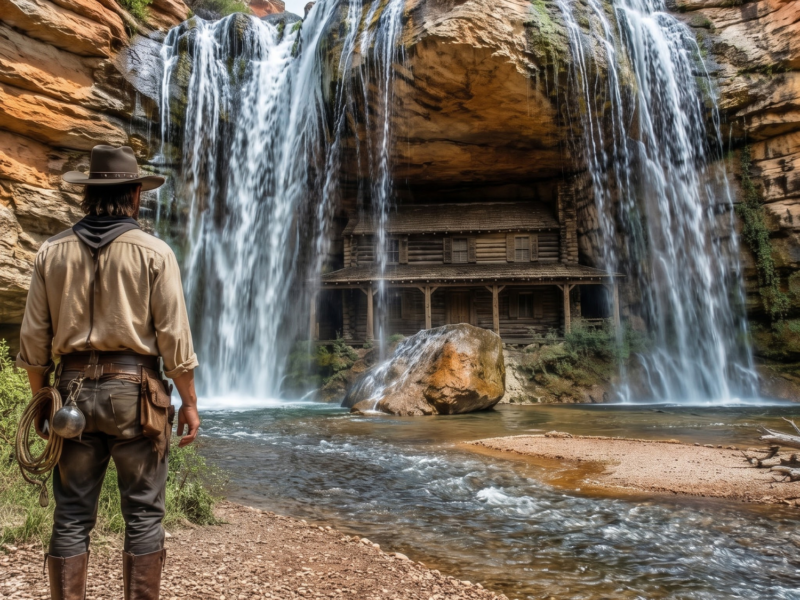
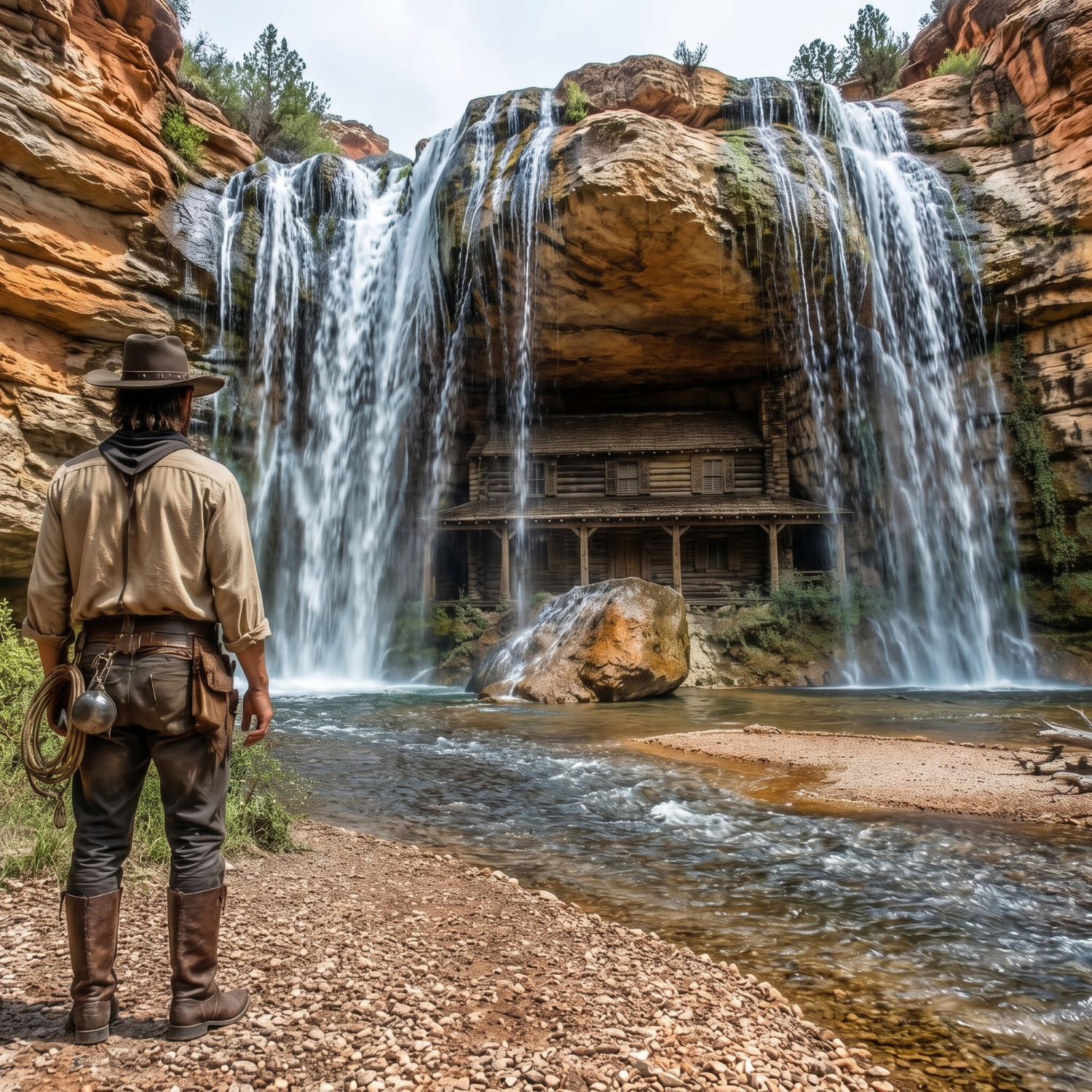
Past the gravel, the mountain opened up into a real, significant space. It was not a damp, dripping cave, exactly. It was a massive, vaulted room that the waterfall had perfectly walled off and hidden from the outside world.
And set far back against the rear wall of that secret room, weathered to the exact gray of the stone itself, was a cabin.
Charles stopped breathing. He stood for a long, impossible moment on the gravel and just looked.
The cabin was small, perhaps twelve feet by sixteen feet. It was built of meticulously squared logs, expertly chinked with pale clay and dried river moss. It was roofed with hand-split cedar shakes that had gone bright silver with extreme age. Its single, heavy door of thick plank pine hung on hand-forged iron strap hinges that had rusted to the deep, rich color of dried blood.
A stovepipe of blackened tin came out through the silver shakes and elbowed sharply up into a natural, vertical chimney flue carved into the rock ceiling above. The draft of that natural chimney was perfect. The smoke of any fire lit inside that cabin would have been drawn straight up through the mountain itself, dissipating high above, never once showing to a man standing at the pool below. It was a masterpiece of hidden engineering.
There was one small window beside the heavy door, glazed with a single, precious pane of thick, wavy, imperfect glass. Under the window was a sturdy bench, built out of the same squared timber as the walls.
Charles walked toward the door. He moved as slowly and carefully as a man walks up on a wild, terrified horse he does not wish to spook.
He laid his calloused hand on the heavy wooden latch. He pressed his thumb down and lifted it.
The door swung inward on its rusted hinges with a low, agonizing groan of complaint, and then stood wide open.
Charles stepped to the threshold.
The inside was dry. That was the very first, overwhelming impression. It was as dry as a hayloft in the dead heat of July. And it was surprisingly warm—warmer than the freezing air outside by the small, significant degree that any deeply enclosed space insulated by earth and stone is warmer than the exposed mountain.
The floor was made of wide plank pine that had gone dark and smooth with decades of age. It was laid impeccably tight, swept completely clean of dirt, and then left undisturbed.
Along the right wall stood a sturdy bunk of pole-frame construction. It held a thick straw tick mattress, still intact, with a heavy wool blanket folded with military precision at the foot—gray with a thick layer of dust, but completely whole.
Along the left wall stood a small, magnificent cookstove of heavy black iron. It was four-legged, with a perfectly flat top and a warming shelf bolted above it. Beside the stove sat a wooden box, exactly half-full of meticulously split, perfectly seasoned pine. And beside the wood box, a wooden shelf was mounted to the logs. On the shelf sat a tin coffee pot, two pristine enamel cups, a heavy cast-iron skillet, and a covered ceramic crock.
Under the wavy glass window stood a heavy plank table with one sturdy chair. On the center of the table stood a brass kerosene lantern. Its wick was perfectly trimmed. Its glass chimney was spotless.
But it was the wall above the table that caught Charles’s eye and held it.
On the logs above the table hung a complete set of tools, resting on smooth wooden pegs. Charles read them left to right, like a man reading a sacred text.
A heavy broad ax. A razor-sharp felling ax. A massive, two-man crosscut saw, the handles folded back, hung on a leather strap. A draw knife. A froe for splitting shakes. A hand adze. A complete set of augers in perfectly graduated sizes. A claw hammer. A roofing hatchet. A whetstone resting in a custom leather sleeve. A length of carefully coiled hemp rope.
And on the lowest, longest pegs, resting by itself, was an old but impeccably maintained Winchester repeating rifle.
Charles walked slowly to the wall. He did not touch anything yet. He leaned close.
Every single tool was oiled. Every edge was gleaming and clean. He smelled the steel. The oil on the ax heads had not yet gone rancid. Which meant the tools had been carefully oiled within a season—maybe two seasons at the absolute most—of the day Charles Gray was standing in the doorway.
Someone had built this place. Someone had kept this place. Someone had come up behind this roaring water regularly, for years, and maintained this secret sanctuary.
Charles stepped fully inside. He took off his hat and set it gently on the plank table. He stood in the exact center of the room, his hands hanging loosely at his sides, and looked around him slowly, from corner to corner to ceiling to floor. It was the specific look of a man who understands profoundly that everything he is currently seeing, he needs to remember for the rest of his life.
He walked over to the bunk. He crouched down.
Tucked neatly under the pole frame of the bunk sat three heavy wooden crates, stacked one on top of the other.
On the very top crate lay a folded piece of yellow oilcloth. And resting on the oilcloth, written in a careful, elegant hand in pencil that had faded slightly with time, were the words:
For Whoever Finds This.
CHAPTER FIVE: The Prospector’s Will
Charles knelt on the plank floor. The wood creaked softly under his weight.
He reached out and lifted the yellow oilcloth aside.
The top wooden crate was nailed shut. But the iron nails were old, and the wood had shrunk slightly. Charles stood up, walked to the tool wall, and took down the claw hatchet. He returned to the crate and wedged the claw under the lid. The nails drew easily, screeching in protest as he pried the lid open and tossed it aside.
When he looked inside the crate, Charles sat back heavily on his heels and let out a long, shuddering breath he had not consciously known he was holding.
Inside the crate lay coin.
Silver dollars, thousands of them, stacked neatly in tight rolls of heavy brown paper. Tucked into the corner of the crate was a smaller, heavy cloth bag that clinked with the unmistakable, dense sound of gold pieces.
Beneath the stacks of coin lay a thick leather wallet, worn soft. And beneath the wallet lay a folded letter composed of four pages of heavy parchment, sealed closed with a thick drop of red candle wax.
Charles did not touch the money. He did not even reach for the gold. He carefully reached past it all, lifted out the letter, and broke the brittle red wax seal with his thumb.
He sat down fully on the floor, resting his back against the solid frame of the bunk. By the gray, filtered light coming through the wavy windowpane, he unfolded the heavy pages and began to read.
The letter was written in the same careful, elegant pencil as the note on the oilcloth. It was signed Josiah Meek.
Josiah Meek had been a prospector originally out of Missouri. He wrote that he had come up the North Fork of the river in the brutal winter of 1849, fleeing a cholera outbreak in the camps below. He had stumbled through the freezing mist and found the cavern behind Widow Falls.
And he had lived behind that water for thirty-one years.
He wrote that he had lost a wife named Ruth to a bad, blistering summer fever in the second year of their marriage. He had buried a boy named Thomas in the fourth year, taken by a winter cough. He had buried them both somewhere high on the ridge, where the water couldn’t reach them.
After he lost his family, the silence of the world had become unbearable to him. The only sound he could tolerate was the deafening roar of the falls, which drowned out his own thoughts. So, he had stayed.
He had worked a small, localized, but incredibly pure dry vein of silver hidden deep in the back wall of the cut. It wasn’t enough to make a man a millionaire in San Francisco, but it was enough to make a man entirely independent. He had cut his own timber. He had kept his tools sharp. He had kept the cabin clean. And he had patiently, systematically put by everything he took out of the mountain into the three crates under the bunk.
He wrote, his handwriting pressing deeply into the paper:
A man who has buried his people learns quickly that money is not a comfort. It is only a tool. It is only a way of carrying work forward, past the end of one life, into the beginning of another.
He wrote that he had absolutely no kin left in the world. He wrote that as his heart began to fail him in his old age, he had prayed for a long time that whoever eventually found this hidden place would be a working man, and not a thief. He prayed it would be a man who knew the value of callous and sweat.
He wrote that he explicitly hoped the finder would take what was in the crates and use it to make an honest, enduring stand on the ground below the falls. To build something that lasted.
And he wrote at the very bottom of the fourth page, in the same careful, steady pencil:
I have been happy here, in the quiet. I hope you will be, too.
Charles Gray read the letter twice through. He read every word, tracing the shape of the letters with his eyes.
Then, he folded the thick parchment perfectly along its original creases. He unbuttoned his canvas coat and placed the letter gently inside the breast pocket, resting it right next to his father’s worthless deed.
He sat on the floor for a very long while. The roar of the waterfall outside was a constant, thrumming vibration in his chest. He rested his hand on his right hip pocket, feeling the hard shape of Emmett Poe’s bone-handled folding knife.
He thought about the silence of the ranch house when his father’s will was read. He thought about the sneer on Merritt’s face. He thought about the eighteen dollars in his pocket.
And after that, Charles Gray stood up, took his hat off the table, and began to work.
CHAPTER SIX: The Foundation
He worked the entire first week in total, unbroken solitude.
His first act was to clear the dry gravel shelf behind the falls of the pine needles and debris that had blown in over the last season. He swept the plank floor of the cabin until it was spotless. He took the heavy, dust-covered wool blanket down to the edge of the pool and beat the decades of dust out of it against a flat stone until his arms ached.
He laid a fire in the black iron cookstove using the perfectly split pine from Josiah Meek’s wood box. He struck a match, and as the flame caught, he watched the smoke draw perfectly up the natural rock flue. He boiled strong, black coffee in his mother’s tin pot on the flat iron top.
Then, he went to work on the land.
He walked the narrow, rocky strip from end to end. He paced it out, measuring the exact dimensions of his inheritance. He marked with a hatchet blaze on standing spruce trees exactly where the corner posts of a massive pole corral might be set. He found this spot below the pool, on a wide, elevated flat of deep grass he had completely missed on the first day because his eyes had been drawn entirely upward to the roaring water.
On the eighth day, he rode the sorrel down to the tiny settlement at the mouth of the North Fork.
He walked into the log courthouse with two heavy silver dollars from Josiah Meek’s crate in his pocket, and the deed folded in his coat. He officially filed the deed on the massive county book with the bored clerk, paid the outrageous recording fee in hard silver, and rode back up the mountain the exact same day, speaking to no one.
But silver talks louder than words on the frontier.
Hollis Renner, fifty-eight years old and the massive, soot-stained blacksmith at the settlement, heard from the loose-lipped clerk that a man named Gray had come in and filed on the “useless” strip up the North Fork, and paid in pure coin.
The very next week, Hollis Renner rode up the trace on a stubborn mule. He carried a heavy leather roll of shoeing tools and a heavy burlap sack of number-two iron nails. He rode up uninvited, simply curious to see what kind of fool was trying to live on vertical rock.
He found Charles Gray hauling massive lodgepole pines out of the timber by hand.
Hollis stayed two full days. He didn’t ask questions. He stripped off his coat and helped Charles sink the heavy posts and set the rails for the pole corral. He took absolutely no pay for his backbreaking labor, accepting only a meal of hot beans and strong coffee by the fire.
But as Hollis was packing his mule to leave, Charles handed him a single, heavy piece of Josiah Meek’s clean, gray silver ore. Hollis slipped it into his coat as a curiosity, and nothing was said between them about where it had come from.
Maryanne Doggett, forty-seven years old, the widow of a teamster freighter and the tough, pragmatic keeper of a small dairy operation on the valley flats, heard the rumors from Hollis. She sent her young nephew up the trail on a pony. The boy carried a heavy ceramic crock of fresh, sweet butter, a massive wheel of hard yellow cheese wrapped in clean muslin, and a note written in pencil on brown paper.
The note said only: Welcome to the North Fork.
Ned Purdie, twenty-two years old and a lean, hungry ranch hand out of work for the winter, came riding up the trace on a borrowed, swaybacked horse three days later. He asked plainly if there was any labor to be had.
Charles hired the boy on the spot at a dollar a day, paid in silver out of the crate. He set Ned to snaking the heavy, fallen lodgepole pines off the flat below the pool, using a heavy iron chain and a double-tree harness hitched to the sorrel.
By the end of the second week, the two men had enough straight timber stacked to raise a small, incredibly sturdy line shack on the flat, using the impeccably sharpened tools taken from the pegs on Josiah Meek’s wall.
By the time the first real snow began to fly, Charles Gray had built an empire from nothing.
He had a massive pole corral of forty feet on a side, set firmly below the pool. He had a tight plank shed, roofed perfectly with hand-split cedar shakes cut with Josiah Meek’s froe on Josiah Meek’s wooden shaving horse. He had a road cut with ax and grub hoe from the settlement trail all the way up to the flat, wide enough and graded gently enough to bring a fully loaded freight wagon in.
He had ridden down to the settlement, walked into the mercantile, and bought twelve head of prime yearling heifers and one young, aggressive red bull from a man breaking up his bankrupt outfit north of town. He had counted the payment out plainly in heavy silver coin on the wooden counter, silencing the entire room.
He had driven the cattle up the North Fork himself over three exhausting days, with Ned Purdie riding drag through the snow. They had turned the herd into the new pole corral at dusk, the cows lowing softly, with the deafening sound of the falls in the near distance and the welcoming smell of woodsmoke going up the rock chimney from the hidden cabin above.
CHAPTER SEVEN: The Winter
Word came around the settlement in the slow, inevitable way word always comes around a settlement in the dead of winter.
It was whispered around the potbelly stove in the mercantile, and shouted over the ringing anvil at the smithy. The Gray who had taken the worthless strip up the North Fork was paying hard cash for everything he bought. He was paying his hired hand on time, every week, in silver. He was quietly asking the land agent about securing massive grass leases on the state ground above the cut.
And after those rumors circulated and were verified, men began to speak of him differently. They called him “Charles” now when he rode into town, or “Mr. Gray” if they did not know him well. Absolutely no one at the settlement called him “the youngest Gray,” or “the poor bastard that got the waterfall.”
Hollis Renner rode up and shod the sorrel gelding in December. He refused coin this time, accepting the trade of a full week’s worth of split, seasoned firewood delivered directly to the smithy door.
Maryanne Doggett sent word up the mountain with her nephew that she would be willing to take butter cows on shares in the spring, if Charles had a mind to keep dairy stock and expand his operation. Charles sent word back down that he did indeed have a mind to do just that, and would ride down in April to discuss the contract properly over her kitchen table.
Ned Purdie stayed on through the brutal, freezing winter at his dollar a day and his keep. He slept warmly in the plank shed on the flat, tending his own iron stove.
In the long, dark evenings, when the stock was fed and the wind howled down the canyon, the two men would sit in the hidden cabin behind the falls. They would leave the heavy wooden door open onto the dry gravel, letting the mesmerizing sound of the falling water fill the room.
Charles would sit by the lantern light and read aloud from the small stack of agricultural almanacs and outdated county newspapers he had brought up from the settlement. Ned would sit across the table, quietly mending leather tack with an awl and waxed thread. Neither of them said much. They were men who understood that silence was not an absence of communication, but a presence of peace.
By February, a small, heavily packed path of snow ran from the secret cabin behind the falls, along the slick rock shelf—which Charles had carefully scored with deep hatchet cuts to provide footing—out around the freezing pool, and down to the flat where the shed and the corral stood, and the road ran on down to the settlement. A man could walk it safely at dusk with a lantern and not slip into the abyss.
Charles kept certain small, specific rituals without ever consciously deciding to do so.
He kept coffee boiling on the black iron stove from an hour before daylight until long after dark.
He kept Josiah Meek’s handwritten letter folded perfectly in the same inside breast pocket of his coat, resting permanently next to his father’s deed.
He kept the tools on the log wall meticulously oiled, exactly the way he had found them. Every Sunday evening, he wiped each heavy steel edge once with a clean rag and a can of lard oil Hollis Renner had sold him for a nickel. He did this so that if any man ever came up the mountain behind him one day, years from now, the exact way he had come behind Josiah Meek, the tools would be found exactly the way Meek had left them: ready for the next set of hands to build a life.
He kept Emmett Poe’s bone-handled folding knife in his right hip pocket, every single day.
And he had begun to keep, hanging proudly on a wooden peg above the plank table beside the glowing brass lantern, his mother’s battered tin coffee pot.
The two solitary objects he had carried up the North Fork out of his childhood home place now sat inside the hidden cabin, resting as plainly and comfortably as if they had lived there for thirty years.
CHAPTER EIGHT: The Reckoning of Spring
In April, the deep snow finally went off the flat below the pool in a miraculous, sudden week of soft, warm rain. The grass came up a startling, violent green under the black spruce, exploding with the suddenness that high mountain country allows only once a year.
Charles Gray stood on the dry gravel behind the falls one evening at twilight. The door of the cabin was open at his back. The water was falling in a massive, steady, roaring white column just three paces in front of his boots.
He stood with his hands in his pockets, and he counted, without meaning to, the things that had come to sit in his life since the bitter day of his father’s funeral in October.
The pole corral down on the flat now held twelve prime heifers, all of them heavy with calf, and one massive red bull that had grown much quieter and steadier with regular work and feeding.
The plank shed had a second, sturdy room framed onto its south side. He had built it for Ned Purdie, who had hesitantly asked in March if he might possibly stay on through the chaotic calving season, and had been told by Charles that he might stay on for as long as he cared to draw a wage.
The road winding down to the settlement had been aggressively widened by a second season of backbreaking ax and shovel work. It would now carry a fully loaded, double-team freight wagon end-to-end without a man ever having to get down in the mud and lift a stuck wheel.
In the heavy leather county book at the log courthouse, the strip six miles up the North Fork was recorded permanently in Charles Gray’s name in the clerk’s tidy pencil. And filed right beside it, secured on Hollis Renner’s excellent advice and paid for in gold, was a sprawling grass lease on two massive sections of prime state ground above the cut. Ground that would carry his growing stock through the high summer heat with ease.
Inside the cabin behind him, on the wooden peg above the plank table, his mother’s tin coffee pot hung beside the trimmed lantern.
And inside his right hip pocket, resting warm and solid against his leg, the exact same way it had been warm against his leg at the lonely crossroads north of the home place six months ago, sat Emmett Poe’s bone-handled folding knife.
Charles took the knife out now. He turned it once in his rough hand, his thumb running over the smooth, yellowed bone.
He thought, without any heat and without much remaining sadness, of the old Texan who had given him seven years of daily, invaluable instruction and never once raised his voice in anger.
And he thought of Josiah Meek, the lonely prospector out of Missouri, who had lived thirty-one silent years behind this roaring water. A man who had lost a wife named Ruth and a son named Thomas, and had written in careful, faded pencil at the bottom of the fourth page that he had been happy here, and desperately hoped whoever came behind him would be, too.
Charles thought that these were two profoundly good men he had never met in the same room, and never would. One was dead in a wooden chair by a bunkhouse stove, his heart just giving out. The other was dead somewhere unrecorded and unmarked in this rocky cut, or the river below it.
And both of those men, in their own entirely separate ways, had fiercely loved a boy they never got to see grown into a man. They had both deliberately left behind a small, hard, incredibly useful thing—a knife, a chest of coin, a set of sharpened tools—so that the boy, when he was finally a man facing a cruel world, would not have to stand empty-handed and freezing in the cold.
Charles walked back inside. He set the folding knife gently on the plank table, right beside the tin coffee pot.
The two objects sat there together in the warm, golden lantern light, casting long shadows. They looked like two silent witnesses at a small, quiet court of law, testifying to a life well-saved. Charles looked at them for a very long time, and he did not speak. He didn’t need to. The roaring water said everything for him.
CHAPTER NINE: The Legacy
Down at the muddy mouth of the North Fork, standing in the busy mercantile and lingering at the ringing smithy door, men called him Charles now.
And absolutely no one at the settlement called him “the youngest Gray,” or “the fool that got the waterfall.”
That pathetic, mocking story had been entirely replaced by another story. It was the story in which a quiet man had gone up a treacherous, rocky cut that nobody in their right mind wanted, and had come out of it six months later with prime cattle, hard cash, a loyal paid hand, and a massive filed state lease. And he had done it all quietly, without boasting, and had paid every single debt in pure coin on the exact day it was due.
Word of that remarkable story had traveled, as such stories inevitably will. It traveled back down the wagon road, and swept east along the trace, making its way straight toward the home place.
Charles knew, from a casual line written in a letter Maryanne Doggett had passed along from a gossiping cousin in town, that Merritt and Jack had heard the story. He knew they had not known what to make of it. He knew they had not written to him, and he knew with absolute certainty that they never would write.
Charles found, standing on the gravel behind the falls, that he did not mind at all.
A man who begs from his own kin has already lost the argument twice, Emmett Poe had told him once, spitting into the dust of the corral. And a man who is asked back by his own kin only because he has finally proved them wrong… he has not won the argument either. He’s just bought his way into a house that doesn’t love him.
Charles Gray had not come up the North Fork to win an argument with his brothers. He had come simply because there was nowhere else on God’s earth to ride.
And he had stayed because the roaring water, the hidden cabin, and the two dead strangers standing silently behind them had, between them, given him the physical means and the moral permission to build a standing on his own. To build a life on the very ground his father had bought sight unseen in 1863, and had never once bothered to visit.
Charles Gray was forty-one years old, and he had been cast out.
His father had left him no house, no herd, and absolutely no acre of grass a cow could eat. He had left him only a narrow, vertical strip of rock and timber six miles up the North Fork, and eighteen dollars folded in a dead man’s coat pocket.
He had ridden north with the worthless deed, the eighteen dollars, and the worn folding knife of an old wrangler who was dead.
And behind the falling water, he had found a cabin. And inside the cabin, a letter. And inside the letter, a magnificent, enduring life he had never known he was meant to inherit.
It was, Charles thought, pulling his hat low and stepping out into the mist to check his herd, the best eighteen dollars any man ever came into.









