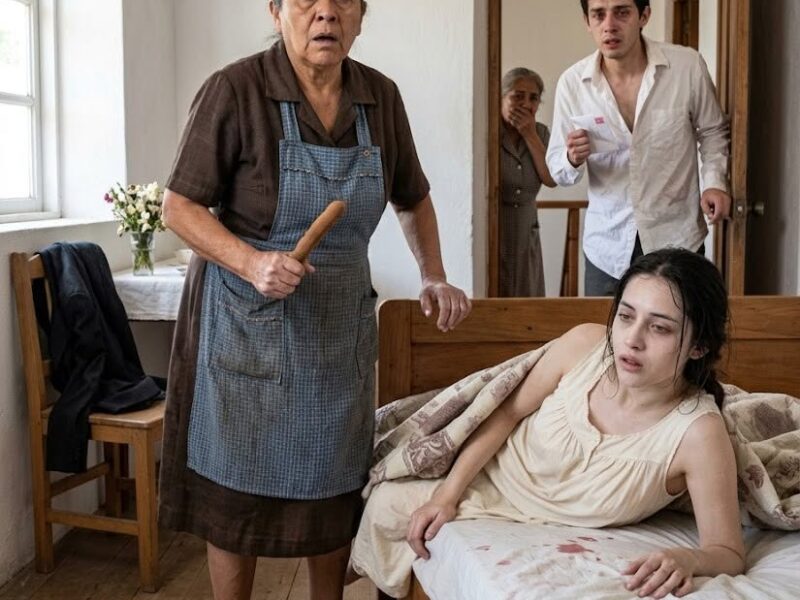
MY MOTHER-IN-LAW BEAT MY WEAK WIFE WITH A WOODEN STICK FOR “SLEEPING ALL DAY” — THEN I MADE HER READ THE MEDICAL REPORT SHE HAD REFUSED TO BELIEVE
Chapter 1 – THE WHITE ENVELOPE
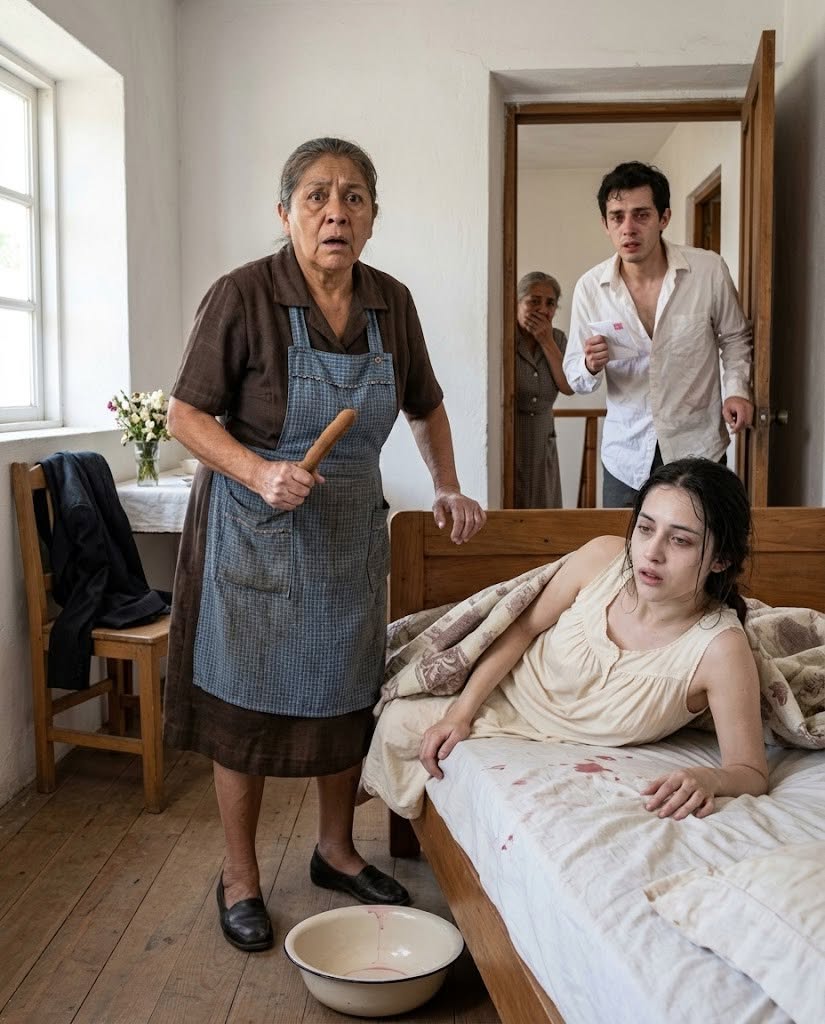 Mrs. Hernández entered the bedroom already angry.
She had been angry since breakfast.
Mariana had not come downstairs.
Had not folded the laundry.
Had not helped prepare lunch.
Had not answered when called.
So Mrs. Hernández carried the long wooden stick she normally used to pull curtains closed and marched toward the bed.
“Get up right now!”
The stick came down across the blanket.
Mariana barely moved.
Mrs. Hernández struck the blanket again.
“Do you hear me?”
Still nothing.
She grabbed the top of the blanket and ripped it backward.
Then froze.
A large dark-red stain covered the sheet beneath Mariana’s hips.
Mariana lay on her side in a pale nightgown.
Her face looked almost gray.
One hand trembled weakly near her stomach.
The wooden stick began shaking in Mrs. Hernández’s hand.
“Mariana?”
No answer.
Then Mariana’s eyelids moved.
“Carlos…”
Footsteps pounded up the stairs.
Carlos burst through the doorway in a half-buttoned white shirt, a small white envelope crushed in one hand.
He saw:
the blood,
his wife,
the stick.
His face emptied.
He ran to the bed.
“Mariana!”
He lifted her gently against his chest.
Her head fell against his shoulder.
She was conscious.
Barely.
Carlos touched her face.
Cold.
Then he looked at his mother.
Fear became fury.
“What did you do to her?”
Mrs. Hernández stepped backward.
“I—I told her to get up.”
Carlos stared at the stick.
“You hit her?”
“The blanket.”
“You hit her while she was bleeding?”
“I didn’t know!”
Carlos looked down at the envelope.
Then thrust it toward his mother.
“Now read what you almost caused.”
Mrs. Hernández stared at it.
The return address belonged to Mercy Women’s Center.
She slowly opened the flap.
The first page read:
PREGNANCY CONFIRMED — 10 WEEKS, 4 DAYS.
The next line:
LARGE SUBCHORIONIC HEMATOMA. SIGNIFICANT IRON-DEFICIENCY ANEMIA.
Mrs. Hernández stopped breathing.
Carlos said:
“She wasn’t lazy.”
Then Mariana’s body suddenly went limp in his arms.
And Carlos screamed for an ambulance.
Chapter 2 – THE BLEED STARTED BEFORE THE STICK
The emergency department did not give Carlos the simple answer he wanted.
He wanted a doctor to say:
Your mother caused this.
Medicine refused.
Mariana had begun bleeding before Mrs. Hernández entered the room.
The blood pattern on the sheet and Mariana’s own fragmented memory supported that.
Her ultrasound still showed fetal cardiac activity.
The subchorionic hematoma had enlarged compared with the morning scan.
Could the stress and striking have worsened it?
The obstetrician answered carefully.
“We cannot determine that.”
Carlos clenched his jaw.
“She hit my pregnant wife.”
“That was dangerous.”
“So she caused the bleed.”
“I did not say that.”
The distinction frustrated him.
Then the doctor continued:
“What we can say is Mariana was already medically vulnerable. She was dizzy, significantly anemic, and experiencing an active pregnancy bleed. Striking or forcing her to stand could have caused a fall or additional injury.”
Enough.
Mariana’s hemoglobin was low enough to explain:
exhaustion,
paleness,
shortness of breath,
and the near-fainting episodes Mrs. Hernández had called laziness.
She received fluids.
Iron treatment planning.
Monitoring.
No emergency surgery.
No guarantee.
The pregnancy remained viable.
The emergency physician also asked Carlos a question he had not prepared for.
“Did Mariana lose consciousness before your mother entered the room?”
“I don’t know.”
Mariana whispered:
“I don’t think so.”
“Did you fall?”
“No.”
“Hit your head?”
“No.”
“Any severe one-sided pain?”
“No.”
Those details mattered because bleeding in early pregnancy can have many causes, some more urgent than others.
The team checked:
vital signs,
blood count,
blood type,
pain level,
and ultrasound findings.
Mariana was Rh positive, so she did not need Rh immune globulin.
Carlos had no idea what that meant.
He only understood the larger message:
medicine was not one dramatic reveal.
It was a chain of smaller questions.
He had spent the morning wanting one sentence that would condemn his mother.
The hospital kept giving him probabilities.
The obstetrician also corrected one assumption Carlos made about “bed rest.”
“I thought she was told not to move.”
“No.”
“So she was supposed to be in bed?”
“We advised relative activity reduction because she was symptomatic and weak. Strict bed rest is not automatically beneficial and can have downsides.”
Carlos looked embarrassed.
Mariana almost smiled.
Even the instruction they had been arguing about was more nuanced than either family member had made it.
Mrs. Hernández heard:
she should still be functioning.
Carlos heard:
she should barely move.
The doctor had actually said:
avoid strenuous activity,
listen to symptoms,
hydrate,
and seek urgent care for specified warning signs.
Families often turn medical guidance into rules because rules feel easier than judgment.
Mariana’s body had needed judgment.
But no one could promise what would happen next.
Carlos sat beside her bed.
His mother waited outside.
Mariana opened her eyes.
“Did she see the paper?”
“Yes.”
“Good.”
Carlos looked at her.
“You knew she didn’t believe you.”
Mariana turned away.
“She told me women in this family don’t spend pregnancy in bed.”
Carlos went still.
“When?”
“Yesterday.”
He had not known that.
Then Mariana added:
“And the day before.”
Carlos stared at the floor.
This had not started with the stick.
It had started with words he had never heard because he had spent the week trying not to be in the middle.
Chapter 3 – CARLOS’S SECRET
Carlos had known about the pregnancy for four days.
He had known about the bleeding risk for six hours.
He had told his mother neither.
Why?
Because Mariana asked for one day.
That was part of it.
They wanted to process the news privately.
But there was another reason.
Carlos knew his mother would react badly.
Not to the baby.
To the rest.
Mrs. Hernández believed illness became worse when people “gave in” to it.
When Carlos had pneumonia at fourteen, she made him sit at the dinner table because:
“Beds make sick people weaker.”
When his father developed heart failure, she complained every time he used the downstairs recliner.
“Move or you’ll never move again.”
She was not anti-doctor.
She attended appointments.
Bought medicine.
Cooked soups.
Then ignored every recommendation involving rest.
Carlos had spent his life translating.
Doctor says reduce activity.
He told her:
Dad should take it easy.
Doctor says avoid exertion.
He told her:
Maybe don’t make him carry groceries.
He softened instructions because direct conflict exhausted him.
Now Mariana had a medical sheet saying:
avoid strenuous activity,
stay hydrated,
follow bleeding precautions,
return immediately for heavy bleeding, severe pain, fainting, or worsening weakness.
Carlos put the envelope in his pocket.
Planned to explain it after work.
Then his boss called.
A client emergency.
He left Mariana asleep.
He told his mother only:
“Please let her rest.”
Mrs. Hernández answered:
“She’s been resting for a week.”
Carlos said:
“Mom, not today.”
Then walked out.
He had known enough to worry.
Carlos eventually told his employer what happened.
Not every detail.
Enough.
His manager asked:
“Why didn’t you take the day off after the appointment?”
Carlos answered:
“I thought I had to handle the client.”
“You had leave.”
“I know.”
“Then why?”
Carlos had no good answer.
Work had been another place he escaped uncertainty.
Clients had:
problems,
deadlines,
solutions.
Pregnancy bleeding had none of those clean edges.
He chose the place where competence still worked.
That insight mattered.
Avoidance is not always hiding in a bar or disappearing for days.
Sometimes it looks like answering email while someone else carries the fear.
Not enough to stop himself from leaving.
That realization would follow him longer than the hospital bill.
Carlos later reviewed the morning before he left for work.
Mariana had said:
“I feel weird.”
He answered:
“Lie down.”
She said:
“I’m scared.”
He kissed her forehead.
Then checked his phone.
The client was already messaging.
He told himself:
the doctor saw her,
the baby had a heartbeat,
the instructions were in my pocket.
Safe enough.
Then he told his mother:
“Don’t bother her.”
Not:
She is pregnant.
She is bleeding.
She is severely anemic.
Call me if she gets worse.
Why?
Because he did not want his mother’s questions.
How far along?
Why didn’t you tell me?
What did the doctor say?
Did you cause this by working?
Are you eating enough?
He wanted to avoid ten minutes of conflict.
That avoidance left Mariana without an informed adult in the house.
He did not cause the bleeding.
He did fail to communicate risk.
Those were different truths.
Mariana had also hidden how harsh Mrs. Hernández had become.
Carlos asked:
“Why didn’t you tell me?”
She looked tired.
“I did.”
He frowned.
“When?”
“Three nights ago.”
“What did you say?”
“I said your mom thinks I’m faking.”
Carlos remembered.
He had answered:
“She’s old-school.”
Mariana stared at him.
That was the moment.
Not that he failed to hear words.
He heard them.
He translated them into something smaller.
Old-school.
Strict.
Traditional.
Difficult.
All softer than:
she does not believe me when I say I’m sick.
Carlos had protected himself from conflict by renaming the problem.
Mariana said:
“I needed you to take the sentence literally.”
He nodded.
“I know.”
Chapter 4 – WHY MARIANA WAS SO WEAK
Mariana’s anemia had been developing before the pregnancy.
Heavy periods for years.
A mostly vegetarian diet she never planned carefully.
Long hours at an architecture firm.
She assumed exhaustion was normal.
Before the wedding, her doctor recommended iron studies.
Mariana postponed them.
Then came:
the wedding,
the move,
the new household,
the missed period.
She thought nausea explained the weakness.
At the first prenatal appointment, the bloodwork came back abnormal.
Hemoglobin 8.1.
Ferritin extremely low.
Not instantly fatal.
Definitely significant.
Her obstetrician explained:
iron supplementation,
possible intravenous iron depending on response,
repeat testing,
and symptoms requiring urgent care.
Then the ultrasound showed the hematoma.
Mariana cried.
“Am I losing the baby?”
The doctor said:
“Not necessarily.”
Subchorionic hematomas are common enough that many pregnancies continue normally.
Size and symptoms can matter.
Bleeding can look terrifying and still resolve.
There was uncertainty.
Mrs. Hernández hated uncertainty.
She wanted:
sick or healthy,
strong or weak,
real problem or excuse.
Mariana’s condition fit none of those clean boxes.
That made her easier to judge.
Chapter 5 – MRS. HERNÁNDEZ’S VERSION OF STRENGTH
Mrs. Hernández’s first pregnancy happened at twenty-two.
She worked in a grocery bakery.
Standing ten hours a day.
She vomited in the mornings.
Worked anyway.
Her mother-in-law, Teresa, told her:
“Women who lie down teach the body to fail.”
Mrs. Hernández repeated that sentence for thirty-seven years.
Not because it was medically sound.
Because she survived it.
Her first son, Mateo, was born healthy.
Then came a second pregnancy.
At twenty-six weeks she began bleeding.
Teresa told her to finish preparing dinner before calling her husband.
Mrs. Hernández did.
The baby died days later after extreme prematurity.
Doctors never told her:
You caused this by working.
They also never told her what she desperately wanted to hear:
Nothing you did mattered.
Grief filled the uncertainty.
Mrs. Hernández eventually built a rule:
I survived because I was strong.
The baby died because some things are fate.
That rule protected her.
If rest had mattered, then Teresa’s cruelty mattered.
If Teresa’s cruelty mattered, Mrs. Hernández would have to admit someone she obeyed had failed her.
So she turned obedience into virtue.
Years later, Mariana lying in bed threatened that entire story.
Chapter 6 – THE HOUSE WAS NOT MRS. HERNÁNDEZ’S
Mariana and Carlos had been married seven weeks.
They lived temporarily in Carlos’s childhood home.
That was the plan.
Six months.
Save money.
Finish renovations on their condo.
Mrs. Hernández acted as if the arrangement meant Mariana had joined her household under her authority.
Carlos contributed to utilities.
Bought groceries.
Paid for a new water heater.
Mariana cooked several nights a week before the nausea worsened.
Still, Mrs. Hernández referred to her as:
“the girl staying upstairs.”
That wording mattered.
One afternoon Mariana corrected her.
“I live here too.”
Mrs. Hernández answered:
“Until your real home is ready.”
Then:
“In this house, everyone contributes.”
Mariana said:
“I do.”
Mrs. Hernández looked at the laundry basket.
“Not lately.”
The conflict was not actually about laundry.
Mrs. Hernández’s idea of contribution also had an economic layer.
After her husband died, the house became harder to maintain.
Taxes.
Repairs.
Insurance.
Carlos helped.
So did his sister Elena.
Mrs. Hernández rarely admitted needing help.
Instead she converted help into family obligation.
Children should contribute.
Spouses should contribute.
Everyone should work.
That belief was not irrational.
The house was expensive.
The mistake was turning contribution into a moral test applied regardless of health.
Mariana once paid for a plumbing repair without mentioning it.
Mrs. Hernández thanked Carlos.
He corrected:
“Mariana paid.”
Mrs. Hernández looked surprised.
Then said:
“Well, she lives here.”
The gratitude vanished.
That moment stayed with Mariana.
Nothing she gave counted as generosity once Mrs. Hernández believed it was owed.
It was about who had authority to define contribution.
Carlos had never clarified that.
He called the living arrangement:
staying with Mom.
Mariana called it:
our temporary home.
Same address.
Different power.
Chapter 7 – THE POLICE REPORT
Carlos did call the police.
Not because Mariana demanded it.
She did not.
At first she said:
“She was scared when she saw the blood.”
Carlos answered:
“She hit you before she saw it.”
That was true.
The wooden stick had struck the blanket over Mariana’s legs and side.
No serious injury was found.
No visible bruising from the stick.
Still, physical force used to compel someone out of bed.
Police documented:
the stick,
the sheet,
the medical envelope,
Mrs. Hernández’s admission that she struck the covered bed,
and the existing verbal conflict.
Mrs. Hernández said:
“I wasn’t trying to hurt her.”
The officer answered:
“Intent is one part of what we document.”
No handcuffs in the bedroom.
No dramatic arrest.
A misdemeanor assault-related investigation followed.
When police interviewed Mrs. Hernández, she insisted the stick was not a weapon.
“It’s for curtains.”
The officer said:
“That may be its normal use.”
“I didn’t beat her.”
“You struck the bed she was lying in.”
“Over the blanket.”
“Yes.”
Mrs. Hernández became frustrated.
Language felt unfair to her.
Beat.
Strike.
Force.
She preferred:
wake.
But the officer kept separating purpose from action.
“You wanted her awake.”
“Yes.”
“You used the stick.”
“Yes.”
“Those can both be true.”
That sentence followed her into counseling.
Intent could explain an action.
It could not rename it.
Carlos’s mother moved to his sister Elena’s house temporarily.
Mariana and Carlos returned to the home only to pack.
The six-month plan ended that day.
Carlos and Mariana’s new condo became important for reasons unrelated to size.
It was smaller than the family house.
Two bedrooms.
No dining room large enough for twenty people.
No place for Mrs. Hernández to assume she could stay for weeks.
The first boundary was simple.
No unannounced visits.
Carlos worried it sounded cruel.
Mariana asked:
“Cruel to whom?”
He thought.
His mother.
Then:
“And safe for whom?”
Mariana.
That was the trade he had avoided his whole life.
Someone’s disappointment can be the price of someone else’s safety.
Carlos gave his mother the rule himself.
Not:
Mariana wants this.
Not:
The therapist says.
“I need you to call before coming.”
Mrs. Hernández asked:
“Because of her?”
Carlos answered:
“Because of me.”
That mattered.
Chapter 8 – MARIANA LOSES THE PREGNANCY
At twelve weeks, the bleeding returned.
This time there was cramping.
Mariana knew before the ultrasound.
The pregnancy had stopped developing.
She miscarried.
Carlos sat beside her in the clinic.
He cried silently.
Mariana did not.
Not immediately.
She asked:
“Was it because of that day?”
The doctor answered:
“We cannot say that.”
Carlos looked angry.
The doctor continued:
“Many first-trimester miscarriages are related to chromosomal problems. Subchorionic bleeding can be associated with increased risk in some cases. We do not have evidence that one specific event caused this loss.”
Mariana stared at the wall.
She wanted someone to blame.
Carlos wanted someone to blame.
Mrs. Hernández already blamed herself.
Medicine gave none of them certainty.
Mariana’s miscarriage also revealed how differently the three of them used blame.
Carlos wanted a culprit.
Mrs. Hernández wanted punishment.
Mariana wanted certainty.
None got what they wanted.
The pathology testing after the loss did not produce a definitive chromosomal answer.
Sometimes it does.
Sometimes it does not.
The physician told them:
“You may never know why this pregnancy ended.”
Mariana hated that sentence more than any diagnosis.
At least a diagnosis gives shape.
Uncertainty leaves space.
Grief rushed into it.
So did imagination.
Carlos imagined:
if I had stayed.
Mrs. Hernández imagined:
if I had not entered the room.
Mariana imagined:
if I had started iron months earlier.
Each counterfactual assigned control backward.
None could be proven.
Mariana’s grief counselor asked her to distinguish three questions.
What happened?
What caused it?
What do you feel responsible for?
Mariana answered the first:
pregnancy loss.
The second:
unknown.
The third took longer.
“I postponed bloodwork.”
The counselor asked:
“Did your doctor say that caused the loss?”
“No.”
“I worked too much before the wedding.”
“Did your doctor say that caused it?”
“No.”
“I stayed in that house.”
Silence.
That answer was not medical.
It was relational.
Mariana did not believe the house caused miscarriage.
She did believe staying there had exposed her to treatment she should never have had to endure.
That was something she could change going forward.
That was brutal.
Also honest.
Mariana finally cried in the car.
Not because the doctor refused comfort.
Because the doctor refused a story.
Chapter 9 – CARLOS BLAMES HIS MOTHER
Carlos stopped speaking to Mrs. Hernández.
Three months.
No calls.
No visits.
When she sent food, he returned it.
When she wrote:
I am sorry.
He did not answer.
He told Mariana:
“She killed our baby.”
Mariana looked at him.
“No.”
Carlos froze.
“She hit you.”
“Yes.”
“She made you stand.”
“Yes.”
“She terrified you.”
“Yes.”
“So how can you say no?”
“Because the doctor said we don’t know.”
Carlos stood.
“Why are you defending her?”
“I’m not.”
“Then what are you doing?”
Mariana’s voice hardened.
“Refusing to make certainty because grief wants it.”
That silenced him.
Carlos’s anger at his mother also concealed anger at himself.
He would say:
“She should have known.”
Then think:
So should I.
He would say:
“She ignored Mariana.”
Then remember every time Mariana said:
I’m tired.
And he answered:
We’re all tired.
He had not been cruel.
He had been habituated.
The household treated fatigue as normal because everyone worked too hard.
That did not excuse his mother.
It widened the accountability.
Families teach each other which complaints deserve urgency.
The Hernández family had taught:
pain becomes real when a doctor proves it.
Mariana nearly collapsed before anyone believed her enough.
Then she added:
“She did something terrible.”
“Yes.”
“That is enough.”
Carlos stared.
Mariana continued:
“I don’t need her to have caused the miscarriage before I’m allowed to be angry.”
That sentence changed the direction of the family.
Chapter 10 – MRS. HERNÁNDEZ READS HER OWN HISTORY
Mrs. Hernández entered counseling because the court required an anger-management assessment.
She hated it.
The therapist asked about the stick.
Mrs. Hernández said:
“I was trying to wake her.”
“Why with a stick?”
“She wouldn’t move.”
“Why did she need to move?”
“She had been in bed all day.”
“So?”
Mrs. Hernández stared.
The question seemed insulting.
Then the therapist asked:
“What happens if a woman rests?”
Nothing.
Mrs. Hernández began talking about Teresa.
The grocery bakery.
Mateo.
Then the baby who died.
For the first time in decades, she said:
“I was bleeding too.”
The therapist did not tell her:
Teresa caused your loss.
There was no evidence for that.
Instead:
“You were frightened and someone responded with pressure rather than care.”
Mrs. Hernández cried.
Then whispered:
“I did the same thing.”
Yes.
Not identical circumstances.
Same rule.
Suffering proves character.
Rest proves weakness.
She had inherited cruelty as a definition of strength.
Mrs. Hernández did not transform quickly.
At counseling she sometimes argued:
“Everyone is too fragile now.”
The therapist asked:
“Compared with when?”
“When we were young.”
“Were you less hurt?”
Silence.
She still complained about:
therapy language,
boundaries,
people needing rest.
But she stopped using those complaints to justify actions.
That distinction was progress.
Beliefs can lag behind behavior.
Sometimes behavior must change before emotion catches up.
Mrs. Hernández learned to say:
“I don’t understand it, but I will respect it.”
For a woman who once believed respect meant obedience to elders, the reversal was enormous.
Mrs. Hernández eventually requested her own obstetric records from decades earlier.
Most were incomplete.
Paper files.
Old hospital codes.
But one surviving discharge summary from her second pregnancy contained:
antepartum hemorrhage,
preterm labor,
fetal demise after extreme prematurity.
No sentence blamed activity.
No sentence blamed Teresa.
No sentence absolved anyone emotionally.
Mrs. Hernández stared at the page.
She had spent thirty-seven years filling in what medicine had left uncertain.
Then using that private story as a rule for other women.
The therapist said:
“Survival is not evidence that the method was safe.”
Mrs. Hernández cried.
That sentence destroyed one of her oldest beliefs.
I survived it.
Therefore it was acceptable.
No.
Sometimes people survive bad treatment.
Survival does not certify the treatment.
Chapter 11 – THE ENVELOPE
The white envelope remained in Carlos’s desk drawer.
For months.
He could not throw it away.
It contained:
the first ultrasound,
the anemia result,
bleeding precautions,
and the sentence:
Viable intrauterine pregnancy at time of examination.
Viable.
At time of examination.
Carlos hated the phrase.
Mariana eventually found him holding it.
“Why keep that?”
“I don’t know.”
“You think it proves something.”
He looked at her.
“Doesn’t it?”
“What?”
“That there was a baby.”
Mariana sat beside him.
“We know.”
Carlos looked down.
“Mom didn’t.”
“She knows now.”
“No. I mean she didn’t know that morning.”
Mariana understood.
Carlos had turned the envelope into another argument against himself.
If only he had left it on the table.
If only he had explained.
If only he had stayed home.
Retrospective bargaining.
Their grief counselor named it.
The mind offering imaginary trades with the past.
May you like
The Japanese CEO Couldn’t Get Anyone to Understand Her—Then a Driver Spo…
A Billionaire Woke Up to a Little Girl Sleeping on His Chest—Then Her Mo…
Her Family Lied About the Wedding Date and Stole $30,000—Then She Made O…
Carlos could learn from what he failed to do.
He could not reopen that morning.
SHARE
Related Stories
Other posts
SEP 09, 2026
The Maid Slapped the Mafia Boss Before He Drank—Then She Revealed Who Tried to Poison Him
AUG 10, 2026
The Billionaire Was Turned Away From a Full Restaurant—Then a Little Girl Invited Him to S…
SEP 18, 2026
The Millionaire Humiliated His Wife in Front of 200 Guests—Then Her Father Revealed His Tr…
SEP 16, 2026
The Mafia Father Opened His Wife’s Locked Cabinet—Then His Face Turned White
JUL 24, 2026
The Mafia Boss Broke Three Rules—Then a 4-Year-Old Girl Put Him in Time-Out
AUG 10, 2026
The Mafia Boss Threw Coffee at the Waitress—Then Her Quiet Threat Made Him Stop His Guards
SEP 03, 2026
The Man Stole a Black Girl’s First-Class Seat—Then the Captain Shut Down the Plane
JUL 21, 2026
The Grandmother Kicked Her 15-Month-Old Grandson Down the Stairs—Then His Father Revealed…
Chapter 12 – THE LEGAL OUTCOME
Mrs. Hernández’s case resolved without prison.
She admitted striking the covered bed with the wooden stick during a confrontation and accepted responsibility for using force against Mariana.
Probation.
Anger-management counseling.
No-contact with Mariana unless Mariana consented.
No entry into Carlos and Mariana’s new condo without invitation.
Mrs. Hernández also apologized to Elena, Carlos’s sister.
Why?
Because years earlier Elena had spent six weeks recovering from surgery in the same house.
Mrs. Hernández constantly told her:
“Walk more.”
“Stop sleeping.”
“You’re making yourself weaker.”
Elena laughed bitterly when the apology came.
“So Mariana wasn’t the first.”
Mrs. Hernández looked down.
“No.”
Elena had never called it abuse.
She had simply moved out earlier than planned.
Family patterns often look like personality until one event makes the repetition visible.
Mariana’s bedroom incident did that.
Suddenly the family could see decades of:
pressure,
minimization,
and moral judgment around illness.
The stick was new.
The rule behind it was old.
The miscarriage was not charged as an injury she caused.
The prosecutor also made one thing clear to Carlos.
His anger did not decide charging.
Carlos wanted the case to include the pregnancy loss.
The prosecutor asked for medical support.
There was none strong enough.
Carlos said:
“But everyone knows stress is bad.”
The prosecutor answered:
“That is not a legal causation standard.”
Harsh.
Necessary.
Carlos later apologized to Mariana.
“I was trying to make the case prove what I felt.”
She nodded.
“Grief keeps trying to hire every system as a witness.”
The criminal case could prove:
force,
risk,
and coercive conduct.
It could not prove the unknowable cause of a miscarriage.
Keeping that line clear protected all of them from building another false certainty.
There was insufficient medical basis.
Carlos hated that initially.
Mariana did not.
“Law should punish what can be proven.”
“You sound like her lawyer.”
“No. I sound like someone who doesn’t want our baby turned into evidence people can’t support.”
That ended the argument.
The wooden stick stayed with the police until the case ended.
Then Mrs. Hernández declined to take it back.
No ritual burning.
It was discarded.
Chapter 13 – MARIANA RETURNS TO WORK
Mariana’s physical recovery took longer than she expected.
The anemia improved.
Iron infusions helped.
Her energy returned slowly.
Emotion moved differently.
Some days she wanted another pregnancy immediately.
Other days she could not pass the baby section in a store.
She returned to architecture part-time.
Then full-time.
Carlos stopped treating every tired expression like an emergency.
That had become its own problem.
“Sit down.”
“I’m fine.”
“Are you sure?”
“Carlos.”
He learned.
Concern can become control too.
Different motive.
Still pressure.
Mariana eventually told him:
“Ask once.”
So he did.
Need anything?
May you like
The Japanese CEO Couldn’t Get Anyone to Understand Her—Then a Driver Spo…
A Billionaire Woke Up to a Little Girl Sleeping on His Chest—Then Her Mo…
Her Family Lied About the Wedding Date and Stole $30,000—Then She Made O…
If she said no, he believed her.
That was their new rule.
SHARE
Related Stories
Other posts
SEP 09, 2026
The Maid Slapped the Mafia Boss Before He Drank—Then She Revealed Who Tried to Poison Him
AUG 10, 2026
The Billionaire Was Turned Away From a Full Restaurant—Then a Little Girl Invited Him to S…
SEP 18, 2026
The Millionaire Humiliated His Wife in Front of 200 Guests—Then Her Father Revealed His Tr…
SEP 16, 2026
The Mafia Father Opened His Wife’s Locked Cabinet—Then His Face Turned White
JUL 24, 2026
The Mafia Boss Broke Three Rules—Then a 4-Year-Old Girl Put Him in Time-Out
AUG 10, 2026
The Mafia Boss Threw Coffee at the Waitress—Then Her Quiet Threat Made Him Stop His Guards
SEP 03, 2026
The Man Stole a Black Girl’s First-Class Seat—Then the Captain Shut Down the Plane
JUL 21, 2026
The Grandmother Kicked Her 15-Month-Old Grandson Down the Stairs—Then His Father Revealed…
Chapter 14 – THE FIRST DINNER
Eight months after the bedroom incident, Mariana agreed to see Mrs. Hernández.
Public restaurant.
Carlos present.
No surprise hug.
Mrs. Hernández looked smaller somehow.
She said:
“I thought you were lazy.”
Mariana nodded.
“I know.”
“I thought rest made people weaker.”
“I know.”
“I was wrong.”
Silence.
Then:
“I hit the bed because I wanted to scare you into getting up.”
Better.
Not:
I tapped the blanket.
Not:
I was worried.
Specific.
Mariana asked:
“Do you think you caused the miscarriage?”
Mrs. Hernández began crying.
“Yes.”
Mariana answered:
“You don’t know that.”
Mrs. Hernández stared.
Mariana continued:
“What you did was wrong without that.”
The older woman covered her mouth.
For months she had wanted punishment through certainty.
Mariana refused to give it.
That was not forgiveness.
It was accuracy.
At the first restaurant dinner, Mrs. Hernández brought a gift.
A folded baby blanket.
Mariana stared at it.
Carlos closed his eyes.
His mother immediately realized the mistake.
“I thought—”
Mariana raised one hand.
“Please don’t.”
Mrs. Hernández stopped.
Then put the blanket back in the bag.
No defense.
No:
I meant well.
No:
You’re too sensitive.
Just:
“Okay.”
That tiny correction mattered more than the gift would have.
Intent had always been Mrs. Hernández’s shield.
Now she was learning that good intent could still require stopping.
Two years later, Mariana was twenty-nine.
Carlos thirty-three.
Mrs. Hernández sixty-one.
Mariana was pregnant again.
Twenty-four weeks.
Healthy so far.
Not risk-free.
No pregnancy is.
Her anemia was monitored early.
When Mariana became pregnant again, she did not tell Mrs. Hernández immediately.
Twelve weeks.
Then fourteen.
Then sixteen.
Carlos asked:
“Are you afraid?”
“Yes.”
“Of Mom?”
“Partly.”
“And?”
“Of telling anyone.”
The first loss had turned announcements into risk.
As if speaking a pregnancy aloud could tempt fate.
Her therapist called that magical thinking gently.
Mariana knew.
Still felt it.
They told Mrs. Hernández at eighteen weeks.
She cried.
Then asked one question:
“What do you need from me?”
Mariana almost cried harder.
Not:
Are you resting too much?
Are you eating?
When can I tell everyone?
What do you need?
Mariana answered:
“Don’t make this pregnancy about fixing the last one.”
Mrs. Hernández nodded.
“I can do that.”
Iron stores stayed normal.
The second pregnancy changed Carlos too.
At the first prenatal visit, the doctor reviewed warning signs.
Carlos took notes obsessively.
Mariana touched his hand.
“You don’t have to memorize everything.”
“I want to.”
“I know.”
Then:
“But if something happens, I need a husband, not a medical secretary.”
He laughed.
The doctor did too.
Carlos put the pen down.
Another correction.
Hypervigilance can feel like care while making everyone else carry your anxiety.
He learned to ask:
“What do you want me to remember?”
Mariana answered:
“Call the doctor if I faint. Otherwise, listen to me first.”
He could do that.
One Saturday morning she slept until ten.
Carlos was in the kitchen.
Mrs. Hernández was visiting for breakfast.
She looked toward the hallway.
Old instinct flickered.
Ten o’clock.
Still in bed.
Then she stopped.
Carlos noticed.
Neither spoke.
A few minutes later Mariana walked in wearing sweatpants and carrying a pillow.
“Morning.”
Mrs. Hernández smiled.
“Morning.”
No:
Get up.
No judgment.
No test of character.
Mariana sat down.
“I slept terribly.”
Mrs. Hernández asked:
“Want coffee?”
“Decaf.”
“Food?”
“In a minute.”
“Okay.”
Simple.
Later Carlos opened a drawer looking for a warranty receipt.
He found another white envelope.
This one from the obstetrician.
Mariana had placed it there.
He opened it only after asking.
Normal anatomy scan.
Normal growth.
Follow-up in four weeks.
He smiled.
The first white envelope had once felt like proof:
that Mariana had been sick,
that his mother had been wrong,
that something terrible had almost happened,
then later that something terrible had happened.
But paper had never carried all that.
It was only a medical summary from one morning.
His mother had been wrong before she read it.
Mariana had deserved care before anyone produced proof.
That was the lesson Carlos finally understood.
People should not need a diagnosis before their pain is treated as real.
Mrs. Hernández entered the kitchen.
“What does it say?”
Carlos looked at Mariana.
She nodded.
“Baby looks good.”
Mrs. Hernández smiled.
Then did something she once would have considered weakness.
She sat down.
Her knees had been hurting lately.
Mariana looked at her.
“Need the chair?”
“I’m already using it.”
They both laughed.
Rest was not surrender.
Work was not virtue by itself.
Pain was not a moral failure.
Carlos looked from his wife to his mother.
Two years earlier, his mother had entered a bedroom shouting:
Get up right now.
Now nobody in the room needed to prove strength by standing.
Mariana reached for toast.
Mrs. Hernández passed it to her.
No speech.
No absolution.
Just breakfast.
And sometimes ordinary kindness is what remains after a family finally stops confusing suffering with character.
THE END