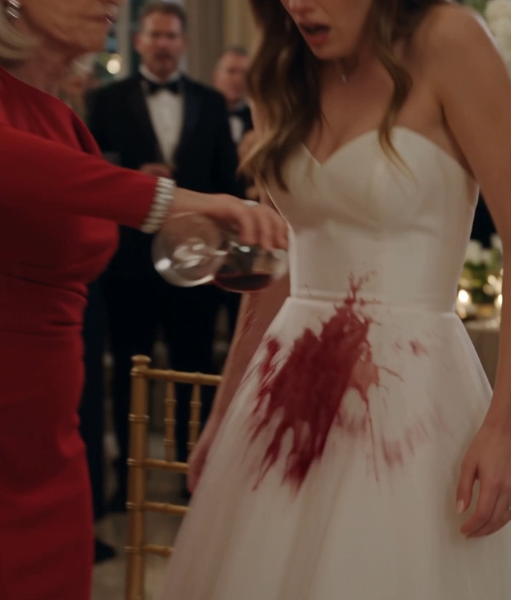
“Oh dear. How clumsy of me.”
CHAPTER ONE — Something Borrowed
The dress had been her mother's last project, and it had taken eleven months to finish.
Clara Ferris had watched it grow. She had watched it through the long grey winter of the year she turned twenty-two, from the corner of a cramped Dayton living room, where her mother, Ruth, sat propped on a mountain of pillows with a sewing machine on a card table and an oxygen tube taped beneath her nose. It had begun as a roll of silk from a fabric outlet on the east side. It had become a bodice, a bell of tulle, a hundred tiny hand-set seed pearls along the neckline, each one stitched on with a needle that shook a little more every week.
It isn’t for anyone yet, her mother used to say, with a wry smile. I’m just keeping my hands busy.
Both of them had known whom it was for.
She had died in April, on a Tuesday, in the hospice on Third Street, with the dress hanging on the back of the door in a clear plastic bag, and her last coherent sentence had been about the hem. It’s a quarter-inch too long on the left. Tell the tailor. Clara had laughed through her tears and promised. Four years later, she had kept the promise. The hem was perfect.
Now she stood in the middle of a ballroom, in that dress, with a bouquet of white roses in her hands, and tried to remember how to breathe.
The Ashbury Hotel had been built in 1923 for people who liked chandeliers. It had a pale marble floor like a frozen lake, and tall arched windows hung with cream silk, and a ceiling so high that the chandeliers hung in it like clusters of stars. Three hundred guests sat at round tables with gilt chairs and white roses, in a hum of laughter and clinking glass. A string quartet played in the corner. Beyond a pair of glass doors at the end of the room, a terrace looked out over the dark lawns, strung with tiny lights.
It was the most beautiful room she had ever seen. It had cost, she calculated, about eleven times her mother’s lifetime earnings.
She had not paid for any of it.
“You look,” said a voice at her shoulder, “like a woman who is working very hard at looking calm.”
She turned. It was Priya Nair, her maid of honour, in a dress of dusty rose, with her dark hair pinned up and a glass of champagne in each hand. She held one out. “Drink this. You haven’t eaten since the ceremony, and you’ve gone green.”
“I’m fine.”
“You are not fine. You are a bride, and you’re wearing a face like a hostage.” She clinked her glass against Clara’s. “Come on. He’s out on the terrace, on the phone. Something about a hospital. He’ll be back in a minute. Just breathe.”
Clara drank.
It was a very small sip. The bubbles stung her nose. Across the room, at the long head table beneath the biggest chandelier, a tall silver-haired woman in a long-sleeved scarlet dress sat very upright in her chair with a glass of red wine in her hand, watching her.
She was not smiling.
Margaret Whitlock had told her, at the rehearsal dinner, exactly what she thought of her.
She had done it with enormous charm. She did everything with enormous charm. It was a skill that Clara, who had grown up in a house where people said what they meant, had never quite learned to read. At nine o’clock the previous evening, in the private dining room of a restaurant that cost more per head than the Ferris family had spent on groceries in a month, with the candles lit and the waiters hovering, Mrs. Whitlock had risen with a glass in her hand and delivered a toast so gracious that the guests had wept.
Then, afterwards, in the corridor by the cloakroom, quite alone, she had laid one cool hand on Clara’s arm, and said:
You’ll find, my dear, that I’m rather an easy woman to get along with. All I ask is that people know their place.
I don’t think I understand, Mrs. Whitlock.
Margaret, darling. We’re family. A smile like a blade drawn very slowly from a sheath. And I do so hope you won’t be offended by my little protest tomorrow. The mother of the groom is supposed to wear beige, you know. Something quiet. She had looked at Clara with her pale, cool, knowing eyes. I intend to wear red.
Why?
Because somebody has to wear a colour that says: I didn’t choose this.
She had walked away.
Clara had stood in that corridor, with her hands knotted in front of her and the blood roaring in her ears, and for the first time in her life, she had thought, with absolute clarity: this woman is going to try to destroy me.
Then she had thought: and I’m going to let her. Because of Ethan.
Because Ethan was worth it.
She had met him two years ago in the kitchen of a bakery. He had come in at six in the morning, in a rumpled suit with a coffee stain on his tie, looking for a birthday cake for his godson, and had stood in front of the display for ten minutes in silent bewilderment before asking, with the gravity of a man consulting an oracle, which one of these is the most cheerful? She had put a lemon tart in a box, and said, this one, and he had said, how much? And she had said, nothing, you look like you need it.
He had come back the next day. And the day after that.
He was thirty-three. He ran, in a reluctant, apologetic, faintly bewildered way, the third-largest hotel group in the country, which his father had built and his mother had inherited and he was expected, in due course, to rule. He was kind. He was funny. He was so shy that he got hiccups when he was nervous. He had once spent forty minutes in a snowstorm helping a stranger push a car out of a ditch, and arrived at a board meeting soaked to the skin and grinning. He had never, in two years, said one unkind word about his mother.
He had only said, once, at three in the morning, in a quiet voice, looking at the ceiling: She wasn’t always like this. After Dad died she just— sort of locked up.
Clara had understood. Her own grief had made her soft. His mother’s had made her hard.
She had thought, in the foolish hopeful way of the very young, that she might be able to thaw her.
She was watching, now.
That was the thing. Clara had felt it from the moment that she walked into the ballroom on Ethan’s arm, an hour ago, to a standing ovation: the weight of a stare, cool and steady and unblinking, like a hand laid flat on the back of her neck. She had told herself not to look. She had looked anyway. And there, at the head table, in the midst of the golden noise and the tinkling glass, had sat Margaret Whitlock, in her dress the colour of an open wound, with her silver-white hair in a perfect bob and a pair of pearl drops at her ears, motionless as a figure in a painting.
She had lifted her glass an inch, and smiled.
It was a toast. It was almost kind. It was the loneliest and most terrible smile that Clara had ever seen, and she had gone cold to her fingertips.
“Priya,” she said.
“Mm?”
“I think I’m going to go and find Ethan.”
“Good idea. I’ll come—”
“No. It’s fine. I’ll be a minute.”
She set down her glass. She lifted the bouquet, and gathered her skirts in one hand, and began to walk across the great pale floor towards the glass doors. She did not hurry. The whole room turned to watch her go, smiling, lifting their glasses, a tide of warm gold faces. A little girl in a flower-girl’s dress waved. An old man at table four blew her a kiss.
She had gone perhaps fifteen steps when a voice spoke at her shoulder.
“Darling.”
She stopped.
It was close. It was very close. She had not heard anyone approach. She turned, slowly, and found herself face to face with a long, narrow, handsome, powdered face, and a pair of pale cool eyes that held hers with perfect composure, and a smell of lilies and bergamot and, underneath, something faintly metallic, like a coin on the tongue.
“Margaret,” said Clara. “I was just going to—”
“What a brave choice,” said Margaret Whitlock.
She was smiling. She said it in the same warm, musical, carrying, gracious tone that she had used to toast her son, so that anyone nearby would have thought that she was offering a compliment. Her glance travelled slowly down the length of the white silk bodice, the seed pearls, the bell of the skirt. She held a glass of red wine in her right hand, at about the level of her waist. She had not touched it. It swayed gently, a dark pool in the crystal.
“White,” she said. “For a girl like you.”
“I beg your pardon?”
“Oh, don’t be hurt. It’s only that one does wonder.” She tilted her head. “It’s such a symbol, isn’t it? Such a statement. All that purity.” Her eyes flickered, very slightly, towards the room. “And your family, my dear. One hears so much.”
The quartet had begun a waltz. The guests were laughing. The chandeliers glittered. And in the midst of it, Clara stood on the marble in her mother’s dress, with her bouquet in her hands and her heart beating in her throat, and understood, with a dreadful, slow, sinking certainty, that the woman before her was not going to stop.