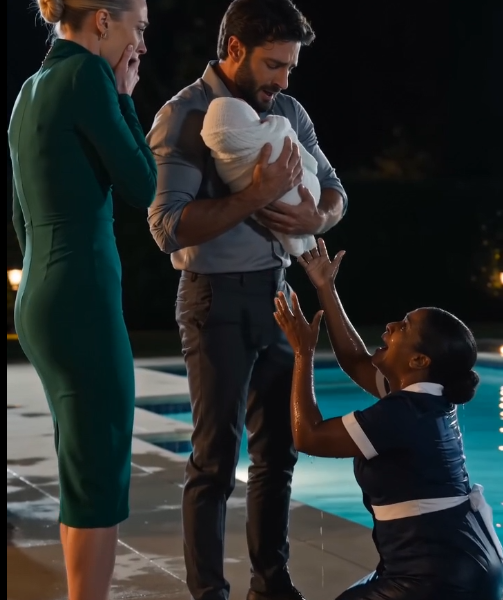
She threw the mafia boss’s five-month-old son into the swimming pool at night, staging it to look like an accident—but she forgot that the “useless” nanny was watching her.
Chapter One — The Green Dress
At 8:51 p.m., the Castellane estate in Lake Forest, Illinois, was so quiet that Naomi Brooks could hear the pool filter humming beneath the terrace like a distant engine.
She stood beside the stroller with a warm bottle of formula in her hand, counting the minutes the way she had once counted drips, and breaths, and heartbeats on the pediatric intensive care unit at Lurie Children’s Hospital. Old habits did not die. They only changed uniforms. Five years ago she had worn scrubs the color of seafoam. Now she wore a navy dress with a white collar and flat, sensible shoes, and the only monitor she watched belonged to a five-month-old boy named Theo Castellane, who had finally, after two hours of fussing, gone soft and heavy under his gray swaddle.
The terrace glowed gold from the tall arched windows of the house. Beyond the stone border, the pool lay still and dark and perfect, lit from below so that it looked like a sheet of green glass laid over the earth. A late September wind moved through the oaks at the edge of the lawn. Somewhere inside, a clock struck the quarter hour.
Naomi bent over the stroller and tucked the edge of the blanket beneath Theo’s chin. His eyelashes were enormous. They rested on his cheeks like tiny black commas. One of his fists had escaped the swaddle, and she gently folded it back, and he sighed in his sleep, a sound so small and trusting that it made her chest ache.
She had been in this house for seven months. In that time she had learned its rules the way people learn the rules of a country where they are not citizens. Do not speak to Mr. Castellane unless he speaks first. Do not look at the men who stand at the gate. Do not ask where he goes when he leaves in the black cars after midnight. Do not ask why the housekeeper, Mrs. Pruitt, crossed herself every time a certain phone rang in the study.
The rules were simple, and Naomi had followed all of them. She had not followed them out of fear, though she was wise enough to feel some. She had followed them because of the baby. Theo’s mother, Sofia, had died eleven hours after giving birth to him, and the house had been trying to learn how to breathe ever since. Adrian Castellane, who ran half the waterfront of Chicago with a voice that never rose above a murmur, had walked past the nursery door for the first three weeks as if it were a room full of fire.
Naomi had walked through it every night.
She had sung to the baby in the dark. She had taught Adrian, very quietly, how to hold his own son’s head. She had never once told anyone that the first time he finally lifted Theo against his shoulder, the most feared man in the city had stood in the middle of the nursery and cried without making a sound.
The heels came first.
Naomi knew them before she turned. A sharp, bright click on the stone, unhurried, like a metronome counting down something. Vanessa Hale had a way of walking that announced the weather. When she entered a room, the room adjusted.
“There you are,” Vanessa said.
She stepped out of the glow of the doorway into the terrace light, and Naomi had to admit, as she always had to admit, that the woman was beautiful. Thirty-one years old, hair the color of pale honey pulled into a smooth knot at her neck, a long emerald dress that fit her like it had been poured. A diamond the size of a thumbnail sat on her left hand. It had been there four months. In six weeks it would be joined by a gold band, and Vanessa would become Mrs. Adrian Castellane, stepmother to the most protected child in Illinois.
“Miss Hale,” Naomi said. “Mr. Castellane isn’t back until eleven.”
“I know when my fiancé is back.” Vanessa smiled. It was a lovely smile. It never reached higher than her cheekbones. “I thought I’d spend a little time with Theo. Since we’re going to be family.”
Naomi kept her voice very even. “He just fell asleep. It took two hours.”
“Then he’ll sleep in my arms.”
“Mr. Castellane’s instructions are that I—”
“Naomi.” Vanessa said her name the way you might set down a cup. Gently. Carefully. As if it were breakable and she was deciding whether to break it. “I’m going to be his mother in six weeks. I think I can hold him for ten minutes.”
There it was. The soft, polite door, closing.
Naomi felt something cold slide down her spine. It was not alarm yet. It was only the thing that nurses learn to feel before alarm, the small private tilt of the floor that says something in this room is wrong and you do not have the words for it yet. She had felt it once before a monitor flatlined. She had felt it once outside a patient’s door, an hour before the family arrived with a lawyer.
“Of course,” she said.
She watched Vanessa lean over the stroller and lift Theo out, and for one second, a quick, hot flicker in her gut, Naomi nearly stepped forward and took him back. But the woman cradled him properly. Her hand supported his head. Her face softened into the practiced shape of tenderness. Theo stirred, frowned, and slept on.
See, Naomi told herself. You’re tired. You’re seeing shadows.
“Why don’t you warm another bottle?” Vanessa said without looking up. “He’ll want one when he wakes. And bring me a glass of water, would you? It’s been a long day.”
It was the third time that week that Vanessa had sent her away from the baby with a small, reasonable errand. A bottle. A blanket. A message for Mrs. Pruitt that turned out to be unnecessary. Naomi had noticed. She had noticed and filed it away, the way she filed everything, in the quiet part of her mind where the numbers lived.
She walked to the warming tray beside the glass doors, perhaps fifteen feet from the stroller, and she set down the bottle she was holding. She reached for the fresh one.
Then she heard the sound.
Not a splash. Not yet. A tiny, bright noise, the clink of Vanessa’s diamond against the stone coping at the pool’s edge.
Naomi turned.
It took less than a second for her mind to catch up to her eyes. Vanessa Hale stood at the very lip of the water, her back to the house, her green dress glittering in the underwater light. She held Theo out in front of her at arm’s length, the gray swaddle hanging from her hands like a parcel. Her face was calm. Her face was calm. That was what Naomi would remember afterward, long after the shock had worn into something she could look at directly. Not rage. Not madness. A cool, clean, almost bored expression, the face of a woman completing an item on a list.
“Miss Hale,” Naomi said. Her voice came out thin and strange. “Miss Hale, what are you doing?”
Vanessa looked over her shoulder.
She smiled.
And she let go.
The bundle fell through the air in a slow, awful arc, and Naomi’s whole body went white and silent, and the water opened its dark mouth, and the splash was so small, so very small, that it seemed impossible that anything so enormous had happened.
The pool closed over her whole life.
“Oh my God,” Vanessa said, in a bright, shaking voice that carried perfectly across the empty terrace. “Oh my God, somebody help, the nanny dropped the baby!”
Naomi did not remember deciding to run. She remembered only that her shoes were gone, that the stone was cold against her stockinged feet, that the glass doors were a blur behind her and the green dress was a blur in front of her. She remembered the wet slap of her own palms against the coping. She remembered looking down and seeing a pale shape, white against the turquoise, tilting, turning, sinking, the gray swaddle opening slowly like a flower in the water.
She remembered the number.
Three minutes. A baby of five months, a closed airway, cold water. In the ICU they had taught it like scripture. Three minutes to damage. Six minutes to the end of everything. Every second that she stood on the stone was a second Theo would not get back.
Somewhere above her head, Vanessa was still performing, her voice rising on a wave of rehearsed panic. Naomi did not hear a word. She had only one thought left, so simple and so clean that it felt like a hand lifting her up.
Go.
She did not decide to jump.
The jump decided her.
The night air tore past her face, and then the water hit her like a wall, and the whole loud world snapped off and turned green and silent. Her uniform dragged at her legs. Her ears roared. The cold punched every last breath out of her chest, and she kicked, and kicked, and opened her eyes in the stinging chlorine, and saw him.
Theo was ten feet below her, drifting, small and pale, one little hand open in the water like he was trying to wave.
Naomi Brooks, who had once held the state record in the two-hundred-meter freestyle, who had not swum a single competitive lap in nine years, who had told herself she’d left that girl behind in a locker room in Springfield, dove.
The girl had not gone anywhere.
She had only been waiting.
Chapter Two — The Water
Underwater, there is no such thing as a loud thought.
Naomi had forgotten that. She had forgotten the particular silence of a pool at night, the way sound dissolved and the body became a single instrument tuned to one purpose. Her arms moved before her mind did. Her kick came up from her hips, long and low, the old rhythm her coach in Springfield used to drill into her with a whistle and a stopwatch and a sentence she had never been able to shake: Don’t fight the water. Make it work for you.
Her uniform fought her anyway. The navy fabric ballooned and clung, heavy as wet sand, dragging at her knees. Her lungs, which had taken only half a breath before the jump, began to tighten. She kicked harder. The turquoise light wobbled around her, throwing bars of shadow across the pale shape below.
Theo was still sinking.
He went down slowly, the way very light things go down, turning a little as he fell. The gray swaddle had come loose in the water and trailed away from him in soft folds. His face was turned up toward the surface. His eyes were closed. A tiny silver thread of bubbles escaped his mouth and spiraled toward the light, and Naomi understood, with a terrible clarity, that each bubble was a breath he would not get back.
Eight feet. Seven.
She could feel the pressure building in her ears. She could feel her own heartbeat hammering in her throat, so loud that it seemed to shake the water. In the ICU she had once spent four hours bringing back a nine-month-old who had stopped breathing in the middle of the night, and when the baby’s heart had finally flickered back to life on the monitor, the attending had laid a hand on her shoulder and said, You never stop doing the math, do you, Brooks. She had laughed. She had not told him that she did the math in her sleep.
Now the math was everything.
Three minutes. Maybe less in cold water. Maybe more. Move.
She reached him.
Her fingers closed around the fabric first, and then around the soft, warm, impossibly small weight of him, and the sheer miracle of it, the realness of it, almost cost her what little air she had left. She pulled Theo against her chest, wrapped one arm beneath his head, and kicked for the surface with everything she had.
The water did not want to let them go.
Her legs screamed. Her shoulder burned. Black dots began to bloom at the edges of her vision, small and gentle at first, like ink dropped into milk. She thought of Sofia Castellane, whom she had never met, whose photograph hung in the hallway outside the nursery, a laughing dark-haired woman in a sundress on a beach. She thought, absurdly: I’m sorry. I’m so sorry. I’m not going to let go.
She broke the surface like a woman coming up out of a grave.
Air hit her face in a violent rush. She dragged it in, coughing, choking, blinking the chlorine out of her eyes. The night was a blur of gold light and black sky. Water streamed from her hair. The terrace shimmered somewhere above her, tilted, enormous.
And Theo was not breathing.
She felt it before she saw it. A stillness in his small body that was different from sleep. His lips had taken on a faint blue shadow. His head lolled against her forearm, and a thin, clear thread of water ran from the corner of his mouth.
“No,” Naomi said. “No, no, no, baby, come on, come on.”
She hoisted him higher, clear of the water, both hands under his tiny back, and for a moment she simply held him up toward the sky as though the night itself might take pity on him and breathe.
Behind her, across the terrace, a pair of glass doors crashed open.
She did not see Adrian Castellane come through them. She only heard the sound, a heavy, desperate pounding of dress shoes on stone, and a voice she had never once heard raised in seven months, now ripped wide open into something raw and animal.
“Theo!”
He came across the terrace like a man falling. He did not slow down at the edge. He dropped to his knees at the coping so hard that the stone cracked under his weight, and he plunged both arms into the pool and took his son from her hands as if lifting something sacred out of a fire.
Naomi hung on the wall, shaking, one hand clamped to the rim, her wet hair plastered over her eyes. “He’s not breathing,” she managed. “He went under. He’s been under at least two minutes. Give him to me, Mr. Castellane, please, I’m a nurse, I know how—”
He was already turning away from her. The baby lay against his chest, small and gray in the white swaddle, and the most feared man in the city looked down into his son’s face, and everything in his own face broke at once.
“Please,” Naomi said. She hauled herself up over the edge of the pool, scraping her knees on the stone, her sodden uniform pouring water. “Please. Let me take him. There’s no time to wait for the ambulance. Lay him on the deck. Support his head. I need to clear his airway now.”
Something in her voice reached him. It was not a request. It was the voice she used in the unit, level and cold and utterly certain, the voice that had once made a surgeon step aside. Adrian stared at her for one half second that felt like an hour.
Then he laid his son down on the stone.
Naomi went to her knees beside him. Her hands, which had been trembling so hard in the water, were suddenly perfectly steady. She tilted the tiny head back, just slightly, a neutral sniffing position, the way she had demonstrated to a hundred frightened new parents. She cleared the mouth with one sweep of her little finger. She bent, sealed her lips over Theo’s nose and mouth together, and gave him two small breaths, each no more than a puff of air.
The chest rose.
Fell.
Nothing.
“Come on, Theo,” she whispered. “Come on, sweet boy. You’re not done yet. Your daddy’s right here. Come on.”
The terrace was dead silent. Somewhere behind her, Naomi was dimly aware of Vanessa Hale’s heels, a quick, frantic clicking, and a voice, high and thin and perfectly pitched: “She dropped him, Adrian! I turned around and she just dropped him, I tried to stop her, I swear to God I tried—”
Naomi did not look up.
She placed two fingers at the center of Theo’s chest and began compressions, gentle, fast, rhythmic. One-and-two-and-three-and-four. She counted aloud, steady as a metronome, her voice cracking. Adrian knelt across from her, his hand pressed over his own mouth, his whole body locked rigid. She had never seen a man look so completely like a building about to fall.
She gave two more breaths.
The tiny chest shuddered.
Then Theo Castellane coughed.
It was a small, wet, ugly sound, like a kitten sneezing, and it was the most beautiful thing Naomi had ever heard. Water spilled from the baby’s mouth. His face crumpled. His arms flew open in the air, tiny fists clenched, and he drew in a ragged, shuddering breath and let out a howl of pure outrage that rang across the terrace and the lawn and every window of the house.
Adrian made a sound she would never forget. It was not a word. It was the sound a man makes when a rope he has been holding for forty minutes finally comes up out of the dark with something alive on the end of it.
He scooped up his son. He pressed him against his chest, wet swaddle and all, and bent his head over the small, furious, living body. His shoulders shook. His hands, great scarred hands that had signed deals and ended careers and done far worse, cradled the baby’s skull as if it were made of glass.
Naomi sat back on her heels. Her legs would not hold her. Her whole body had gone weightless and strange, a balloon after the string is cut. She laughed once, a dry, cracked, astonished sound, and then she pressed the back of her wrist against her mouth and shook.
And Vanessa Hale stood over them both in her emerald dress with one hand clapped to her lips.
She had the face for it, Naomi would think later, in the dark. She had always had the face. The wide, shining eyes. The trembling mouth. The perfect, perfect expression of a woman witnessing a tragedy she had been powerless to prevent. Only when you looked closely, only when you had spent seven months learning the way she breathed, could you see what lay beneath the surface of that performance.
She was not relieved.
She was calculating.
Because Theo was alive, and that had not been in the plan.
“Adrian,” Vanessa said, her voice breaking prettily. “Oh, Adrian, thank God. Thank God. I was so frightened. I only turned my head for a second, I was just standing right here, and she—” She swallowed and pointed at Naomi with a hand that shook, and her whole face contorted into grief. “She was holding him over the water. I told her to stop. I begged her. I don’t know what’s wrong with her. I think something’s wrong with her. She’s been so strange lately.”
The words dropped into the night like stones into the pool.
Naomi raised her head slowly.
She looked at the woman in the green dress.
She looked at the man holding the baby.
Adrian Castellane lifted his eyes from his son’s face. He looked at Naomi, kneeling at his feet, soaked to the bone, her hair streaming, her hands still shaking from the compressions. He looked at Vanessa, standing tall and dry above her, one jeweled hand over her heart.
He was an intelligent man. He had survived thirty years in a world where a single misread face could cost a life. And in that moment, in the long slow second where the two women waited for him to speak, Naomi saw the thing she feared most cross his features.
Not belief.
Doubt.
“Silas,” Adrian said quietly.
A tall man in a charcoal suit had appeared at the glass doors, one hand already resting on his earpiece. Silas Moreno, head of the Castellane household security, had a face like a locked door.
“Sir.”
“Get the car. Northwestern, Lake Forest. Call ahead.” Adrian’s voice did not shake, but his throat worked as if he were swallowing nails. “And nobody leaves this house.”
His eyes moved, slowly, from Vanessa to Naomi, and back again.
“Nobody.”
Chapter Three — Two Stories
The emergency room at Northwestern Lake Forest Hospital had been built to look like a hotel lobby, with warm lamps, pale wood, and a coffee station nobody used. It did not feel like a hotel lobby at 10:40 p.m. with a baby behind a curtain and two women on opposite sides of the corridor who had not spoken a word to each other since the car.
Theo was alive.
That was the single fact Naomi held in both hands as she sat in a plastic chair under a flickering light, wrapped in a thin gray hospital blanket that smelled of detergent. Her hair had dried into stiff ropes. Her stockinged feet were bruised. Somebody, a nurse, kind, brisk, with a gold cross at her throat, had pressed a paper cup of tea into her hands, and Naomi had not yet been able to drink it, because the cup kept rattling against her teeth.
Behind the curtain, a pediatrician named Dr. Priya Raman had been working for forty minutes. Every so often Naomi heard her voice, calm and quick, giving instructions. Pulse ox. Another set of vitals. Let’s get a chest film. Every so often she heard Theo cry, a weak, hoarse, indignant sound, and every time he did, something inside Naomi unclenched by a quarter inch.
He was alive. He was crying. Crying was good. Crying meant air.
Across the corridor, Vanessa Hale sat with her legs crossed and her chin lifted. She had accepted a blanket too, a better one, a thick cream wool the hospital kept for donors, and she had arranged it around her shoulders so that the emerald dress showed at the edges like a jewel. She had cried, a little, in the car. Tidily. She had dabbed beneath her eyes with a folded tissue and held Adrian’s sleeve and murmured, I’m so sorry, I’m so sorry, I should have stopped her sooner.
Adrian had not answered.
He had not said a single word to either of them since the terrace.
He stood now at the end of the corridor with his back to the wall and his hands in his pockets, his jacket stained dark from the pool, his shirt collar open and wet at the throat. He looked like a man who had been taken apart and put back together by someone who had not read the instructions. Silas Moreno stood a respectful ten feet away, scrolling slowly through something on a phone.
Nobody spoke. The clock on the wall ticked. A vending machine hummed.
At 11:05, Dr. Raman came through the curtain, pulling off a glove.
Adrian was beside her before she finished the motion. “Tell me.”
“He’s going to be all right.” The doctor had silver in her hair, tired brown eyes, and a voice that carried exactly the weight it needed to. “He inhaled a small amount of water, and he was without oxygen for what I’d estimate at under three minutes. That is, frankly, a miracle. We’ll keep him overnight for observation. The next twelve hours are important. Aspiration can cause delayed complications, and I want a pediatric pulmonologist to look at his lungs in the morning. But his oxygen saturation is stable, his heart rate is strong, and his neurological responses are exactly what I’d hope for.” She paused. “Whoever started rescue breathing and compressions on that terrace, I’d like to shake her hand.”
Adrian’s jaw moved. He turned his head, slowly, and looked down the corridor.
Naomi stared at the floor.
“I’ll sit with him,” Adrian said at last, hoarsely.
“Of course.”
He went through the curtain. The hospital lamps swallowed him.
The corridor was quiet again, and then, softly, with no one left to perform for, Vanessa Hale spoke.
“You really should have been more careful, Naomi.”
Naomi lifted her head.
Vanessa was looking at the ceiling, not at her. Her voice was low and pleasant, and so reasonable that for a moment the words didn’t register. “I understand it was an accident. I’m sure it was. Everyone has bad days. You’re obviously exhausted, you’re not sleeping, you’ve been so emotionally invested in that baby. It’s not healthy. I mentioned it to Adrian last week, actually. I said, I think she’s getting too attached.”
“You threw him,” Naomi said.
It came out barely above a whisper. She was surprised she had the strength for it.
Vanessa turned her head. Her face was a mask of gentle confusion. “I’m sorry?”
“You threw him into the pool.” Naomi’s hands tightened around the tea. “I saw you. I was thirty feet away. I saw your face. You looked at me, and you smiled, and you let go.”
“Oh, honey.” Vanessa leaned forward and put one hand on Naomi’s knee, soft as a feather, and spoke in the tone people use for the very ill. “You’re in shock. That’s what shock does. It rewrites things. You were holding him, and he slipped, and you’ve turned it into a story because you can’t bear what happened. I understand. I won’t hold it against you. But you have to stop saying things like that. People will think you’re unwell.”
Naomi stared at her.
In all the long years of the unit, through all the nights and the codes and the families who screamed, nothing had ever frightened her the way that hand on her knee did. It was not cruelty. She knew cruelty, and cruelty was hot and obvious. This was something else, something cool and ordinary and perfectly sealed, like a door with no handle on the inside.
Vanessa patted her once and withdrew.
“Think about it,” she said gently. “Who are they going to believe?”
The nurse with the gold cross passed in the corridor and glanced between them. Vanessa gave her a tremulous, grateful smile. The nurse smiled back. Naomi watched the whole thing happen, a small clean transaction of trust, and she saw how easily it could go the other way.
She was a Black woman in a wet uniform. Vanessa was a blonde woman in a designer dress.
She did not need to ask who the world would believe. She had spent thirty-two years knowing the answer.
—
Silas Moreno came for her at midnight.
“Miss Brooks.” He did not sit. He stood in front of her chair with his hands folded, a tall, broad, quiet man with a scar through one eyebrow and eyes the color of wet slate. “Mr. Castellane would like you to wait at the house.”
“I want to stay with Theo.”
“I understand.”
“He needs someone who knows his routine. He’ll wake up in the night. He doesn’t take the bottle from strangers. He’ll scream until he vomits, and the doctors won’t know that, and—”
“Miss Brooks.” His voice was not unkind. “It isn’t a request.”
She looked up at him. For seven months she had walked past this man a dozen times a day. He had nodded to her. He had once, in February, left a thermos of coffee outside the nursery door without a note. She had never thought of him as anything but part of the weather of the house.
“Am I under arrest?” she asked.
“No.”
“Am I free to go?”
Silas was silent for a moment. “You are being asked to remain at the estate,” he said carefully, “until Mr. Castellane has had a chance to understand what happened tonight.”
It was the most polite description of imprisonment she had ever heard.
She stood. The blanket fell away. She folded it, neatly, and placed it on the chair, because her mother had raised her to leave a room better than she found it, and she followed him out through the sliding doors into the cold night air.
—
The room they gave her was the small guest suite on the ground floor, the one overlooking the herb garden. It was nicer than any room she had lived in for a decade. It had a white bed, a reading chair, a framed print of a lighthouse. The door had a lock on the outside.
Silas apologized. He actually apologized, quietly, before he turned the key.
Naomi sat on the edge of the bed in the dark and let the shaking come.
It came in waves, from the center of her body outward. First her hands. Then her shoulders. Then her jaw, so hard that her teeth clicked. She pressed her face into a pillow and made no sound at all, because in seven months this house had taught her the value of being quiet. The adrenaline drained out of her like water out of a tub, and in its place came the rest. The cold. The fear. The memory of the weight of him in her arms, so light, so light.
When the worst had passed, she sat up and wiped her face with the heel of her hand and made herself think.
Nobody had ever taught her to be a detective. But she had been a nurse for six years, and nurses are trained, above everything else, to notice. To notice a patient’s color. To notice the family member who doesn’t look at the bed. To notice what is missing from the chart.
She began, slowly, to go back.
It had been three weeks since the engagement dinner. Three weeks since Vanessa had first started to appear in the nursery at odd hours, always when Adrian was out. At first she had come with gifts: a silver rattle, a cashmere blanket, an enormous stuffed giraffe that Theo regarded with deep suspicion. She had cooed. She had held him stiffly, as though he were a parcel she had been asked to carry for a friend.
Then the questions had started.
What time does he go down for the night? Who’s with him when you’re off? Does Adrian ever sleep in the nursery? Is it true there’s a trust, something Sofia’s family set up? Do you know how much? Who manages it?
Naomi had answered the first two politely. She had deflected the third. She had told herself that a woman who was about to become a stepmother had every right to be curious.
But Vanessa’s curiosity had a shape, and the shape was money.
She remembered a conversation she had overheard a week ago, passing the sunroom with a stack of laundered bibs. Vanessa’s voice, low and urgent, on the phone. No. I told you, I need more time. The wedding’s in six weeks. After that it’s all mine. Of course it’s real. Don’t you dare threaten me. A pause. A laugh with no humor in it. Then you’ll have to wait like everybody else.
Naomi had walked on. She had told herself it was none of her business.
She remembered the day Vanessa asked Mrs. Pruitt to take the cameras on the terrace offline, because she wanted “a more natural look” for the engagement photographs. Mrs. Pruitt had mumbled something about Mr. Castellane’s rules. Vanessa had said, sweetly, I’ll speak to him. The next week the terrace cameras had been shut down for “maintenance.” They had stayed down.
Naomi stood up and began pacing the small room in her bare feet.
Tonight, the cameras would have been dark. Of course they would. Vanessa had planned it. She had picked the night Adrian was due home late, the hour when the household staff took their dinner, the corner of the terrace where the light was dim and the walls were high. She had even sent Naomi away from the stroller, once, twice, three times that week, as practice. Small errands. Small obediences. Training the nanny to look away.
It had all been rehearsed.
Who are they going to believe?
A cold rage began to rise in her, so new and so strong that it startled her. She was not an angry woman. She had learned long ago that anger was a luxury for people with someone to catch them when they fell. But she stood in the middle of a locked room in a mansion owned by a crime boss and thought, quite clearly: She put a baby in the water. She would have let him drown. She would have let me take the blame for it. And in six weeks she would have married his father.
The silence of the room pressed down on her.
Then, across the dark, a faint green light caught her eye.
It was her bag, hanging on the back of the reading chair, brought in by Mrs. Pruitt along with her shoes. The strap had slid open. Inside, beside a worn paperback and a pair of reading glasses, a small rectangular screen glowed softly in the dark.
Naomi went still.
It was the tablet.
The little tablet she kept in her bag for the baby monitor.
She stared at it. And slowly, like a key turning in a lock, a memory came back. Eight weeks ago, when Theo started to roll over. A small black camera, no bigger than a coin, that she had clipped under the canopy of his stroller so she could watch him through the monitor app when she stepped away to warm a bottle. She had bought it with her own money from a drugstore. She had never told anyone. She had only used it for naps.
She had never switched it off.
Her heart began to pound. She reached for the tablet with fingers that suddenly would not obey her, and she woke the screen, and she saw a gray folder icon she had never opened, labeled with a date.
Today’s date.
A small blue progress circle spun beside it, saying only one word.
Uploading.
Chapter Four — What the Camera Saw
Naomi pounded on the door until her fists ached.
“Silas! Mr. Moreno! Please, I need you to open the door!”
She had never shouted in this house. It felt like breaking a window in a church. But the little blue circle was still turning on the tablet’s screen, and she did not know how long it would keep turning, and she did not know whether a signal could cross a mansion built with walls two feet thick, and she did not know whether the woman in the green dress, wherever she was tonight, had thought of every single thing.
The lock clicked.
Silas stood in the doorway in his shirtsleeves. It was 1:20 in the morning. He looked as though he had not blinked since the terrace. “Miss Brooks. If you need medical attention—”
“I have it.” She held out the tablet with both hands. “I have it on camera.”
He did not move.
“The stroller,” she said, and her voice shook, and she made it stop. “There’s a camera under the canopy of the stroller. A little one. I put it there in July so I could watch Theo when I stepped away. It records to a cloud account. It must have been running the whole time. It must have seen everything.”
Silas looked at the tablet. He looked at her. He had a way of looking, slow and flat and thorough, that she had always assumed was suspicion. Standing under the lamp in the hallway, she realized it was only attention. He took in everything. He judged nothing until he had finished.
“Play it,” he said.
Her thumb slid across the screen. The little circle finished turning. The folder opened.
The video was dim and grainy, shot from below at a skewed angle, a world seen from a stroller canopy. A strip of stone terrace. The edge of the pool. A slice of arched window with warm gold light behind it. The timestamp in the corner said 8:49 p.m. A small, familiar shape stood at the edge of the frame. Naomi. She was folding a blanket. She looked, from this angle, painfully small.
Then another shape moved into view, tall and gleaming and green.
The audio crackled into life. It was tinny, but clear. Naomi heard her own voice say, Miss Hale, Mr. Castellane isn’t back until eleven. She heard Vanessa say, I know when my fiancé is back. She watched herself bend over the stroller. She watched the tall woman lift the baby out and cradle him.
“Wait,” Silas said quietly. “Go forward. Past the errand.”
She dragged the bar. On the screen, Naomi walked off toward the warming tray, shrinking into the corner of the frame. The camera, tucked under the canopy, now looked directly across the terrace, and what it saw was Vanessa Hale standing alone in the light with the child in her arms.
The tinny audio caught a murmur.
Vanessa was speaking to the baby.
“Shh. Shh. You’re not going to remember any of this, so it doesn’t matter, does it?” Her voice was soft, lilting, almost loving. It was the voice of a woman humming a lullaby. “Your mommy’s money should have been mine from the start. Do you know what it’s like to be thirty-one and owe two million dollars to a man who doesn’t take no? Do you know what it’s like to be so close*? One little splash, baby. One little accident. And it all goes where it belongs.”*
The room went very cold.
Silas had stopped breathing. Naomi could see the small muscle in his jaw jump, once, twice.
On the screen, Vanessa walked to the edge of the pool. She turned. Her eyes swept the terrace once, scanning for witnesses, passing right across the lens of the camera she had never known was there. She looked directly into it for a whole second, and she saw only a stroller.
She held the bundle out over the water.
She looked over her shoulder at Naomi.
She smiled.
The video did not need sound for what came next.
Silas put his hand over the screen.
“That’s enough,” he said.
His voice was raw. Naomi had never heard it like that, and for a moment she saw something in his face that was not a security chief’s calm at all. It was the face of a man who had spent two weeks quietly suspecting a monster, and who had watched the monster smile.
“Mr. Moreno,” Naomi said. “You knew.”
“I suspected.” He lowered his hand. “There was a payment. Three weeks ago. A transfer to an account in Chicago that I traced to Anton Kozlov. A man who lends money to people who can’t get it from banks, and collects it in ways banks don’t.” He rubbed his face. “Miss Hale owes him a great deal. I’ve been trying to find out how she meant to pay it. I did not understand until tonight that the plan was to inherit it from a baby.”
“Why didn’t you tell Mr. Castellane?”
“Because I had no proof,” Silas said. “And because Mr. Castellane was happy, for the first time since Sofia. And because I’ve worked for this family for eleven years, and in all that time, I have never once seen a man more afraid of losing something than he was of losing his son.” He looked at her. “I did not want to hand him a grief without evidence. I should have.”
“The cameras on the terrace,” Naomi said. “She had them shut down.”
“Her authorization code. Entered at 7:12 this evening.” He almost smiled, and the smile was terrible. “She was careful. She turned off every camera in that house but one.”
“The one she didn’t know about.”
“The one the nanny bought at a drugstore,” Silas said quietly.
He stood straight. He took the tablet from her hands as gently as if it were a living thing. “Is the file saved? Is there a copy?”
“It uploaded to my account. And my phone. I can send it anywhere.”
“Do not send it anywhere.” He was already moving. “Wait here. Lock the door from inside. Do not open it for anyone but me. Do you understand? Anyone.”
“Where are you going?”
Silas Moreno paused in the hall.
“To wake a man who has not slept in nineteen hours,” he said, “and show him what his house has been sleeping beside.”
—
At 3:04 a.m., in a private hospital room on the fourth floor of Northwestern Lake Forest, Adrian Castellane watched the video on a six-inch screen.
Theo slept in a clear plastic bassinet at the foot of the bed, a pulse monitor glowing on his foot like a tiny red star. The window looked out on a black parking lot and a few orange lamps. There was a vase of hospital carnations on the sill. The room smelled of antiseptic and warm milk.
Adrian watched all of it.
He watched Naomi fold a blanket. He watched Vanessa lift his son out of the stroller. He listened to the soft, lilting voice. He watched the woman he had given his mother’s ring to walk to the edge of his pool and look at the baby he had named for his grandfather and say one little splash.
He did not make a sound.
Silas stood beside the door with his hands folded and did not look at him, which was a form of respect.
When it was over, Adrian set the tablet carefully on the bedside table. He placed it very gently, as though it might go off. Then he leaned forward and pressed both hands against his eyes, and sat that way for a long time.
“I saw her,” he said at last. His voice was a whisper. “On the terrace. I saw the nanny in the water holding my son and I saw Vanessa standing there with her hand on her mouth and for one second, one second, Silas, I thought—” He stopped. “I thought the girl had done something.”
“Sir—”
“She saved him. She jumped into a pool in a dress and gave him her own breath and I stood there and doubted her.” He lowered his hands. His eyes were red and perfectly dry, the eyes of a man who has gone past tears into something harder. “What kind of man does that?”
“A man who has been lied to by people who love him,” Silas said. “It teaches you to look for the knife in everyone.”
“It taught me to miss it in the one who held it.”
He stood. He crossed the room to the bassinet and stood over his sleeping son, and he looked at the small rise and fall of the white blanket. His hand hovered, not quite touching.
“Where is she?” he asked.
“At the house. She’s in the east wing. I have two men outside her door and Dr. Hollis has given her something to sleep. She believes, sir, that you are still undecided.”
“Good.”
“Sir.” Silas hesitated. “There are options. Some of them are the kind you would ordinarily choose. I want it on the record that I would not argue with any of them.”
For a long moment Adrian said nothing. When he spoke, the voice was one Silas had not heard in eleven years, quiet, level, and so empty of heat that it was more frightening than any shout.
“A man like me,” Adrian said, “has two ways to settle a debt like this.”
Silas waited.
“The old way would be easy. It would be over by sunrise. And my son would grow up in a house that had been paid for in a coin I never want him to learn the weight of.” He turned from the bassinet. “Wake the woman in the guest room. Give her a chair. Give her tea. Give her my coat if she’s cold. And ask her, Silas, very respectfully, whether she would do me the honor of joining me in the library at dawn.”
“Sir?”
“She is going to watch this with me,” said Adrian Castellane. “She has earned the right to see how it ends.”
Chapter Five — Dawn in the Library
The library at the Castellane estate was a long, dim, wood-paneled room that smelled of old paper and cold ash. Floor-to-ceiling shelves ran down both sides. A carved marble fireplace stood at one end, and at the other, a wall of tall windows looked east across the lawn and the pool and the oaks, toward the first thin line of gray light on the horizon.
Naomi sat in an armchair near the fireplace with a blanket over her knees and a cup of tea she had finally managed to drink. She had been given dry clothes by Mrs. Pruitt, a pair of soft gray sweatpants and a cardigan that smelled faintly of lavender, and the old housekeeper had pressed her hand for a moment and said nothing at all, and Naomi had understood.
Silas stood at the door. Two other men, big, quiet, in dark suits, stood at the walls. A large television screen had been rolled in and placed before the fireplace, its cable snaking across the Persian rug.
Adrian was at the window with his back to the room. He had changed his shirt. He had come home from the hospital twenty minutes ago, leaving Theo in the care of Dr. Raman and two of Silas’s best, and he had not said a word to anyone since. The coming light made a narrow silhouette of him, a tall, still shape against the glass.
At 6:10, footsteps sounded in the hall.
The door opened.
Vanessa Hale came in wearing a cream silk robe, her hair loose and brushed and shining, her face carefully bare. She looked pale, fragile, and exhausted. She had even, Naomi noticed with a cold flicker of wonder, dabbed a touch of redness beneath her eyes.
“Adrian,” she said softly. “Darling. I couldn’t sleep. I kept thinking about Theo. How is he? Is he awake? Can I see him?”
“He’s well,” Adrian said, without turning around.
“Oh, thank God.” She pressed a hand to her chest and moved forward, graceful as a swan. “I’ve been so worried. And I know it’s been a terrible night for you, I know you must feel torn, but I want you to know I understand. I understand why you’re angry with Naomi. I just hope you’ll be gentle with her. She’s clearly not herself, and I don’t think she should be punished for—”
She stopped.
She had seen Naomi.
It lasted less than a second. A flicker, bright and quick and ugly, like a fish rising under black water. Then the smile came back, tender, concerned.
“Naomi. I didn’t realize you’d be here.”
“Sit down, Vanessa,” Adrian said.
“Adrian, I don’t think this is the right time for a confrontation—”
“Sit down.”
He had not raised his voice. He had not even turned. But the words fell across the room with such mild finality that Vanessa’s knees obeyed before her mind did. She lowered herself onto the edge of the sofa with her hands folded in her lap.
“I would like to tell you a story,” Adrian said. He turned at last, and the dawn light caught the side of his face, and for the first time in her life, Vanessa Hale looked at him as if she were seeing something that had always been standing in her house. “It’s a short one. It begins on a terrace.”
He nodded to Silas.
The television flickered on.
She watched it with her back very straight. Naomi, sitting ten feet away, kept her eyes on Vanessa’s face rather than the screen, because she had already seen the screen, and because there are few things in the world more instructive than watching a person’s story fall apart in real time.
At first there was nothing. A fixed, polite, interested expression, the face you wear at a stranger’s wedding. Then, when the grainy video showed her own hands lifting the baby from the stroller, a small tightening at the corners of the mouth. When the tinny voice began to murmur, You’re not going to remember any of this, so it doesn’t matter, the color left her cheeks in a slow, even tide.
When it reached the words one little splash, she closed her eyes.
When it reached the water, she opened them again.
The screen went black.
The silence in the library was enormous.
“That’s fake,” Vanessa said.
Her voice came out quite steady. She had always been good at this, Naomi realized. The recovery. The instant, clean pivot. “Those things can be done on a laptop in ten minutes. Adrian, you know that. Anyone can put anyone’s voice into anything. She’s a nurse, she’s clever, she’s had hours to—”
“The timestamp on that file,” Silas said evenly, “is 8:49 p.m., recorded by a camera that was purchased with a drugstore receipt in July and logged into the cloud at that hour by a server in Virginia. We have the metadata. We have the receipt. We have the stroller, which I am happy to bring in, with the camera still clipped beneath the canopy.”
“She could have—”
“We also have your authorization code on the terrace cameras. Entered at 7:12 p.m. from the household tablet in your dressing room.” Silas did not raise his voice. “We have a transfer from your account to Anton Kozlov, dated three weeks ago, for the sum of four hundred thousand dollars. We have a recorded voicemail from Mr. Kozlov’s office to your private phone, sent yesterday afternoon, using the words final notice.”
Vanessa stared at him.
“You went through my phone?”
“I went through everything,” Silas said. “It is, I’m afraid, what I’m paid for.”
It happened very slowly. Naomi would remember it afterward the way you remember watching a glacier calve into the sea: a long, silent shifting, and then a great sudden collapse. Vanessa Hale’s face did not crumple. It rearranged. The beautiful, wounded mask slid away, and what lay beneath it was the face from the terrace, the cool, clean, almost bored face, the one that had smiled and let go.
She sat back on the sofa. She crossed her legs.
“Fine,” she said.
“Fine?” Adrian said.
“Fine.” She looked at him with something that almost resembled contempt. “Do you know how dull you are, Adrian? A crime boss who cries at a christening. You lock your doors and you hold your baby and you talk about legitimacy, and you think because you’ve got a good heart under all that money that the world owes you a clean ending. It doesn’t.” Her gaze flicked toward Naomi, and the hate in it was so naked and so tired that Naomi felt it as a physical pressure on her skin. “And her. Do you know how many of her there are? A hundred in every city. Invisible. Helpful. Waiting for someone to notice how good they are. It’s pathetic. I did you a favor, you know. I’d have been an excellent wife.”
“You would have been a widow’s widow,” Adrian said. “With a trust you couldn’t touch, and an inherited debt, and a boy in the ground.”
“It would have been tidy.”
The words hung there.
Naomi realized she was gripping the arms of the chair so hard her knuckles had gone white. She forced her hands open one finger at a time.
Adrian walked across the room. He did not hurry. Each step was measured, deliberate, and the two men at the walls drew in an almost imperceptible breath. Silas shifted his weight, a very small movement, and a very large silence.
He stopped in front of the sofa and looked down.
“Take off the ring,” he said.
Vanessa looked at the diamond on her left hand. For the first time, something flickered across her face that might, in a better woman, have been fear.
She slid it off.
Adrian held out his palm. She dropped it into it, a small cold clink.
He turned it over in his fingers, once, and looked at the tiny inscription inside the band, a date, a word. Mama. His mother’s ring. Then he walked, unhurried, to the tall windows and unlatched one. The cold dawn air poured into the library, smelling of wet grass and chlorine. Below, in the gray light, the pool lay perfectly still.
He opened his hand.
The ring went out into the air and down, a small glint, and disappeared beneath the surface of the water without a sound.
“The pool is a good place,” Adrian said quietly, “for things I don’t want back.”
He turned from the window.
“Here is what is going to happen. At six-thirty, two detectives from the Lake County Sheriff’s Office will arrive at my front gate. They have been waiting there since four. Silas telephoned them himself. They will be given the tablet, the receipts, the transfer records, the voicemail, and a statement from a registered nurse who gave a drowning child her breath on the stone beside my pool. Those documents will go to a state’s attorney who has never once accepted a favor from me, which was the reason I chose her.”
Vanessa stared at him.
“You won’t,” she said.
“I will.”
“You can’t. You’re—” She laughed, high and strained. “You’re you. You don’t call the police. People like you don’t do this.”
“People like me,” said Adrian, “have been telling that to themselves for a very long time.”
He came back across the room and stood over her, tall and gray-lit and terrible, and when he spoke again, it was so soft that Naomi barely heard it.
“My son is going to grow up in a house where the worst thing that happens to a person who tries to hurt a child is that someone says her name in a courtroom and the whole world hears. That is the harshest thing I know how to do. It is also the only thing I am willing to teach him.”
“Adrian—”
“And Kozlov,” he said, “is a separate conversation. And I would think very carefully, Vanessa, if I were you, about whether you would rather meet the Lake County Sheriff or the man you owe two million dollars when your lawyer tells you what you’ve done to him by failing.”
She went absolutely white.
From the hallway came the sound of a car on gravel, then another. A bell chimed, deep and formal, at the front gate. The first red thread of sunrise touched the oaks.
Silas Moreno opened the library door.
Two plainclothes detectives stood in the hall, a man and a woman, badges clipped to their belts, a young deputy in uniform behind them.
Vanessa Hale rose from the sofa. She straightened her cream silk robe. She drew a long, slow breath, tilted up her chin, and walked toward the door the way she had walked onto that terrace, her head high, her bare feet silent on the old carpet, performing to the last.
At the threshold she stopped.
She turned and looked at Naomi.
Naomi stood up.
She was five feet seven in her bare feet, in a borrowed cardigan and sweatpants that were too long, with her hair in a rough knot and the print of the stone still bruised on both her knees. She looked at the woman who had put a baby in the water and said, Who are they going to believe?
“I believe him,” Naomi said softly. “I believed Theo. I always will. That’s the difference between us.”
Vanessa opened her mouth.
No words came.
The female detective, politely and firmly, took her arm.
The heels of the emerald dress were still lying somewhere on the terrace. Naomi would find them later, beneath a hydrangea bush, one on its side, the other upside down, abandoned in a hurry by a woman who had always believed there would be someone to pick them up.
Chapter Six — Don’t Fight the Water
The trial was in March.
It lasted five days, and in the end it took the jury under three hours. The prosecutor, a small fierce woman named Eleanor Voss, played the stroller video on a courtroom screen twice, once at full volume, once in silence, and by the second viewing nobody in the gallery was looking at it. They were looking at the defense table.
Vanessa Hale was convicted on every count, including attempted murder of a child and conspiracy to defraud a trust. The judge, a gray-haired man who had presided over many cases involving the powerful, delivered the sentence in a flat, unadorned voice. When it was done, the gallery was so quiet you could hear the radiators tick.
Anton Kozlov was indicted two weeks later on seventeen unrelated counts, after a certain package of financial records landed anonymously on the desk of a federal investigator. Nobody knew how. Silas Moreno, asked about it, said only that the paper had been very persistent in finding its way.
By then the Castellane estate had changed.
It was not obvious at first. The black cars still came and went. The men still stood at the gate. But on a cool April morning, Naomi walked into the kitchen to find Mrs. Pruitt laughing at something Silas had said, and Mrs. Pruitt had not laughed in that kitchen in seven months. The cameras on the terrace had been turned back on, all of them, and a new one had been installed on the stroller by Adrian himself, with a ridiculous, enormous, military-grade lens that made Naomi cover her mouth to keep from laughing. The door of the little guest suite had been taken off its outside lock. Nobody had ever suggested it would come back.
Adrian had come to her in the nursery the night after the arrest.
It was late. Theo had finally fallen asleep. She sat in the rocking chair, humming under her breath, her hair still smelling of chlorine, though she had washed it three times. He stood in the doorway for a long minute before he spoke. She could feel him there, the way you feel weather.
“I owe you an apology,” he said.
“You don’t.”
“I do.” He crossed the room and stood before her, and he did something she had never seen him do in seven months. He lowered himself to his knees on the nursery carpet, so that his eyes were level with hers. “I stood at the edge of that pool and I doubted you. Only for a second. But it was the longest second I’ve ever lived. A man who loves his child as much as I do should know who is holding him in the dark.”
Naomi was quiet for a moment.
“You saw a woman crying and a woman dripping wet,” she said at last. “You saw the version of the story the world had already written. I know why. I’ve been living inside it all my life.” She put her hand, gently, on his sleeve. “It’s not the doubt, Mr. Castellane. It’s what you do afterward. You went and looked at the proof. Most men don’t.”
“Adrian,” he said hoarsely.
She almost smiled. “Adrian.”
He was silent for a while. The moon laid a long pale bar across the floor.
“I won’t ask you to stay,” he said. “I don’t think I have the right. I’ll write you a letter for any hospital in the country. I’ll put whatever you want in a bank account, and you’ll never have to speak to me again. But if there’s anything I can offer—”
“Teach him to swim,” Naomi said.
Adrian blinked.
“Theo.” She looked down at the sleeping baby. “Not now, he’s too small. But in a few months there are classes. Gentle ones. Babies are born knowing how. They just forget if no one reminds them.” She felt something unfamiliar in her chest, loose and warm, like a knot unraveling. “I haven’t been in a pool since Springfield. I thought I’d left that girl somewhere. And then I jumped in, and she was right there. I’d like to be there when he finds the same thing.”
Adrian stared at her for a long time. Then he did something he had not done since the night in the hospital. He smiled, and the smile reached all the way up.
“That’s not an offer,” he said. “That’s a salary.”
“Is it a good one?”
“It’s whatever you say it is.”
“Then I’d like weekends,” Naomi said. “And a key to the pool at dawn.”
—
It was June when Theo laughed for the first time.
Naomi was in the water. She wore a plain black swimsuit and a pair of goggles pushed up on her forehead, and she stood waist-deep in the shallow end with the baby held up under his arms. He wore a tiny hat with a ridiculous flap and a pair of floaties that Adrian had bought in a fit of paternal anxiety. The pool glittered in the morning sun. The oak trees threw long shadows across the stone. Birds argued somewhere in the hedge.
She lowered him toward the surface.
His little legs touched the water, and they kicked, a startled, wobbling, ecstatic frog-kick that sent a sparkle of droplets into the air.
And Theo Castellane threw back his head and laughed.
It was the most ridiculous sound she had ever heard. It was a gurgle and a shriek and a hiccup all at once, a wet, wild bubbling joy that rose out of his chest and rang across the terrace and the lawn and the glass of every window in the house. He kicked again. He slapped the water with both fists. He looked straight at her with those enormous lashes and his father’s dark eyes and laughed again, and she laughed with him, helplessly, until she had to blink the sun out of her eyes.
“Look at that,” said a voice from the terrace.
Adrian Castellane stood at the edge of the stone in his shirtsleeves, holding two cups of coffee. He had not shaved. He looked ten years younger than the man who had stood in that spot on a night in September. His eyes were wet, and he was not bothering to hide it.
“Do it again,” he said.
“I’m not a trained circus performer.”
“You’re a registered nurse and a state-record freestyler who took a bullet for my son’s lungs. I think you can manage.”
Naomi rolled her eyes. She lifted Theo high, then lowered him again, and he shrieked with delight, and Adrian laughed out loud, and from the open kitchen window the sound of the household came drifting down: a radio, a kettle, Mrs. Pruitt singing off-key.
Naomi drew a deep breath of warm air and closed her eyes for a moment.
In the quiet behind her eyelids she heard, as clearly as if he stood beside her, a long-ago coach in Springfield with a whistle and a stopwatch and a sentence she’d carried for fifteen years.
Don’t fight the water. Make it work for you.
She had thought it was advice about swimming.
It had been about everything.
She opened her eyes. The sun was bright. The baby was laughing. And in the shallow end of the pool, in the place where a green dress had once cast a long reflection, there was only the sky, rippling gently, wide and clear and blue.