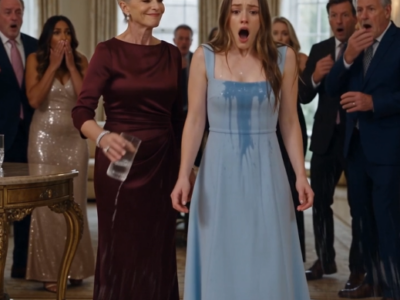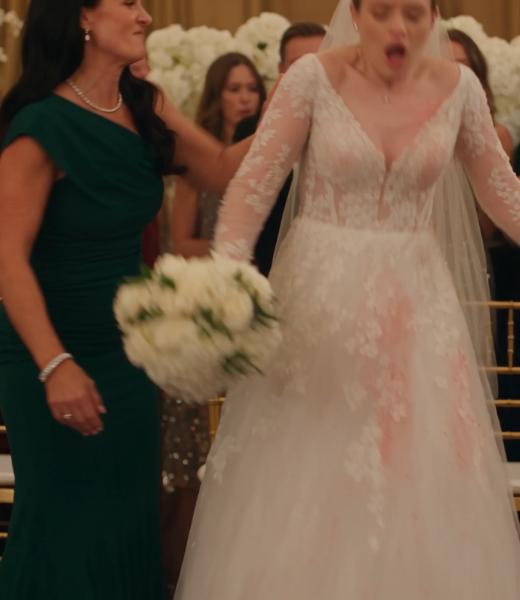
“A toast, everyone. To the bride who’s wearing a dead woman’s dress.”
CHAPTER ONE — My Mother's Dress
The dress had been waiting for her for twenty-nine years, and it knew exactly how it was going to be ruined.
Hannah Voss could not have said where the thought came from. She stood in the bridal suite of the Grand Corvane Hotel at ten minutes to four on a bright Saturday in October, in her stockinged feet, with a hairdresser fussing at her shoulder and a make-up artist hovering with a brush and the whole bright chaos of a wedding day swirling around her, and she thought, quite clearly: something is going to happen to this dress.
It was a silly thing to think. It was a beautiful dress.
It was ivory lace over silk, with a deep V at the neck and long sleeves like frost, and a skirt that fell in a cathedral sweep to the floor. It had been made in 1993, in a small atelier in Florence, for a woman of twenty-seven named Elaine Voss. It had been worn once, in a stone church on a hill in Tuscany, in the sun, and then put away in tissue paper in a cedar chest in the attic of a house in Connecticut, where it had waited for three decades with a bundle of dried lavender and a note in a woman’s hand.
For Hannah. When she’s ready.
Her mother had written it a year before she died.
Hannah had been eleven. She remembered the funeral as a series of grey images: the long black cars, the damp grass, her father’s hand, huge and dry and heavy on her shoulder, shaking very slightly. She remembered a woman in a veil who whispered poor lamb. She remembered the weight of the silence in the house afterwards, the way that it filled up the stairwell like water in a well. And she remembered, a year later, the afternoon on which a tall, dark, elegant, quiet woman in a pearl-grey suit had come to the front door with a casserole and a sympathetic expression, and had stayed.
Her name was Celeste.
“Hold still, darling,” said the make-up artist, “you’re frowning.”
“Sorry.”
“It’s fine. Everyone frowns. It’s the nerves.” A soft brush swept her cheekbone. “Is your dad here yet?”
“He’s downstairs. He came in with Lena.”
“Oh, I’m so glad. I heard he’d had a bad year.”
Hannah closed her eyes.
A bad year. It was a polite phrase. It did not cover it. Eight months ago, on a wet February night, in his study, at the age of sixty-eight, Richard Voss had put down his glass of whisky, stood up from his chair, said in a puzzled voice, oh, I don’t feel— and fallen sideways onto the Persian rug like a tree.
They had said that it was a major stroke.
He had survived it. That was the miracle, they told her, in the grey light of the hospital. He had lain for eleven days in a bed full of tubes. He had opened his eyes on the twelfth. And since then he had been a man in a different country: a large, silent, heavy, bewildered figure in a wheelchair, with a slack right hand and a drooping mouth and a pair of pale blue eyes that followed her about the room with a look of desperate, unsayable urgency.
He had not spoken a full sentence in eight months.
He could say yes. He could say no. Occasionally, on a good day, he could say Han, the old childhood contraction of her name, in a hoarse cracked whisper that made her heart turn over. But the rest, the vast, rich, drily humorous flood of language that had been Richard Voss, who had built a shipping company from a single tug on a Connecticut dock and talked his way into half the boardrooms of Europe, was simply gone. It was locked up behind a wall of silence, and nobody had the key.
Except, perhaps, one person.
“The doctors say he’ll never speak again,” Celeste had said, in the car, on the way home from the hospital, with her white-gloved hands folded in her lap. “I think we must be realistic. I think we must think about what’s best for him. A quiet life. A little sedation, to keep him calm. I’ve spoken to Dr. Pruitt.”
Hannah had looked out of the window at the rain.
She had agreed. She had been twenty-nine and exhausted and sick with grief. She had thought: Celeste knows best. She’s been his wife for six years. She’s the one who’s always been practical. She had said yes to the power of attorney. She had said yes to the live-in nurse, and the quiet room, and the pills that came in small brown bottles every morning at eight and every night at ten.
She had not asked what was in them.
She had not asked a great many things.
“There,” said the hairdresser. “Look.”
Hannah opened her eyes.
She was looking at a stranger in a mirror. A young woman in an ivory gown, with her pale-brown hair pinned in a low soft knot under a long lace veil, and a light flush on her cheeks, and a pair of grey eyes, enormous and shining, that did not look like her own. The lace fell round her like a sigh. It seemed to glow. It was so exactly the dress she had seen in a faded photograph on her father’s desk, a woman in a church door with her head thrown back and her mouth open in a laugh, that for a moment she could not breathe.
“Oh,” said the make-up artist, softly. “Oh, your mum would have loved that.”
A lump rose in Hannah’s throat.
There was a knock at the door, and a tall dark-haired man put his head round it, and said, in a low voice: “Is it safe? Am I allowed?”
“You are absolutely not allowed,” said the hairdresser.
“I’m not looking. I’m in a state of terror. I’ve got my eyes screwed shut.” He edged in sideways, with one hand over his face. He was in a black tuxedo, with a bow tie crooked and his dark hair on end, and a fine pink flush along his cheekbones. “Han? I only wanted to say—”
“Marcus.”
“—that I love you, and I’m an idiot, and I’ve forgotten my vows.”
She laughed. It broke out of her, high and helpless and slightly cracked, and she crossed the room in three steps with her skirts in her hands and flung her arms round his neck.
He was warm. He smelled of soap and starch and coffee, and something faintly metallic, like a camera. He had been a newspaper reporter for ten years, a stooped, quick, untidy man with ink on his cuffs and a way of asking questions so gently that people forgot that they were being interviewed. They had met at a dinner party two years ago, over a plate of undercooked salmon, and he had said, I’m so sorry, I think I’ve just insulted your host’s mother, and she had laughed so hard that she had spilled her wine.
“You have got your eyes open,” she said into his collar.
“I couldn’t resist.” He drew back. He looked at her, properly, for the first time. And she saw something go across his face, a slow, wide, stunned, almost frightened tenderness, like a man looking at a sunrise over a cliff. “Oh, Han,” he said. “Oh, God. Look at you.”
“Don’t. I’ll cry. I’ve got three layers of mascara.”
“Then I’ll say it quickly.” He took her face in both hands. “Whatever happens today. Whatever happens. I need you to remember that I love you, and that none of it—” He hesitated. “None of it was ever a trick.”
“What does that mean?”
“Nothing. Everything.” He kissed her forehead, quickly, like a man crossing a bridge. “I’ll see you at the end of the aisle.”
“Marcus—”
But he was gone.
She stood quite still, with her hand pressed to her chest, looking at the door. She did not know why her heart had started to beat so fast. She had seen it in his face: a shadow, a tension, a faint grey tightness round the eyes. She had seen it for days. He had been quiet. He had made a great many telephone calls, in the garden, in a low voice, and rung off when she came near. He had spent three evenings in a hotel room with his brother Sam and a laptop and a crate of papers, and when she asked what they were doing, he had said, with a very odd smile, wedding speeches.
She had let it go. She was a bride. She had let a great many things go.
They took her down in the service lift.
It was a small steel box, lined with mirrors, and she rode in it with the hairdresser and the wedding planner and a bridesmaid holding up her train, and watched the numbers fall. Four. Three. Two. At the ground floor the doors slid open on a long, cool, dim, marble corridor, hung with flowers, and at the far end, through a pair of tall carved doors, she heard the soft hum of a crowd.
The Grand Corvane Hotel had a ballroom like a cathedral. It rose two floors, with a gilded coffered ceiling and tall windows hung with ivory curtains, and a floor of polished black marble so glossy that it reflected the chandeliers like a lake reflects stars. Three hundred gold chairs stood in rows on either side of a long central aisle. White flowers climbed the walls. At the far end, beneath an arch of white roses and trailing ivy, a man in a black suit stood with a paper in his hands: the officiant, a gentle round-faced man named Reverend Okafor. And beside him, with his hands clasped in front of him and his eyes fixed on the doors, stood Marcus.
She stopped on the threshold.
It was the most beautiful thing she had ever seen.
And then she saw her father.
He was in the front row, on the left, in his wheelchair, in a dark suit that hung a little loose on his big frame. The nurse, Lena Park, a small, calm, black-haired woman in a plain navy dress, sat beside him with one hand resting lightly on the arm of the chair. His head was bowed. His good hand lay in his lap. But as the doors opened, and the string quartet struck up the first soft bars of the processional, Hannah saw him lift his face.
He looked at her.
It was a long look. It was the look of a man at the bottom of a well, looking up at a patch of sky. And his pale blue eyes, in the great ruined weathered face, were so bright and clear and awake that she felt a quick, fierce, wholly irrational thrill go through her, like the first touch of electricity.
He lifted his good hand.
It was not a wave. It was a small, stiff, trembling, deliberate gesture, a lifting of two fingers from the arm of his chair, a thing that she had seen him do a thousand times in a boardroom, across a table, when he wanted to say wait.
Wait. I’m here. I’m listening.
Hannah’s eyes filled.
She lifted her bouquet. She gathered her skirts in one hand. She took a breath, and stepped out onto the black marble, into the long white light of the chandeliers, and three hundred heads turned as one.
And on the other side of the ballroom, in the second row on the right, in a long, sleek, close-fitting gown of emerald green silk, a dark-haired woman in a rope of pearls had risen slowly from her seat, with a glass of red wine in her hand.