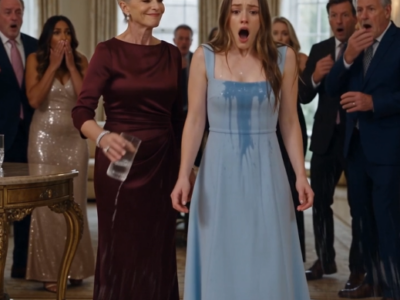
“A toast, everyone. To the bride who’s wearing a dead woman’s dress.”
CHAPTER FOUR — Eight Months
Marcus Bell had never in his life run so fast, and he could not afterwards remember covering a single yard.
He was a man of thirty-two, tall and lean and stooped, who had played no sport since school and had a lifelong policy of avoiding anything that involved sweating in a tuxedo. But he had seen her go down. He had seen the long white swing of the skirt, and the lift of the veil, and the small pale hands going out in front of her like a diver’s. And something inside him, a cold, clean, final thing, had simply let go.
He had been standing at the altar with his hands clasped, next to the Reverend and his brother, thinking about the vows that he had forgotten. He had been looking at the doors. He had seen her come in: a small white figure in the long gold light, with her head up, and the lace shining like frost, and that look on her face, wide and shy and wondering, like a child at the top of a staircase on Christmas morning.
Then he had seen the green dress step out of the second row.
And he had known.
He had known it with a slow, sick, deadly certainty, like a man who sees a car start to skid. Not here. She wouldn’t. Not in front of— He had taken one step down from the altar. He had said, very quietly, Sam. And his brother, at his side, in his best man’s black suit, had put a hand on his arm, and muttered: not yet. Let her do it. We need it on camera.
He had gone anyway.
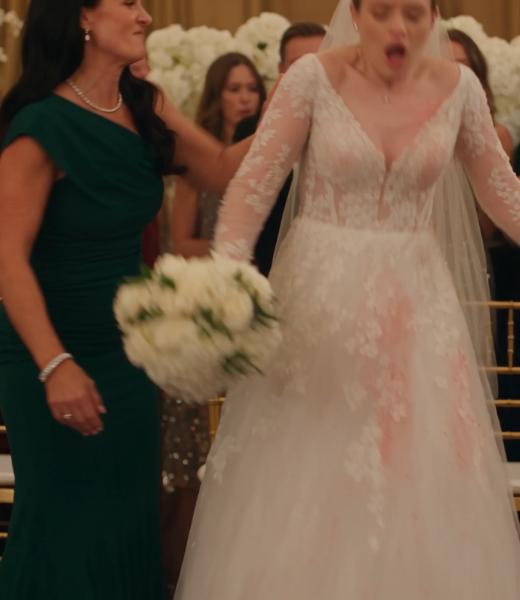
He went down the aisle at a dead run, with his tuxedo jacket flapping and his bow tie coming loose and the black marble flying beneath his polished shoes. He heard shouts. He heard the quartet’s last discordant squeal, and a woman scream. He saw, ahead of him, as in a film run too slow, a flare of white, a shower of dark liquid, a bouquet spinning through the air in a spray of petals. And at the centre of it, bent over the kneeling bride with her arm raised and her face contorted, a woman in emerald green.
“Celeste!”
It was a roar. It tore out of him raw.
She turned her head.
He reached her in three strides. He did not decide what to do. His hand simply shot out, like something with a will of its own, and closed round her upper arm, above the elbow, and hauled. She spun. She was lighter than he had expected. She came round in a half-circle with a gasp, her heels skidding on the polished floor, her dark head flung back, and her free hand came up, claw-fingered, to rake at his face.
He caught that, too.
“Get away from her,” said Marcus.
His voice was shaking. He heard it. It was hoarse and thick, and it did not sound like his own. He held her wrists, both of them, in a hard careful grip, as one holds a bird. He could feel the bones, thin and fine, jumping under the skin. He could feel her pulse, racing. And through the thin silk of her sleeve, as he held her, he felt a shudder, a long, hard, convulsive tremor, that ran through her whole body from head to foot.
She was not afraid. He saw that. It was something else: it was fury, pure and white, the blind exultant fury of a person who has been waiting a very long time to be seen.
“Take your hands off me!”
“Not until you step back.”
“I’ll have you arrested! This is— This is assault! Do you hear me? I’ll have you in court! Hannah!” She was screaming now. She twisted her head round, and her voice rose, thin and shrill and ringing, to the very rafters. “Hannah! Look what he’s doing! Look at the sort of man you’ve—”
“Celeste.”
He said it very softly.
He had not meant to. But something in him, in that moment, went suddenly cold and quiet and clear, like a river freezing from the bottom. He was aware of the whole ballroom around him: the silence, the staring faces, the little cold lights of the cameras. He was aware of the girl at his feet, on her hands and knees, shaking, with her veil in her hair. He was aware of his brother, somewhere behind him, hissing his name.
And he was aware, with a strange, detached, glassy lucidity, of the last eight months of his life, going past him like a train.
It had begun with a telephone call, on a Tuesday afternoon in February.
He had been at his desk at the Hartford Courant, in a tangle of notes, eating a limp sandwich over a keyboard, when the call had come through from the front desk. There’s a woman here. She won’t give her name. She says it’s about a company. He had gone down. He had found her sitting in the lobby, on a plastic chair, in a grey cardigan: a small plain tired woman of about fifty, with her handbag clutched in her lap and a look of dreadful quiet resolve.
I’m an accountant, she had said. I worked for Voss Marine for nineteen years. I was let go in January. I have something that I think a newspaper should see.
She had been called Janet Doyle.
She had laid a thick brown folder on the table in front of him. She had not said a word. He had opened it. And he had sat there, in a plastic chair, in a municipal lobby, with the winter light fading in the windows, and watched a small, quiet, patient, methodical theft come up off the pages at him like a picture in a developing tray.
It had been so neat. That was the thing that had caught him. A consultancy fee here. A management charge there. A series of small, regular, unexplained payments to a company in Delaware with a pleasant name. It had been going on for years. It was the work of someone intelligent, and careful, and extraordinarily patient.
Who’s the signatory? he had said.
The Chief Financial Officer’s wife, Janet had said.
He had looked up.
Mrs. Celeste Voss, she had said. The chairman’s second wife. She has authority over the family trust accounts. He’s never looked at them. He doesn’t read a balance sheet. He just signs. She had folded her hands. I tried to tell him, in December. I went to his study. He was reading something. He said, ‘Janet, I’ll look at it after the holidays.’ And then he had the stroke.
He had sat very still.
Voss, he had thought. Richard Voss. Hannah’s father.
He had been dating Hannah for eleven months.
He had told her the next night.
He did not think that he had ever been more frightened. He had sat opposite her, at a small table, in a quiet Italian restaurant on the harbour, with a candle between them and the night coming down over the water, and he had said, slowly and carefully, without looking up: I need to tell you something, and I need you to hear all of it before you say anything.
She had listened.
She had listened to the whole of it, with her grey eyes fixed on his face and her hands very still. He had watched them grow dark and wide. He had watched her go pale. And when he had finished, she had said nothing for a long time. She had only looked out of the window, at the water, and he had thought, with sick terror: I’ve lost her.
I knew, said Hannah, at last.
What?
Not about the money. I never knew that. She had turned her head. Her eyes were full of tears. But I knew about Dad. She had drawn a long, shaky breath. I’ve been watching him, Marcus. For months. He doesn’t— He isn’t— He looks at me sometimes, as if he’s trying to say something, and then his eyes go cloudy and he looks away. And I look at the pills, and I think— She had pressed her fingers to her lips. I think that I’m going mad. I think that I’m making it up.
You’re not.
How do you know?
Because I think he’s still in there.
It was the thing that he had been afraid to say. The thing that had sat in the back of his mind for a week, ever since he had stood for ten minutes in the doorway of a sunlit sickroom and watched an old man in a wheelchair, with a slack face and a clouded stare, track a nurse across the room with a pair of eyes that were absolutely, terribly clear.
He had gone to see Lena Park the following morning.
She was the nurse. She was thirty-four, small and calm and unexcitable, with a flat Midwestern voice and a habit of looking very hard at things before she spoke. She had listened to him in a corner of the garden, under a dripping lilac, with her arms folded. She had said, at the end, in a quiet voice: I’ve been waiting for someone to ask me that.
Ask you what?
Whether I think he’s overmedicated. A pause. He’s on four times the dose that his chart says. I checked. There are two sedatives and an antipsychotic. He’s never had an episode that would justify any of them. She had looked at him, level and grey. I’ve been afraid to say it. She’s his wife. She’s got the power of attorney. And Dr. Pruitt—
What about him?
He signs everything, said Lena. And he never examines him.
It had taken eight months.
He thought of them now, standing on the black marble floor with Celeste Voss’s wrists in his hands, as one thinks of a long road at the moment of arriving. Eight months of nights in a rented room with his brother Sam, a retired fraud investigator, a stack of bank statements and a laptop that never switched off. Eight months of quiet conversations in cars. A subpoena that went nowhere. A cousin at the district attorney’s office, an elegant, tired, dry-voiced woman named Detective Inspector Kovac, who had said, in March, over a bad cup of coffee: It’s good, Marcus. It’s very good. But I need more. I need her doing it. I need her on tape.
So they had got her on tape.
It was Lena’s idea. She had said it one night in April, in the kitchen of the big house in Connecticut, with a mug of tea going cold between her hands. He’s the one who keeps going back to the study, she had said. He tries to wheel himself in there. I think— I think he knows something is in there. She had hesitated. I think he wants us to look.
They had looked.
They had found it, taped under the lowest drawer of the desk, in a plastic bag: a small black memory stick, labelled in a clumsy, shaking, left-handed scrawl that Hannah had known at once. H. Her father had managed, in the days before the stroke, in some last lucid weeks that nobody had noticed, to copy a file. It was a spreadsheet. It was a complete record of his wife’s twenty-two million dollars.
He knew, said Hannah, in a whisper, with the little thing in her palm. He knew. He saw it, and he knew, and then she—
She had not been able to finish.
So they had done the other thing.
There is a small black camera, in the second bookcase to the left of the study window, between a volume of Melville and a model of a clipper ship. It has a lens the size of a sesame seed. Lena had put it there in May, on a Sunday afternoon, with a stepladder and a cheerful face, while Celeste was at her tennis lesson. It had run for ninety-one days. It had caught, in all that time, twenty-six hours of a woman moving about a room.
A woman, alone, with a laptop. A woman in a doorway, whispering to a soft grey man with a leather bag. A woman at her husband’s desk, at one in the morning, with a pen in her hand and a sheet of his headed notepaper under it, signing, over and over and over, in a hand that was not her own.
Sam had cut it. He had done it in a hotel room in Hartford, on a Tuesday night, in a state of grim joy. He had put the best of it together: the forgeries, the whispers, the cheques. He had titled it, with a small ironic flourish, over a black card.
THERE IS MORE.
He had said it was for the sequel.
“Marcus!”
It was Sam. He was at his shoulder, in his black suit, with a small silver remote in his fist. He was a stocky, grey-eyed, bearded man of thirty-six with an air of permanent faint amusement, and he was not amused now. His jaw was tight. His eyes were fixed on the woman in Marcus’s grip. “Marcus. Don’t. Let her go. She’ll say you hit her.”
“I didn’t hit her.”
“She’ll say it.”
“Then she’ll be saying it,” said Marcus Bell, “in front of three hundred people with their phones out.”
He let go.
Celeste staggered back. She clutched at her wrists. She stared at him with wild, glittering, furious eyes, her chest heaving, and then, with a shrill, ringing, theatrical cry, she flung out her hand and pointed down at the girl on the floor, who had pushed herself half upright and was kneeling in the stained heap of her skirts, quite still, with her face turned up to the light.
“That dress,” said Celeste. She was laughing, and she was sobbing, both at once, in a high cracked wail. “That dress was never yours! None of it was! You have her face and you have her bones and you think you can wear her! Do you hear me? Do you hear? There’s nothing of her in you! She’s dead! She’s dead, and I’m alive, and I’m the one who—”
She stopped.
She had caught, suddenly, with a visible start, something in Marcus’s face. She looked at him. She looked at his brother, and the remote. She looked, slowly, over her shoulder, at the front of the ballroom, where a vast white screen hung on the wall beside the altar, blank and gleaming. And a very small, quick, cold flicker went through the black eyes, like a fish turning in deep water.
“What,” she said, “is that?”
Marcus did not answer.
He was looking at Hannah.
She had got to her feet. She stood in the middle of the aisle, in her ruined dress, with the wine drying on the lace in long dark stains and the veil hanging crooked from her hair and a bruise already blooming on her palm. Her face was white and wet and streaked with mascara. She was shaking. But she was standing straight, with her shoulders back and her chin up, and she was looking at him with a look that he would carry with him for the rest of his life.
It was not a question. It was not even trust.
It was permission.
He nodded, very slightly, to Sam.
“You’ve said enough, Celeste,” said Marcus Bell, very quietly. “I think it’s time everyone else had a turn.”
He turned his head.
“Sam,” he said. “Roll it. All of it.”