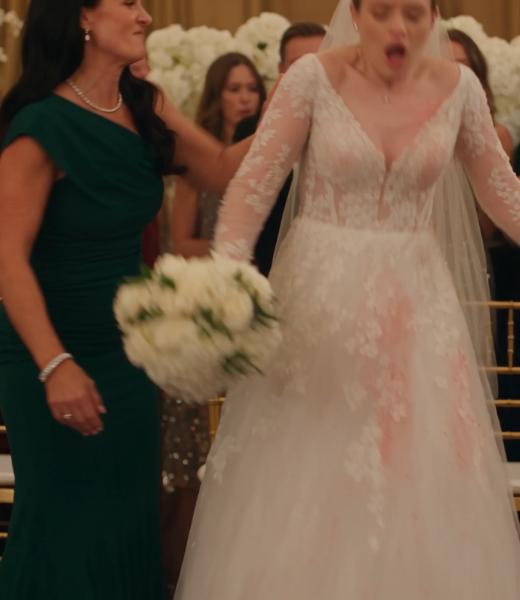
“A toast, everyone. To the bride who’s wearing a dead woman’s dress.”
CHAPTER TWO — Emerald
Celeste Voss had been planning this moment for six years, and she was not going to let anyone call it spontaneous.
She stood beside her gilt chair in the second row, with her glass held at waist height and her chin lifted, and watched the girl come down the aisle. She did it with the cool, narrow, appraising attention of a collector examining a piece of porcelain for hairline cracks. Lace. Silk. The soft grey-gold glow of antique ivory. A bouquet of white roses, and a veil like a cloud of breath.
It’s a very good dress, she thought. I always said so.
It was the only thing about the girl that she had ever wholly admired.
She was forty-seven. She was tall, and slim, and dark, with black hair cut to the jaw and a long, intelligent, severe face that had been called, by various people at various times, distinguished, chilly, and arresting. She wore a rope of grey pearls that had cost eighty thousand dollars. She wore a dress the colour of a deep forest pool, cut on the bias, with one shoulder bare. And on the third finger of her left hand, set in a band of platinum, she wore a flawless oval emerald the size of a plum stone.
It had not been a gift. She had earned it.
She had earned it, over six long years, in a thousand small, silent, exhausting ways. She had earned it by marrying a man twenty-one years her senior, a rough, brilliant, widowed shipping magnate with a dead wife’s photograph on his desk and a nineteen-year-old stepdaughter-to-be who looked at her, across the dinner table, with eyes like a pair of cold grey stones. She had earned it by sitting beside him at every dinner, and nodding at every joke. She had earned it by never once, in six years, pointing out that the photograph was still on his desk.
She had loved him, in her way.
She had thought, at the beginning, that it might be possible. He had been funny, and gruff, and unexpectedly gentle, and he had looked at her, on the night that he proposed, with a kind of astonished gratitude that had touched her more than she liked. You’re the first person who’s made me feel like I might get to be happy again, he had said. And she had said: Then I’ll try to be that.
She had tried.
She had tried for a year. Then two. She had sat in the great echoing house in Connecticut, in a drawing room full of another woman’s furniture, among another woman’s books and another woman’s china and the faint ghost of another woman’s perfume, and been nobody. She had been the second wife. The consolation prize. The one whom guests addressed, kindly, as Richard’s friend.
And always, in the middle of every room, on every wall, there had been Elaine.
Laughing in a frame. Smiling from a silver locket. A bright, quick, brown-haired ghost in a white dress in a doorway, who had died at thirty-three of a thing with a long Latin name, and who had become, in the manner of the dead, more perfect with every passing year. Richard had never said an unkind word about her. He had never needed to. It was in the way that he stopped, sometimes, at the foot of the stairs, with his hand on the banister and a faraway look in his face. It was in the way that he said Hannah’s mother, never Elaine. It was in the way that he looked at the girl.
The girl had her face.
It was the thing that Celeste could never forgive. Every morning, across the breakfast table, in the pale light of the kitchen, she saw it: the same grey eyes, the same long upper lip, the same quick trick of tilting the head when she was thinking. It was like being haunted by a ghost who also needed to be fed.
It was not for love that she had done it. She could admit that, now.
It had begun with the money.
She had never been rich. She had been born Celeste Marchetti, in a flat above a dry-cleaner’s in Providence, the daughter of a bookkeeper and a seamstress, and she had learned at an early age that there was one great distinction in the world, and it was not between good and bad, or clever and stupid, or kind and cruel. It was between those who had enough and those who did not. She had spent her youth in a state of exhausted vigilance, at the very edge of the first group, watching the second group with a hunger so sharp that it was almost a taste.
She had worked. She had been a paralegal, and then a personal assistant, and then, for nine bright years, the right hand of a Wall Street financier, who had taught her everything. She had learned how to read a balance sheet. She had learned how to move money so quietly that nobody noticed the rustle. And she had learned, above all, the most important lesson of her life, that nothing is ever stolen all at once.
It is taken a little at a time. A rounding error. A discretionary fund. A line in the accounts that no one ever looks at. You take it so slowly, and so patiently, and in such small amounts, that the loss becomes part of the landscape, like erosion.
Her husband’s company was worth four hundred million dollars.
She had married him, in the beginning, because he was kind, and because he was lonely, and because he had looked at her with those pale astonished eyes. She had stayed with him, in the second year, because she had discovered that he was a very poor judge of accounts. And in the third year, she had begun to take.
It had not been hard.
He trusted her. That was the horror of it. He had handed her the keys to the whole kingdom, and said, you handle it, darling, I’ve never had the head for it, and gone back to his boats. She had started small. A consultancy fee. A management charge. A private company with a pleasant name, registered in Delaware, that billed the family firm for services which were never rendered. By the sixth year, the leak had become a river.
Twenty-two million dollars.
It was gone. It was in accounts in Grand Cayman and the Isle of Man, and a villa on Lake Como, in the name of a company that did not exist. And the only thing in the world that stood between Celeste Voss and a very long, very cold, very public prison sentence was her husband’s failing attention, and the fact that no one had yet asked to see the books.
Then, in February, he had had the stroke.
And she had thought, with a sudden, lucid, sickening, terrible clarity: this is my chance.
She had not planned to keep him silent.
She wanted that clear. She wanted it understood, if anyone ever asked, in the long dark nights that were to come: she had not planned it. The stroke had been an act of God. It was only that in the weeks afterward, as he lay in his hospital bed, mumbling and weeping, she had seen, in his face, something that frightened her very much. It was a look of dawning recollection. His eyes, in those first days, had been clear and sharp and lucid, and he had looked at her, sometimes, with a new, curious, narrow, calculating attention, as though he had come back from the dead with a question.
What was it? she had wondered. What did he see, in that last second on the rug?
He had been in his study. He had been going through the papers. He had been looking, she realised, at a ledger.
She had gone to Dr. Pruitt the following morning.
It had been quite easy. He was an old family doctor, soft and vague and eager to please, with a gambling habit that she had quietly discovered two years before. She had said, in a worried voice, that she thought her husband was agitated. That he was in some distress. That a little sedation, just to keep him comfortable, might be a kindness. And the little brown bottles had begun to come.
He had slept. He had grown quieter. The terrible clear blue eyes had clouded over, day by day, to a soft dull haze. And in the third week, with the help of a family lawyer and a short, kindly, regretful meeting in a hospital corridor, she had been given his power of attorney.
It was perfectly legal.
She had not hurt him. She told herself that every night, lying alone in the great dark bed in Connecticut. She had looked after him. She had given him the best nurses. She had kept him warm and clean and fed. It was only that, for the time being, he did not need to be awake.
And all that time, the girl had watched.
She had not understood it, at first. She had thought it was grief. But there was a stillness in the girl, these last months, a watchfulness, like a cat at a mousehole, and Celeste had seen her looking at the bottles. She had seen her whispering with the nurse. She had seen her come home at odd hours with a pale, strained, abstracted face. And three weeks ago, in the hall of the house, on a grey Tuesday morning, she had passed the girl’s fiancé, a tall, quick, untidy man in a raincoat, standing at the foot of the stairs with a camera round his neck, talking in a low voice to the nurse.
He had looked up. He had smiled.
Mrs. Voss. I’m Marcus Bell. We haven’t been properly introduced. I’m a reporter.
She had known then.
She had known it the way that one knows a gas leak: not by sight, nor by sound, but by a small cold prickle at the back of the throat. He knows. He’s asking questions. He’s going to look at the books.
She had smiled back.
How charming, she had said. What sort of reporter?
The curious sort.
She had not slept for three nights.
It was a very simple plan, in the end.
It could not be stopped by lawyers, or by money, or by the slow grinding gears of the law. It had to be stopped at the root. The root was the girl. If the girl were to leave him, if the engagement were to break, if the whole bright shining edifice of the wedding were to come down in ruins in the first minute, then the reporter would go too. He would be hurt. He would be distracted. He would lose his foothold in the family, and his excuse for being in the house. And she would have six more months.
Six more months was all that she needed.
She had thought about it, in the dark. She had turned it over and over. She had considered a hundred ways. A rumour. A letter. A lie in the right ear. But in the end, she had come back to the oldest and simplest weapon in the world.
Humiliate her.
In front of everyone. In front of three hundred people, in her dead mother’s dress, on the one day when she was most beautiful and most exposed. Break her publicly, so utterly that no amount of love could put her together again. Make her ashamed. Make her run.
She was thirty feet from the altar.
Celeste Voss took a long, slow breath. She felt the cool weight of the glass in her hand. It was a heavy crystal goblet, filled to the brim with a deep dark Burgundy, the colour of arterial blood, and as she tilted it a quarter-inch, she saw the red catch the light of the chandelier and shimmer.
She rose.
She stepped out into the aisle. The black marble floor gleamed beneath her heels like glass. The quartet faltered, and played on. A murmur went through the crowd, soft and puzzled, and she let it come. She lifted her glass a little higher. She smiled her most charming, most radiant, most dazzling smile, the smile of a woman about to give a toast.
At the far end of the aisle, a bride in a wedding dress turned her head and saw her.
The grey eyes widened.
Good, thought Celeste. Look at me.
Look at me, Hannah. You’ve been looking through me for six years.
She took one slow step forward.