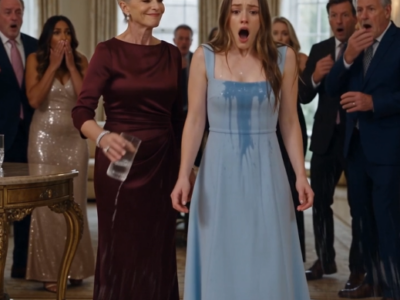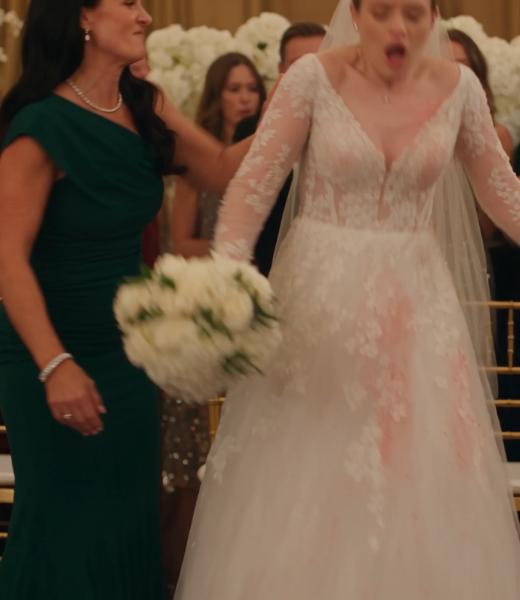
“A toast, everyone. To the bride who’s wearing a dead woman’s dress.”
CHAPTER SIX — Stand
"Mrs. Voss?"
The voice was dry and level and entirely without emphasis, the voice of a woman reading out a bus timetable. It carried to every corner of the ballroom. The tall figure in the dark coat had come to a halt three paces from the woman in green, and stood there with the badge held open on her palm. Behind her, two uniformed officers had entered the ballroom by the great doors and taken up positions on either side of the aisle, quite quiet, with their hands folded.
“I’m Detective Inspector Anna Kovac, of the Connecticut State Police Financial Crimes Unit. I’d be grateful if you’d step this way.”
“I—” said Celeste.
She seemed to have forgotten how to speak. She stood with her mouth slightly open, and her eyes on the badge, and one hand still gripping the chair. She looked suddenly very much smaller. The tall, dark, brilliant, glittering creature who had stood in the aisle with a glass in her hand had somehow withered into something thin and pale and sharp-boned, a woman of forty-seven in a green silk dress that was a little too tight across the shoulders.
“I haven’t done anything,” she whispered. “This is a— It’s a, it’s a private family— I haven’t—”
“Celeste Marchetti Voss,” said the detective, not unkindly, “I’m arresting you on suspicion of fraud by abuse of position, forgery, theft in excess of twenty million dollars, and the neglect and unlawful sedation of a vulnerable adult.”
A sound went through the ballroom.
It was a very low sound, a kind of long collective sigh, and with it came, quite unexpectedly, a ripple of something else. It was not applause. Nobody clapped. But it was the sound of three hundred people who had held their breath for ten minutes and had, at last, been allowed to let it out.
“You do not have to say anything,” said Inspector Kovac. “But anything you do say may be given in evidence.”
“No,” said Celeste.
She took a step back.
“No. No. I won’t. You can’t— It’s Hannah. Don’t you see? It’s all— It’s her. She’s been— She’s turned them all against me. She’s always, always— Richard!”
She flung out her arm.
“Richard! Tell them!”
It was a wild, high, cracked scream, and it echoed up into the gilded ceiling and died. She was pointing across the ballroom, into the front row, with a rigid, shaking, accusing finger, at the man in the wheelchair.
“Tell them it isn’t true! Tell them I looked after you! I’ve done everything— I fed you! I washed you! I sat up with you through— You know I did! Tell them!”
She was weeping now. Great jerking sobs, tearing at her chest. She had begun, quite unconsciously, to go down on one knee, a stiff, awkward, clumsy motion, like a woman in a dream. “Richard. Please. Please. I did it for us. I only ever— You were going to leave me. You’d have found out. I only—”
Her voice dwindled.
Something had happened in the front row.
It began as a creak.
It was a sound like a ship’s timber under strain. It came from the great black wheelchair, where it stood by the end of the aisle. The big grey-haired man seated in it had put both hands on the arms, one good and one slack, and was pressing down. The knuckles had gone white. The tendons stood out in the thick corded neck. And beside him, the small calm nurse in the navy dress, Lena Park, who had been gripping his shoulder, took her hand away.
She did it slowly. She did it with a face of perfect trust.
“All right, Richard,” she said, very softly. “Go on.”
He rose.
It took a long time. It took, perhaps, a quarter of a minute, and nobody in the ballroom drew breath during any of it. First the shoulders heaved. Then the chest. The massive head came up, with the lips drawn back from the teeth, and the face working with effort, and a thin cry of pain broke from the throat. The left leg straightened. The right leg trembled, and held. And then, in a long slow shuddering unfolding, like a great old tree being pulled upright by an invisible hand, Richard Voss stood up from his wheelchair, and was on his feet.
He swayed.
He was six foot three. He had been, for forty years, the biggest man in any room. He stood now in the middle of the ballroom aisle, in a dark suit that hung loose on his shrunken frame, with his right hand clutched against his chest and his left gripping the arm of the chair, and he looked, to everyone who saw him, like a monument that had been knocked down and had picked itself up.
Hannah could not breathe.
She had her fist pressed hard against her mouth. She was shaking so much that her teeth chattered. She heard a voice somewhere saying oh, my God, oh my God, and understood after a moment that it was her own. For nine days, she had known. Lena had told her, in a whisper, in the kitchen, at midnight: he’s coming up. The vitamin tablets, the saline, it’s working. I think he’s nearly clear. I don’t know what he’ll be able to do. She had told no one. She had not dared to hope.
She had not let herself imagine this.
“Celeste,” said Richard Voss.
It was a voice like a rusted gate.
It was harsh, and thick, and cracked, and slurred at the edges, as if each syllable were being dragged up from a great depth. It was the first word that he had spoken in eight months. It was the first name. It hung in the hushed gilded air of the ballroom, hoarse and slow and shaking, and every head in it turned.
The woman in the green dress had stopped moving.
She was kneeling on the black marble with her hands pressed to her mouth. She stared at him. She stared at the huge swaying figure, with its drawn white face, and its pale clear blazing eyes, and the thin trickle of saliva at the corner of the mouth. Her own eyes were fixed and enormous and glassy, like those of a rabbit in the beam of a lamp.
“I saw,” said Richard.
He did not shout. He could not. He spoke very slowly, with great effort, forcing each word out through a numb and clumsy tongue. But he spoke, and the sentences came, one after another, like stones laid on a wall.
“February. The ledger. I— saw. All of it. I— knew. Then—” He gasped. His whole body shuddered. “Then you. Brought the pills.”
A stunned murmur ran through the room.
“I tried. To tell. Han. Every day.” He turned his head, with enormous difficulty, and looked at his daughter, and the tears that had been standing in his eyes spilled over and ran, unhindered, down the deep-lined cheeks. “Couldn’t. Make it. Come out. I’m— sorry. My girl. I’m so sorry.”
“Dad,” whispered Hannah.
She was running.
She did not know when she began. She was simply there, in an instant, across the black floor, in the soaking, stained, sweeping lace, with her veil streaming behind her, and her arms were round his neck. He was so thin. She had not known how thin. He was a great gaunt scaffold of bone in a suit, and he smelled of soap, and old tweed, and the faint, sharp, medical smell of the sickroom. His good arm closed round her. It was shaking so hard that it hurt.
She felt his face in her hair.
“Han,” said her father, into the lace. “Han. Han. Han.”
Nobody ever remembered, afterwards, who had begun to cry first.
It seemed to be everyone. It spread through the ballroom like a fire through dry grass: the lilac-clad woman on the board, and the white-faced chairman, and the little girl in pink, who had no idea why, and the quartet’s cellist, who had dropped his bow, and the stout elderly woman at the back who had come from Florence to see her friend’s daughter married. Across the great gilded room, three hundred guests wept openly, without shame, while on the black marble floor in the middle of the aisle an old man in a dark suit and a girl in a wine-stained wedding dress clung to each other like two survivors of a shipwreck.
Somebody had taken Celeste.
She went without a struggle. She went between the two uniformed officers, with her head down and her wrists together, quite quiet, like a woman walking in her sleep. The detective walked behind. They passed down the long black aisle in a slow small procession, and the guests drew back from them on either side, silent, as before a hearse. At the great doors, the woman in emerald green paused, for a second, and looked back.
She did not look at the screen.
She did not look at Marcus, or the reporter’s brother, or the grey-faced board. She looked, over the heads of the weeping crowd, at a large old man in a dark suit, standing in the aisle with his arm round his daughter, and for a long, long moment, her pale tragic ruined face worked, as though she were trying to say something.
Then the doors closed.
It was Marcus who broke the silence.
He had come up quietly behind the two of them, and he stood now a little to one side, with his hands in his pockets and his bow tie hanging loose and his eyes suspiciously bright. He cleared his throat. He said, in a rough, shaky voice, with an attempt at lightness that did not quite succeed:
“Mr. Voss. Sir. I think perhaps that I owe you an apology.”
The old man turned his head.
He regarded the tall, untidy, anxious young man in the crooked tuxedo with a long, slow, steady, appraising stare. It was the stare of a man who had spent forty years deciding whether to give people money. It lasted for some time. And then, in a voice like a door grinding on a rusty hinge, but quite distinct, with every syllable clear, Richard Voss said:
“You. Are. Late.”
Marcus blinked.
“I was. Supposed. To give her away.” The great ruined face twitched, and a ghost of something crossed it, crooked and dry and astonishingly warm. “Eight months. Been practising. In my head.”
A wild, helpless, hiccuping laugh burst out of Hannah. She put both hands over her mouth. She was laughing and crying at once, and her mascara ran, and her veil was crooked, and the great dark stain spread across her bodice like a map. She had never in her life been so happy.
“Then do it,” she said.
“What?”
“Give me away. Now.” She wiped her face with the heel of her hand. “I’m not changing. I’m not going upstairs. I’m going to walk down this aisle in my mother’s dress, with the wine on it, in front of everyone who loves me.” She lifted her chin. “And I’d like you to walk beside me.”
Richard Voss looked at her.
He was silent for a long moment. And then, slowly, with a great effort of the whole shaking frame, he drew himself up to his full height. He took his daughter’s hand in his own, the good one, large and dry and warm. He crooked his bad arm, stiffly, at the elbow. And Lena Park, at his side, without a word, set in it the polished black cane that he had refused to touch for eight months.
“Elaine,” said Richard Voss, very softly, to nobody, to the high gilded roof and the blazing lights.
“She’d. Have. Loved. That.”
He took a step.
EPILOGUE — There Is More
The trial lasted nine days in the spring.
It was not, in the end, a difficult one. The jury, twelve ordinary people in a plain, airless, wood-panelled courtroom in Hartford, sat through three weeks of evidence. They saw the ledgers. They saw the forged signatures. They saw the grey-haired doctor, who had wept in the witness box, and the accountant, Janet Doyle, who had not. They watched the whole of the footage from the study, from the first frame to the last. And at the end of the third week, without leaving the room, they returned a verdict on every count.
Celeste Marchetti Voss received eleven years.
She made no statement. She sat very straight in the dock in a grey cardigan, with her dark hair going white at the roots, and looked at her hands. Only once, on the final morning, as they were leading her down, did she turn her head. She looked across the court at a large grey-haired man in the front row of the public gallery, who was sitting upright with a cane across his knees. And Richard Voss, who had not spoken to her since the day of the wedding, said, quite quietly, in the slow careful voice of a man who has taught himself to talk again:
“I did love you, Celeste.”
It was true. It was the cruellest thing he could have said.
She went down the steps without a word.
He is better now.
It has been fourteen months. He walks, with a stick, down the long gravel path of the house at Ridgefield every morning at eight, in a soft cap and a battered waxed jacket, with a small, calm, black-haired woman in a navy fleece at his shoulder. He speaks in short, slow, careful, dry sentences, with long pauses, like a man laying stones across a stream. His right hand will never be what it was. But on a good day, in the long gold light of the afternoon, sitting at the kitchen table with a cup of tea and a plate of toast, he will tell a story about a tug in Bridgeport in 1974, and the whole room will laugh.
Lena Park is the head of the household now. Nobody remembers who decided it.
Janet Doyle is the chief financial officer of Voss Marine. She wears a grey cardigan to every meeting, and it is said that the board has never been quieter. The company is in good health. The money, most of it, was found: eleven million in a bank in Grand Cayman, nine in a villa on Lake Como, which was sold, and the proceeds put into a trust.
It is called the Elaine Voss Fund. It pays for the care of stroke patients who cannot afford a nurse.
And on the third Sunday of every month, at four o’clock, in the long yellow drawing room with the tall windows and the cedar chest, a young woman in a plain linen dress sits on the arm of her father’s chair, and a young man with ink on his cuffs sits on the floor at their feet with a notebook, and the old man, with enormous care, begins to talk.
He talks about her mother.
He tells them everything. How he met her, in a bookshop in Bologna, in 1989, in the rain. How she laughed at his Italian. How he proposed on a bridge, and dropped the ring, and had to go into the river after it. How she had said, on the day she died, in a bed by a window, with the light in her hair: Richard, be happy. Promise me. How he had not kept the promise, for a very long time.
Hannah writes it down.
It is going to be a book. Marcus is helping with the structure. It is going to be called, for reasons that nobody outside the family quite understands, There Is More.
The dress hangs in the cedar chest again.
It came back from the cleaners in November, in a long white box with a little apologetic note. They had done what they could, they said. The wine had set. They could soften it, but they could not take it out. Hannah had looked at the pale rosy ghost across the bodice and down the sleeve, delicate and wandering, like the print of a hand on a window. She had laid it back in the tissue paper without a word.
She has a daughter now.
She is seven weeks old. She has her grandfather’s pale blue eyes, and her father’s dark untidy hair, and a way of staring at the ceiling in the early morning light that Hannah has seen before, in an old photograph, on a woman in a church door. Her name is Elaine. She lies in a cot by the window in the room that was once a study, in the sun, between a volume of Melville and a model of a clipper ship.
The little black dot is long gone.
But every so often, at about four in the afternoon, when the light falls just so across the bookshelf, her grandfather will stop in the doorway, with his stick in his hand and his cap pushed back, and look at the sleeping child, and then at the empty place between the sails.
And he will smile, a slow, dry, crooked, astonished smile, and say, to nobody in particular, in a voice like a gate swinging back on a well-oiled hinge:
“There is more.”
THE END 🕊️