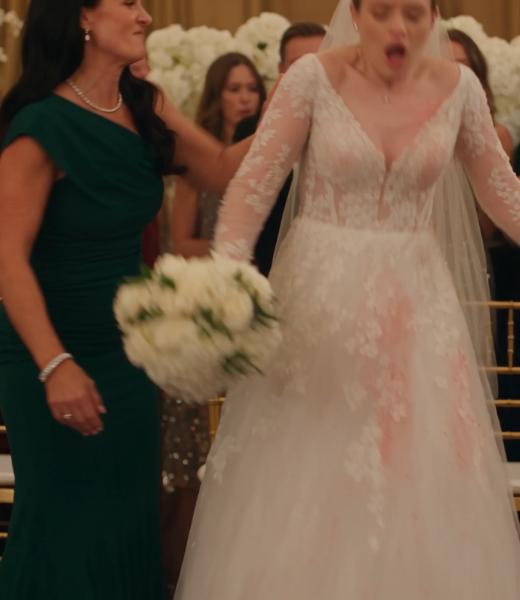
“A toast, everyone. To the bride who’s wearing a dead woman’s dress.”
CHAPTER FIVE — Roll It
The screen came alive without a sound.
It was a very large screen. It had been hung that morning, by two men on stepladders, against the cream wall to the left of the altar, to show a slideshow of the couple’s childhood photographs during the reception. It was eleven feet wide. It had been blank all afternoon, a smooth white rectangle in a sea of roses, and no one had given it a second glance.
Now it flickered, and went black, and a pale blue glow rose in its centre like a moon.
Three hundred heads turned.
It was a very slow, collective movement, like a field of grass bending in a wind. The phones, which had been lifted in a wavering forest to film the bride on the floor, lowered, and swung, and rose again, aimed now at the wall. Somebody coughed. Somebody whispered, what’s that? A child’s voice piped up, high and clear, Mummy, is it the pictures?
Celeste Voss stood on the black marble in her emerald dress and looked at the screen.
She did not know why her mouth had gone dry. She did not know why her hands, which had been so steady with the glass, had begun, ever so slightly, to tremble at her sides. It was a screen. It was a piece of equipment. It was some sort of sentimental video that the boy had put together, no doubt, with his brother’s help, a montage of baby photographs and pop songs, designed to make the guests weep. It would be tedious. It would be sweet.
It would not be anything that she need be afraid of.
Then the picture came up.
It was a grainy picture. It was grey and green and slightly distorted, like the picture from a security camera, and it was shot from a high angle, looking down into a dim, book-lined room. A large mahogany desk. A green-shaded lamp. A Persian rug, worn at the edges. A small model of a sailing ship on a shelf.
She knew the room at once.
It was the study at Ridgefield. It was her husband’s study. It was the room in which she had spent, by the most careful reckoning, eleven hundred hours of the last six years, with the door shut, with a pen in her hand, and a ledger open before her, and a silence round her like a cupped palm.
It was perfectly clear. In the bottom right-hand corner, in small white digits, ran a date and a time.
14 JUNE 01:12:47.
And into the frame, across the dark carpet, in a long silk dressing gown the colour of dried roses, walked Celeste Voss.
A small sound went through the ballroom.
It was not quite a gasp. It was something lower and more thoughtful, an intake of breath through the teeth. On the screen, the woman in the dressing gown crossed to the desk and sat down. She switched on the lamp. She pulled open the bottom drawer, took out a thick cream folder, and laid it on the blotter. She opened a laptop. She looked about her, once, quickly, over her shoulder, with a sharp, sly, furtive, familiar glance.
She did not look at the camera.
She took a sheet of cream notepaper from a leather case, headed in gold: RICHARD A. VOSS. She uncapped a fountain pen. She studied, for a moment, a document at her elbow, a long sheet of figures, with a signature at the foot. And then she bent her dark head over the notepaper, and began, with extraordinary care, with the tip of her tongue caught between her teeth, to write.
She wrote a name.
She wrote it again. She wrote it six times, in a row, down the page, in a looping, rolling, old-fashioned hand, and each time it came out a little more fluent, a little more bold, a little more like a man’s.
Richard A. Voss.
She held the sheet up to the lamp. She tilted it. She smiled.
The room was utterly silent.
In the second row, at the far end, a stout elderly man in a dark suit had risen to his feet. It was Gordon Pell, the chairman of the Voss Marine board. He had gone the colour of putty. His mouth hung open. And beside him, a plump woman in a lilac dress, who had sat on the same board for thirty years, was saying, over and over, in a small stunned whisper: oh, Celeste. Oh, no. Oh, no, no, no.
“That’s—” said Celeste.
Her voice cracked.
“That’s not— That’s a fabrication. That’s— It’s some sort of, of digital— It’s edited! They’ve— Turn it off! Turn it off!”
Nobody moved.
On the screen, the picture shivered, and went black. A card came up: plain white letters on a black ground, in a heavy sans-serif type.
FEBRUARY–OCTOBER. EIGHT MONTHS.
And then, without a pause, a second clip.
This one was in colour.
It had been shot from the second bookcase to the left of the window, at a slightly different angle, in the clear flat light of a bright afternoon. It showed the same study. A pair of tall windows. A leather sofa. A small, soft, grey-haired man in a tweed jacket, seated on the sofa with a black medical bag at his feet and his hands twisted together in his lap, looking up with the dismal, hunted, ingratiating look of a dog that has been caught on the furniture.
Dr. Pruitt.
And standing over him, tall and straight and quite calm, with her arms folded, in a pale-grey suit, was Celeste.
The sound had been recovered. It came out of the great speakers in a thin, tinny, unmistakable murmur, like a voice from the bottom of a well.
“I don’t see why it should be any trouble, Walter.”
“But Celeste, it’s rather— It’s rather a lot. His chart— If anyone were to examine—”
“Nobody is going to examine anything.” A pause. A short, light, dry laugh. “Honestly, you do fuss. He’s an old man. He’s had a stroke. He’s frightened and confused, and the kindest thing we can do is to let him sleep. I’d like the dosage doubled by the end of the month.”
“Doubled.”
“Before the wedding.”
She had said it quite lightly. She had said it in the same cool, bright, practical, conversational tone that she used to order a florist’s delivery. And in the great gilded hush of the ballroom, with the chandeliers shimmering overhead, three hundred people heard Celeste Voss say, on a silent screen, in her own voice: “I don’t want him sitting up and saying anything awkward in front of all those people.”
Hannah made a sound.
It was a very small sound. It was not a word, nor a sob. It was a kind of dry quiet, like the breath of a person who has been struck beneath the ribs. She was standing in the middle of the aisle, in her wine-soaked dress, with her hands pressed against her breast, and her face was perfectly white. She was not looking at the screen. She was looking, over it, across the ballroom, at a large grey-haired man in a wheelchair in the front row.
He was sitting very still.
He had stopped trying to rise. His big hands lay on the arms of the chair. His head was lifted, and his pale blue eyes, clear and wide and terrible, were fixed, not on the screen, not on his wife, but on his daughter. And as she looked at him, he did something that nobody in that ballroom had ever seen him do.
He nodded.
It was a slow, grave, deliberate nod, as of a man confirming a figure across a table.
Yes, it said. That’s right. All of it.
She was going to be sick.
That was the thought that went through Celeste’s mind, absurdly, in the middle of the horror. It rose in her like a tide, hot and sour and swift. She could feel her pulse in her ears, and the hammering of her heart, and a strange cold dizziness stealing up her legs. The ballroom had begun to tilt. The chandeliers swung. The faces of the guests rotated round her, a ring of wide, white, fixed, appalled ovals, like the faces in a Greek chorus, staring.
They can see.
They can all see.
She had thought, in the beginning, that it was impossible. That nobody could have known. She had been so careful. She had checked the study for bugs, in the first week. She had had the whole house swept by a security firm in May. She had told the housekeeper to keep the door locked, and the nurse to keep out, and she had been so very, very watchful. She had never once thought that the danger would come from the bookshelf.
It was the model ship.
She knew it now. She knew it with an awful, absurd, upside-down clarity. It had been sitting on that shelf for twenty years: a little three-masted clipper, in a glass case, a gift from the crew of the Eleanor, the first ship that Richard had ever built. She had passed it a thousand times. She had dusted it. She had looked at it.
She had never noticed the little black dot between the sails.
“Turn it off,” said Celeste.
It was a whisper.
“Turn it off. Please. I’m— Please.”
She was talking to nobody. She was standing in the aisle with her hands hanging empty, and her glass lay shattered at her feet, and the wine that had been in it was a dark spreading stain on the black floor, like blood on a mirror. She had begun to shake. It started in her knees and ran up through her spine, until even the rope of grey pearls at her throat trembled. She felt the sweat spring cold along her hairline.
She looked up at the screen.
The clip had ended. For a moment it was dark. And then, in the middle of the vast white rectangle, in big plain letters that filled the whole ballroom with their silent shout, three words appeared.
THERE IS MORE.
Her knees gave way.
She did not fall. She caught herself, with one hand, on the back of a gilt chair. But she felt the room turn over. She felt it slide. And she looked, as a drowning woman looks for a rope, round the great hushed gleaming ballroom, for a single friendly face.
There was none.
There was the chairman of the board, white as bone. There was the plump woman in lilac, weeping. There was the little girl in the pink frock, who had stopped eating cake. There was Hannah, in the aisle, with her hand over her mouth. There was Marcus Bell, quite calm, with his arms at his sides, watching her steadily with eyes like grey stone. There was a stocky bearded man with a remote in his hand, who had not so much as blinked.
And at the very back of the room, by the doors, in a plain dark coat that she had not noticed before, rising slowly from a gilt chair in the last row, was a woman she had never seen in her life. She was tall and spare and sallow, with a long dry face, and cropped grey hair, and a pair of tired, patient, shrewd, unhurried eyes. She was holding something small and flat and gold in her hand.
It was a badge.
She began to walk down the aisle.