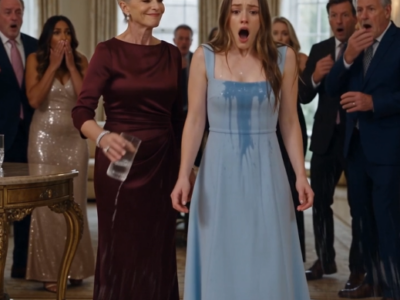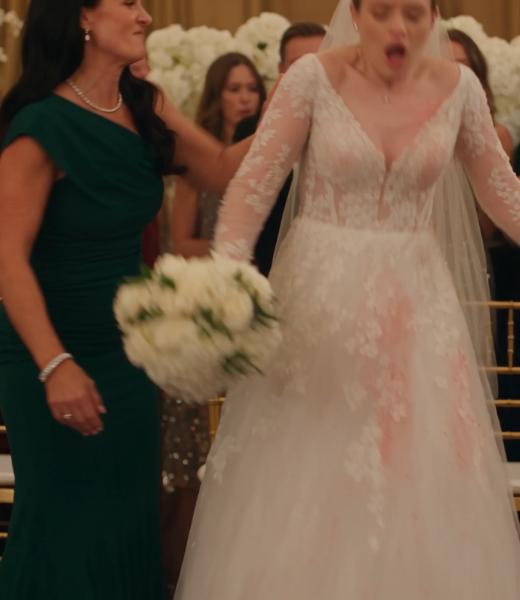
“A toast, everyone. To the bride who’s wearing a dead woman’s dress.”
CHAPTER THREE — The Black Floor
"A toast," said Celeste, "everyone."
Her voice was clear and bright and musical, a voice pitched to carry to the back of a cathedral, and it did. It rolled out across the great gilded ballroom like a bell. The quartet stumbled, and fell silent. Three hundred guests, who had been turning in their seats to watch the bride, swivelled back, slowly, one row at a time, with the faint dry creak of gilt chairs. Somebody laughed, uncertainly, expecting a joke.
Hannah stopped dead.
She was perhaps thirty feet from the altar. She stood on the glossy black marble in her mother’s dress, with her bouquet of white roses held against her waist and her veil lifting very slightly in the draught from the doors, and she saw, ahead of her, down the long dark mirror of the aisle, her stepmother coming towards her in a gown the colour of a deep sea.
She was smiling. She was holding a glass of wine at her breast like a priest with a chalice.
“Celeste,” said Hannah, quietly.
“Not a word, darling. I haven’t finished.” The smile widened. It was a beautiful smile, white and bright and perfectly composed, and the eyes above it were as flat and black and still as a pair of winter ponds. “I should like to raise a glass,” said Celeste, to the room, “to the bride.”
She lifted it.
The chandeliers caught the wine. It glowed, deep and dark, like a jewel.
“To the bride,” said Celeste Voss, “who’s wearing a dead woman’s dress.”
A gasp went round the room.
It was a low, collective, appalled sound, like a wind in a wood. A woman in the third row put a hand to her throat. A man in a grey suit half rose from his seat. And all down the aisle, among the lilies and the gold chairs, Hannah saw the phones begin to lift: one, and then three, and then a dozen, and then a forest of them, held up in a sudden silent field of small cold lights.
“Celeste,” she whispered. “Please. Not today.”
“Oh, today.” Celeste took a step. “Today is exactly the day.”
She took another.
Hannah could not move. It was the strangest thing. She stood there like a rabbit in the road, with her feet rooted to the marble and her heart pounding like a fist against her ribs, and a part of her mind, a small cold clear one at the back, observed quite calmly: she is going to do something. She is going to do something terrible. And you are going to stand here and let her.
It was the way she had stood for six years.
That was what she understood, in that frozen second. It came over her in a long cold wave. She had stood in a hundred rooms, in a hundred silences, with her hands folded and her eyes lowered, while this woman took, and took, and took: her mother’s pearls, her father’s study, her own chair at the head of the table. She had been so polite. She had said thank you. She had held her tongue, in the cold house, through every little cruelty, because a good girl does not make scenes, and because her father had looked so tired.
Move, she thought. Move. Run.
She could not.
Celeste was two yards from her. She could smell her perfume: something dark and sweet and expensive, like crushed violets. She could see, in the pale oval face, every line of it, the small hard shining triumph in the eyes, the faint flush along the cheekbones, the tip of a pink tongue, caught for a second between the teeth, like a child about to break a window.
“Do you know,” said Celeste softly, so that only Hannah could hear, “I’ve wanted to do this since the day I walked into that house.”
And she tipped the glass.
It was not a splash. It was a blow.
She would remember that, afterwards, in the long white nights when the memory came back to her in pieces. She had expected a spatter, a sprinkle, a delicate rain. But the wine was heavy and cold and it came in one swift, full, deliberate sweep, across her bodice and her breast and the long lace of her sleeve, soaking through in an instant to the skin beneath. It was freezing. It took her breath. It ran down the ivory silk in a long dark stream, and where it passed, the lace turned the colour of a bruise.
She cried out.
It was an animal sound. It came out of her without her permission. She staggered, and flung up her hands, and the bouquet flew out of her fingers in a wild white arc, scattering petals, and rolled away across the glossy black floor. She felt her heel catch on the hem of her skirt. She felt her knees give. And then something struck her sharply on the shoulder, a hand, a shove, a quick hard flat push of the palm, and the world turned over.
She went down.
It was like falling through ice. For a long moment she was aware of nothing but the rush of air in her ears and the swinging, dizzying glitter of chandeliers. Then her palms struck the marble. Her knees followed. The black floor rose up and met her with a cold smack, and she was on her hands and knees in the middle of the aisle, in her mother’s dress, with her veil fallen over her face and wine dripping from her chin onto the shining stone.
There was silence.
It was a silence of such perfect, ringing, horrified completeness that she could hear the hum of a chandelier. She could hear a single breath being drawn in somewhere to her left. And above her, from a great height, in a clear and tender and ringing voice, her stepmother said:
“That dress was never yours, Hannah.”
She did not look up.
She could not. She was staring at the floor. Beneath her, in the glassy black marble, as in the surface of a pool, she could see a reflection: a small white crumpled shape on its hands and knees, with a stain spreading across it like a dark flower. It was herself. It was a girl of eleven, kneeling in a hall.
“None of it ever was.”
She lifted her face.
She did not know why. It was an instinct, an animal reflex, like the lifting of a head to the first drop of rain. She pushed back the veil with one trembling wrist, and she looked up, through the tears that she had not known she was weeping, into the ballroom.
It looked very strange from down there.
It looked enormous. The ceiling soared away overhead into a golden dusk, hung with chandeliers like frozen fountains. The faces of the guests were a long way off, pale ovals in a dark sea, with the small cold stars of the phones among them. A woman in a silver dress had her hand over her mouth. A man at the back was shaking his head, over and over, as if at a car crash. In the second row, a little girl, perhaps six, in a pink frock, was staring at her with enormous round eyes, and a smear of cake on her chin.
And in the front row, on the left, in a wheelchair, with a small navy-clad woman gripping the arm of it, a large, heavy, grey-haired man had begun to struggle to his feet.
Dad.
It was only for an instant. A flash, a flicker, a jerky desperate lurch of the huge frame against the straps of the chair. She saw the good hand clamp round the armrest. She saw the slack face contort. She saw the nurse’s hand go down hard on his shoulder and press him back, and her lips move: no, no, not yet, please. And she saw her father’s pale eyes, huge and blazing and wet, locked on hers across the width of the floor.
He was crying.
He was crying and he was trying to speak. She saw his mouth work. She saw the muscles of his throat strain. And through the dreadful silence, she heard it: a thin, harsh, cracked, wordless sound, rising from the great chest, like the grinding of a rusted door.
“Ha—”
She could not bear it.
She could not bear any of it. The wine, the phones, the little girl with cake. Her father’s face. The silence. The sound of her own breath, coming in short harsh sobs, ripping at her throat. She put both hands over her eyes, and she wept.
It was the ugliest crying she had ever done.
It was not the pretty, quiet, glistening weeping that brides do in films. It was a great hoarse, hiccuping, shuddering sob, that tore its way out of her chest and filled the room: the sound of a girl who has been brave for twenty years and has just, in front of three hundred strangers, been told that it was all for nothing.
“Why?” said Hannah.
It came out a cracked whisper.
“Why would you do this? Why would you— It’s my wedding. It’s my mother’s— I never did anything to— Why?”
She was looking up now, with her face wet and swollen and the tears running freely down her cheeks. She could see her stepmother quite clearly. The long white face, the bare shoulder, the rope of grey pearls. The glass, empty, dangling from one slender hand. And in the dark eyes above it, as she stared down, something that she had never seen before in six years of looking: not triumph, not hatred, not even contempt, but a kind of bright, blind, glittering, ravenous relief, like that of a person who has stood for a very long time on the edge of a high place and at last been allowed to jump.
“Because you looked at me,” said Celeste.
Her voice shook.
“All those years. You looked right through me. As if I were a piece of furniture. As if I’d come with the house.” She flung out her arm. The glass swung wildly. “I gave that man six years! Six years, Hannah! I wiped his chin! I— And what did I get? A seat at the end of the table. A name on a Christmas card. And her—” She jabbed a finger at the soaked ruin of the lace. “Her dress. Her face. Her—”
She broke off.
She was breathing hard. Her chest heaved. The perfect mask had slipped, and for a second, in the dazzling light, Hannah saw the face beneath: raw and ugly and naked, with its mouth twisted, and its eyes red-rimmed and dilated, like the face of a woman at the bottom of a pit.
And then someone shouted her name.