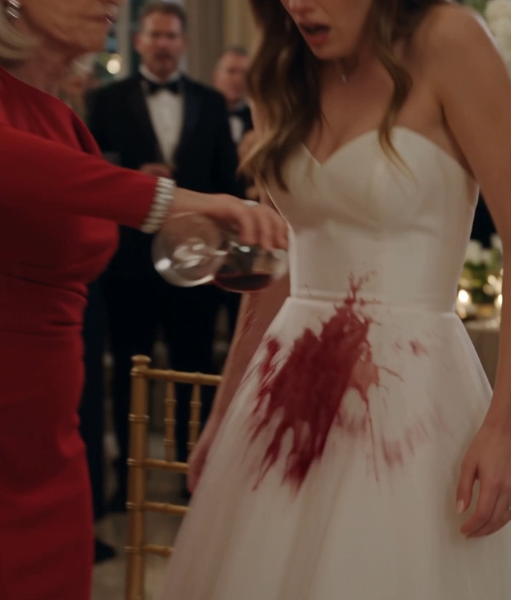
“Oh dear. How clumsy of me.”
CHAPTER FOUR — The Microphone
It is a curious thing that the people who do the most damage in the world so rarely expect to be stopped.
Margaret Whitlock did not step away. She straightened, slowly, with the empty glass still in her hand, and turned her head, and looked at her son as one looks at a waiter who has spoken out of turn. The gracious mask had not slipped. It was still there, smooth and bright and gently amused, but there was something behind it now, a small, hard, narrow flicker, like the glint of a knife in a pocket.
“Ethan, darling,” she said. “You mustn’t be dramatic.”
“Step. Away.”
“It was an accident. I tripped. These shoes are quite impossible, I’ve been saying so all evening—”
“It was not an accident.”
“I assure you—”
“I saw you.”
Her face did not change. But the faint, polite, indulgent smile stayed fixed on it a half-second too long, as a smile does on a mask that someone has forgotten to take off. “You were on the terrace, Ethan.”
“Through the glass.” He had not raised his voice. “I watched you cross the floor. I watched you tilt it. I watched you take your time.” He took a breath. His hands, at his sides, had curled into fists. “You didn’t trip, Mother. You aimed.”
A ripple went through the ballroom.
It was a small, soft, shocked ripple, like wind in a field of wheat. Guests who had been sitting rigid began, very slightly, to move. A man at table three set down his fork. Two bridesmaids in dusty rose had drawn together, their arms linked. In the corner, the string quartet had lowered their bows. And all across the great golden room, at every table, under every chandelier, three hundred pairs of eyes were fixed on the little knot of people in the middle of the floor.
“This is neither the time nor the place,” said Margaret. Her voice had dropped. It was cold now, and clear and carrying, with the faint metallic ring of command. “Take your wife upstairs. Have the dress cleaned. We shall speak of this tomorrow, in private, like civilised people.”
“No.”
“Ethan.”
“I said no.”
He turned.
He turned his back on her, which was a thing that he had never in his life done. He took three long strides across the marble to where the bandleader stood by the dais, a plump, bewildered young man in a white dinner jacket with a microphone in his fist and his mouth open. Ethan held out his hand.
“May I?”
The young man gave it to him.
“Ethan,” said his mother, behind him, in a high, sharp voice. “Ethan, I forbid—”
“Then let’s tell everyone about accidents,” said Ethan Whitlock.
He tapped the microphone.
It gave a soft, dull thud that rolled out over the speakers and filled the ballroom to its gilded roof. He turned to face the room. He was a tall man, and for the first time in all his life he stood to his full height, with his shoulders squared and his chin up, in his black tuxedo and his loosened tie, under the blazing chandeliers, and looked out over three hundred people who had known him since he was a child.
There was a long silence.
Clara could not feel her hands.
She was standing in the middle of the floor where he had left her, with her veil askew and her arms wrapped round her middle. The wine had soaked through the silk and was cold against her skin. It had a faint sour smell, like old fruit. She had stopped crying. It had stopped on its own, as a rain stops, leaving behind a great hollow ringing quiet, and she was looking at her husband’s back as one looks at a stranger on a street.
She had never seen him like this.
He had been so gentle. In two years she had never seen him angry. She had seen him tired, and frightened, and silly, and shy, and once, memorably, drunk on cooking sherry. But she had never seen this tall, rigid, white-faced man, with the microphone gripped in his fist and a vein standing out in his temple.
“Ladies and gentlemen,” said Ethan.
His voice was perfectly steady. It came out of the speakers deep and level and slow.
“I apologise for the interruption. I had planned, tonight, to give a speech. It was going to be a short one. I was going to thank you for coming, and say how happy I was, and sit down.” He paused. “I’m afraid I have to say something else.”
He did not look at his mother.
“Four years ago,” he said, “my mother’s kidneys failed.”
A stir.
It was a different kind of stir, uncertain and puzzled, like the movement of a crowd that has been given the wrong programme. A few heads turned. Somebody coughed. In the front row at table one, an elderly man in a morning coat lowered his glass.
“Many of you will remember. She was very ill. She was on dialysis three times a week, and she did not complain. She is, as you know, the bravest person I have ever met.” He drew a long breath. “She waited eleven months on a list. And on the morning of the eleventh month, a hospital telephoned and said that a stranger had agreed to give her one of her own.”
“Ethan.”
It was Margaret. She had taken a step forward. Her voice had changed. It was no longer cold. It was thin and brittle and high, with a strange, scraping, uneasy note, like a nail dragged across glass. “Ethan, I should like you to stop.”
“A living donor. A young woman. She asked to stay anonymous. She asked that nobody be told her name, and nobody was.” He turned his head, at last, and looked at his mother across the empty floor. “My mother has often said, at dinner parties, that she does not know who it was. That it was a very modern arrangement. That she is grateful, of course, but that one doesn’t make a fuss.”
Margaret had gone absolutely still.
She stood in the lamplit glitter of the ballroom with the glass in her hand and her mouth slightly open, and something moved at the back of her pale eyes, deep down, like a fish turning in black water. It was not understanding. It was not yet understanding. It was the first, small, formless, creeping chill of a person who has felt a floor tilt beneath her and does not yet know which way it will fall.
“Tonight,” said Ethan, “I should like to tell her.”
The silence was now absolute.
Clara heard her own heartbeat. It was slow and heavy and very loud, like a drum in a cellar. She heard the faint, tiny, tinkling sound of a chandelier, trembling in a draught. She heard the creak of a gilt chair as somebody shifted. And she heard, with a strange dreamlike clarity, the sound of her husband drawing in a long careful breath, as a man does who is about to step off a cliff.
She thought: what is he doing?
She thought: no.
She thought, with a sudden, dizzy, upside-down lurch of the heart, as when a lift stops too fast: oh. Oh. He knows.
Because she had never told him.
She had never told anyone. She had told the coordinator, in a quiet room, on a grey March morning, with a plastic cup of water in her hand and a pen that she could hardly hold. She had signed the form. She had gone into the theatre in a paper gown with her mother’s wedding ring on a chain round her neck, and come out of it with a scar, a pain, and a small, bright, wordless sense of being, for the first time since the spring, useful. She had not been able to save her mother. Her mother had died on a list, on a Tuesday, after four hundred and eleven days of waiting. And she had thought, in the dark of the recovery room, with the morphine humming in her veins: somebody’s mother is going to live.
That’s all. That’s enough. That’s all I want.
She had never wanted to know whose.
“The donor,” said Ethan.
He looked down. He took a small white card out of his breast pocket, and held it in the light, and she saw it flutter in his fingers.
“The donor was twenty-three years old. She was a pastry chef from Dayton, Ohio. Her mother had died waiting for a kidney, and she could not bear for it to happen to someone else. So she put her name on a list, and she gave a part of her own body to a stranger, and she asked for nothing. She didn’t want to be thanked. She only wrote four words on a card.”
He lifted it.
“Live well. Be kind.”
Clara’s hands flew up to her mouth.
She could not stop them. They simply went, of their own accord, in a wild instinctive flutter, as though to catch something falling. She saw the card. She saw the handwriting. She saw the L, with its small curling loop like a fish hook, held up in her husband’s trembling hand for the whole world to see. And then the floor seemed to dissolve beneath her, and she heard, from a very long way off, as if through water, the low steady voice of the man she loved, saying the last thing in the world that she had ever expected to hear:
“Her name is Clara Ferris.”
There was no sound.
There was not a cough, nor a rustle, nor the clink of a glass. Three hundred people sat or stood in a vast gold-and-white ballroom beneath the chandeliers with their mouths slightly open, and nobody breathed. It was the silence of a church, in the instant after the bell stops.
And on the far side of the floor, in the exact middle of the marble, a tall silver-haired woman in a long red dress had begun, very slowly, to shake.
It started in the hand. The glass that she had been holding, the empty crystal goblet with its dregs of dark wine, trembled, and tilted, and slid out of her fingers. It fell. It struck the marble with a clear high ringing note, and burst into a hundred pieces, and the sound went round the room like a shot. She did not look down. She did not move. She stood quite upright, with her hands hanging empty at her sides, staring at her son with an expression that Clara would remember for the rest of her life.
It was not anger. It was not shame.
It was terror.
It was the face of a woman who has just seen, with absolute and irrevocable clarity, the whole shape of the thing that she has done. Her lips moved. Her skin, beneath the powder, went the colour of candle wax. Her pale eyes widened and widened and widened until they seemed to fill her face, and she turned them, slowly, painfully, as if each degree cost her an effort, from her son to the small figure in the ruined white dress.
She looked at the stain.
She looked at the wet silk, and the scattered seed pearls, and the shaking hands pressed to a waist, and under them, beneath the cloth, in the exact place where a thin pale scar ran low on the left side, the place where a surgeon had once reached in and taken out a small, living, essential part of a young woman’s body, and given it to a stranger.
The stranger whose body was now keeping her alive.
“No,” whispered Margaret Whitlock.
It was a breath. It was hardly a sound at all. It came out of her chest like the last air out of a punctured tyre, and she put out one trembling hand, palm outward, as if to push the whole thing away.
“No. No. No. That isn’t— that can’t—”