A Millionaire Saw Her Sitting Alone—Until He Heard Her Whisper, “Nobody Picks Me… They Never Do”
A Millionaire Saw Her Sitting Alone—Until He Heard…
A Millionaire Saw Her Sitting Alone—Until He Heard Her Whisper, “Nobody Picks Me… They Never Do”
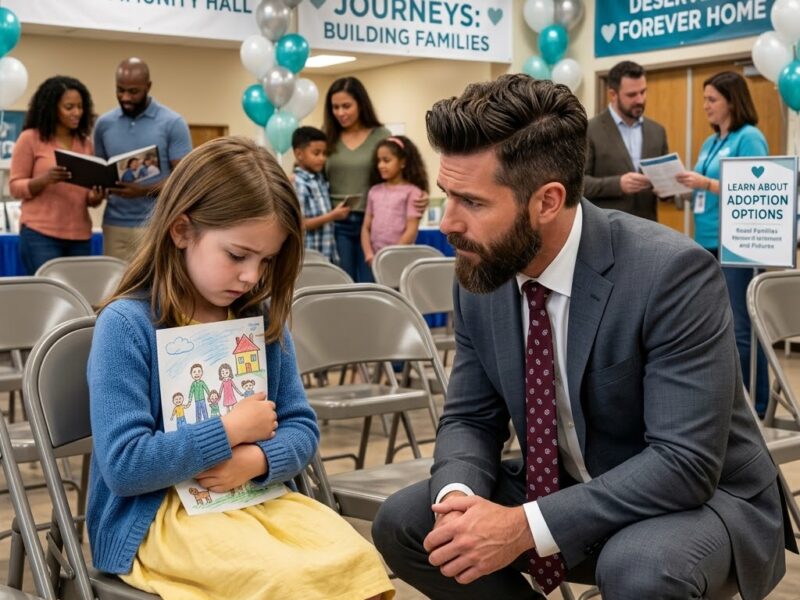
The folding chairs never quite lined up straight, no matter how many times the volunteers tried to drag them into uniform rows. Lukewarm coffee sat forgotten in a stainless steel urn beside a plate of frosted cookies nobody had touched. Outside, Pittsburgh was gray and ordinary, a Tuesday morning dripping with cold autumn rain. Inside the community center’s gymnasium, eleven children sat waiting to be chosen.
Emily was eight, and she had learned to make herself small.
She sat near the end of the back row with a manila file folder in her lap, too thick for a child her size, too heavy for arms that thin. Someone had written her name on the tab in blue marker, and underneath it, a nine-digit case number. She kept both hands flat on the cover, her knuckles white, as if she were afraid it might slide off her knees and spill her whole life onto the linoleum for strangers to read.
The adults moved through the room the way people move through a farmer’s market—unhurried, comparing, searching for the perfect fit. They paused in front of each child just long enough to be polite, asking a volunteer a hushed question, then drifted on. Their voices carried past Emily in jagged fragments, never quite lowered enough.
Medical history is a concern. We were really hoping for one without behavioral flags. She looks like a lot of work.
A woman in a cashmere cardigan crouched in front of the little girl beside Emily, complimented her crayon drawing of a horse, and moved on within a minute. Emily watched the woman’s suede boots pass her own chair without slowing down. She stared down at her sneakers instead. They were a size too small, the canvas frayed, the left toe held together with packing tape that had gone gray and started to curl at the edges.
She didn’t cry. She had learned, through three foster homes and two group facilities, that crying in a room like this only made the adults walk faster.
“Nobody picks me,” she whispered to the floor. “They never do.”
Near the back exit, close enough to leave without being stopped by the organizers, Carter Hale stood with his hands in his pockets. His charcoal suit was immaculate, though his tie was already loosened. He hadn’t come to look at children. He had come to hand over a heavily publicized corporate donation check, shake a hand for a photograph nobody would remember by tomorrow, and be back in his waiting town car within ten minutes.
Then Emily tucked a strand of dark hair behind her ear.
It was a small motion. Ordinary. But something in the fragile tilt of her wrist, the way her narrow shoulders drew inward as if she were physically bracing to be disappointed, reached into a part of Carter that had been sealed shut for six years. It turned the lock without asking his permission.
For one unguarded second, the folding chairs and the stale coffee smell fell away. He was standing in a hospital room years earlier, watching a much smaller hand do the exact same thing against a white sheet.
He didn’t let himself finish the memory. He didn’t remember making the conscious decision to move across the gymnasium. He only remembered the sound of chair legs scraping as a couple stepped aside for him.
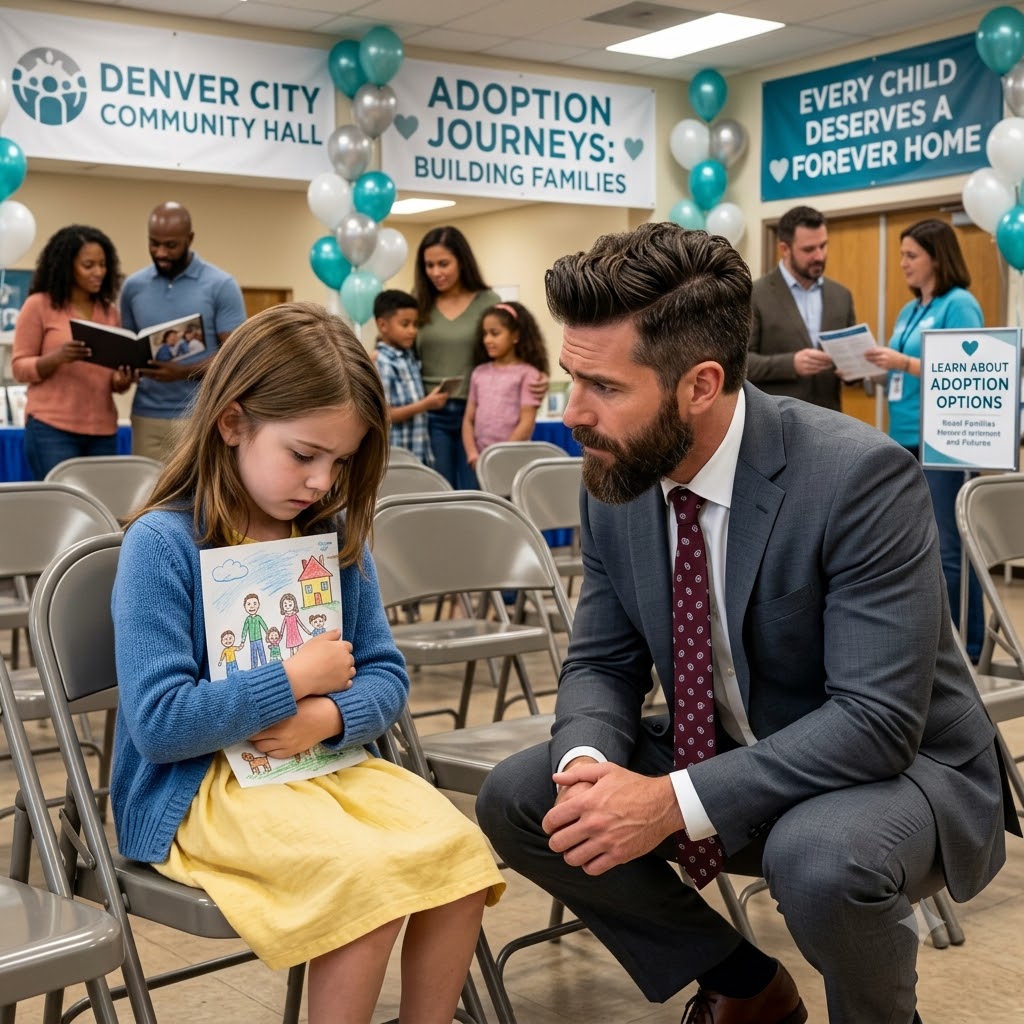
And then the linoleum was cold and hard under his knees. He had gone all the way down until his eyes were perfectly level with hers, refusing to look down at her the way everyone else in the room did.
Up close, she smelled like the inside of an old municipal building—dust and industrial soap. Her eyes were wide, wary, her small body instinctively flinching backward before he had spoken a single word.
“I’m not here to pick a project,” Carter said. His voice was a low, steady rumble, quiet enough that the rest of the room couldn’t get its hands on it. “I’m here to choose you.”
Emily blinked. The sentence didn’t fit any shape she recognized. Grown-ups said things like that sometimes—bright, shiny sentences that dissolved the moment they walked out to the parking lot and realized she was broken. She had learned better than to hold onto any of them.
“You don’t have to say that,” she said. Her voice was so quiet he almost missed it over the hum of the crowd. “You can just go. It’s okay.”
Behind them, near the check-in table, Mara Voss, the placement director, was watching. Her smile—practiced, professional, aimed at every wealthy visitor like a porch light—went thin and tight at the corners. She watched Carter Hale kneel on her floor and felt a spike of cold dread in her chest that had nothing to do with the Pittsburgh weather.
“I know I don’t have to,” Carter said to Emily, ignoring the sudden shift in the room’s gravity. “I’m choosing to.”
Carter reached out slowly, the way a person offers a hand to something wild and starving, giving it a clear avenue to bolt before asking it to trust him. Emily’s fingers, when they finally, hesitantly touched his, were like ice. Her grip was so light it barely registered. She had learned not to hold onto anything too hard, just in case it got yanked away.
That was when Carter’s executive assistant, Sarah, leaned down at his shoulder. Her phone was still lit in her hand, her voice pitched to an urgent whisper.
“Sir,” Sarah said. “That child isn’t on the active adoption list.”
Carter didn’t look away from Emily’s face.
“She’s not in the system at all,” Sarah continued, scrolling rapidly. “I just pulled the event’s digital manifest. On paper, sir… she doesn’t exist.”
The Empty House
Carter Hale had built Hale Systems from a single regional logistics contract into an empire that moved freight, managed supply chains, and guarded warehouses across eleven states. People who worked for him used the same three words when they described him: disciplined, exacting, and closed. He answered emails at five in the morning. He never raised his voice in a board meeting. He also never stayed for the cake when someone retired.
His house sat up in the hills above the city, a fortress of glass and poured concrete. It was the kind of place a magazine photographer would call minimalist, and a person who actually lived there would call suffocatingly empty. Nothing sat out of place because nothing was ever touched. The cleaning service came twice a week to a house that barely showed anyone had been in it. There were no photographs on the walls, no mail left on the granite counter. Even the stainless steel refrigerator hummed quietly, as if apologizing for making a noise.
In his home office, on the corner of a massive mahogany desk that was otherwise bare, a single silver frame lay face down.
It had lain that way for six years. Carter dusted around it without turning it over, the way a person steps around a crack in a floor they’ve stopped noticing but never stopped avoiding. He knew exactly what the photograph showed without needing to look. A beach in the Carolinas. A laugh caught mid-breath. A small hand wrapped tight around his thumb.
He sat in that office the night after the adoption event, his phone heavy in his hand, doing something he almost never did. He wasn’t working.
Emily’s voice kept surfacing in the quiet of the room. Nobody picks me. They never do.
He finally picked up the phone and dialed the number for Dana Klene, an independent social worker three different legal colleagues had recommended with some variation of the same warning: She’ll tell you the truth, even when it costs her the referral.
Dana arrived the next morning at eight sharp. She carried a battered leather satchel and none of the sycophantic polish Carter was used to from people who wanted his money. She had the tired, unhurried manner of a woman who had sat in a hundred immaculate living rooms just like this one, and learned long ago not to be intimidated by the furniture.
“You want to help her,” Dana said, sitting across from him in his office without waiting to be invited. “That’s good. But you should know something about the system you’re about to step into, Mr. Hale. It isn’t always broken by accident. Sometimes, it’s held broken on purpose by someone who benefits from it staying exactly that way.”
“Meaning what?” Carter asked, leaning back in his leather chair.
“Meaning a kid can get labeled ‘unplaceable’ for reasons that have nothing to do with the kid.” Dana watched him carefully, measuring his reaction. “I’ve seen guardians keep children in limbo because a placement changing status changes a check. I’m not saying that’s definitely what’s happening with Emily. I’m saying you should go in with your eyes open, not just your checkbook.”
Carter’s jaw tightened, a microscopic shift in bone and muscle. His voice stayed dead level. That was the thing rivals always underestimated about him. The calm wasn’t the absence of feeling. It was a containment vessel. He had spent six years learning how to hold something enormous and violent perfectly still.
“If someone hurt her on paper,” Carter said, “we’ll prove it. If someone hurt her in real life, we’ll stop it.”
Dana studied him a moment longer, looking for the lie. Whatever she saw in his eyes settled something deep inside her, because she unclasped her satchel and pulled out a thin blue folder.
“Then let’s start with what’s actually on paper,” she said, “because none of it adds up.”
She slid a printout across the mahogany desk. It was a state registry entry, Emily’s nine-digit case number circled twice in blue ink. Carter leaned forward. Halfway down the page, a dense block of legal text had been highlighted in yellow.
“Right here,” Dana said, tapping the highlight. “This is a continuing benefit clause. As long as Emily’s custody status stays exactly as it is—unadopted in the system, technically still a ward under a legal guardian’s name—a monthly payout keeps being distributed. Not to the county. Not to the group home.”
She looked up at him, her eyes dark with disgust. “To someone else entirely, Mr. Hale. Someone who isn’t listed anywhere on Emily’s active daily care.”
The Pink Suitcase
The transitional placement facility was a cinderblock building on the industrial edge of the city. It smelled intensely of bleach and cheap lemon floor cleaner, desperately trying to mask the older, sour scent of institutional despair underneath.
Carter arrived twenty minutes early. He parked his car in the cracked asphalt lot and sat behind the wheel for most of that time, staring at the reinforced glass doors. He had sat through hostile corporate takeovers without blinking. He had fired executives who threatened to ruin him. This was different. This felt like something he could actually lose before he even had his hands on it.
When Emily finally came out through the double doors, a caseworker walking a half-step behind her, she was dragging a suitcase. It had been pink once, faded now to a color with no real name. One wheel was missing entirely, forcing her to drag it sideways across the concrete so it scraped with a terrible, rhythmic shhh-clack.
A standard airline luggage tag was tied around her thin wrist with a rubber band. Her name and case number were printed on it in the same blue marker from the file folder.
Carter looked at that tag longer than he meant to. It was the kind of thing you put on lost cargo, not a human being. Something in his chest seized—quiet and furious all at once—though not a single muscle moved in his face.
Emily stopped three feet away from him. She gripped the plastic suitcase handle in both hands as if she expected him to snatch it away. Her eyes went to his polished leather shoes, then briefly to his face, then immediately back to his shoes. She possessed the particular, heartbreaking stillness of a child who had learned that moving too fast or hoping too visibly only made the inevitable disappointment land harder.
Related Articles

They Mocked the Widow’s Dirt Cellar—Then the Freeze Left Every Cabin Cold but Hers Warm
They Mocked the Widow’s Dirt Cellar—Then the Freeze Left Every Cabin Cold but Hers Warm…

A Homeless Veteran and His German Shepherd Inherited a Ridge No One Wanted — 35 Feet In, They Found
Chapter 1 / 7 A Homeless Veteran and His German Shepherd Inherit… A Homeless Veteran…

Neighbors Laughed When He Built A Cabin Inside An Old Barn—Until It Kept His Home 35 Degrees Warmer
Chapter 1 / 8 Neighbors Laughed When He Built A Cabin Inside An… Neighbors Laughed…

His Sod House Had No Woodpile in January – Until the Trains Stopped and the Town Came Begging
Chapter 1 / 10 His Sod House Had No Woodpile in January – Until t……

She Built Her Cabin Over the Woodshed and Never Burned Wet Wood Again
Chapter 1 / 8 She Built Her Cabin Over the Woodshed and Never Bu… She…

The Duke Abandoned Her on Their Wedding Day—Years Later, He Discovered What He Had Lost
Chapter 1 / 7 The Duke Abandoned Her on Their Wedding Day—Years… The Duke Abandoned…

He Wedged a Tiny A Frame Into a Crevice Before Winter and His Family Slept at 75°F While Town Hit
Chapter 1 / 7 He Wedged a Tiny A Frame Into a Crevice Before Win……

He Was Too Old to Ride—So He Bought the Ruined Ranch and Found the Room Behind the Fireplac
Chapter 1 / 5 He Was Too Old to Ride—So He Bought the Ruined Ran……

Settlers Laughed at His Underground Heat Recovery Duct — Until It Kept His Cabin 71°F Warmer
Chapter 1 / 9 Settlers Laughed at His Underground Heat Recovery… Settlers Laughed at His…

A Navy SEAL Built a Home Inside a Mountain—Then His Dog Warned Him Before the Storm
Chapter 1 / 5 A Navy SEAL Built a Home Inside a Mountain—Then Hi… A…