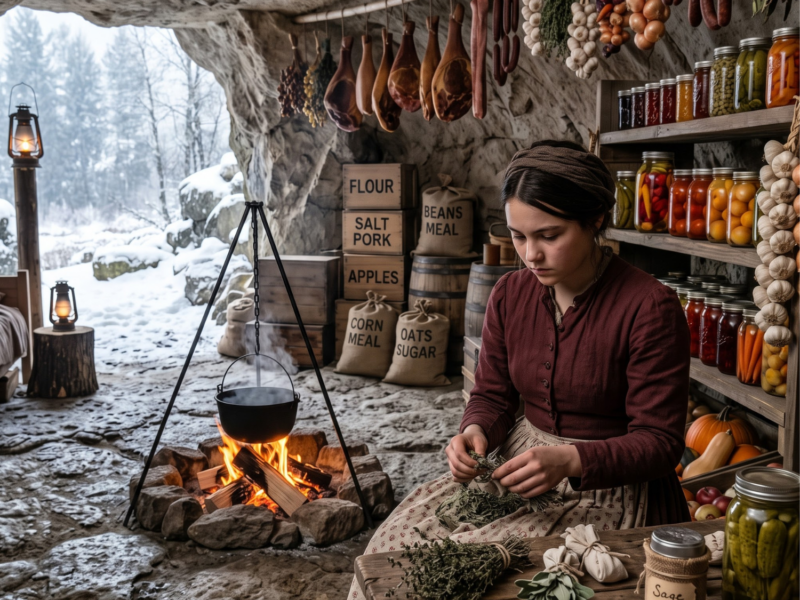
At 17 She Stockpiled Food in a Cave—Then a Deadly Blizzard Made the Whole Town Beg….
At 17 She Stockpiled Food in a Cave—Then a Deadly…
At 17 She Stockpiled Food in a Cave—Then a Deadly Blizzard Made the Whole Town Beg….
The first warning came from the cattle.
Three days before the snow, every steer in Caleb Rusk’s north pasture turned away from the open range and crowded against the southern fence. Seventeen-year-old Norah Hail noticed it before anyone else did. She stood beside the livery stable in Red Willow, Wyoming Territory, a heavy wooden bucket of oats resting against her hip, staring out across the valley.
The animals beyond town pressed shoulder-to-shoulder. Their noses pointed south. Their backs faced the mountains. No storm clouds filled the sky. No snow touched the ground. The sun was pale, but present. Yet the cattle would not move.
Norah set the bucket down. The handle clattered against the wood, a sharp sound in the cold, still air. Above the western ridge, a thin strip of cloud stretched like a smear of gray smoke across the blue.
Then she noticed something stranger.
The magpies were gone. For most of October, they had fought over scraps behind the butcher shop, their raucous calls a constant background noise. That morning, the alley was empty.
Norah wiped her hands on her brown work skirt, the coarse wool rough against her chilled skin, and looked toward the mountains again. Her grandfather had once told her that people watched the sky because it was easy.
A careful person watches everything beneath it, Silas had said, his voice raspy from years of mountain air. The animals, the creek, the wind… even the smell of the dirt before the weather changes.
Norah had listened. Most people in Red Willow had not. And before the week ended, some of them would be pounding on a hidden stone door, begging a seventeen-year-old girl to let them inside. But on that clear Monday morning, they were still laughing at her.
Norah lifted the oat bucket and carried it into the stable. The air inside smelled of dust, old leather, and manure. Her employer, Amos Bell, was tightening a saddle strap beside a massive chestnut mare. Amos was fifty-eight, broad through the shoulders, with gray whiskers and hands scarred from thirty years of breaking horses. He glanced outside.
“Rusk’s herd acting foolish again,” Amos grunted, pulling the cinch tight.
Norah poured oats into the feeding box. The sound of grain hitting the wood was sharp and rhythmic. “They’re trying to get out of the north wind.”
“There isn’t a north wind, Norah.”
“There will be.”
Amos stopped pulling the strap. He studied her for a second. Then one corner of his mouth lifted in a half-smile. “You planning to argue with October?”
Norah hung the empty bucket on a rusted nail. “No.” She reached for her heavy canvas coat. “I’m planning for November.”
That answer followed her through town. By noon, Norah was pulling a small, creaking handcart along the main dirt road. A fifty-pound sack of potatoes rested inside it, the burlap rough and dusty. Two bags of dried beans sat beside the potatoes. A wrapped block of salt lay hidden beneath an old wool blanket.
People noticed. Red Willow was too small for private business. The barber, sweeping hair from his stoop, stopped and stared. The blacksmith paused his hammering. Three ranch wives standing outside Miller’s general store stopped talking as the cart squeaked past.
Norah kept her eyes forward. She knew what they thought of her. The orphan. The eccentric girl who lived above the stables. The girl who listened to her crazy grandfather’s ghost stories instead of focusing on finding a husband.
At the edge of town, the road divided. The main wagon trail continued south toward Laramie. Norah turned the cart west. The wooden wheels bumped across the hard, frozen earth toward Cottonwood Ridge.
She had made the same trip four times in six days. Nobody knew where the supplies went. That was exactly how she wanted it.
The ridge rose behind Red Willow like the spine of a sleeping beast. Cottonwood trees with pale, skeletal branches grew along its lower creek bed, but higher up, there was only jagged stone, brittle sagebrush, and twisted pine. Norah pushed the cart until the incline became too steep, leaving it beneath the skeletal remains of a dead cedar.
She loaded the potatoes into a canvas sack, hoisted it onto her shoulder, and began to climb.
The trail was not really a trail. It was a memory. A line she navigated between two massive boulders, around a fallen pine, across a narrow shelf of slick limestone, then down into a shallow cut completely obscured by thorn brush.
At the bottom of the cut stood a wall of pale rock.
Norah dropped the sack. She placed both hands against a large, loose slab of stone and pushed. The slab, balanced on a hidden pivot point, shifted inward with a grinding sound.
Cold, intensely dry air touched her face. Behind the slab waited absolute darkness.
Norah struck a sulfur match against her boot. The sudden flare illuminated the narrow entrance. She lit a small, brass lantern hidden just inside the opening.
The cave was wider than it looked from the outside. The first chamber was low, forcing Norah to duck beneath a section of the ceiling, but farther in, the stone opened into a room nearly twenty feet across.
Old, sturdy wooden shelves lined one wall. A rusted iron stove, a relic from a mining camp, sat beneath a natural crack in the rock ceiling. Someone had shaped a sleeping platform from flat river stones and thick pine boards. Two large clay water jars stood in the corner.
Her grandfather, Silas Hail, had found the cave while trapping in 1869. He had never lived there. He had never told anyone in town about it. But during bad winters, he had quietly stored supplies inside. When Norah was nine, he had brought her there for the first time.
He had handed her a piece of white chalk and told her to mark the back wall. She still remembered his words, spoken in the hushed, resonant acoustics of the cavern.
Food in a kitchen belongs to today, he had said, tapping the stone shelf with a calloused finger. Food hidden from the weather belongs to whatever comes next.
Silas had been dead for four years. The chalk mark, a jagged ‘N’, remained.
Norah dragged the potatoes inside. She placed them carefully beside sacks of cornmeal, oats, beans, dried apples, onions, and flour. She had already hung strips of smoked beef from wooden pegs driven into fissures in the rock. Three jars of rendered fat stood wrapped in oilcloth. Matches sat sealed inside a tin box to protect against moisture. Lamp oil rested far from the stove.
Nothing was arranged by chance.
She checked the potatoes for soft spots, tossing two bruised ones aside. She lifted the flour sacks onto wooden pallets to keep them off the cold stone floor. She turned the dried meat so air reached both sides.
Then, she pulled a small, worn leather notebook from her coat pocket.
Flour: 62 lbs. Beans: 41. Cornmeal: 33. Potatoes: 109. Dried beef: 18. Salt: 8.
Norah stared at the numbers scribbled in charcoal. It was enough for one person for many weeks. Enough for two if portions stayed strictly rationed.
It was not enough for a town.
She closed the notebook. At that exact moment, a sharp sound echoed through the cavern.
Click. Clatter.
A pebble dropped somewhere behind her.
Norah turned sharply. The lantern flame swayed, casting long, dancing shadows. The cave extended farther than the shelves, a narrow passage disappearing behind a shoulder of jagged black stone.
She waited. The silence was absolute.
Then, another sound.
Scrape.
Then nothing.
Norah reached toward the small skinning knife she kept sheathed at her belt. Her fingers brushed the cold leather handle, but stopped before drawing the blade. Instead, she lifted the lantern high.
“Hello?” she called out. Her voice sounded small and vulnerable in the vastness of the rock.
No answer.
She stepped closer to the dark passage. A sudden, chilling current of air moved across her cheek. That had not happened before. The air in the cave was always still.
Norah raised the lantern higher, illuminating the floor of the passage.
Ten feet inside the tunnel, she saw tracks in the thick dust.
They were not animal tracks. They were boot marks.
Norah crept forward, her heart hammering against her ribs. The tracks looked old—the edges were softened, partially filled with fallen grit from the ceiling. One print pointed toward the deep, unexplored back of the cave system. Another pointed out.
Norah crouched, her knees popping loudly in the quiet. She placed two fingers beside the clearest print. The boot had been large. Much larger than her own, and larger than Amos’s. It was a man’s boot, heavily treaded.
She slowly stood up. Her grandfather had never mentioned another passage. He had never mentioned anyone else using the cave.
Norah stared into the suffocating darkness for several long seconds, her grip tightening on the lantern handle. Then, she backed away.
The food mattered more. The storm mattered more. Whatever was deeper inside the mountain could wait.
Outside, the afternoon light had turned a sickly, jaundiced yellow. The air had completely changed. It felt heavy, electric.
Norah stopped beside the hidden entrance, her hand resting on the stone slab. She wet one finger and raised it. The wind was moving steadily from the northwest. It was cold enough to sting her damp skin.
The cattle had been right.
She hurried down the ridge, her boots skidding on the loose rock. By the time Norah reached Red Willow, the temperature had plummeted. The sudden cold bit through her canvas coat.
People on the street had begun pulling heavy coats from wagon seats and wrapping scarves tightly around their necks. At the blacksmith shop, Gideon Price, a man built like a barrel with a beard black as coal, was hammering a horseshoe flat on his anvil. Orange sparks jumped across the dirt floor.
Two ranch hands, leaning against the open barn doors, watched Norah approach with her empty handcart. One of them pointed a calloused finger.
“There she is.”
Gideon looked up, wiping sweat from his forehead, seemingly immune to the sudden chill. “Our mountain merchant.”
The ranch hands chuckled. Norah kept her eyes fixed ahead, gripping the handle of the cart tighter.
Gideon stepped outside, leaning his heavy hammer against the doorframe. “What are you selling up there, Norah?”
“Nothing.”
“Then what are you buying all this food for?” Gideon demanded, his tone losing its mocking edge and turning slightly aggressive.
Norah stopped. Behind Gideon, the forge snapped and hissed, the only source of heat on the street. She looked past him, toward the northern ridge. The thin strip of gray cloud had thickened, joining together into a solid, ominous mass that blotted out the horizon.
“Storm,” Norah said simply.
One of the ranch hands snorted, adjusting his hat. “It’s Wyoming, girl. We get storms.”
“This one is early.”
Gideon wiped soot from his massive hands with a dirty rag. “You seventeen now, Norah?”
Norah nodded.
“You lived through many winters at seventeen?”
The men smiled again, exchanging knowing glances.
Norah looked at Gideon, her gaze steady and unnervingly serious. “Enough to know I don’t want to meet one hungry.”
Nobody laughed. The smile vanished from Gideon’s face. For a second, the only sound was the wind picking up, rattling a loose sign down the street. Then, Gideon turned back inside and the hammer started again, striking the anvil with unnecessary force.
Norah moved on.
Inside Miller’s general store, the air smelled of stale coffee, oiled leather, and dust. She walked straight to the counter and placed a small, worn leather coin purse on the polished wood. She spent almost every coin she had left.
Mr. Miller, a thin, nervous man with wire-rimmed glasses, placed her purchases on the counter with hesitant hands. Two boxes of matches. Three pounds of coffee. More salt. A coil of hemp rope. Candles. Needles. Soap. Another small sack of flour.
He looked at the few coins remaining in her palm. “That leaves you twenty-three cents, Norah.”
“I know.”
Mr. Miller adjusted his glasses. “You keeping anything for rent?”
Norah folded the empty coin purse and slipped it into her pocket. “I don’t have rent.”
Mr. Miller’s hands stopped arranging the candles. He knew the situation. Everyone did. Since her grandfather’s cabin had burned the previous spring—a mysterious fire that no one liked to talk about—Norah had slept in the small, drafty loft above Amos Bell’s stable. Amos charged her nothing as long as she mucked the stalls before sunrise. Most people in town knew that. Few spoke about it because it made them uncomfortable.
Mr. Miller glanced toward the window. The yellow light was fading rapidly, replaced by a harsh, metallic gray. The wind howled against the glass panes.
He reached under the counter and pulled out a heavy, folded gray wool blanket. He set it on top of her purchases.
“Take another blanket.”
“I can’t pay for it, Mr. Miller.”
“You can bring it back in April.”
Norah looked at the folded wool. It was thick, warm, and expensive. She looked at Mr. Miller’s anxious face. Then, she picked it up.
“April,” she said.
He nodded slowly. “April.”
When Norah stepped outside the store, the wind nearly tore the door from her grasp. She looked up as the first snowflake landed on the gray wool blanket in her arms. It melted immediately.
A second flake touched her sleeve. Then a third.
People walking along the main street stopped and looked upward. A young boy ran into the road, laughing, trying to catch the flakes on his tongue. His mother scolded him from a porch, but she was smiling too.
Norah did not smile. She loaded the cart with practiced efficiency.
Then, she heard the frantic, staccato rhythm of hoofbeats.
A rider came hard from the north road, pushing his horse to a dangerous gallop. The animal’s chest was wet with sweat, its breath pluming in massive white clouds.
The rider was Owen Pike, a young fence worker from the Bar 7 ranch. He hauled back on the reins, pulling the horse up sharply beside the water trough near the stable.
“Amos Bell here?” Owen shouted, his voice cracking with panic.
Norah pointed toward the stable doors. “What happened?”
Owen practically fell from the saddle, his boots hitting the frozen dirt hard. “Rusk’s cattle broke the south fence!”
Norah stared at him, the sack of flour slipping slightly in her grasp. “All of them? Near two hundred head?”
Owen rubbed his hands together furiously, shivering uncontrollably. “Down valley.”
That made Norah’s jaw tighten so hard her teeth ached. Cattle did not abandon good grass, break through a sturdy barbed-wire fence, and stampede together without a reason. Not like that. They were running.
She left the cart where it stood and walked quickly toward the stable. Amos was already coming out, holding a pitchfork, his eyes fixed on the panicked rider.
Owen spoke before Norah could reach them. “Bar 7 horses are fighting their stalls, Amos! Kicking the wood to splinters! Rusk’s herd moved south. Dawson says deer are crossing his lower field in broad daylight. Hundreds of them.”
Amos looked toward the sky. The amusement that had been there that morning was gone, replaced by a deep, grim lines around his eyes. The sky was no longer gray; it was a churning, bruised black, descending rapidly toward the valley floor.
Norah stepped up beside Amos. She spoke quietly, but her voice cut through the rising wind.
“Tell people to bring in wood.”
Amos looked down at her. “Tonight?”
For the first time, he did not tease her. He didn’t smile. He looked at the sky, then at the panicked fence worker, and then back at the seventeen-year-old girl who had been preparing for this moment while everyone else laughed.
“Now,” Norah said.
Related Articles

They Mocked the Widow’s Dirt Cellar—Then the Freeze Left Every Cabin Cold but Hers Warm
They Mocked the Widow’s Dirt Cellar—Then the Freeze Left Every Cabin Cold but Hers Warm…

A Homeless Veteran and His German Shepherd Inherited a Ridge No One Wanted — 35 Feet In, They Found
Chapter 1 / 7 A Homeless Veteran and His German Shepherd Inherit… A Homeless Veteran…

Neighbors Laughed When He Built A Cabin Inside An Old Barn—Until It Kept His Home 35 Degrees Warmer
Chapter 1 / 8 Neighbors Laughed When He Built A Cabin Inside An… Neighbors Laughed…

His Sod House Had No Woodpile in January – Until the Trains Stopped and the Town Came Begging
Chapter 1 / 10 His Sod House Had No Woodpile in January – Until t……

She Built Her Cabin Over the Woodshed and Never Burned Wet Wood Again
Chapter 1 / 8 She Built Her Cabin Over the Woodshed and Never Bu… She…

The Duke Abandoned Her on Their Wedding Day—Years Later, He Discovered What He Had Lost
Chapter 1 / 7 The Duke Abandoned Her on Their Wedding Day—Years… The Duke Abandoned…

He Wedged a Tiny A Frame Into a Crevice Before Winter and His Family Slept at 75°F While Town Hit
Chapter 1 / 7 He Wedged a Tiny A Frame Into a Crevice Before Win……

He Was Too Old to Ride—So He Bought the Ruined Ranch and Found the Room Behind the Fireplac
Chapter 1 / 5 He Was Too Old to Ride—So He Bought the Ruined Ran……

Settlers Laughed at His Underground Heat Recovery Duct — Until It Kept His Cabin 71°F Warmer
Chapter 1 / 9 Settlers Laughed at His Underground Heat Recovery… Settlers Laughed at His…

A Navy SEAL Built a Home Inside a Mountain—Then His Dog Warned Him Before the Storm
Chapter 1 / 5 A Navy SEAL Built a Home Inside a Mountain—Then Hi… A…