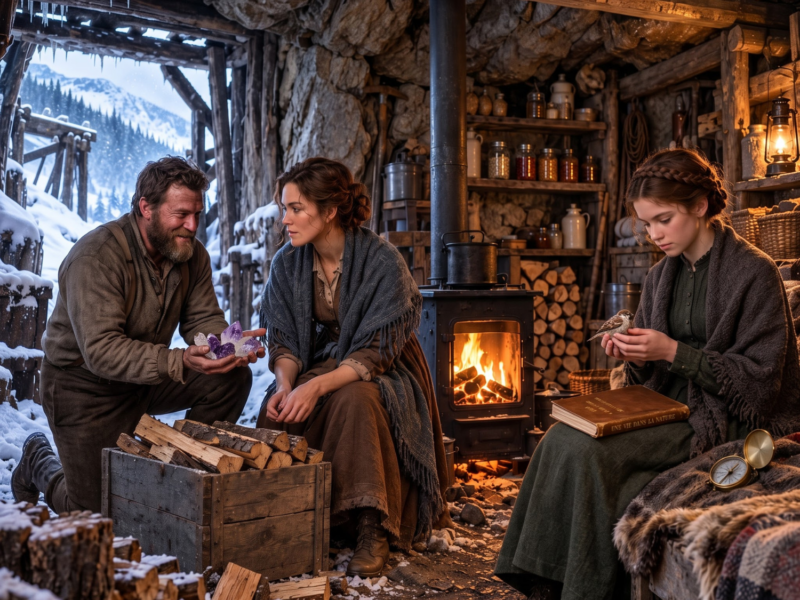
Before Winter, She Stocked a Mine With Food and Wood—Then an 8-Day Blizzard Came
Before Winter, She Stocked a Mine With Food and Wo…
Before Winter, She Stocked a Mine With Food and Wood—Then an 8-Day Blizzard Came
.
.
The last click of the orphanage gate was as sharp as the autumn wind cutting through Ara’s threadbare wool coat. It was a singular, metallic sound—heavy iron teeth slotting into a rusted groove—but to her, it was the sound of a guillotine dropping. Twenty-two years of living in an institution ended with that one resounding clack.
Ara stood on the cracked cobblestones of Last Grasp, a frontier town that clung to the edge of the civilized world like a desperate beggar. She did not look back at the looming, gray-brick facade of St. Jude’s Home for the Abandoned. She knew every crack in its mortar, every draft that howled through its dormitories, every bell that dictated when she slept, woke, ate, and prayed. She had spent her entire life obeying those bells. Now, there was only the wind.
In her hands, her fingers numb from the biting cold, she held a thin manila envelope and a canvas bag containing two spare dresses, a comb, and a pair of worn boots. She had no family to go back to, no friends waiting in the wings, and no money to her name.
Inside the envelope were three things: a deed to a faraway piece of land in the foothills of the Dragon’s Tooth Mountains, a heavy iron key mottled with rust, and a single twenty-dollar bill.
The land had belonged to her great-grandmother, Anya, a woman the town remembered less as family and more as a cautionary tale. Ara had never met her, but she had heard the whispers in the town square when she was marched to church on Sundays. The madwoman of the mountain, they called her. The witch of the high peaks.
Mr. Thorne, the chairman of the town council, had handed over the papers an hour earlier. He was a large, imposing man who wore his authority like a tailored suit. He had summoned Ara to his office, sat behind a desk of polished mahogany, and slid the envelope across the pristine wood with a smirk that didn’t reach his cold, calculating eyes.
“A fitting inheritance,” Thorne had said, his voice dripping with condescension. “They call it the Burned Place. Nothing but scorched stone and bad memories up there. It is worthless land, really. The fire took everything of value decades ago. But the law is the law, and the state dictates that upon your emancipation, it belongs to you.”
Ara had stared at him, her jaw set. “If it is worthless, why does the town care who owns it?”
Thorne’s smile had vanished. “We don’t. We only care that you do not become a burden on the parish. Take the twenty dollars. Find a husband, or find a scullery job. But do not expect charity from Last Grasp. You are an adult now.”
Standing on the street, Ara opened the envelope and looked at the crisp twenty-dollar bill. It was the only barrier between her and starvation.
She turned her back on the orphanage and walked toward the mercantile district. The air tasted metallic, thick with the scent of coming snow. The sky above was a bruised, heavy purple. She found a general store and spent almost all the money on survival: a fifty-pound sack of oats, dried salted meat, hardtack, a canteen, a box of matches, and a heavy wool blanket. With her last five dollars, she bought a one-way seat on a freight wagon heading north, toward the jagged, snow-capped teeth of the mountains.
The driver, a silent man with a face like weathered leather, didn’t ask questions. He helped her load her meager supplies, flicked the reins, and the draft horses pulled them out of Last Grasp.
Ara watched the town disappear behind the rolling hills. She felt no nostalgia. The world had just handed her a key to a ruin and called it a future. She intended to see it for herself.









