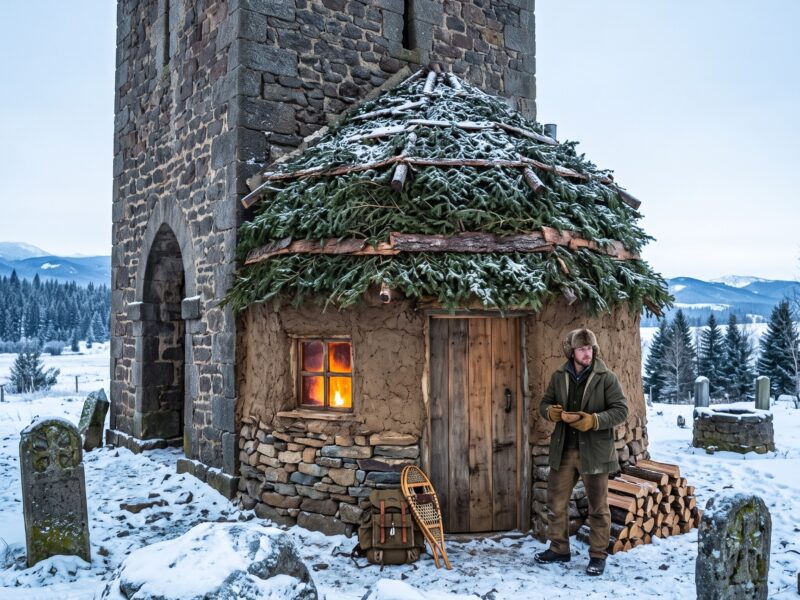
Evicted With Nothing, He Turned a Collapsed Church Into a 63° Shelter While the World Outside Froze
CHAPTER SEVEN
The siege finally broke in mid-January.
When the winds died and the sun emerged, the valley was devastated. Livestock losses were catastrophic. But word of the standoff at the church, and the impossible temperature inside it, spread like wildfire.
Silas Croft became the first and most fervent apostle of the McLoud method.
By the first thaw in March, the story of the man in the mud hut had completely changed. He was no longer a stubborn fool. He was a master.
Peter Finch, a practical farmer who had lost half his herd to the freeze, approached Euan at the trading post. “Show me,” Finch asked simply.
Euan didn’t gloat. He walked Peter through the principles of thermal mass, the thermal break, and airtight insulation. “You don’t have a church ruin,” Euan told him. “But you have the earth.”
That summer, Peter dug into the side of a south-facing hill, building a dugout framed with heavy timber and insulated with clay, using the immense thermal mass of the earth itself. The following winter, Finch’s dugout held a steady 60 degrees.
The adoption accelerated. Nineteen families adapted their cabins by the winter of 1890, adding heavy stone heat sinks and clay-sealed insulation walls. Silas Croft overhauled his entire carpentry business, offering a hybrid design known locally as the “McLoud Build.”
As for Alastair Vance, Euan kept his word. In the spring, Euan and Silas rode to Helena and presented the iron box to the federal magistrate. Vance’s fraudulent land claims were dissolved. The land was returned to the public trust, and Euan formally claimed the acreage around the ruined church. Vance fled the territory before the marshals could arrest him.
Years later, the stone apse was incorporated into a beautiful, sprawling, permanent home for the McLoud family. The pine and mud wall was eventually replaced by thick timber and double-paned glass, but the granite semicircle remained the warm, steady heart of the house.
When a visiting journalist from back East came to write a story about the famous “Montana Thermal Dwellings,” he asked Euan if he was proud of revolutionizing frontier architecture.
Euan, gray-haired but still strong, sat by the potbelly stove and ran his hand over the warm granite.
“This isn’t new,” Euan said, his Scottish brogue still thick. “The earth was always warm. The stone always knew how to hold it. We just had to stop fighting the wind long enough to listen.”
The frontier never rewarded stubbornness for its own sake. It rewarded what worked. It rewarded the quiet competence of a man who faced a brutal problem, not with more desperate effort, but with a better idea.









