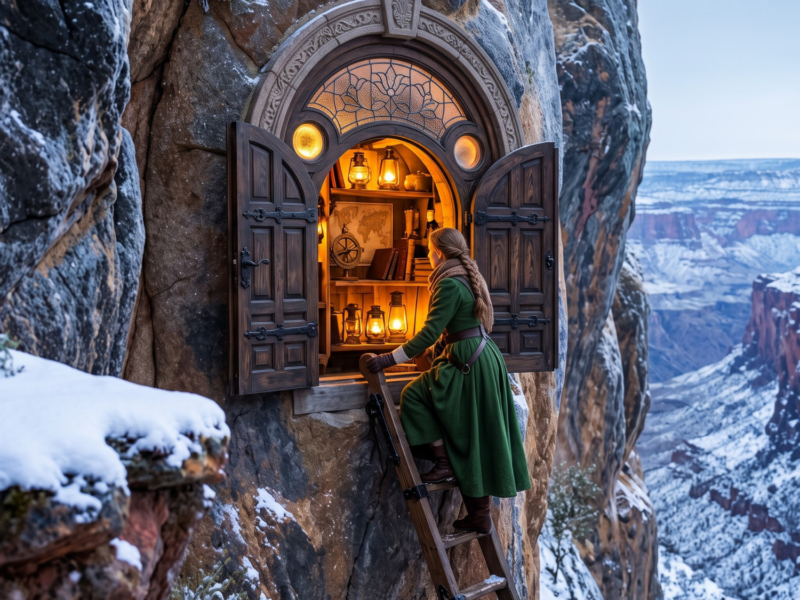
Firewood Filled the Widow’s Cave—Then an 11-Day Blizzard Trapped the Whole Valley
THE ARCHITECTURE OF SECRETS
From the valley floor, the labor made no sense.
The men of Cold Water Hollow packed fresh mud into the seams of their log cabins, hammered loose shingles, and stacked cordwood beside their doors. Whenever they paused to wipe the sweat from their brows, they looked up at the ridge.
They saw Dela Ainsworth hauling one-hundred-pound bundles of cedar up a thirty-degree incline.
“Widow’s lost her mind,” muttered Holston Pike, a massive freighter with a beard like rusted wire, tying off a tarp over his wagon. “Hauling fuel into a hole in the ground when she’s got a perfectly good iron stove in her cabin.”
Beside him, Cormac Thorne, an aging stoneworker with a ruined knee, squinted up at the ridge. “She ain’t lost her mind, Holston. She lost her husband. Grief makes people build strange monuments.”
But Dela wasn’t building a monument. She was building a machine.
Three years ago, the winter of 1884 had settled over the hollow like a suffocating blanket. Silas had gone out to retrieve their emergency wood cache. When the search party found him three days later, frozen solid beneath a snowdrift, the sheriff had declared it death by exposure.
But Dela had seen the body before they buried it. Silas’s skull had been fractured behind the left ear. His pocket watch was gone. And most damning of all, he was missing his right glove—a heavy, wool-lined leather gauntlet Dela had meticulously mended with thick, uneven thread just days before.
Silas hadn’t frozen by accident. He had been ambushed, robbed, and left to die in the snow.
And Ned Hollis, who suddenly had enough capital to buy up half the foreclosed claims in the valley the following spring, was the only man who profited.
Dela knew Hollis was looking for the original surveyor’s deed to the ridge—the deed Silas had hidden. The ridge wasn’t just limestone; Silas had suspected a massive subterranean silver vein ran directly beneath the cave.
Dela didn’t care about silver. She cared about the thermal mass of limestone.
She spent the next week transforming the cave based on Silas’s old architectural notes. She built a passage five-and-a-half feet long with a hard, right-angle dog-leg turn near the entrance. The wind, roaring off the mountain, would strike the timbered bend, lose its velocity, and die before it ever reached the inner chamber.
Past the bend, she laid a trench of coarse gravel. The Wet Line. Snow and slush stopped here. Beyond it was the Dry Line. She hung heavy panels of washed fleece from the ceiling, leaving a deliberate hand’s-width gap between the wool and the limestone to prevent condensation rot.
Cormac Thorne had visited her once, pressing his calloused hand against a pale seam running down the back wall of the cave.
“Stone remembers water, Dela,” the old man had warned, drawing a charcoal line beneath the fissure. “When the heat of a fire hits the freezing rock, this seam will weep. Don’t put your beds under it.”
She had heeded the warning, moving the sleeping shelf twenty-one inches off the floor on the opposite wall.
By the end of October, the shelter was complete. She had enough seasoned cedar and dense mountain mahogany stacked in the dry crib to survive forty days of absolute isolation.
She stood at the mouth of the cave, looking down at the valley. The sky to the north had turned the color of bruised iron. The wind ceased entirely. The pines stopped swaying.
Juno whimpered, pacing nervously at the gravel line.
“It’s here,” Wyatt whispered, standing beside her.
Dela nodded. “Get inside, Wyatt. Don’t look back.”









