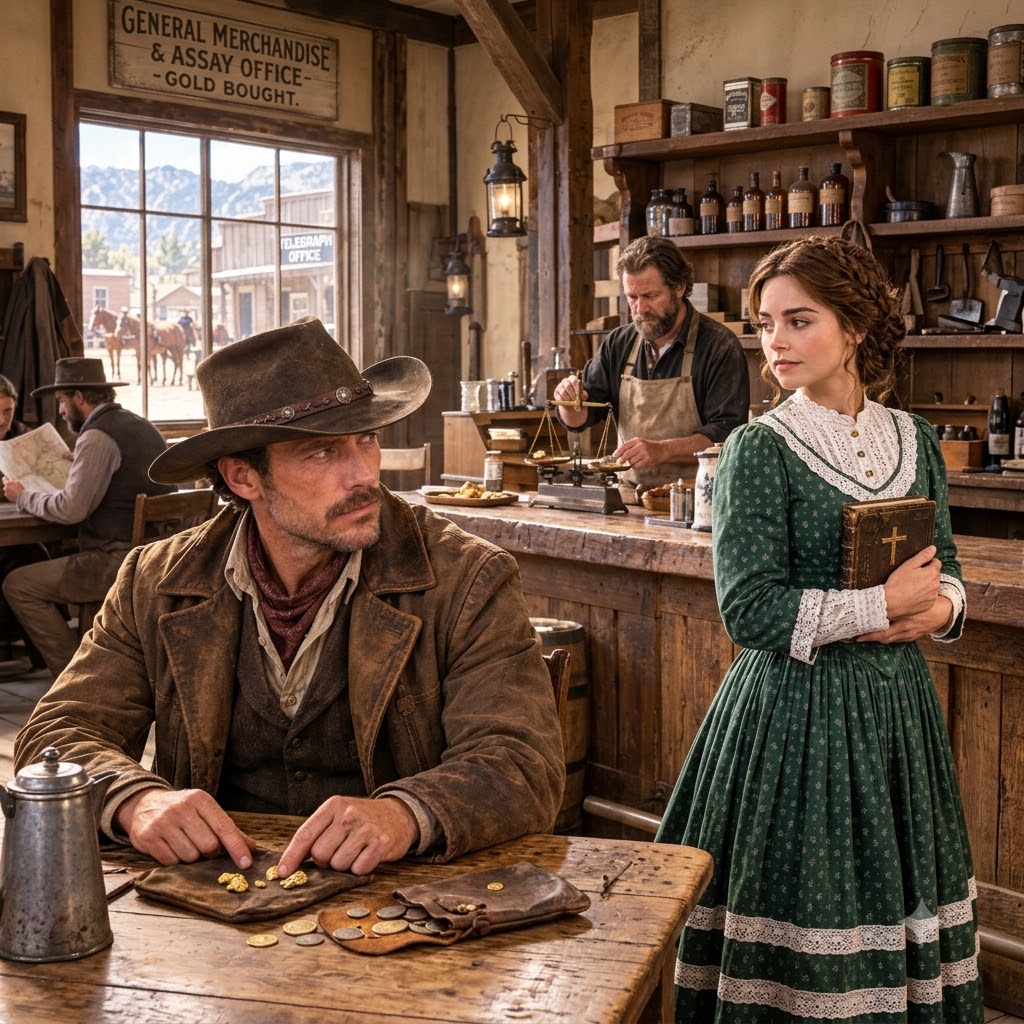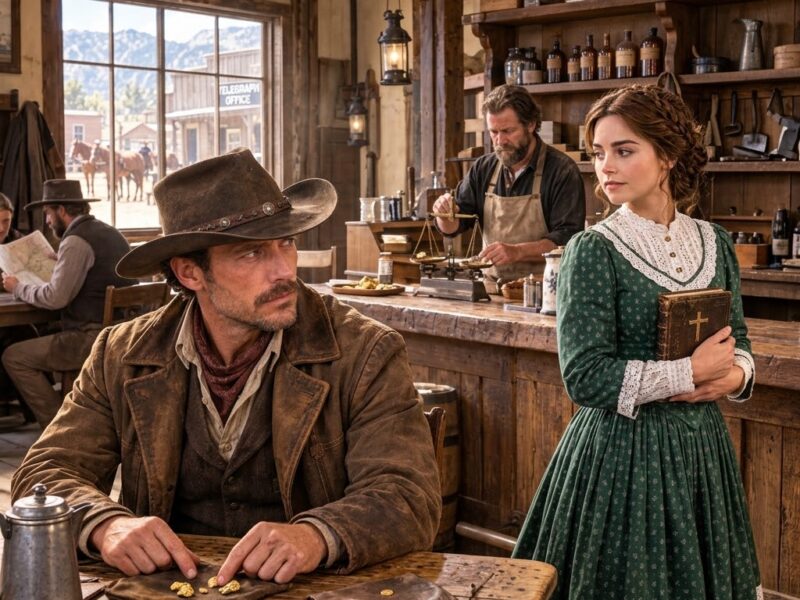
He Stopped Just for Coffee… But Heard a Humble Voice Praying: “Lord, Send Me a Godly Man
THE BLOOD IN THE LEATHER
Jonas Whittaker ran his thumb over the saddle horn, feeling the jagged, splintered groove where a bullet had recently passed.
He stood in the dusty corral of a waystation ten miles outside of Willow Creek, Idaho Territory. The six horses he had just purchased milled nervously in the afternoon heat. The seller, a twitchy man with a scar pulling down his left eyelid, was already packing his saddlebags, eager to leave with Jonas’s gold.
Jonas didn’t ask about the bullet hole. At thirty-four, he had learned that curiosity was a luxury that usually cost blood. He was a rancher now, not a gunfighter, and his only goal was to get this fresh string of bays back to the Whittaker spread before the snow flew.
He mounted his gelding, tipped his hat to the nervous seller, and rode west. The afternoon sky over the mountains was clear, a pale, dry blue that promised a hard freeze by nightfall. The road ahead was good. He could have ridden another twenty miles before sundown without a second thought. He almost did.
But as he crested the ridge overlooking the town of Willow Creek, a strange, suffocating tightness gripped his chest. A phantom ache he hadn’t felt in over a decade. He pulled his bay to a stop outside a boarding house with a peeling, hand-painted sign that read: Meals and Coffee.
He told himself the horse deserved a rest. He told himself a man his age had earned a quiet cup of coffee. He didn’t know yet that if he had kept riding, he would have passed her by a second time. And he didn’t know that before he left this dirt-street town, the empire he had spent twelve years building would begin to violently unravel.
Inside, the room smelled of roasted coffee, warm yeast, and pine boards baking in the sun. Dust motes danced in the light pouring through the tall front windows. Three ranch hands sat near the door, speaking in low tones, their hands hovering near their holsters. An old man with a hacking cough sipped from a tin cup at the counter.
Jonas took off his Stetson, ordered his coffee, and sat at a corner table with his back to the wall.
Then, he heard it.
“And we know that all things work together for good to them that love God.”
Jonas stopped breathing. His calloused hand froze halfway to his coffee cup.
The voice was soft and low, coming from a table across the room. It wasn’t meant for him. But it went through his chest like a Winchester round. He hadn’t heard that voice in twelve years. But he knew it the way a man knows the sound of his own heartbeat. He knew the way it lingered on the vowels, the quiet, unbending steel underneath it.
Slowly, his pulse thundering in his ears, Jonas turned his head.
She was sitting beside an elderly widow in a black traveling dress, a woman whose eyes were red and swollen from crying. The younger woman wore a sky-blue cotton dress, faded at the shoulders. Her chestnut hair was pinned up, a few loose strands framing a neck he had once kissed.
In her hands was an old leather Bible, the corners worn soft as velvet, a small brass cross embedded in the cover.
Jonas stared at the brass cross. The room seemed to tilt. It was his mother’s Bible. He had placed it in Lydia Monroe’s hands twelve years ago, the week before he rode away. And she was still carrying it.
“My daughter was supposed to meet me here,” the old widow wept, clutching a crumpled handkerchief. “Her letter said Tuesday. It’s Thursday.”
“Then we’ll wait together,” Lydia said, her voice steady. “And if she doesn’t come tomorrow, I’ll help you write to her. Nobody should wait alone.”
Jonas watched as Lydia rose and poured the old woman a fresh cup of coffee. When the proprietor set a plate of bread and beans in front of Lydia, she quietly cut it in half and slid one piece toward the widow without a word.
A little boy of maybe seven was sitting on a flour barrel near the counter, his brow furrowed as he stared at a torn newspaper. Lydia crouched beside him, the blue fabric of her dress pooling on the dusty floor.
“That word is cattle,” she whispered, pointing. “You see? The two T’s stand together like fence posts.”
The boy’s face lit up with a gap-toothed grin. Lydia smiled back, and the warmth of it hit Jonas like a physical blow.
When the old man at the counter fumbled in his pockets and came up short for his tab, Lydia seamlessly slid a nickel onto the wood beside his cup and returned to her seat before he could even turn around to thank her.
Jonas saw the kindness. But he also saw what she was hiding. There were faint, bruised lines of exhaustion beneath her eyes. The cuff of her blue dress was meticulously mended, the thread a slightly different shade. A folded newspaper lay beside her Bible, open to the notices for work. Twice, she glanced at it and pressed her lips together in a tight, anxious line.
She was worried. She was exhausted. And she was still kind.
That was what broke him. Twelve brutal years of frontier survival had turned Jonas into a man made of rawhide and suspicion. But whatever life had done to Lydia, it hadn’t made her hard.
Then, she looked up.
Her eyes, the color of a summer storm, met his across the crowded room.
The clinking of silverware, the low hum of conversation, the ticking of the grandfather clock—it all vanished. Twelve years evaporated in a single breath, then came rushing back with the force of a flash flood.
Lydia didn’t gasp. She didn’t move. The widow kept talking, but Lydia wasn’t hearing a word. Slowly, she lowered her hands, resting them flat on the brass cross of the Bible.
Jonas stood up. His legs felt like lead, heavy with the ghosts of a thousand unsaid apologies. He crossed the floor, stopping three feet from her table.
“Lydia,” he said.
Her knuckles turned white against the leather book. “Jonas.”
Two names. A decade of silence between them.
The widow looked from one to the other, sensed the sheer, suffocating gravity in the air, and quietly excused herself to check the stagecoach schedule.
Jonas pulled out a chair and sat down across from her, because if he stood any longer, he was going to collapse. Outside, a heavy wagon rattled past on the boardwalk, snapping them back to reality.
“You look well,” Lydia said at last. Her voice was careful, a locked door. “I heard you did well for yourself. The Whittaker ranch. Everyone in the valley knows the name.”
There was no bitterness in her words, but there was a deep, unhealed bruise beneath them.
“I heard you were teaching,” Jonas said, his voice thick.
“I was. In Silver Fork. The school closed in the spring. Not enough families left.” She deliberately straightened the newspaper, her eyes dropping to the help-wanted ads. “I came to Willow Creek looking for work.”
Jonas looked at the book under her hands. “You kept it.”
Lydia followed his gaze. For the first time, the flawless composure cracked. A tremor hit her lower lip. “It was your mother’s,” she said quietly. “I couldn’t throw away something that belonged to her. Even after…”
The sentence hung there, dripping with the blood of their past.
Even after you abandoned me.
Twelve years ago, Jonas had been a dirt-poor ranch hand with nothing to his name but a borrowed saddle and a relentless hunger to be someone. Lydia had believed in him when he was nothing. They used to sit on the porch of her aunt’s boarding house in Red Bluff, drawing floor plans in the dirt with a stick. A house with a wraparound porch. A stove. Children.
Then, a ruthless cattle baron named Harlan offered Jonas a place on a massive drive to Montana, promising him a percentage of the herd. It was a golden ticket. But they were leaving at dawn. Lydia had been three days’ ride away, nursing her dying aunt.
Jonas had stayed up all night, writing a letter that contained his entire soul. He left it at the Red Bluff stage station with the keeper, Amos Reed, paid him a silver dollar to ensure its delivery, and rode out.
He waited in Montana for an answer. None came. He wrote three more times. Silence. He assumed she had realized a schoolteacher deserved better than a cowpuncher.
Lydia had come home to an empty town, a dead aunt, and a ghost.
“What kind of work are you looking for?” Jonas asked, forcing the memories back down.
“Anything honest,” she said, lifting her chin. “Teaching, if I can find it. Bookkeeping. I can keep accounts. I can write a clean letter.”
Jonas stared at her. An idea—dangerous, impulsive, and entirely necessary—took root in his mind.
“Old Walter Price has kept my ledgers for nine years,” Jonas said slowly. “His eyes gave out this summer. He can’t read his own figures anymore. There are letters on my desk from buyers in Boise I haven’t answered in six weeks. And there are eleven children living on my ranch, the families of my hands. Not one of them has a teacher closer than fifteen miles.”
Lydia’s spine stiffened. “Jonas, I am not asking for charity.”
“I know you’re not, and I’m not offering any. I’m offering a job I need done. At the exact same wages I’d pay a man.”
She searched his face. Her gray eyes stripped away the expensive wool coat he wore, looking for the boy she used to know. “I don’t know if this is wise,” she said softly. “I don’t want to mistake gratitude for something else. I don’t want either of us to mistake old feelings for present ones.”
Jonas took his Stetson, turning the brim slowly in his hands. “I’m not asking you to be the girl you were twelve years ago, Lydia. I wouldn’t know how to be that boy again, either. I’m only asking whether two people who turned out to be who we are… might still do some good together.”
Lydia looked down at the brass cross, then out the dusty window toward the jagged, snow-capped peaks in the distance.
“Only the work,” she said, her voice a fragile boundary.
“Only the work,” Jonas agreed.
He didn’t know it yet, but bringing Lydia Monroe to the Whittaker ranch was going to unearth a secret that would nearly get them both killed.