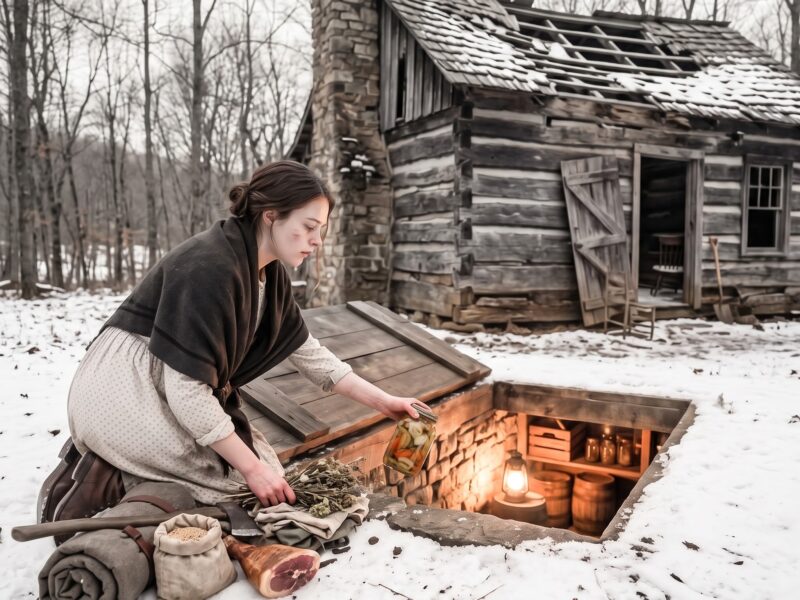
Her Brother in Law Forced Her Out Before Winter — Then She Found What Was Buried Below
THE METRONOME
Two months earlier. Late October, 1887.
The road that ran past the Ashcom homestead was little more than two ruts pressed into the hardpan soil, bending away from the small huddle of buildings that made up Copper Kettle Bend.
In the center of the yard, twenty-five-year-old Effie Ashcom swung a splitting maul. Crack. Crack.
She worked with a coiled, metronomic efficiency, splitting lodgepole pine rounds. Her hair, the color of dry oak, was pulled tight against her skull. Her hands, once soft, were calloused and blistered. She was counting her remaining days of manageable weather not by a calendar, but by the growing height of the woodpile.
Josiah, her husband, had gone to the Idaho gold country fourteen months earlier. He had taken a mule, a rifle, and a promise to return before Thanksgiving. Two Thanksgivings had passed. Neither had brought him back. Not even a letter.
Effie had learned not to look east down the road when the light was failing. Longing was a habit that fed on the shape of the horizon, and she could not afford to feed it.
The dispossession, when it came, did not arrive with shouting. It arrived in a well-kept wagon driven by her husband’s brother, Thaddeus Ashcom.
Thaddeus owned the town’s feed store and held a seat on the county council. He wore a black wool coat, brushed perfectly clean of dust. He didn’t knock. He simply stood on her porch until she stopped swinging the maul and acknowledged him.
Inside, at the plank table Josiah had built, Thaddeus laid out the papers. They bore the crisp, raised seal of Johnson County.
“The land note was co-signed by me with Josiah,” Thaddeus explained, his voice low and measured, like a man speaking to a slow child. “With my brother gone more than a year and presumed dead… or derelict… the debt and title revert. It is the law, Effie.”
He tapped the paper. “The note is due January first. The property stands as security against it. I will give you until the first heavy snow to vacate.”
He suggested she find work as a seamstress at the boarding house, or take a room in town until she could arrange passage back East to Pennsylvania. He presented it all as a kindness.
Effie looked at the papers. She looked at Thaddeus’s clean, uncalloused hands.
She said nothing.
She did not argue. She had learned the language of men like Thaddeus. It was a closed system, written to confirm what they already believed. Her three years of labor on this homestead, her husband’s promises—none of it was legible in that language.
Thaddeus took her silence for capitulation. He folded the papers, touched the brim of his hat, and left.
Effie stood at the window, watching his wagon disappear.
The town of Copper Kettle Bend formed its consensus quietly. It wasn’t malice; it was practicality. A lone, twenty-five-year-old woman with no livestock and a disputed claim could not survive a Wyoming winter. The winters here didn’t just freeze; they hunted. They sought out weakness and dismantled it.
Ezra Whitfield, the general store owner, regretfully informed Effie that he could no longer extend her credit. Henrietta Caldwell, the pastor’s wife, brought her withered apples and a pamphlet titled Finding Strength in Prayer, her eyes brimming with suffocating pity.
They were all waiting for her to leave. They had already written her ending: the sorrowful, defeated widow on the stagecoach heading East.
Effie took the withered apples, cut out the rot, dried the good pieces for her pantry, and went back to splitting wood.
Because behind the cabin, half-overgrown with wild rose and thistle, was a heavy oak door set diagonally into a slope of earth. It was banded with iron and secured by a rusted, fused lock.
Josiah had told her it was an old root cellar left by the original settlers. They had never opened it.
But as the October wind pressed flat and cold against her back, Effie remembered a story her grandfather, Amos Ridgeway, had told her fifteen years ago in a coal-dusted company house in Pennsylvania.
Amos had been a miner. He understood the earth from the inside out.
“Up here, the cold owns the air,” Amos had told a ten-year-old Effie, drawing on a slate with chalk. “It is a tyrant. But down below… the earth remembers. It holds the warmth of summer all winter long. It’s a slow, stupid animal, but it has a long memory for heat. I built a cellar on a claim out West before your grandmother got sick. I sealed it up tight. Left the key inside, in a manner of speaking.”
Effie stared at the rusted lock on the oak door.
Belief and knowledge were not the same thing. One was a map drawn by others; the other was the territory you walked yourself. She had believed her grandfather because she loved him. Now, she was about to find out if he was right.









