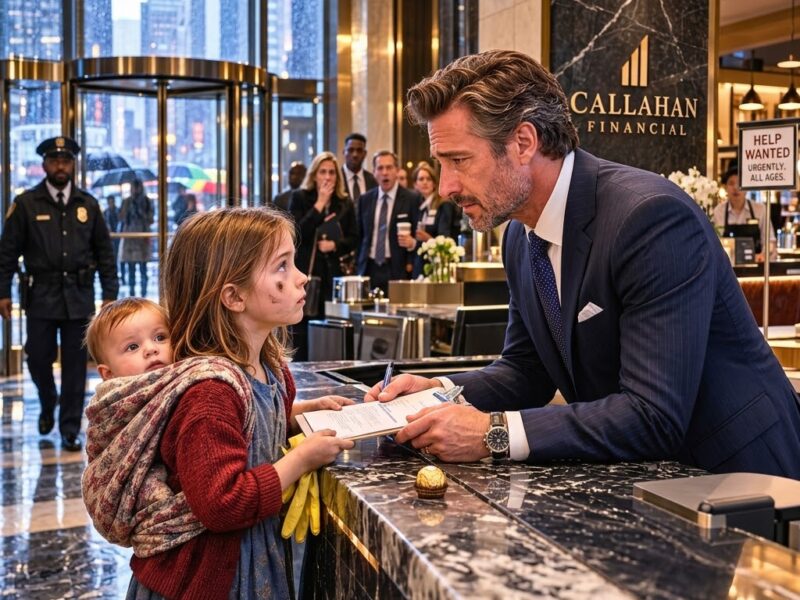
“I Can Clean, Cook—Anything. My Baby Just Needs Food,” She Told the CEO—Then His Reply Stunned Her
The End of the Ledger
A year can change a physical house more than it changes the people living in it, but sometimes, if you are incredibly patient and willing to sit in the mess, it permanently changes both.
The official adoption was finalized on a remarkably ordinary, sunny Thursday afternoon the following March.
There was no sweeping courtroom drama. There were no tears of anguish. There was just a tired but smiling family court judge, a few swift signatures on thick, watermarked paper, and a short, legal sentence that made the bond irrevocable and permanent.
With Kayla Holt gone, and with no other blood relatives deemed capable or willing to take them, Maddie and Penny Holt legally, forever, became Maddie and Penny Callahan.
Andre Simmons, the exhausted DCFS investigator, came to the courthouse on his lunch break. He stood in the back of the room, holding his trench coat. Afterward, he shook Owen’s hand firmly.
“Most of my cases don’t end like this, Mr. Callahan,” Andre said quietly, looking at the girls. “Most of my cases haunt me. Thank you for making one of them a story I can actually tell my kids.”
Opal wore her absolute best, wide-brimmed Sunday church hat for the occasion. She cried exactly once, standing by Owen’s car in the courthouse parking lot, and fiercely told everyone it was just the spring wind aggravating her allergies.
She had closed her official state foster license that previous August, retiring just like she said she would. But she never actually left their lives. Every single Sunday afternoon, without fail, she came to the Lincoln Park house for a massive family supper. And every single Sunday, she ruthlessly corrected Owen’s grocery list, telling him he bought the wrong brand of butter.
The girls called her Grandma Opal now. She loudly pretended not to love it, but she carried a picture of them in her wallet and showed it to the cashiers at her local pharmacy.
Tracy Coleman’s story ended quietly, moving slowly and tragically through an entirely different, far less forgiving system.
The initial police investigation morphed into a criminal case. Months later, facing overwhelming evidence, Tracy pleaded guilty to felony child endangerment and abandonment. She served a short sentence, followed by mandatory probation. She completed a state-run substance abuse treatment program and a grueling, hundred-hour parenting and life-skills class.
Any contact with the girls now was heavily restricted by the court. It came only through handwritten letters, carefully screened and passed along by a new social worker.
One such letter arrived in late March.
Owen sat at his desk and read it first, his face grim. Then, he brought it into the kitchen and let Maddie read it sitting at the table, with Opal sitting right beside her, holding her hand.
I’m sorry I made you think love was a chore, Tracy had written in sloppy, cursive ink. I was broken, and I broke you. Your mama would be so proud of how strong you are, Maddie. I’m working hard every day on trying to make her proud of me, too.
Maddie read the short letter twice. Her face gave away nothing. Then, she folded the paper carefully along its original creases, carried it upstairs, and put it in the back of her nightstand drawer. She hadn’t asked for a pen to write back yet. Nobody pushed her to. Forgiveness was a marathon, not a sprint.
Not everything had magically healed. Trauma leaves deep scars that weather cannot wash away.
Maddie still kept track of the pantry inventory a little too closely, panicking if the milk ran below half a gallon. She still went completely, terrifyingly still and silent if a stranger raised his voice in the grocery store aisle. On Wednesday afternoons, Owen drove her to see a child psychologist named Mrs. Lindren, a soft-spoken woman who let Maddie draw pictures of houses with massive, impenetrable walls while they talked.
But some beautiful, undeniable things had changed.
Penny was almost two years old now. She was a loud, robust, gloriously healthy toddler who ran everywhere, grabbing anything she could reach with sticky, chaotic hands.
And the massive, pristine Lincoln Park greystone finally, truly looked like people actually lived in it.
There were broken crayons scattered across the expensive kitchen island. A floral diaper bag was perpetually slung over the mudroom bench. A permission slip for a school field trip to the aquarium was stuck proudly to the stainless-steel refrigerator door with a magnet. One of Owen’s critical corporate merger folders had completely disappeared under a towering stack of library picture books in the living room, and for the first time in his career, he wasn’t in a screaming hurry to find it.
In the exact middle of the refrigerator, held up by a plastic magnet shaped like a smiling yellow sun, hung a creased, slightly yellowed sheet of company note paper.
JOB: Big Sister. DUTIES: Sit down. Eat first. Let the grown-ups do the grown-up work. PAY: Lunch. Every day.
The desperate, crayon-written list was not on the fridge. It wasn’t in Maddie’s coat pocket, either.
Months ago, she had folded it one last, final time and put it away in a wooden keepsake box under her bed. She wanted to keep it, she told Owen, so she would always remember what she survived. But she didn’t feel the need to carry the physical weight of it around with her every single day anymore.
Kayla Holt’s faded green fleece blanket lay folded casually over the back of the expensive living room couch. Opal had taken it home one weekend, washed it with gentle soap, and lovingly stitched the frayed, torn satin edges back together with tiny, careful, invisible stitches. Penny didn’t desperately need it to stay warm anymore; she had a dozen blankets now. But it was part of where they came from. It was their history, preserved rather than discarded.
On a Saturday morning in April, it rained.
It was not a violent, freezing storm. It was just a steady, gentle gray spring rain tapping rhythmically against the kitchen window, exactly one year to the day from the morning Maddie had walked into the lobby.
The old radiators ticked a familiar, comforting beat. The kitchen smelled overwhelmingly like melting butter, cinnamon, and burnt sugar.
Owen was standing at the stove, making French toast badly. One side of every single slice came out a little too dark, bordering on charred, but he kept cheerfully trying, flipping them with a spatula and whistling slightly off-key.
Penny sat in her high chair, banging a plastic spoon aggressively on the tray, shouting something joyous that might have been a word, or might have just been noise.
Owen turned from the stove and set a warm ceramic plate in front of each of them at the table.
Then, out of ancient, deeply ingrained survival habit, Maddie automatically reached across the table with her fork to cut up Penny’s food and feed her sister first.
But her hand stopped halfway across the table.
She froze. She looked around. No one had yelled at her to stop. No one was hovering, watching her, grading her performance, waiting for her to earn her keep.
She looked at Penny. The toddler was messy, radiantly happy, and already shoving a piece of burnt toast into her own mouth with both hands, humming with delight.
Maddie looked down at her own full, warm plate. The butter was melting perfectly into the syrup.
Slowly, Maddie pulled her hand back. She picked up her own fork. She glanced up at Owen, trying to look casual, but her eyes asked the eternal question.
“Do I still need to help today?” she asked softly.
Owen set the frying pan down. He picked up a jug and poured her a tall glass of cold milk.
“Only if you want to, kiddo,” Owen smiled, leaning against the counter. “You’ve still got exactly one job in this house.”
Maddie looked at the milk. She looked at the toast.
And this time, the little girl who had carried the weight of the world ate first.
Owen watched her chew for a long, quiet moment. He felt a profound, settling peace wash over him, a feeling he hadn’t known in half a century.
Then, Owen pulled out the wooden chair right beside her. He sat down.
He didn’t check the time on the wall clock. He didn’t reach into his pocket for his buzzing phone. He didn’t look around the kitchen for one more chore to do, one more thing to fix, one more reason to stay in motion. He just stayed exactly where he was, sitting still, the way the two of them had slowly, painfully, and beautifully learned to do together.
Some children, born into the harsh shadows of the world, learn entirely too early that love always has a terrible price. Some grown-ups, driven by their own invisible ghosts, spend their entire lives endlessly paying a debt they never actually owed.
Sometimes, it takes one freezing, rainy morning, one desperate sign that says Help, and one strange, impossible reply to teach them both the exact same, life-altering truth:
You were never meant to earn your place at the table. You were only meant to sit down.









