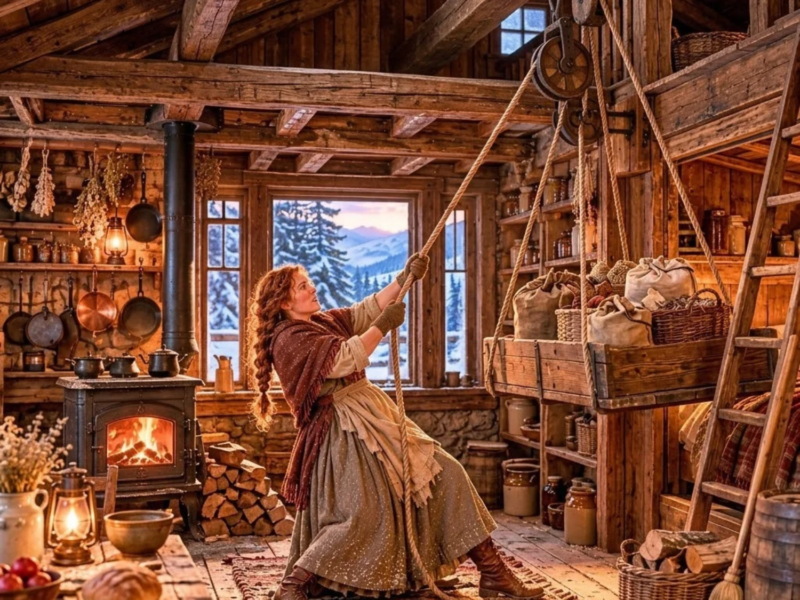
Neighbors Mocked Her Cabin With No Bedroom — Until 9 Children Slept Warm Inside the Wall
The Standard of a Good Soul
The church, or what was left of it, stood empty longer. Reverend Thaddius Ainsworth arrived from Boston in April—twenty-nine years old, slight, bookish. He had heard the story before he arrived. He came to Ingred’s house on his second day in the valley, took off his hat at the door, and asked if he might come in.
She let him in. He looked at the wall. He looked at Astrid playing on the bench with Tobias. He looked at Rosalyn, who had come by that afternoon with a jar of preserves.
Then Reverend Ainsworth got down on his knees right there on the plank floor of a one-room cabin at the foot of a black stone mountain, and said: “Mrs. Soulberg, I do not know what my predecessor did or failed to do, but I know what you did, and I would like to serve a valley where that is the standard of what a good soul looks like.”
Ingred did not know what to say. “Would you like some tea, Reverend?” “I would.”
She poured it. They sat by the wall.
The valley learned slowly, the way valleys always do. That first spring, three families asked Ingred to help them build a wall like hers. She helped. She did not charge. She only asked that they help the next family who came after them.
By the following winter, there were seven such walls in Copper Hollow. By the winter after that, eleven.
Rosalyn opened a room at the back of her shop and began to teach reading, chemistry, weights, measures. She taught boys and girls together. She taught Tobias first; she taught Astrid alongside him. She taught anyone whose parents would let them come. And she taught Ingred in the evenings by the light of one lamp, with her father’s notebook open on the table between them.
It took Ingred six years. She was forty when she read her mother’s Bible aloud for the first time in her own voice to her own daughter, who was twelve years old and had not coughed at night in three winters.
She read the 23rd Psalm. She read it slowly. She did not stumble.
When she was finished, Astrid put her small hand on her mother’s hand and said, “Papa would have liked to hear that.” “I know, sweetheart.”
Then she closed the Bible. Then she sat there in the warm room with her warm child on the warm bench beside the wall her father had died trying to build. And she was quiet for a very long time.
Epilogue: The Warmth That Endures
Otie Brenamman lived to hold that Bible in her own hands and read it with her own eyes. She learned to read at seventy-one. She said it was the only useful thing she had done since her daughter died; she said she had been waiting most of her life to do it.
She died in her sleep in her own small bed on a warm night in June of 1904. Ingred found her in the morning. She had a small smile on her face. Her Bible was open on her chest. The page was Psalm 23.
Tobias grew tall. Not as tall as some, but tall enough. He became a stonemason; he built walls all his life. He never charged a family that could not pay. He married a girl from the next valley over when he was twenty-four, and he named his first daughter Ingred.
Astrid grew strong. She did not remember as an adult what it was like to be afraid of winter; she said this often, and every time she said it, her mother had to leave the room for a moment. Astrid became a teacher. She married late. She had two sons. Both of them had lungs like their grandfather’s. Both of them slept from the day they came home from the hospital on a stone bench beside a warm wall that their grandmother had helped their mother build. Neither one of them ever coughed at night.
The last time anyone in Copper Hollow saw Ingred Soulberg was on an afternoon in early October of 1912. She was fifty-seven years old. Her hair was silver. Her hands were still strong.
She was walking home from the little schoolhouse. Rosalyn still ran a schoolhouse that by then bore both their names on a small brass plaque above the door: The Soulberg-Auerbach School: Built by hands, kept warm by heart.
Ingred walked slowly that afternoon. The leaves were down. The air was clean. There was a bite in the wind that meant snow was two weeks away.
She stopped at the edge of her property. She stood there for a long time. She looked at the small one-room house at the foot of the Black Rock Mountain. The wall still stood. The wall would always stand.
She thought about her father, who had died at the base of a wall in Bergen when she was twelve. She thought about her husband, who had gone into cold water to save someone else’s child. She thought about the promise she had made him: Keep her warm. Whatever you have to do.
She had kept it. She had kept it every day for twenty-three winters now. She had kept it.
She walked up the path. She opened the door. She went inside.
The wall was warm. It always was.









