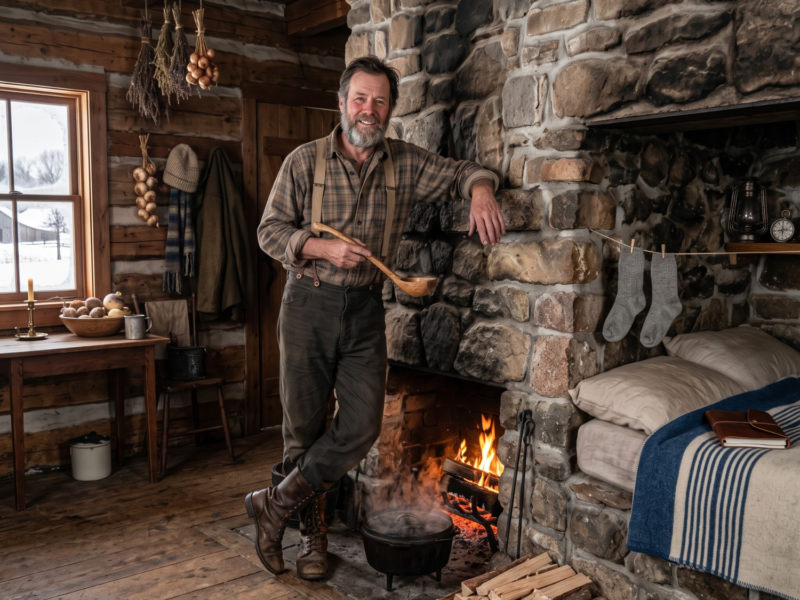
Neighbors Mocked His Cabin With No Bedroom — Until They Found His Bed Inside the Stove Wall
THE ANATOMY OF A HEATER
By the first week of October, the wall was chest high.
Neighbors who rode past the cabin noticed the missing bedroom before they noticed anything else. A few laughed quietly. One man asked Elias directly where his family intended to sleep once the room filled with woodsmoke and February arrived.
Elias only pointed at the stone and said, “There.”
Nobody understood what he meant. They didn’t know that Elias wasn’t just building a wall; he was building a survival machine.
He was eleven years old the last time he slept beside a structure like this, in his grandmother’s house in the German countryside. It was a masonry heater. Unlike an iron stove, which sends ninety percent of its heat straight up a chimney, a masonry heater forces the exhaust smoke through a winding maze of internal stone flues. The massive weight of the stone absorbs the violent energy of a short, intense fire, storing it like a thermal battery. It then radiates that heat back into the room for twenty-four hours after the fire is dead.
It was a masterpiece of thermodynamics. But Elias wasn’t building from blueprints. He was building from a forty-year-old memory.
Greta waited until the stone reached her shoulders before she asked the question that had been keeping her awake.
“Elias,” she said, wrapping her shawl tighter against the biting draft. “Where does the smoke go once it leaves the firebox?”
Elias set down a heavy fieldstone. “It travels up, hits the baffle, and gets pulled down through the side channels before it reaches the main chimney.”
“And if the draft fails?” Greta asked, her eyes darting to Samuel, who was asleep on a pile of furs, his breathing a wet, ragged rasp. “If the fire burns low in the middle of the night and the smoke backs up?”
Elias looked at the intricate maze of clay and stone he was assembling. “It won’t.”
“You don’t know that,” Greta said, stepping closer, her voice dropping to a fierce whisper. “You built vaults, Elias. You didn’t build chimneys. If you miscalculate the pressure, you won’t just freeze us. You’ll suffocate us in our sleep.”
She was right. If the channels were too wide, the fire would lose its pull. If they were too narrow, the wall would choke with soot and carbon monoxide would flood the room.
“What do you want me to do, Greta?” Elias asked, his voice strained. “We can’t afford a doctor. We can’t afford a train ticket out of here. Kincaid’s men are tearing Chicago apart looking for us. If we go to a town, they’ll find us. This stone is the only thing keeping us alive.”
Greta looked at the wall, then at her sick child. “Build an emergency vent,” she demanded. “An iron door at the base. If the smoke backs up, we can open it and bypass the maze. Promise me, Elias.”
“I promise,” Elias said.
He installed the heavy iron cleanout door the next morning. But the fear Greta planted took root in his mind. He was building a machine out of Dakota fieldstone and creek clay—materials he had never tested.
Two days later, the real test arrived on foot.









