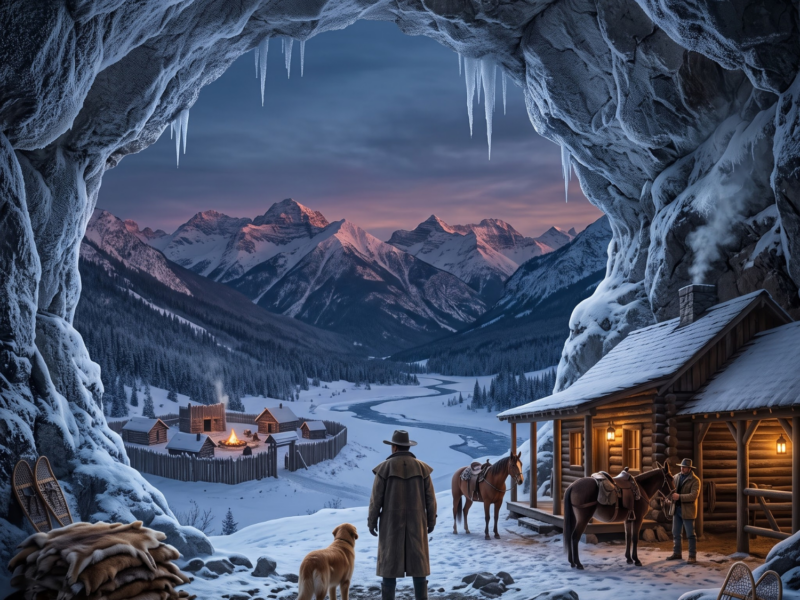
No One Believed in Two Brothers’ Mountain Cabin—Until a Three-Day Blizzard Cut the Entire Town Off
The Architect's Warning
June 1887
“You’re out of your mind, Parin.”
Owen Vale, six years younger and carrying a massive cottonwood joist on his right shoulder, dropped the timber onto the stone floor of the hollow. The sound echoed like a gunshot. Owen wiped the sweat from his brow, glaring at his older brother. “Merrick Sloan was right. Every beam, every nail, every pound of flour has to come up a thirty-degree grade. We could have bought the meadow.”
“The meadow floods,” Parin said calmly, driving a wooden stake into the ground near the rear wall. He kept his back to his brother. “This stone can take the weather. And it gives us the high ground.”
“Since when do we need the high ground to ranch?”
Parin didn’t answer. He measured the distance between the timber frame and the rock wall. They were building a cabin inside the hollow, an architectural anomaly. A service gap of three feet separated the wooden shell from the mountain’s throat. Parin told Owen it was for drainage and dampness.
That was a lie. The gap was so Parin could keep digging.
“Make sure the floor timbers don’t touch the stone,” Parin instructed, shifting the subject. “Use the rubble skirt. I want air moving under it.”
Before Owen could argue, a shadow fell over the entrance.
Holland Creed, a sixty-one-year-old builder with hands like cured leather, stood at the lip of the cave. He didn’t say a word. He walked past Owen, studying the proposed roofline, the split willow lattice, and the clay-lime chinking stacked near the fire pit. Finally, he looked at the ceiling of the hollow.
Holland bent down, picked up a handful of dry mountain grass, and threw it upward.
The brothers watched. The grass rose, caught a violent unseen current, scattered, and curled sharply back down, whipping against the rear wall.
“Still air at the floor doesn’t mean clean air above it,” Holland said, his voice raspy. He pointed a crooked finger at the spot where Owen had marked the stove’s chimney exit. “The mountain protects the walls, but it disturbs the air over the roof. When the winter wind shifts east, your flue is going to choke. The smoke will push backward. It’ll kill you in your sleep.”
Owen frowned, looking at his schematics. “I can extend the pipe. Run it past the pressure pocket.”
Holland looked at Owen, then slowly turned his gaze to Parin. “A pipe you can fix, son. I’m more worried about what else you’re burying up here.”
Parin’s jaw tightened. “We aren’t burying anything, Mr. Creed. Just building a home.”
“I built this town,” Holland said softly, stepping closer to Parin. “I know every foundation in Cold Water Gap. I know who paid for them, and I know whose blood is mixed in the mortar.” He glanced deliberately at the disturbed earth in the rear of the cave. “Make sure your cabin can breathe, Parin. Because the men down in that valley? They’ll suffocate you if they think you’ve found what they lost.”
Holland turned and walked out into the blinding summer sun.
Owen stared at his brother. “What the hell was he talking about?”
“Nothing,” Parin said, grabbing his pickaxe. “Get back to work.”
But that night, while Parin slept, Owen opened his brother’s heavy ironbound tool chest. He moved the wrenches, the chisels, the plumb bobs. His fingers caught on a loose wooden panel at the bottom. Owen pried it up.
Beneath the false bottom lay a rusted, blood-stained Wyoming territory marshal’s badge.
Marshal Elias Vale. Their father.
Owen’s blood ran cold. Five years ago, they were told their father’s freight wagon had slid off the western cut in a blizzard. No body was ever recovered. No cargo. Now, his badge was sitting in Parin’s toolbox.
Owen looked toward the dark rear of the hollow where Parin had been digging all afternoon. Parin hadn’t brought them here to build a ranch. He had brought them here to build a fortress.









