No One Could Serve the Foreign Tycoon — Until the Waitress Switched Languages!
No One Could Serve the Foreign Tycoon — Until the…
No One Could Serve the Foreign Tycoon — Until the Waitress Switched Languages!
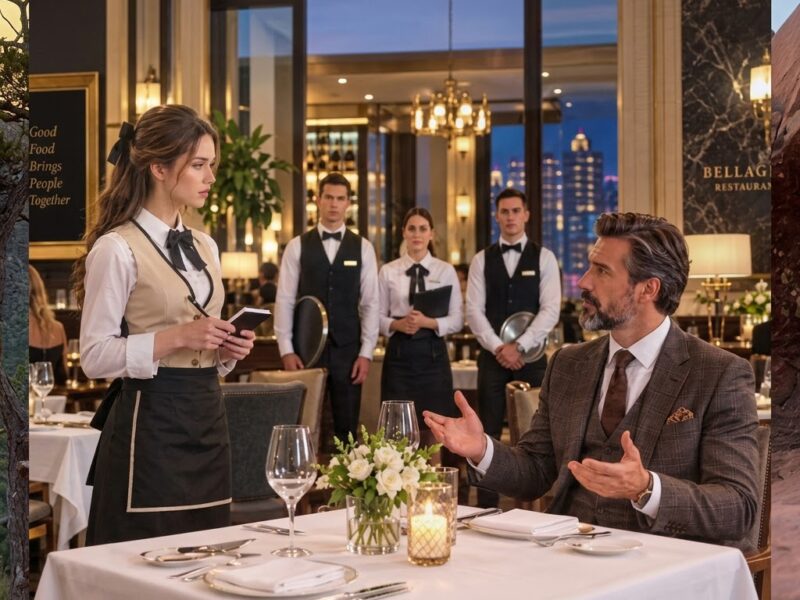
The dining room of the Bellagio didn’t just exude wealth; it weaponized it. The crystal chandeliers hanging from the vaulted ceiling refracted light so sharply they seemed to slice through the air. The heavy silverware clinked against bone china with the dull, resonant thud of old money. Waiters glided across the Italian marble floors like ghosts, trained to be invisible until the exact moment a wine glass dipped below the halfway mark.
But at 1:14 PM on a bright Tuesday afternoon, the Bellagio was not invisible. It was paralyzed.
A silver fork clattered violently against a porcelain plate, the sound cracking like a whip across the silent dining room.
“Take it away,” a voice rasped. The English was heavily accented, thick with exhaustion and fraying patience. “I said no oils. No reductions. Are you actively trying to poison me, or do you simply not understand the words coming out of my mouth?”
The waiter, a seasoned professional named Thomas who had served senators and movie stars, stood trembling. He looked at the plate of seared scallops glazed in a walnut-truffle emulsion, then looked at the man seated alone at the corner table. “Sir, the chef assures me—”
“You are fired.” The man didn’t raise his voice. He didn’t have to. The quiet finality of the statement sent a shockwave through the room. “Send someone who speaks a language other than incompetence.”
Thomas backed away, his face pale, retreating toward the kitchen. He was the third waiter to be dismissed from Table Four in less than ten minutes.
From her station near the brass espresso machine, twenty-six-year-old Marin Whitlock watched the disaster unfold. She wiped down the marble counter, her hands moving mechanically while her eyes stayed locked on the man at the window.
His name was Lucien Votan. Every employee had been briefed on him during the morning lineup. He was a European industrial titan, a man whose shipping terminals and tech firms moved global markets. He was in the city to close a hostile acquisition worth hundreds of millions. Alistair Crane, the Bellagio’s general manager, had paced the floor an hour ago, sweating through his tailored suit, warning the staff that if Votan left unhappy, the restaurant’s Michelin aspirations would die with him.
Marin studied Lucien. He wore a charcoal suit that probably cost more than her mother’s annual medical bills, but it hung on him awkwardly. His posture was rigid. He was staring at the leather-bound English menu as if it were a puzzle he lacked the cipher to solve.
And then, Marin noticed his hands.
His left hand rested on the white tablecloth, his fingers trembling with a faint, rhythmic tremor. It was not the tremor of a man consumed by anger. Marin had seen that specific, terrifying vibration before.
He’s terrified, she realized. He’s sick, he’s exhausted, and he’s completely alone.
Alistair Crane materialized from the shadows, his face a mask of panic masked by corporate obsequiousness. He practically shoved a fourth waiter out of the way and approached Table Four himself.
“Mr. Votan,” Alistair purred, offering a smile that looked painful. “I apologize profusely. Our staff is highly trained, but perhaps there is a misunderstanding. Everyone here speaks perfect English. Perhaps it would be easier if you simply pointed to the menu item you desire? I can personally guarantee—”
Lucien slowly raised his eyes. The look he gave Alistair was so profoundly desolate that Marin felt a phantom ache in her own chest. It was the look of a man screaming behind soundproof glass.
Marin remembered her grandmother’s final months. The dementia had stolen her English first, leaving her trapped in the French of her childhood. Nurses had spoken to her louder, slower, as if volume could bridge a cognitive gap. They thought the old woman was angry. Marin knew she was just terrified of being misunderstood.
Marin looked down at the pocket of her apron. Inside rested a worn notebook, two cheap pens, and a rejection letter from a translation institute in Montreal. She was a waitress working double shifts to keep her sick mother out of a state ward. She was not supposed to approach VIP tables.
Alistair was still talking, his voice dripping with condescension. Lucien closed his eyes, his trembling fingers pressing against his temples. He was going to leave. He was going to walk out, the deal would collapse, and Alistair would likely fire half the staff in retribution.
Marin untied her side-towel, tossed it onto the espresso counter, and picked up a fresh silver pitcher of iced water.
She stepped onto the main floor.
Alistair saw her immediately. His eyes widened in horror. He gave a sharp, subtle shake of his head, a silent command: Stop. Turn back. Do not approach.
Marin didn’t stop. She walked straight past the furious manager, her cheap rubber-soled shoes silent on the marble, and stopped at the edge of Table Four.
Related Articles

They Mocked the Widow’s Dirt Cellar—Then the Freeze Left Every Cabin Cold but Hers Warm
They Mocked the Widow’s Dirt Cellar—Then the Freeze Left Every Cabin Cold but Hers Warm…

A Homeless Veteran and His German Shepherd Inherited a Ridge No One Wanted — 35 Feet In, They Found
Chapter 1 / 7 A Homeless Veteran and His German Shepherd Inherit… A Homeless Veteran…

Neighbors Laughed When He Built A Cabin Inside An Old Barn—Until It Kept His Home 35 Degrees Warmer
Chapter 1 / 8 Neighbors Laughed When He Built A Cabin Inside An… Neighbors Laughed…

His Sod House Had No Woodpile in January – Until the Trains Stopped and the Town Came Begging
Chapter 1 / 10 His Sod House Had No Woodpile in January – Until t……

She Built Her Cabin Over the Woodshed and Never Burned Wet Wood Again
Chapter 1 / 8 She Built Her Cabin Over the Woodshed and Never Bu… She…

The Duke Abandoned Her on Their Wedding Day—Years Later, He Discovered What He Had Lost
Chapter 1 / 7 The Duke Abandoned Her on Their Wedding Day—Years… The Duke Abandoned…

He Wedged a Tiny A Frame Into a Crevice Before Winter and His Family Slept at 75°F While Town Hit
Chapter 1 / 7 He Wedged a Tiny A Frame Into a Crevice Before Win……

He Was Too Old to Ride—So He Bought the Ruined Ranch and Found the Room Behind the Fireplac
Chapter 1 / 5 He Was Too Old to Ride—So He Bought the Ruined Ran……

Settlers Laughed at His Underground Heat Recovery Duct — Until It Kept His Cabin 71°F Warmer
Chapter 1 / 9 Settlers Laughed at His Underground Heat Recovery… Settlers Laughed at His…

A Navy SEAL Built a Home Inside a Mountain—Then His Dog Warned Him Before the Storm
Chapter 1 / 5 A Navy SEAL Built a Home Inside a Mountain—Then Hi… A…