Nobody Believed Her House Carved Into Stone Would Work — Then Colorado Vanished Beneath the Snow
Nobody Believed Her House Carved Into Stone Would…
Nobody Believed Her House Carved Into Stone Would Work — Then Colorado Vanished Beneath the Snow
The wind screamed through the sandstone canyons of the Colorado high country, tearing across a valley that had, until eleven days ago, held a town.
Now, there was only white. Smooth, endless, and silent. A grave the size of a village.
Somewhere beneath twenty-five feet of packed, driven snow, a single chimney still breathed. A thread of woodsmoke rose from the suffocating drift, thin as a desperate prayer.
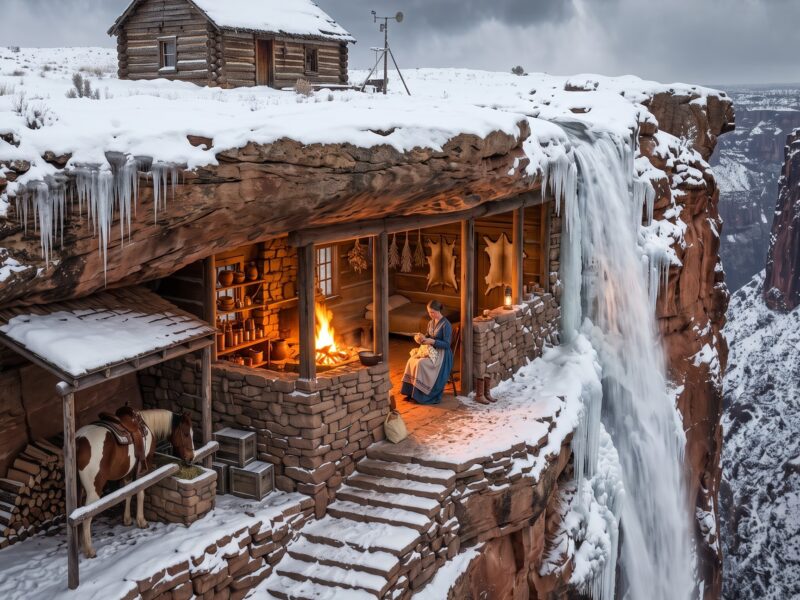
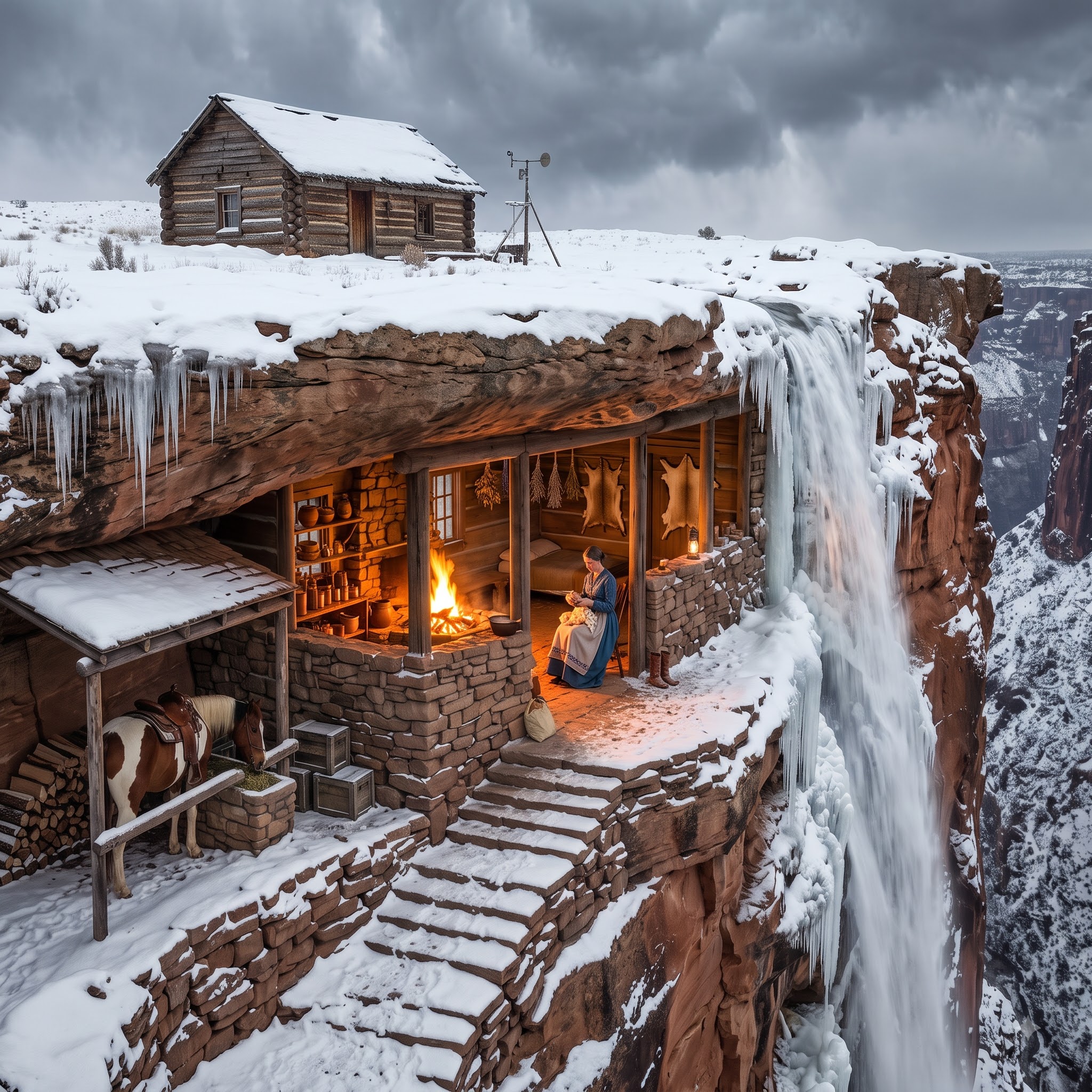
The camera lifts higher. Past the buried rooftops of Iron Hook Gulch. Past the shattered timber of the Methodist Chapel. Up the honey-colored face of a sheer sandstone cliff that no one in the valley had ever thought to look at.
And there, sixty feet above the frozen graveyard, a single window glowed amber against the storm.
Behind the heavy, hand-glazed glass, Winifred Howerin set down a tin cup of black coffee. Her hands, thick-knuckled and calloused from twenty years of stonework, were perfectly steady. Her eyes were not.
She had been counting the columns of smoke for six days now.
Yesterday, there were nine.
This morning, she counted four.
Four fires left in a town of one hundred and eighty souls.
“They’re burning the furniture now,” Emmett’s voice came from the shadows behind her, rough with a dry, hacking cough he had been trying to hide for three days. Her younger brother sat near the belly of the iron stove, wrapped in a heavy sheepskin coat. “If they have any furniture left.”
Winifred didn’t turn around. She kept her gaze locked on the great double-chimney of Bartholomew Ashcroft’s three-story mansion at the head of the valley—one of the four still breathing.
“They should have built with the rock,” Winifred said, her voice flat, devoid of the smugness a lesser woman might have felt. “Not against it.”
Three years earlier, no one in this valley had believed she would last a season.
It began in the soot-blackened stoneyards of Pittsburgh. The Long Depression had crushed her father’s masonry firm in the winter of 1877. Winifred, a forty-two-year-old widow who could read a fracture line in granite better than any journeyman, and Emmett, a disgraced schoolteacher fleeing a scandal he refused to name, had packed their tools and gone West.
Iron Hook Gulch was a raw, bleeding silver town. The valley floor was already claimed by men with capital. So, Winifred bought a section of the south cliff face—six rods wide, straight up to a massive sandstone overhang.
“You mean to tell me,” the land clerk had sneered, “you want to live in the cliff like a swallow?”
“Like a woman who understands stone,” Winifred had replied.
The town mocked her. Bartholomew Ashcroft, the wealthy, bombastic merchant who owned half the valley, had loudly christened her project The Swallow’s Perch. He promised the patrons of the Silver Ingot saloon that the “crazy stonecutter widow” would come crawling down the goat path begging for a roof before the first frost.
He was wrong.
Winifred spent fourteen months carving a home into the cliff. She worked with the natural horizontal grain of the honey-colored sandstone, excavating a main chamber, a sleeping room, and a stall for their gelding. When a massive slab of ceiling rock detached, nearly crushing her, she didn’t quit; she read the fault lines and shored the ceiling. When Emmett’s chisel broke through into a natural aquifer, they gained a pure, unfrozen spring deep inside the mountain.
By the time the brutal winter of 1881 hit, The Swallow’s Perch was a fortress. The massive stone walls absorbed the low winter sun, radiating heat through the night. The great overhang shed the snow completely, leaving their doorway clear.
But Iron Hook Gulch had been built on arrogance and green pine.
The storm had started on the second of March. It didn’t stop for twelve days. The snow buried the first floors, then the second. The wind shattered windows and tore off roofs.
Now, looking down at the four remaining threads of smoke, Winifred knew the arithmetic of survival had run out.
“Freddy,” Emmett coughed, a wet, rattling sound that tightened her chest. “There are families down there. Children. The Bakewell baby.”
Winifred pressed her palm against the freezing glass. She had set heavy iron ring-bolts down the face of the cliff the previous autumn, anticipating a day when the switchback path would be impassable.
“I know,” Winifred said quietly. “But if we go down those ropes tonight, in this wind, we will die inside a hundred yards. And no one down there will be one degree warmer.”
“So we just watch them freeze?”
Winifred finally turned from the window. She picked up a coil of heavy manila rope and a five-foot iron probe rod she had forged herself.
“No,” Winifred said, her gray eyes hardening into flint. “We wait for the storm to break. The very second it stops… we go hunting for chimneys.”
Related Articles

They Mocked the Widow’s Dirt Cellar—Then the Freeze Left Every Cabin Cold but Hers Warm
They Mocked the Widow’s Dirt Cellar—Then the Freeze Left Every Cabin Cold but Hers Warm…

A Homeless Veteran and His German Shepherd Inherited a Ridge No One Wanted — 35 Feet In, They Found
Chapter 1 / 7 A Homeless Veteran and His German Shepherd Inherit… A Homeless Veteran…

Neighbors Laughed When He Built A Cabin Inside An Old Barn—Until It Kept His Home 35 Degrees Warmer
Chapter 1 / 8 Neighbors Laughed When He Built A Cabin Inside An… Neighbors Laughed…

His Sod House Had No Woodpile in January – Until the Trains Stopped and the Town Came Begging
Chapter 1 / 10 His Sod House Had No Woodpile in January – Until t……

She Built Her Cabin Over the Woodshed and Never Burned Wet Wood Again
Chapter 1 / 8 She Built Her Cabin Over the Woodshed and Never Bu… She…

The Duke Abandoned Her on Their Wedding Day—Years Later, He Discovered What He Had Lost
Chapter 1 / 7 The Duke Abandoned Her on Their Wedding Day—Years… The Duke Abandoned…

He Wedged a Tiny A Frame Into a Crevice Before Winter and His Family Slept at 75°F While Town Hit
Chapter 1 / 7 He Wedged a Tiny A Frame Into a Crevice Before Win……

He Was Too Old to Ride—So He Bought the Ruined Ranch and Found the Room Behind the Fireplac
Chapter 1 / 5 He Was Too Old to Ride—So He Bought the Ruined Ran……

Settlers Laughed at His Underground Heat Recovery Duct — Until It Kept His Cabin 71°F Warmer
Chapter 1 / 9 Settlers Laughed at His Underground Heat Recovery… Settlers Laughed at His…

A Navy SEAL Built a Home Inside a Mountain—Then His Dog Warned Him Before the Storm
Chapter 1 / 5 A Navy SEAL Built a Home Inside a Mountain—Then Hi… A…