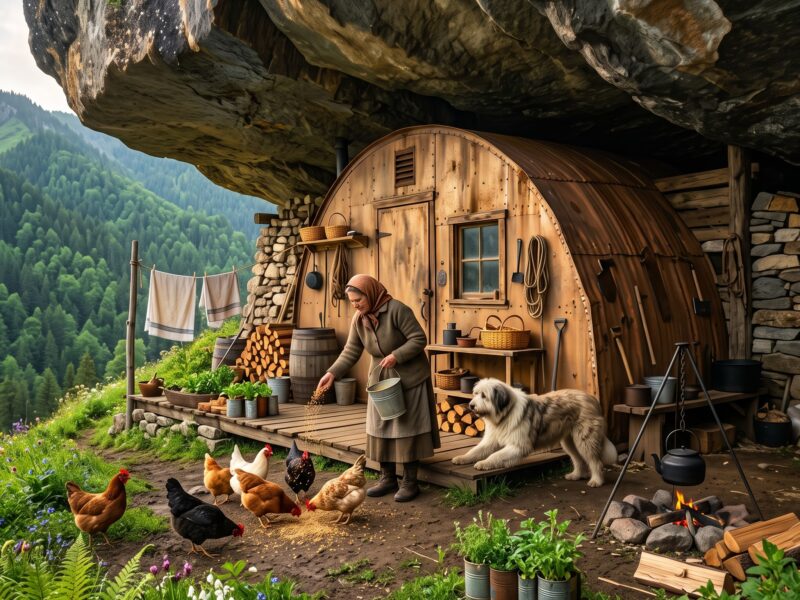
Nobody Trusted Her Mountain Quonset Cabin — Until a Blizzard Buried the Whole Town
THE HELD BREATH
The next morning, the temperature plummeted, but the wind stopped completely.
A heavy, suffocating stillness settled over the valley. The sky turned the color of bruised iron. Not a single bird sang in the pines. Even the creek seemed to slow, freezing solid in absolute silence.
Anders stood by the window, his small hand pressed against the glass. “Mama? Why is it so quiet?”
Ingred looked up at the peak. She had felt this exact stillness only once before. Three years ago. The day before Henrik died.
“The mountain is taking a breath,” Ingred whispered, pulling her son away from the glass. “And it’s about to scream.”
Down in the valley, the town of Oakhaven celebrated the break in the weather. Children played in the streets. Men chopped wood in their shirtsleeves, thinking the worst of the early freeze was over.
Elias Thorne sat in his luxurious, peaked mansion in the center of town, pacing in front of his roaring fireplace. Kael stood by the door.
“She has the ledger,” Thorne seethed, slamming his fist on the mantle. “How did she find it? I tore that old cabin apart.”
“She’s hiding in that barrel roof,” Kael said. “We can go up there tonight. Burn it down. Blame it on an overturned stove.”
“No,” Thorne snapped. “If she dies in a fire, Halver Berg might grow a conscience and talk. He’s weak. We need to make it look like an accident. An avalanche. Or exposure.”
Before Kael could answer, the glass in the bay window rattled.
Then, it shattered entirely.
The wind didn’t return gradually. It slammed into the valley like a freight train.
It wasn’t coming from the north, where the town’s windbreaks were planted. It was a northwest sheer—a violent, localized weather anomaly that funnelled directly through the canyon, amplifying its speed until it was tearing shingles off roofs within seconds.
By midnight, it was a whiteout blizzard of historic proportions.
Up on the ridge, Ingred fed the stove. The curved roof above her groaned, a deep, unsettling sound, but it held. The wind shrieked, slicing over the arch, failing to find a flat surface to push against.
But she noticed a single, terrifying detail. On the western seam, where the wind was hitting hardest, a thin, white line of frost was creeping inside. A micro-fracture in the clay.
If the wind caught a lip under that frost line, it could peel the roof off like the skin of an orange.
Ingred dragged her heavy wooden dining table against the wall and wedged two spare spruce poles between the table and the ceiling, creating an emergency brace against the western seam. She wrapped Anders in three quilts and held him tight.
“Close your eyes, Anders,” she sang softly over the roar of the storm. “The mountain protects us.”
Down in the valley, the mountain was offering no protection at all.
At 2:00 AM, the Henderson family’s barn, a tall, proud peaked structure, caught the full lateral force of the northwest wind. The trusses snapped like dry twigs. The roof collapsed inward, crushing their winter livestock in seconds.
At 3:15 AM, the mayor’s office lost its roof.
The traditional peaked roofs of Oakhaven had been built to shed gravity—snow falling straight down. They were utterly defenseless against lateral, horizontal wind pressure carrying tons of driving ice. The snow piled into massive, lopsided drifts on one side of the peaks, snapping the center beams.
Panic consumed the valley. Families fled their collapsing homes in the pitch black, blindly wading through waist-deep snow, searching for shelter.
Halver Berg stood in his hallway, listening to the agonizing shriek of his own roof beams splitting. He looked at his wife and daughters, terrified.
“The church?” his wife screamed over the wind.
“The steeple fell an hour ago!” Halver yelled back.
He looked out the shattered window, up toward the ridge. Through the blinding whiteout, he saw a single, faint pinprick of warm yellow light.
Ingred’s lantern. In the window of the barrel.
“We go up,” Halver ordered, grabbing his coat. “To the widow’s.”









