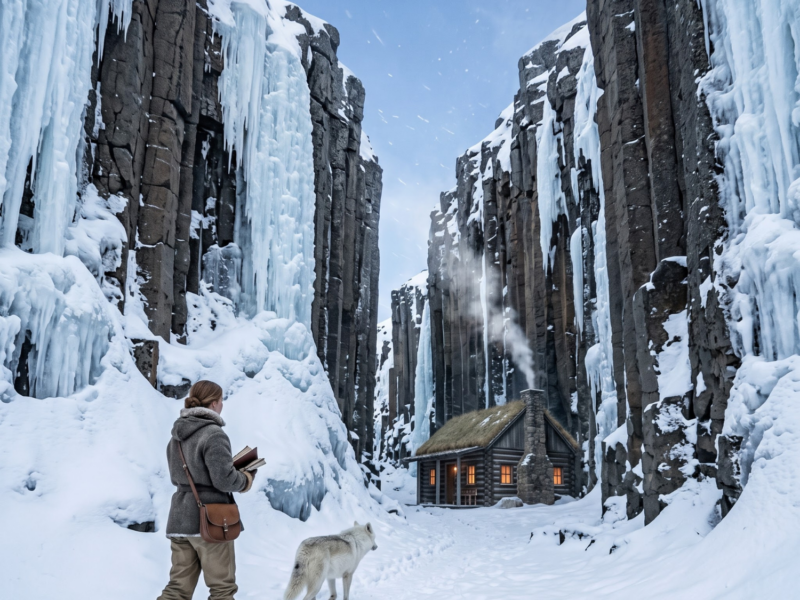
She Built Her Home in a Mountain Crevice Barely Wider Than a Door—Then the Blizzard Hit
THE ANATOMY OF A FOOL
Eight months earlier. Spring, 1886.
The Holleridge Basin was a sprawling, glacier-carved trough of open grassland in the western reaches of the territory, flanked by jagged limestone ridges. It was a place that offered timber, water, and grazing in the summer, and withheld all mercy in the winter.
When Ainsley Ferris arrived, she brought almost nothing. No cattle, no farm implements, just a wagon, a trunk of books, and a quiet, watchful stillness. She was in her early forties, with striking features weathered by a grief she refused to speak of.
The men of the basin—sturdy, pragmatic homesteaders—began raising their cabins in March, the moment the ground thawed. They felled lodgepole pine, notched the logs, chinked the gaps with clay and prairie grass, and set iron stoves squarely in the center of their single-room homes. It was the way it had been done in Ohio, in Pennsylvania, in the soft forests of the East.
Ainsley didn’t build.
Instead, she pitched a temporary lean-to of bark and boughs against a rock face and spent the entire spring and summer doing nothing but watching.
Silas Harmon, a thoughtful man who kept a meticulous journal of the settlement’s early days, watched her from his own property. “The widow walks the ridges at dusk,” he wrote in May. “She stands in the wind. She presses her hands to the rocks. I fear the solitude has unspooled her mind.”
He had offered twice to help her raise a proper cabin. Thaddeus Rowe, a master builder who had erected seven homes in the valley, offered his crew. Ainsley declined them both with a polite, impenetrable smile.
“I have not yet found the right room, Mr. Rowe,” she had told him, adjusting the cuffs of her white dress.
Rowe had spat tobacco into the dirt. “The winter here don’t care about the right room, ma’am. It cares about thick logs and a roaring fire. You’re courting a frozen grave.”
But Ainsley wasn’t looking for a place to build a house. She was looking for a house that was already built.
She found it in late August. A deep, natural crevice on the upper ridge. It was eight feet wide at the mouth, driving thirty feet deep into the living rock before opening into a natural chamber. The opening faced just east of due south.
The basin’s residents thought she was insane.
“A hole in the ground,” Warren Kesler had sneered outside the general store. “The meltwater will drown her in spring. The smoke will smother her in winter. No light, no draft. She’s digging a tomb.”
But Ainsley had spent ten years in the copper country of Michigan’s Upper Peninsula. Her husband, Thomas, had been a shift boss deep in the underground drifts. From Thomas, and from the brutal physics of the mines, she had learned a secret that none of these timber-chopping farmers understood.
Air holds nothing. It loses heat instantly. But stone? Stone remembers.
One hundred feet down in a copper mine, the temperature never shifts. The rock absorbs warmth and holds it, acting as a massive thermal battery. Ainsley had tested the south-facing granite of the crevice. At ten o’clock at night, hours after the sun had set, the rock was still radiating the day’s heat.
She didn’t need to build walls to fight the winter. She needed to close the door and let the mountain do the fighting for her.
In November, as the first frost hardened the mud, Ainsley finally began to work. But she didn’t haul logs. Over three grueling weeks, she dragged a wooden sled loaded with raw sandstone slabs up the ridge. Three thousand pounds of rock, hauled by a single woman in a white dress, dragged into the dark belly of the crevice.
She wasn’t building walls. The mountain had already provided four-to-seven-foot-thick walls of solid granite. She was building mass. She set her small cast-iron stove not in the center of the room, but flush against the deep back wall. She paved the floor with the sandstone.
She was creating an engine.
When Silas Harmon saw the sheer volume of rock she had dragged inside, an uneasy feeling settled in his gut. It wasn’t the pity one feels for a madwoman. It was the chilling suspicion that she knew something the rest of the world didn’t.









