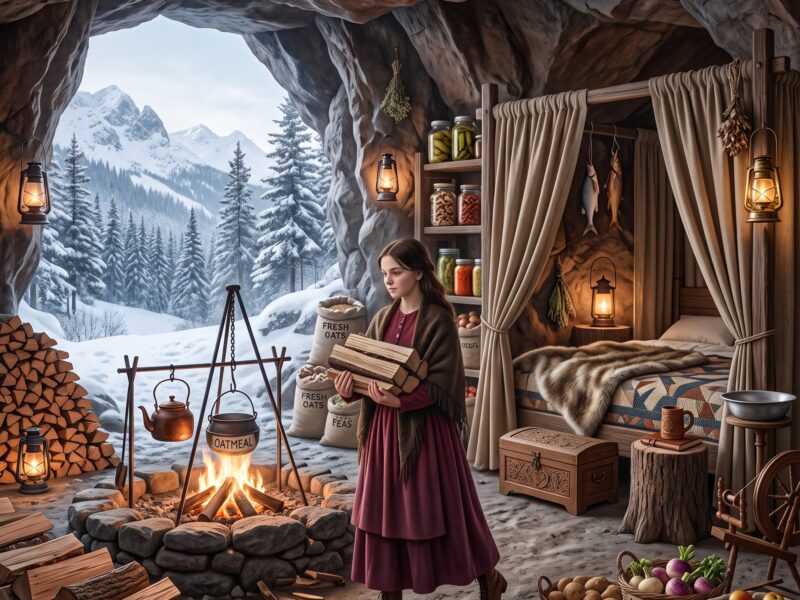
She Hid a Bedroom Deep Inside a Mountain Cave—The Deadliest Blizzard Proved Her Right
She Hid a Bedroom Deep Inside a Mountain Cave—The…
She Hid a Bedroom Deep Inside a Mountain Cave—The Deadliest Blizzard Proved Her Right
At 3:00 in the morning, Delia Voss’s hand reached down through the dark and struck a bucket of water, frozen solid to the bottom.
She didn’t gasp. She didn’t pull her hand back. She simply let her bare fingers rest against the unyielding ice, feeling the cold bite into her skin. There was usually a sound to the cabin at night—the faint sloshing of water when she turned in bed, the creak of timber settling. Tonight, the silence was absolute, heavy, and terrifying. It was the silence of a house that had given up.
Across the single room, her six-year-old son, Silas, slept beneath two heavy quilts. His knees were drawn tightly to his chest, curled into a defensive knot against the bitter air. Each small breath he took whistled faintly through his nose—a sound Delia had learned to count the way a miser counts coins. It was the sound of the fever from the spring before last, lingering in his small lungs. The doctor down in Cedar Junction had been blunt: Cold air makes it worse. Keep him warm and dry through the winters, and he’ll likely grow out of it.
Keep him warm. The words mocked her in the freezing dark.
Delia forced herself out from beneath the covers. The shock of the freezing floorboards shot up through her ankles like iron nails. She moved silently toward the hearth, where a low red glow pulsed weakly at the heart of the ashes.
She held one palm over the last red coals. The heat touched her skin, real and generous, a fleeting comfort. Then, she moved that same hand toward the log wall, tracing the rough line of the chinking. The warmth vanished instantly. Cold air slipped between her fingers, sharp as a knife, as if the timber were nothing more than an open door to the Montana winter.
Beside the hearth, fourteen split pieces of pine leaned against the stone. Outside, stacked against the cabin wall, was perhaps a three-day supply.
Fourteen pieces inside. Three days outside. It was early December.
The arithmetic was simple and fatal. The cabin was taking the wood she fed it and handing the warmth straight back to the mountain. They would never make it to February.
Delia pulled her worn wool cloak over her plain white nightdress. The dress was a remnant of a different life, its hem now frayed and stained with ash. She moved to the small shelf beside the heavy oak door. Emmett’s hunting knife lay there in its leather sheath, a silent sentinel. Beneath it, holding down a curled piece of paper against the pervasive draft, sat a flat piece of pale limestone.
She had seen the stone a hundred times. It was a paperweight, a curious rock her husband had brought back one evening. But tonight, in the desperate, grasping silence of the cabin, she picked it up and turned it over in her hands.
Two letters were cut into the underside of the stone. Shallow, precise, deliberate.
E. V.
Emmett Voss. Her husband’s initials. The same mark he burned into the handles of his axes and the stocks of his rifles.
“Papa brought it back,” a small voice piped up from the darkness.
Delia jumped, nearly dropping the stone. Silas was sitting up, his face pale in the dim glow of the coals.
“Go back to sleep, Silas,” she whispered, her voice tight.
“He brought it from the hill,” the boy continued, his eyes wide and fixed on the limestone. “Behind the house.”
Delia moved to the edge of the bed and pulled the quilts tighter around his small shoulders. “When did he tell you that?”
Silas looked down, tracing a pattern on the blanket. “Before he went north. He told me never to follow him up there.”
The words settled into the freezing air like dust. Emmett had ridden north in the last week of August to repair a washed-out freight crossing. He was supposed to be gone eight days. Twelve days later, Josiah Ren had ridden into her yard, leading Emmett’s horse. The saddle was soaked; the reins trailed in the dirt. They had found the horse by the flooded river. They had found nothing else.
For months, Delia had lived around the hollow space he left behind. His boots still under the bed, his shaving cup on the washstand. But this—a marked stone from the hill behind the house, and a warning to their son—this was new.
“Go back to sleep,” she said again, her voice softer this time. She kissed his forehead. It was terrifyingly cold.
She stood and looked out the small, frost-rimed window. Behind the cabin, Elkhorn Rise climbed steeply through the scattered pines. In the moonlight, the wind had stripped the snow from the ridges, revealing raw, grey limestone that showed through the white like bone through a wound.
Emmett had gone up that hill. He had cut his name into a piece of it and brought it home. And he had warned his son away.
Delia lit Emmett’s small kerosene lantern. She didn’t know what was up on Elkhorn Rise, but she knew the fourteen pieces of wood beside the hearth weren’t going to save her son.
She wrapped the cloak tighter, picked up the lantern, and stepped out into the biting wind. She was going to find out what her husband had hidden.
The climb was worse than it looked from the window. The loose rock shifted treacherously beneath her boots, and the frozen grass snapped like glass when she grabbed it for balance. The wind whipped her cloak around her, trying to drag her back down to the valley.
She climbed at an angle, following the path of least resistance, when the lantern light caught something unnatural on the trunk of a pine tree. A clean, sharp blaze cut into the bark.
She moved closer, her breath pluming in the freezing air. It was an old mark, weathered but distinct. A deliberate cut.
She looked higher up the slope and saw another. Then a third.
Emmett had blazed a trail. He had marked it carefully so that anyone who knew what to look for could find it, but hidden it well enough that a casual passerby would miss it entirely.
She followed the blazes, the cold seeping through her thin dress and worn cloak. The trail led her around a massive shoulder of limestone. As she stepped behind the rock face, the wind abruptly stopped. The sudden silence was jarring, a vacuum in the howling night.
Ahead of her, half-concealed by a tangle of dead brush, was a narrow, dark opening in the stone face.
Delia stopped. The lantern light barely penetrated the gloom of the cave entrance. It was barely high enough to crawl through.
She pushed the brush aside and knelt in the snow. She held the lantern out, peering into the blackness. The air that touched her face wasn’t the biting, bitter cold of the mountain. It was cool, yes, but it lacked the vicious edge of the wind. It was the even, earthy coolness of a deep root cellar.
She hesitated for only a second before crawling inside.
The stone passage was tight, the rock pressing close to her shoulders. But after ten feet, it widened, and the ceiling lifted away into darkness. She stood up, raising the lantern high.
The light revealed a chamber larger than her cabin. The walls were pale limestone, curving smoothly upward. The floor was packed clay and rock, worn nearly flat. There was no snow, no dripping water, no smell of animal dens. It was dry, clean, and profoundly still.
Delia took a few steps deeper, the sound of her boots echoing softly. The air in here was different. It didn’t feel like the dead of winter.
She reached into her cloak pocket and pulled out Emmett’s small brass thermometer. She set it on a flat ledge of rock and waited, holding the lantern near enough to see the numbers, but far enough away not to skew the reading.
Outside, it was well below zero. Inside the chamber, the needle slowly settled.
Forty-eight degrees.
She stared at the brass face, her mind racing. Forty-eight degrees inside a mountain on a night when water froze solid inside her cabin. The rock was insulating the space, trapping the ambient heat of the earth.
She lifted the lantern again, sweeping the light across the chamber. It caught on a small stack of three stones near the far wall. Beside them, scratched deeply into the packed clay floor, was a long, rectangular outline. It was the exact size and shape of a bed.
Within the outline, a shallow channel had been dug into the clay, running from the head of the rectangle toward the base of the rear wall. At the head of the trench, the stone was blackened with soot. Someone had built a small test fire here.
Delia knelt beside the unfinished trench. The pieces clicked into place with terrifying clarity.
The narrow entrance to block the wind. The thick limestone walls to hold the heat. The channel dug into the floor.
Emmett hadn’t just been exploring a cave. He had been building a hypocaust—an underground heating system. A small fire at the head of the channel would draw heat under the stone platform, warming the rock slowly and steadily. It wouldn’t need constant feeding. It would hoard the heat and release it gently through the night.
He had been building a safe, warm place for Silas.
And then he had died before he could finish it.
Her lantern light caught on something glinting behind the stack of stones. She reached out and picked up a short iron chisel with a wooden handle.
Burned into the wood were the letters E. V.
He had held this. He had knelt exactly where she was kneeling, carving a lifeline for his family into the frozen earth. While she thought he was repairing a freight crossing, he had been up here, keeping a secret that could have saved them.
Delia sat back on her heels, clutching the chisel. The grief she had held at bay for months threatened to overwhelm her. But the cold logic of survival pushed it back down.
The cabin was failing. The wood was gone. Silas was whistling when he breathed.
She looked at the unfinished channel, then up at the dark seam in the rear wall where the smoke was meant to escape. She didn’t know where that vent led. She didn’t know if the system would work. She didn’t know if she had the strength to haul enough flat stone up the mountain to build the platform.
But she looked at her husband’s chisel in her hand, the worn wood smooth against her palm.
She wasn’t going to let the winter take her son.
Delia gripped the chisel, set the iron edge against the frozen clay at the head of the channel, and brought a heavy rock down on the handle. The sharp crack echoed through the chamber, a declaration of war against the cold.
Related Articles

They Mocked the Widow’s Dirt Cellar—Then the Freeze Left Every Cabin Cold but Hers Warm
They Mocked the Widow’s Dirt Cellar—Then the Freeze Left Every Cabin Cold but Hers Warm…

A Homeless Veteran and His German Shepherd Inherited a Ridge No One Wanted — 35 Feet In, They Found
Chapter 1 / 7 A Homeless Veteran and His German Shepherd Inherit… A Homeless Veteran…

Neighbors Laughed When He Built A Cabin Inside An Old Barn—Until It Kept His Home 35 Degrees Warmer
Chapter 1 / 8 Neighbors Laughed When He Built A Cabin Inside An… Neighbors Laughed…

His Sod House Had No Woodpile in January – Until the Trains Stopped and the Town Came Begging
Chapter 1 / 10 His Sod House Had No Woodpile in January – Until t……

She Built Her Cabin Over the Woodshed and Never Burned Wet Wood Again
Chapter 1 / 8 She Built Her Cabin Over the Woodshed and Never Bu… She…

The Duke Abandoned Her on Their Wedding Day—Years Later, He Discovered What He Had Lost
Chapter 1 / 7 The Duke Abandoned Her on Their Wedding Day—Years… The Duke Abandoned…

He Wedged a Tiny A Frame Into a Crevice Before Winter and His Family Slept at 75°F While Town Hit
Chapter 1 / 7 He Wedged a Tiny A Frame Into a Crevice Before Win……

He Was Too Old to Ride—So He Bought the Ruined Ranch and Found the Room Behind the Fireplac
Chapter 1 / 5 He Was Too Old to Ride—So He Bought the Ruined Ran……

Settlers Laughed at His Underground Heat Recovery Duct — Until It Kept His Cabin 71°F Warmer
Chapter 1 / 9 Settlers Laughed at His Underground Heat Recovery… Settlers Laughed at His…

A Navy SEAL Built a Home Inside a Mountain—Then His Dog Warned Him Before the Storm
Chapter 1 / 5 A Navy SEAL Built a Home Inside a Mountain—Then Hi… A…