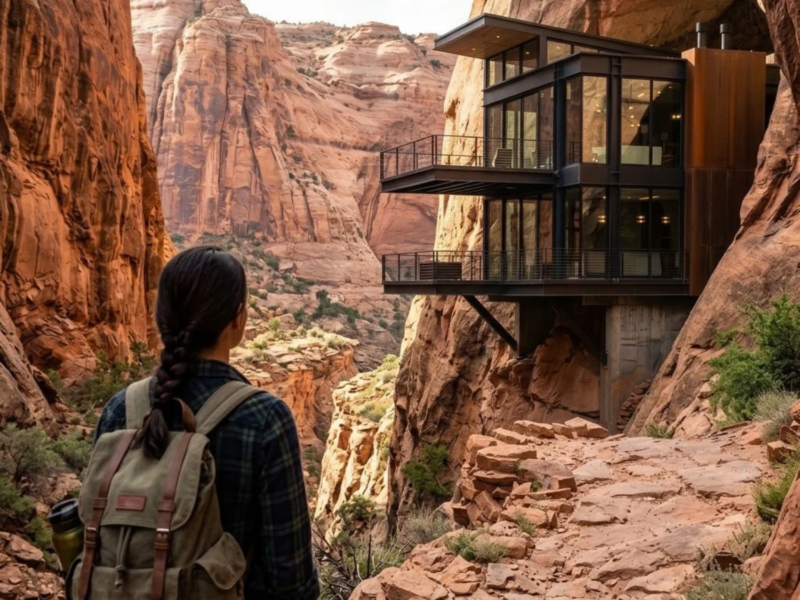
She Inherited a Worthless Canyon—Then Found the Hidden Cliff House Her Father Built for Her
The Desert Graveyard
Two days later, driven by a stubborn, desperate need to see the graveyard of her inheritance, Clara drove her battered Subaru Outback across the state line into the harsh, breathtaking desolation of southern Utah.
Echo Ridge Canyon was a sixty-mile drive from the nearest paved road. It was a punishing landscape of jagged red rock, scrub brush, and a relentless, baking sun. When she finally parked at the GPS coordinates provided by the deed, she stepped out into a suffocating silence.
The canyon was a massive, sweeping gouge in the earth, flanked by sheer sandstone walls that rose two hundred feet into the blinding blue sky. It was beautiful in a savage way, but it was dead. There were no roads, no power lines, no water. Mitchell was right; it was entirely worthless.
Tears of absolute defeat finally spilled over Clara’s eyelashes. She kicked a loose stone, screaming her frustration into the empty expanse. The echo bounced back, mocking her. She slumped onto the hood of her car, pulling the brass compass from her pocket.
She traced the scratches on the back—a gift she had bought him at a pawn shop when she was twelve. As she flipped the compass over, the harsh sunlight caught a tiny, almost invisible etching on the inside of the brass lid. It wasn’t a manufacturer’s mark. It was a set of coordinates precisely engraved, ending with a tiny symbol: a triangle intersected by a vertical line.
Clara frowned, her pulse quickening. She pulled out her phone, opened a downloaded topographic map application, and typed in the coordinates. The pin dropped exactly 1.2 miles deep into the canyon, right at the base of the towering eastern cliff face.
She grabbed her backpack, two bottles of water, and began to walk. The terrain was brutal—a twisted ankle waiting to happen among loose shale and thorny mesquite bushes. After nearly an hour of grueling hiking in the ninety-degree heat, she reached the GPS location.
There was nothing there. Just a massive, sheer wall of solid Navajo sandstone and a chaotic pile of massive boulders that looked like the result of an ancient rockslide.
Clara felt a fresh wave of despair. “You’re chasing ghosts, Clara,” she muttered to herself, turning to leave.
But as she pivoted, the sun dipped slightly, casting long, sharp shadows across the rockfall. She stopped. Among the chaotic tumble of car-sized boulders, she noticed a metal rod sticking out of the dirt, obscured by a clump of dead sagebrush.
She scrambled over the loose scree and brushed the dirt away. It was an old surveyor’s peg. Stamped into the steel head was a serial number, and beneath it, the exact same symbol from the compass: a triangle intersected by a vertical line.
Clara looked up from the peg, staring at the massive boulders. They looked entirely natural, a random collapse of the cliff face. But as her eyes traced the shadows behind the largest boulder, she realized the shadow didn’t end against a rock wall.
It continued into darkness: a narrow, perfectly hidden fissure, no wider than three feet, concealed behind thousands of tons of fallen rock. It was a slot canyon, invisible from the valley floor and shielded from satellite view by a massive overhang.
Clara squeezed between the cold, abrasive rocks, her heart hammering against her ribs. The air temperature dropped instantly by twenty degrees. As she navigated the dark, twisting passage, the walls grew smoother, the floor leveled out, and a faint ambient light began to glow ahead.
She rounded a final sharp bend and froze, the breath completely knocked from her lungs. Her brain refused to process the impossibility of the structure before her.









