She Opened Her Door to Two Lost Strangers Never Knowing Their Son Was the Richest Rancher in Wyoming
Ghosts of Missouri
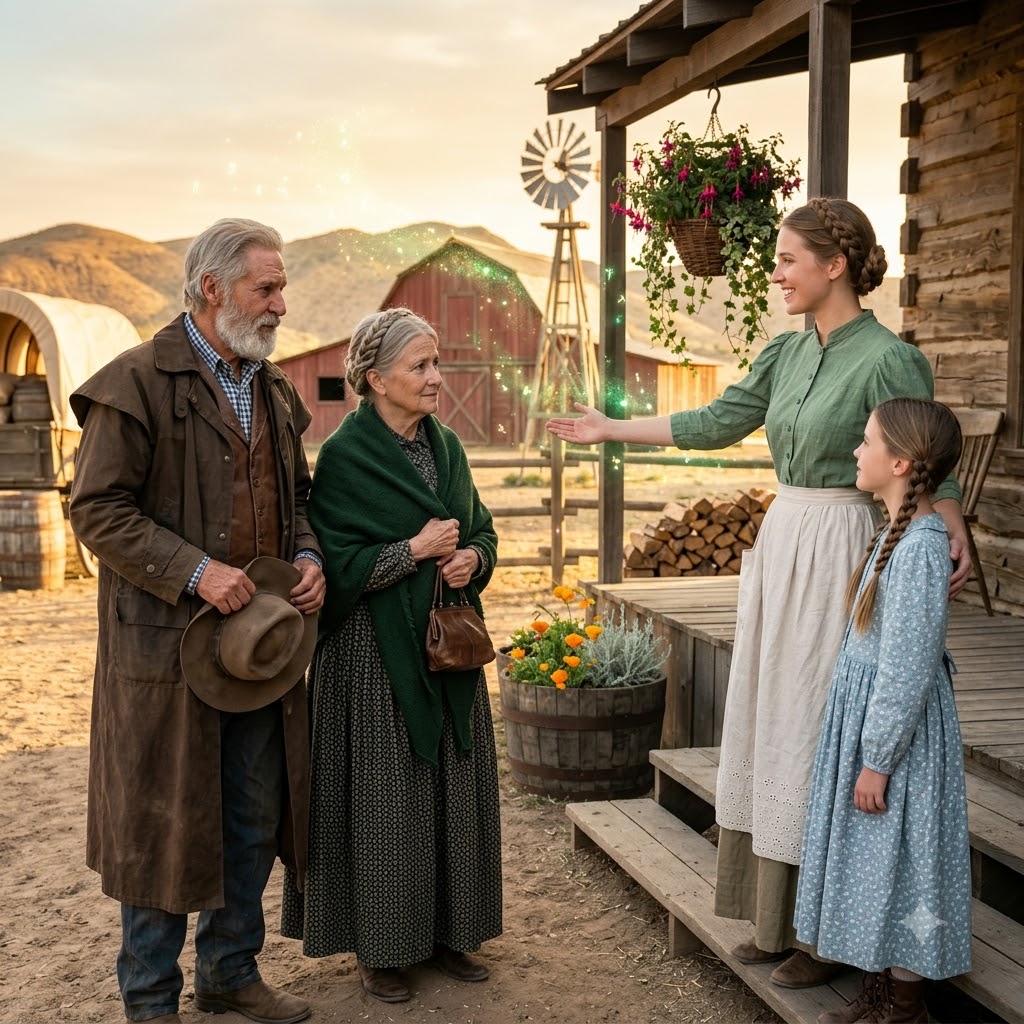
The storm raged for four days, burying the cabin up to the windowsills. Inside, bathed in the amber glow of kerosene lamps and the heat of the stove, a fragile sanctuary took hold.
The old man’s name was Abel Merrick. His wife was Sarah.
Once his vocal cords thawed, Abel spoke in a voice that sounded like rusted iron hinges. Sitting in Ben’s old rocking chair, his hands wrapped around a mug of hot coffee, he told Ruth their story. They had come from Missouri, following the railroad west by whatever means they could beg, borrow, or buy.
“Our wagon broke an axle forty miles back, near the badlands,” Abel explained, his eyes fixed on the fire glowing through the stove grate. “A freighter took pity on us. Hauled us as far as the crossroads. But he had a schedule to keep, and the sky was turning black. He left us on foot. We thought we could make the next town before it hit.”
He shook his head, a gesture heavy with the weight of near-death. “We saw the smoke from your chimney, Mrs. Callaway. We walked toward it because it was the only thing in this whole frozen world that looked like hope.”
Sarah spoke up from the bed, her voice a fragile whisper. “We have no money to pay you. Only what’s in this satchel. A few tin plates, some thread.” Her gray eyes met Ruth’s, and in them, Ruth saw a familiar, crushing shame. It was the shame of a proud person reduced to begging.
Ruth stood up, taking the empty cup from Abel’s hands. “You’ll pay me by getting well,” she said firmly. “That is the only currency accepted in this house.”
Over the next few days, the small, lonely cabin transformed. It became something Ruth had not felt in three years: a home with more than two people in it. The silence that usually suffocated her in the evenings was replaced by the murmur of voices, the clinking of spoons, the soft tread of footsteps.
Abel, though weak and possessing a cough that rattled in his chest, could not bear to sit idle. By the second day, he had found Ben’s old tool box. He sat by the hearth, quietly whittling a new, perfectly balanced leg for Ruth’s wobbly kitchen table.
Sarah rose from her sickbed on the third morning. She tied an apron over her dress and took over the bread dough as if she had been born to that very kitchen. As she kneaded, she hummed old, lilting tunes—hymns and folk songs that Ruth half-remembered from her own mother’s knee.
Lily was mesmerized. Having never known a grandmother, the little girl attached herself to Sarah like a burr to a wool sock. In the evenings, while the blizzard screamed outside, Lily sat cross-legged at Sarah’s feet. The old woman told stories of Missouri—of apple orchards heavy with fruit in the autumn, of summer nights sparkling with fireflies, and of a boy who used to whistle for the mockingbirds so perfectly that the birds would answer him back.
“Was that your son?” Ruth asked quietly on the fourth night.
Sarah’s hands, which had been deftly knitting a sock, suddenly stopped. Across the room, the scraping of Abel’s knife against wood ceased. The silence in the cabin grew heavy.
“Our Daniel,” Sarah said, her voice dropping to a mournful register. “He left us twenty-three years ago. He was nineteen.”
She looked at the frost on the windowpane, seeing ghosts in the ice. “He and his father had a terrible fight about the farm. Daniel wanted to go West. He read those dime novels, heard the stories of gold and open land. He wanted to make something of himself. Abel…” Sarah glanced at her husband. “Abel was a hard man back then. He told Daniel that if he walked off the land, he need not ever come back.”
Abel closed his eyes. The knife in his hand trembled.
“He was angry,” Sarah continued, her chin trembling slightly. “Boys say such things. So do fathers. But pride is a wicked master. Daniel wrote to us twice from Colorado. Short letters. Then… the letters stopped.”
Ruth felt a pang of profound sorrow for the woman. “I’m so sorry.”
“It gets worse, child,” Sarah said, picking up her knitting needles, though she did not knit. “A few years ago, Abel lost his sight to the fever for a year. A man came from the county. Said our farm had been sold for back taxes. We had trusted my sister’s boy to handle our affairs while Abel was blind. But the farm was gone, and we had nothing left. So, we packed what we could carry, and we started walking.”
“Walking where?” Lily asked, her eyes wide.
“Toward the last place we ever heard he might be,” Abel said quietly from the shadows. “A freighter passing through Missouri a decade ago said he knew a Dan Merrick up in the Montana Territory. Near a place called Miles City.”
“Sarah,” Abel’s voice cracked. “It’s been a long time. The boy may be dead. Or, if he lives, he may want nothing more to do with us. I cast him out.”
“Then we will stand at his grave and weep,” Sarah said, a sudden, astonishing steel entering her fragile voice. “Or we will hear his rejection from his own mouth. But I will not die without knowing what became of my boy.”
Ruth looked at the two of them. She saw a man being eaten alive by guilt he had carried for two decades, and a woman fueled by a hope so stubborn it defied reason. She thought of Ben, resting under the frozen earth. She thought of how quickly the people you love can be taken away.
She made a decision that any sensible, pragmatic neighbor on the prairie would have called pure foolishness.
“Miles City is one hundred and twenty miles from here,” Ruth said, her voice cutting through the heavy air. “The roads are buried. The drifts will be ten feet high in the passes. You cannot travel.”
Abel looked down. “We will trouble you no longer once the storm breaks, ma’am. We can sleep in the livery in town—”
“You will stay here until the spring thaw,” Ruth interrupted, her tone brooking no argument. “There is room. I have a cellar full of potatoes, and more chopped wood than I can burn alone. You are not a trouble, Abel Merrick. You are my guests.”