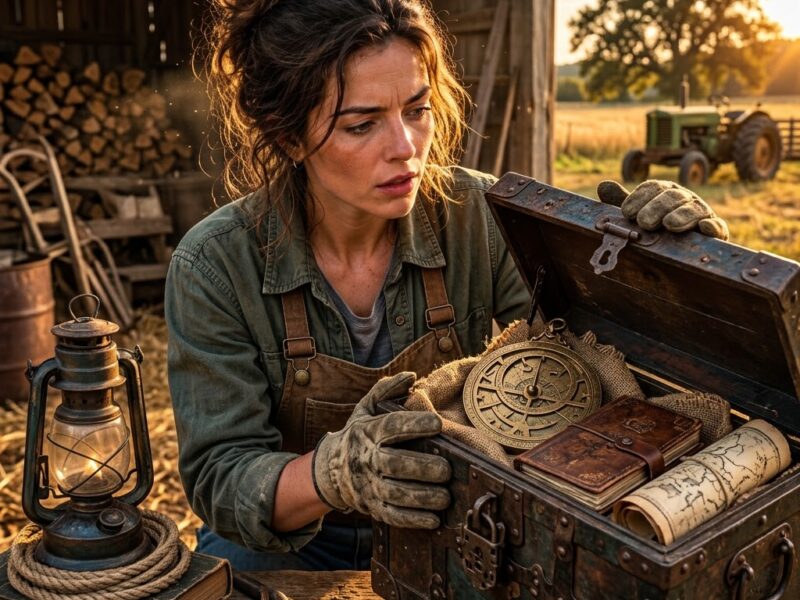
She Was Paid $300 to Clean His Barn — But She Found Something Inside
The Resurrection
For the next two months, Hannah’s truck insurance, her eviction notices, and her financial panic faded into the background. She took a night job waiting tables to pay her immediate bills, dedicating every daylight hour to the Vance homestead.
Working side-by-side with Arthur every afternoon, the barn became a sanctuary of resurrection.
Hannah carefully cleaned every single brass gear with specialized solvents, restoring them to a mirror-like shine. She re-oiled the heavy steel balance wheels. She built custom, archival-quality wooden frames to mount Samuel’s original 1928 patent blueprints, hanging them proudly on the cedar walls.
Arthur, whose mechanical skills came rushing back to him, rewired the copper storage cells and tested the continuity of the resin-sealed coils. The machine was absolutely flawless.
In early November, Hannah made a phone call.
She reached out to the Virginia Historical Machinery Society, and through them, contacted the head of the mechanical engineering department at the State University.
When a team of three university professors arrived at the farm in late November 1993, they expected to find a crude, backwoods water wheel.
Instead, they walked into a pristine 1920s laboratory.
When Arthur manually turned the crank, spinning the planetary gears, the copper coils engaged. The multimeter attached to the output terminals spiked, registering a steady, pure, impossibly efficient electrical current.
The professors were stunned into silence.
Samuel Vance’s 1928 kinetic gear design wasn’t just a historical curiosity. His method of low-speed power conversion, minimizing friction through a unique gearing ratio, offered mechanical insights that were remarkably relevant to the developing field of modern green energy systems, specifically low-flow hydro-turbines.
The university team spent two weeks carefully documenting the workshop. They created a digital, photographic historical archive, photographing every journal entry and blueprint. But they honored Arthur’s one strict condition: the original machinery would not be moved to a museum. It would stay right where Samuel had built it—inside the cedar-lined room in the barn.









