She Worked Three Jobs and Endured Their Mockery—Until a Lonely Cowboy Offered Her a New Beginning
THE DISPUTED INVOICE
By the end of her first week, the Bennett Ranch did not recognize itself.
Grace had reorganized the pantry, tossing the rot and inventorying the good supplies. She corrected three duplicate supply orders in the ledger, and established rigid, non-negotiable meal times. The table was cleared. The stove gleamed.
Not everyone appreciated the sudden shift in power.
Peter Collins, a young, brash ranch hand with a quick temper, watched her carry a fifty-pound sack of potatoes from the root cellar to the kitchen. He leaned against the doorframe, chewing on a matchstick.
“Careful, boys,” Peter called out to the men in the yard. “She might eat our winter supplies before Christmas if we let her keep moving like a draft horse.”
A few of the men laughed. Grace didn’t break her stride. She hauled the sack into the kitchen, dropped it with a heavy thud, and returned to her ledger. She didn’t have time for bruised male egos.
Three days later, Peter Collins came into the kitchen, holding his hat. His ears were burning bright red.
He had just discovered that Grace had caught a massive billing error from the local blacksmith—an error Peter had signed off on without checking. The mistake would have cost the ranch nearly a month’s wages for the crew.
Peter stood awkwardly by the stove. “Miss Miller. About what I said earlier in the week… I spoke out of turn.”
Grace didn’t look up from her columns of numbers. “Check your invoices before signing them, Peter. A signature is a promise. Don’t make promises you can’t pay for.”
Peter swallowed hard. “Yes, ma’am. I just… I wanted to say I was sorry.”
Grace finally looked up. She studied the young man. She had learned a long time ago that an apology meant little if a person still expected you to make them feel better about giving it.
“Apology accepted,” she said flatly. “Supper is at six. Don’t be late.”
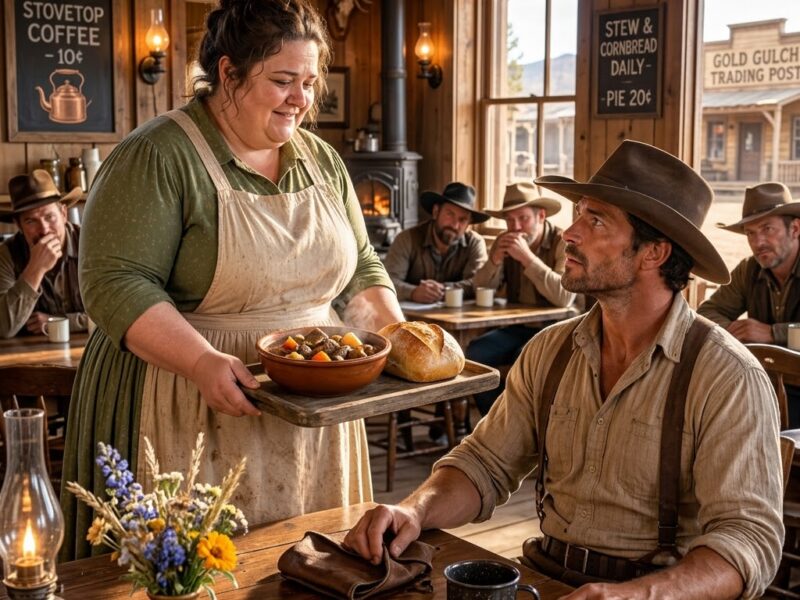
That evening, Grace prepared a massive beef stew and baked three loaves of bread. She served the men, moving back and forth from the stove to the table, making sure every plate was full. She waited until the men finished eating, cleared the table, and began scrubbing the iron pots.
The house went quiet. The clock ticked in the hallway.
Samuel returned to the kitchen. He had been out late checking the perimeter fences. He stopped in the doorway, watching her scrub.
“Have you eaten?” he asked.
“I’ll eat when I’m done,” Grace said, wiping her brow with the back of her arm.
Samuel didn’t say another word. He walked to the cupboard, pulled down two ceramic plates, and served a heavy portion of stew onto each. He placed them on the freshly wiped kitchen table. He pulled out a chair.
“Sit down, Mr. Bennett,” Grace said, turning around with a soapy rag in her hand. “I still have work. The dishes can wait.”
Grace hesitated. Her heart gave a strange, uncomfortable flutter. For years, she had treated rest like a luxury she couldn’t afford—like something she needed to earn with blood and sweat. Even the act of sitting down while others were present made her feel vaguely guilty, as if she were stealing time.
“Grace,” Samuel said softly. It was the first time he had used her first name. “Sit.”
She slowly lowered the rag. She walked to the table and sat across from him. They ate without speaking. The silence wasn’t heavy or demanding; it was just quiet.
For the first time in four years, Grace Miller finished a meal while it was still warm.









