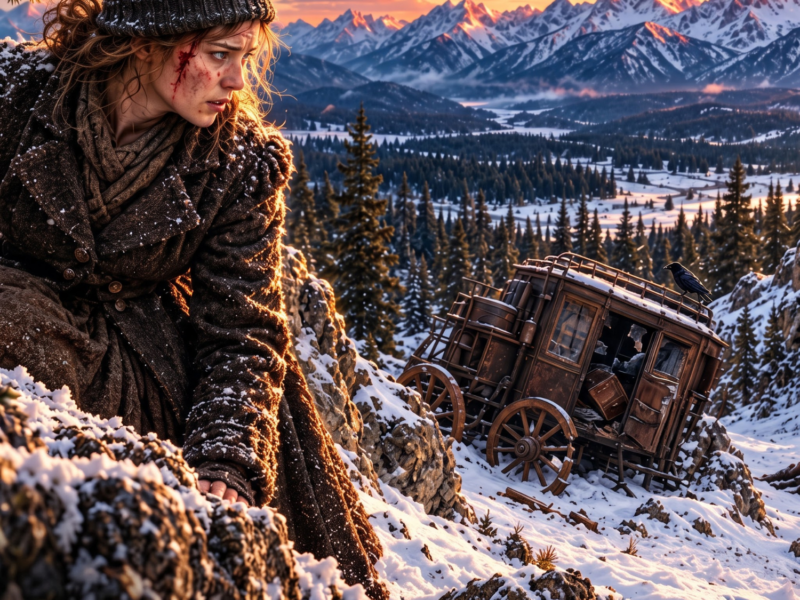
Stranded in the Mountains, She Found a Cabin With Blood on the Floor—But No One Inside
The Bell Rings
Near sunset, the shadows were growing perilously long. Evelyn’s strength was failing. Her vision blurred at the edges.
Then, as they crested a steep ridge, she stopped dead.
Beyond the next ridge, rising straight and true against the darkening sky, was a thick plume of gray smoke.
A few days earlier, the sight of smoke had meant safety. Now, hardened by the cabin, she did not rush forward. She dropped to a crouch and watched first, scanning the tree line for movement, for a man in a dark coat carrying a missing glove.
Nothing moved.
Slowly, they advanced to the edge of the ridge and looked down into the valley.
There, nestled against the mountain side, was a towering wooden mining headframe. Below it sat a large barn, several sturdy log cabins, and men moving between them carrying buckets and tools.
Red Creek.
Evelyn tried to call out, to shout to the men below, but her throat was so raw her voice broke into a dry, breathless croak.
Jonah raised the rifle and fired a single shot into the air. The crack echoed across the valley.
Down in the settlement, a miner dropped his bucket. He looked up, spotted the two figures standing against the snow on the ridge, and began shouting. Men dropped their tools and started running up the hill toward them.
Evelyn leaned against a pine tree, watching them come.
After seven days of fighting the mountains, the cold, the wolves, and the greed of men, Evelyn Hart stopped walking. She let the rifle slip from her fingers into the snow. This time, she knew she did not have to keep going.
Epilogue: The Prepared Mind
The company doctor at Red Creek told Jonah he had been the luckiest man in Montana territory. The bullet had missed every vital artery and bone, and the cold had surprisingly slowed the bleeding, saving his life.
Evelyn’s ankle was severely sprained, the ligaments torn, and her hands were cracked, scarred, and burned from the iron pan and the freezing ice. But she would recover.
Several days later, a group of armed miners from Red Creek found Silas Vain sheltering in a shallow cave a few miles south of the town. He was out of ammunition and starving. His right hand, ungloved in the sub-zero temperatures, was completely black with severe frostbite. A deputy sheriff from Bozeman rode up a week later to take him into federal custody.
By the spring thaw, the roads cleared. Evelyn traveled onward to the town in the valley where she had originally accepted a position as a schoolteacher.
She stood at the front of her classroom, writing on the chalkboard, the sound of chalk clicking rhythmically. Under her heavy wooden desk, hidden from view, sat a thick leather satchel. Inside it, she kept a bundle of strike-anywhere matches heavily wrapped against moisture, a sharp hunting knife, fifty feet of strong cord, a metal cup, dried salted meat, thick bandages, and a highly detailed, folded map of the territory.
Months later, during the first heavy snowfall of the winter, Evelyn stood beside the classroom window. White flakes gathered against the thick glass, swirling in the wind.
For a moment, the warmth of the room faded. She remembered the twisted metal of the shattered carriage. She remembered the desperate, trembling flare of the final match in the dark overhang. She saw Jonah lying half-dead under the spruce trees, and she heard the cabin door scraping open in the pitch black, revealing the man with the rifle. She felt the terrifying, breath-stealing shock of the cold water spreading across the river ice.
Then, she blinked, pulling herself back to the present.
She looked around her classroom. The cast-iron stove burned steadily in the corner, radiating a fierce, comforting heat. Her students were bent over their slates, scratching out their arithmetic lessons in quiet safety.
Under the desk, the leather bag waited.
Evelyn turned back to her students, her scars fading but her memory sharp. She knew a truth that none of the children in the room could yet understand, a truth carved into her bones by the Montana winter.
Survival does not begin when disaster arrives. It begins long before the first snowflake falls.









