
The Duke Mocked His Shy Bride at Meal—Then Her Reply Left the Whole Ballroom in Shock, Tonight!
The Duke Mocked His Shy Bride at Meal—Then Her Rep…
The Duke Mocked His Shy Bride at Meal—Then Her Reply Left the Whole Ballroom in Shock, Tonight!
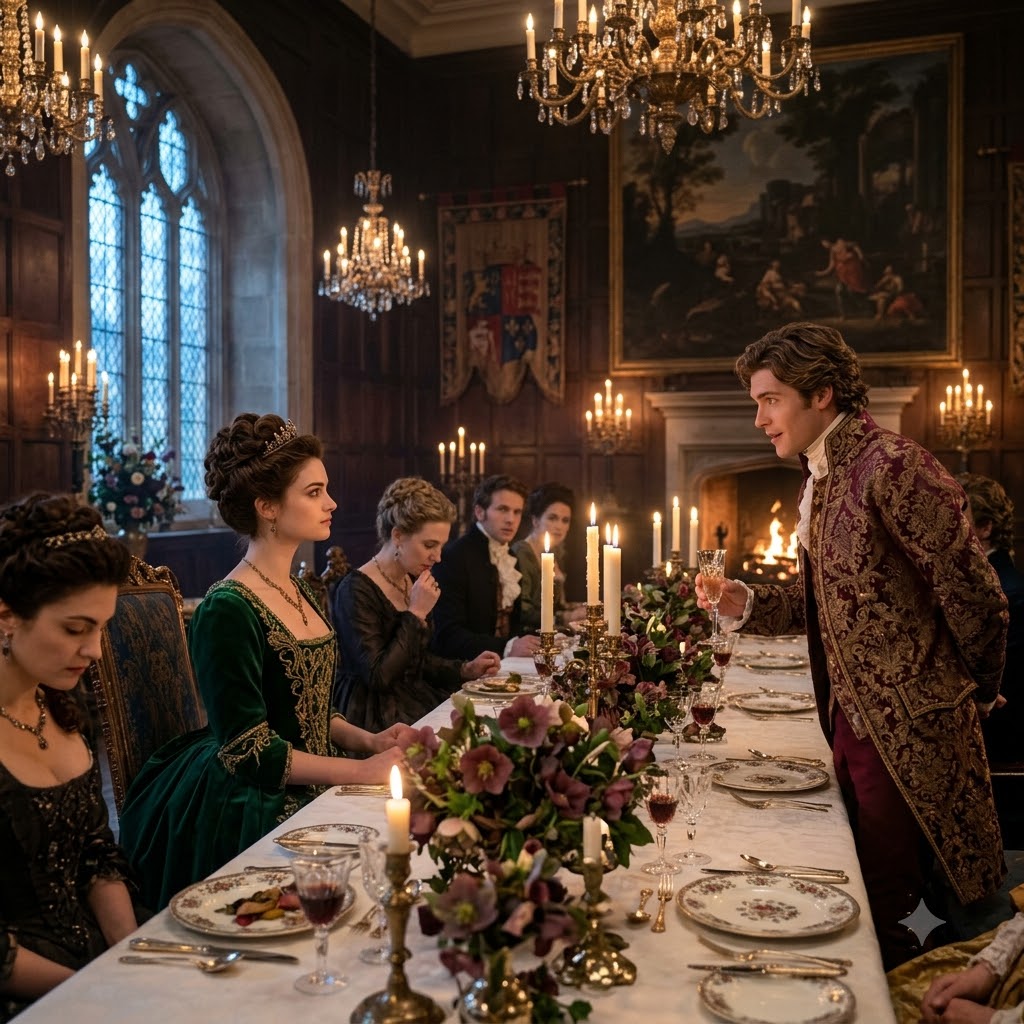
The great hall of Vantry Manor glowed with candlelight, and the long table was set with silver plates and crystal glasses that caught the flames like tiny stars. It was the first formal dinner since the wedding, and every noble family within a day’s ride had come to see the new duchess for themselves.
But Rosalind Hail’s attention was not on the glittering jewels of the viscounts or the whispered gossip of the baronesses. Her focus was entirely on the weight of the forged iron key currently hidden beneath the folds of her pale blue silk gown, pressing cold against her thigh. She had stolen it from her husband’s private study twenty minutes before the dinner gong rang.
Rosalind sat at the head of the table beside her husband, Duke Allaric Vantry, her hands folded neatly in her lap. Compared to the emerald-encrusted dresses and feathered collars around her, her gown was startlingly simple. She kept her eyes lowered most of the evening. To anyone watching, she looked like a woman trying very hard not to be noticed.
She had grown up far from this world, in a quiet, wind-battered house near the coast, raised by a father who taught mathematics at a small school before building a shipping empire, and a mother who mended clothes for the neighbors. Her marriage to the Duke had been arranged quickly, for reasons that had little to do with love. His family desperately needed the vast liquid capital her father possessed. Her family needed the safety and unassailable status that only a centuries-old title could offer against ruthless trade rivals.
Neither Rosalind nor Allaric had been given much say in the matter. But while Allaric had grown deeply resentful of the arrangement—and of her—Rosalind had chosen from the very first day to meet it with quiet patience.
That patience, however, was often mistaken for weakness.
“Try not to embarrass yourself tonight,” Allaric had told her in the corridor before the heavy oak doors opened, his voice cold and flat, smelling faintly of brandy. “These people expect a duchess, not a merchant’s daughter who counts coins for fun.”
Rosalind had said nothing. She rarely did when he spoke to her that way. She had learned over the past two months of marriage that silence was often the safest response. It did not mean she agreed. It did not mean she accepted his words as true. It simply meant she was choosing her moment.
Dinner began smoothly enough. The guests spoke of politics, of the coming barley harvest, of a royal wedding that would take place in the spring. Rosalind answered when spoken to, her voice soft but clear, her manners mathematically precise. She had studied etiquette books for weeks before the wedding, determined not to give anyone a reason to laugh at her.
Still, there was a stiffness to the room. An invisible line seemed to separate her from everyone else at the table, as if they all shared a cruel inside joke about how she did not belong. She noticed the small things other people might have missed. The way certain guests angled their chairs slightly away from her, as though politeness required only the smallest gesture of inclusion, and nothing more. The way conversations paused briefly whenever she joined them, then resumed in a slightly different direction, as if steering around a subject too delicate to touch.
None of it was cruel on its own. Taken together, it painted a clear picture. She was tolerated. She was a bank vault in a silk dress.
A young woman across the table, the daughter of a viscount, tried once or twice to include her in lighter conversation, asking about her childhood home near the coast. Rosalind answered warmly, describing the smell of salt in the morning air and the harsh, beautiful sound of gulls over the harbor. For a fleeting moment, it seemed the ice might crack.
But then Allaric interrupted. “Yes,” he drawled, swirling his wine. “I imagine the stench of the fish markets builds quite the character.”
The young woman, unwilling to challenge her host, flushed and let the subject drop.
Rosalind returned to her soup without complaint, though something in her chest tightened. She thought, not for the first time, that a person could be surrounded by people and still feel entirely alone. Her mother had always said that a calm face could carry a person through storms that would sink someone who wore every feeling openly. Rosalind had taken the lesson to heart long before she ever imagined needing it in a room full of wolves.
It was during the second course, as servants cleared away bowls of roasted pheasant soup, that Allaric decided to make the evening truly interesting.
“Tell me, my dear,” he said, loudly enough for the whole table to hear. “Did your father teach you which fork to use, or only how to add columns of numbers?”
A ripple of laughter moved down the table. Some guests hid their smiles behind linen napkins. Others simply looked away, uncomfortable, but entirely unwilling to defend a woman they barely knew.
Rosalind’s cheeks warmed, but she kept her expression perfectly calm. Her fingers grazed the hidden key in her dress.
“My father taught me both, Your Grace,” she said quietly. “Numbers and manners are not so different. Both require patience to get right.”
It was a mild answer, meant to close the subject gently, but Allaric was not finished. He leaned back in his carved wooden chair, clearly enjoying the rapt attention of the room.
“Patience,” he repeated, as though tasting the word and finding it bitter. “Yes, I suppose patience is useful when one has little else to offer. Beauty, wit, breeding—these things cannot be taught. But patience anyone can manage. Even a girl who spent her childhood adding up a shopkeeper’s accounts.”
More laughter followed, sharper this time.
At the far end of the table, the Dowager Duchess Eleanor, Allaric’s mother, sat with a face carved from marble. She had said little all evening, watching Rosalind with the careful attention of someone conducting a private test. Though what she was testing for, no one could say.
Rosalind felt the heat rise in her face. But beneath the embarrassment, something else stirred. Something steadier.
She thought of her father sitting at their small kitchen table late at night, checking shipping manifests by candle light, never once raising his voice, no matter how exhausted he became. She thought of her mother, stitching torn hems with a needle so fine it seemed to disappear between her calloused fingers. Neither of her parents had status. Neither had titles or grand houses. But they had never once been small.
She set down her spoon. Deliberately. Without haste.
She lifted her eyes to meet her husband’s for the first time all evening.
“You are right, Your Grace,” she said, her voice carrying further than it had all night. Steady and clear. “Beauty fades. Wit can be cruel. And breeding, as I understand it, only tells us where someone was born, not who they choose to become.”
The hall grew utterly quiet. Even the servants carrying silver platters near the walls seemed to freeze in place.
“But patience,” Rosalind continued, holding Allaric’s gaze, “is not something anyone can manage. As you say, patience is a discipline. It is choosing, again and again, not to say the cruel thing simply because you can. It is enduring small humiliations without becoming bitter. And it is waiting for the right moment to speak, rather than filling every silence with noise.”
She tilted her head just a fraction. “I have watched you very carefully these past two months, Your Grace. And I confess, patience does not seem to be a skill you have needed to practice.”
A few guests exchanged startled, wide-eyed glances. Allaric’s arrogant smile faltered, though he tried to recover it.
“You forget yourself,” he said, his voice dropping into a tighter, dangerous register. “Now.”
“No,” Rosalind said gently. “I remember myself very well. Perhaps better than you remember yourself, Your Grace. You called me a merchant’s daughter as though it were an insult. But my father built his fortune from nothing, with nothing but careful work and honest dealing, while men born into titles gambled theirs away at card tables.”
She leaned forward, just slightly. “I have heard the servants talk, though they try to be discreet. I know about the crippling debts this house carried before our marriage. I know whose money is quietly repairing the roof above our heads tonight.”
The room had gone utterly still. Somewhere near the middle of the table, a crystal glass was set down too hard on the wood, the sound sharp as a gunshot in the silence.
“I did not marry you for love, Your Grace, and I think we both understood that from the beginning,” Rosalind went on, her tone never rising, never sharp. Simply honest. “But I believed—foolishly, perhaps—that two people brought together by circumstance might still choose kindness toward one another. I have tried every day to be patient with you. To give you time to see me as more than an arrangement on paper. I have said little, not because I have nothing to say, but because I hoped silence might be kinder than the truth.”
She paused. For a moment, something almost like sorrow crossed her face before it settled back into cool composure.
“Tonight, you asked the room to laugh at me for counting numbers and mending manners instead of being born into them. I will not apologize for where I came from. My father’s hands were rough from work, not soft from doing nothing. And I am prouder of that than you could possibly understand. If patience is a weakness, then I am glad to be weak. Because I have watched what impatience and cruelty look like up close for two months now, and I want no part of becoming that.”
The silence that followed felt enormous, stretching across the long table like a held breath.
Then, from the far end of the room, a single sound broke it.
Clap.
The soft, unmistakable clap of hands.
It was the Dowager Duchess. She rose slowly from her high-backed seat, her expression no longer unreadable, but warm. Almost proud.
“Well said, child,” she murmured, her voice laced with iron and honey, loud enough for the nearest guests to hear. “Well said, indeed.”
Other hands joined hers. Hesitantly at first, then with more confidence, until a gentle, rolling applause moved through the hall. Not everyone joined in—some guests remained frozen, unsure how to react to a duchess who had just quite calmly dismantled her husband’s cruelty in front of the entire county—but enough did that the message was unmistakable. The room’s sympathy, which had rested so easily with Allaric all evening, had violently shifted.
Allaric sat rigid in his chair. His face went pale, then flushed a dark, furious red, then pale again. He opened his mouth as though to respond, but no words came. For the first time since Rosalind had known him, he seemed to have nothing clever to say.
The Dowager Duchess walked the length of the table, her heavy silk skirts whispering against the stone floor, and stopped beside Rosalind’s chair. She placed a hand gently, deliberately, on the younger woman’s shoulder.
“I have watched you closely since the wedding,” the Dowager said, addressing the room now as much as Rosalind. “Many of you assumed, as my son did, that quiet meant weak, and that a soft voice meant an empty mind. I wondered myself whether that assumption was fair. Tonight, I have my answer. And I suspect several of you do as well.”
She turned her sharp, predatory gaze to her son. “Allaric. Your father built this house on hard work, much like the Hail family did. He would be ashamed to see you mock the very quality that rebuilt your own inheritance, simply because it now sits across the table from you instead of down in the accounting rooms.”
Allaric said nothing. The muscles in his jaw ticked. There was nothing left to say that would not make things worse.
Rosalind, for her part, did not gloat. She did not smile in triumph or glance around the room to measure the effect of her words. Instead, she rose from her chair with the same quiet grace she had carried all evening.
“I did not speak tonight to humiliate anyone,” she said, addressing the table one final time. “I spoke because silence has its limits, and I believe there comes a moment when standing up for oneself is not pride, but simple honesty. I hope in time this house can be a place of kindness rather than performance. That is all I have ever wanted from it.”
With that, she gave a small, polite bow of her head to the guests, turned, and walked from the hall. Her steps were calm and unhurried, though her heart pounded fiercely beneath her composed exterior. She did not look back to see her husband’s face, though she could feel his stunned, venomous silence following her out like a shadow.
As she reached the heavy oak doors, a footman opened them for her. As she passed, he leaned in, his voice barely a breath against the ambient noise of the hall.
“The library, Your Grace,” the footman whispered. “Before he checks the desk.”
Rosalind didn’t break her stride. But her fingers tightened around the iron key in her pocket.
Related Articles

They Mocked the Widow’s Dirt Cellar—Then the Freeze Left Every Cabin Cold but Hers Warm
They Mocked the Widow’s Dirt Cellar—Then the Freeze Left Every Cabin Cold but Hers Warm…

A Homeless Veteran and His German Shepherd Inherited a Ridge No One Wanted — 35 Feet In, They Found
Chapter 1 / 7 A Homeless Veteran and His German Shepherd Inherit… A Homeless Veteran…

Neighbors Laughed When He Built A Cabin Inside An Old Barn—Until It Kept His Home 35 Degrees Warmer
Chapter 1 / 8 Neighbors Laughed When He Built A Cabin Inside An… Neighbors Laughed…

His Sod House Had No Woodpile in January – Until the Trains Stopped and the Town Came Begging
Chapter 1 / 10 His Sod House Had No Woodpile in January – Until t……

She Built Her Cabin Over the Woodshed and Never Burned Wet Wood Again
Chapter 1 / 8 She Built Her Cabin Over the Woodshed and Never Bu… She…

The Duke Abandoned Her on Their Wedding Day—Years Later, He Discovered What He Had Lost
Chapter 1 / 7 The Duke Abandoned Her on Their Wedding Day—Years… The Duke Abandoned…

He Wedged a Tiny A Frame Into a Crevice Before Winter and His Family Slept at 75°F While Town Hit
Chapter 1 / 7 He Wedged a Tiny A Frame Into a Crevice Before Win……

He Was Too Old to Ride—So He Bought the Ruined Ranch and Found the Room Behind the Fireplac
Chapter 1 / 5 He Was Too Old to Ride—So He Bought the Ruined Ran……

Settlers Laughed at His Underground Heat Recovery Duct — Until It Kept His Cabin 71°F Warmer
Chapter 1 / 9 Settlers Laughed at His Underground Heat Recovery… Settlers Laughed at His…

A Navy SEAL Built a Home Inside a Mountain—Then His Dog Warned Him Before the Storm
Chapter 1 / 5 A Navy SEAL Built a Home Inside a Mountain—Then Hi… A…