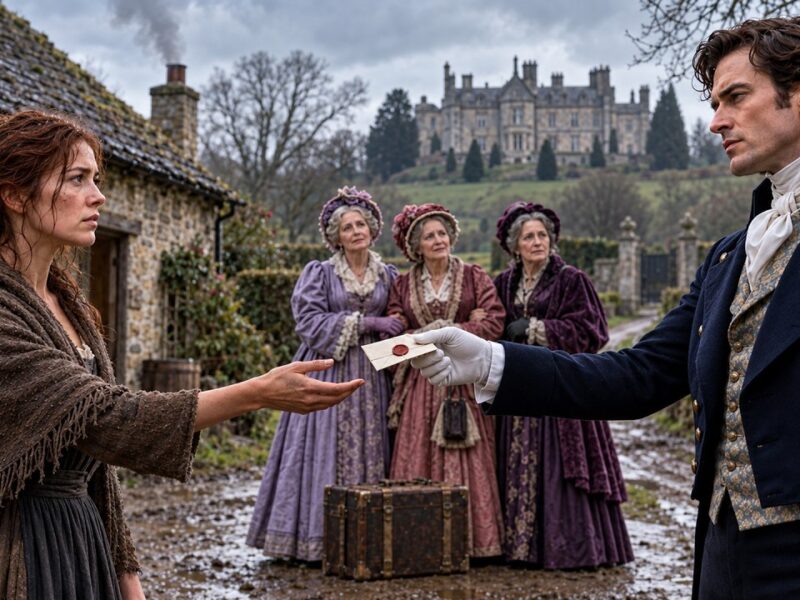
The Duke Sent Her His 3 Old Aunts for Winter — By Easter His Duchess Begged a Seat at Their Table
The Twelfth Night Storm
On Twelfth Night, the sky turned a sickly, bruised yellow. By noon, it began to snow. Great, soft, heavy flakes plummeted to the earth, and by dusk, the snow lay a foot deep in the lane, drifting higher by the hour.
Up at Brackwell, the Duchess was giving her first Twelfth Night ball. It was to be her triumph. Forty esteemed guests were traveling from all over the county. The great hall was hung with sprawling boughs of evergreen and holly, the fires were blazing, and Cordelia, dressed in breathtaking white satin, stood at the top of the grand staircase waiting to receive her new society.
Nobody came.
The main road up to the Brackwell estate passed through a deep, steep-sided cutting below the hill. By seven o’clock, the wind had driven the snow into the cutting, creating a drift higher than a carriage roof. The first arriving carriages plowed into it and stuck fast. The carriages behind them, trapped in the narrow lane, could not turn around. The horses panicked, plunging in the deep powder. The coachmen yelled.
And then, through the blinding whiteout, somebody saw a light.
It was the window of Cold Harbor Farm, a mile back down the lane. It was the only light in all that desolate, freezing country, burning brightly because Maud Lowry set a tallow candle in it every single night to guide Abel’s lads walking home in the dark.
Abandoning the trapped carriages, the guests stepped down into the waist-high snow. Ladies in thin, delicate satin slippers and gentlemen in fine evening coats began the grueling, freezing march toward the beacon.
Maud saw them coming from the window—a long, straggling, ghostly line of flickering lanterns and pale faces emerging from the blizzard. She knew instantly what had happened.
She threw her husband’s coat on over her flour-dusted apron, grabbed her heavy storm lantern, and plunged out into the blizzard. She met the vanguard at the gate, half-carried them inside to the fire, and went back out. She went back five times.
On the final trip, she found an old gentleman lying in the ditch at the bend of the lane. He was a stout, white-haired man in a luxurious velvet coat who had slipped on the ice beneath the snow and could not rise. The cold was rapidly putting him to sleep.
Maud hauled him up, got her shoulder firmly under his arm, and dragged him out of the snowbank. She half-carried, half-walked him the quarter-mile back to the farm, his arm draped heavily around her neck, while he mumbled delirious, impeccably polite apologies to her the entire way.
By the time she kicked the farmhouse door shut behind them, the kitchen was at capacity. Forty people—the highest society of the county—were packed like sardines onto the mended bench, the mismatched chairs, and the upturned buckets. Snow was melting off expensive wool and silk, pooling on the stone flags, steaming furiously in the heat of the roaring fire.
The three aunts rose from their places near the hearth, as calm and regal as if they had been expecting a ball of forty people to crash through their door all week.
“Well,” Dorcas said, surveying the shivering nobility. “We shall want the big pot.”
Every scrap of food in the farmhouse went into the cast-iron pot. The Sunday bacon, Mr. Tebbut’s flour, the very last of the autumn onions, and a bag of dried beans. Dorcas stood over the inferno for two hours, her face scarlet from the heat, and fed forty starving aristocrats out of a single pot, pairing the stew with massive loaves of hot, brown bread pulled fresh from the mended oven.
Honoria moved through the crowd with the blue jug, dispensing cups of hot, heavily spiced ale, firmly refusing to take a single coin from anyone. When they were all fed, and the fire was banked up high, throwing dancing shadows against the walls, Winifred stood by the hearth and sang.
She sang an ancient, melancholic Christmas carol. The old gentleman in the velvet coat, sitting near the fire, buried his face in his hands and wept openly into his silk handkerchief, saying it was the song his mother used to sing to him, and he did not care in the slightest who saw his tears.
Miles away, upon the hill, the great house of Brackwell stood isolated in the snow, every window blazing with wasted light. And Cordelia, the Duchess of Brewwell, still wearing her white satin, sat entirely alone at a banquet table laid for forty, and ate a single piece of Twelfth Cake in the silence.









