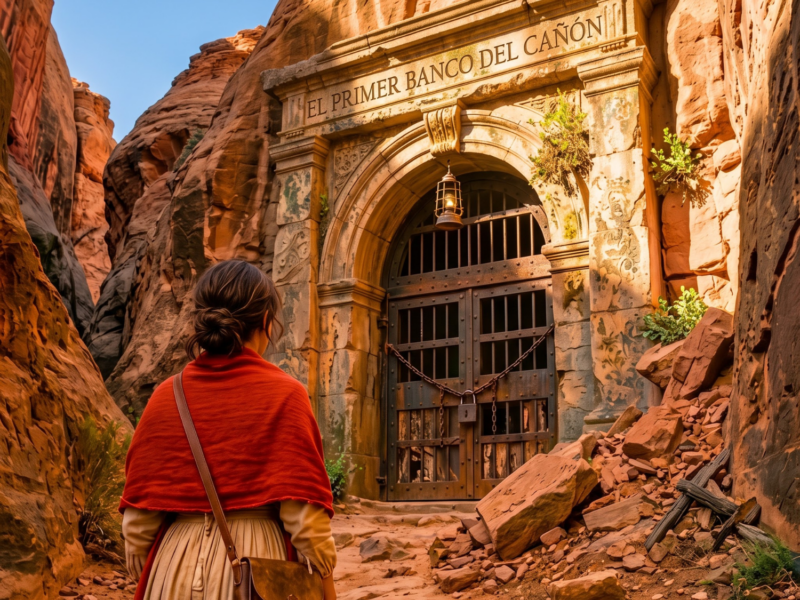
The Forbidden Town Was Marked “Destroyed” in 1889—She Found Its Bank Still Locked Underground
The Ghost of County Clare
In the oppressive heat of July, Josephine found herself drifting through the dusty streets of the county seat. Every door she had knocked on for a position—teaching, sewing, keeping accounts for the mercantile—had been closed with polite firmness. We need a man for the ledgers, Mrs. Callaway. Perhaps if your husband were still living, ma’am.
She survived on hardtack and the occasional apple, rationing the coins in her hem as if they were drops of water in a desert.
She sought refuge from the midday sun beneath the awning of the county land office. The windows were thrown wide open to catch the nonexistent breeze, and from within, the rhythmic, sing-song voice of an auctioneer spilled into the street.
Josephine closed her eyes, letting her mind drift back to St. Louis, to the smell of brass and the gentle scrape of a file. Michael Ror had been a master of his craft. He did not build locks; he built promises.
A lock that fails a widow or a farmer is a lie told in iron, he would whisper as she held the oil lamp for him late into the night. Never build a lie, Josie.
Her father’s skill had carried them westward, chasing railway booms and mining strikes. But it was in a town called Larks Hollow, a dozen miles up the valley, that her father had taken his final, most secretive commission. He had been gone for three months. When he returned, he was older, paler, and burdened by a quiet agony he refused to explain. It was the finest work of my life, he had told her, his hands trembling. And I pray to God I never have to explain it to anyone.
“Next parcel!” the auctioneer’s voice snapped Josephine back to the present. The men inside the office chuckled, a low rumble of amusement.
“Lot forty-two. Forty acres. The platted town of Larks Hollow.”
Josephine froze. Her breath caught in her throat.
“Condemned by county decree in the year of our Lord 1889,” the auctioneer read, wiping sweat from his brow. “Marked destroyed. Forbidden for resettlement. Sold as is, where is, with no warranty and no recourse. Who will give me five dollars for the ashes?”
The room laughed. Larks Hollow was a ghost story. Flooded out and burned in the same week, they said. Cursed ground.
Josephine stepped through the doorway. The room was thick with cigar smoke and the smell of unwashed bodies.
“Do I hear five?” the auctioneer sighed, lifting his gavel. “Come now, gentlemen. There’s good timber on the ridges, even if the valley is cursed.”
Silence.
Never build a lie. Her father’s voice echoed in her mind, mingling with the auctioneer’s plea. Larks Hollow. The place that had broken her father’s spirit. The place where his finest work lay buried.
Josephine raised her hand. Her voice, when it came, was clear and sharp as a struck bell.
“Nine dollars.”
The men turned, their amusement shifting to bewildered pity. A young, dark-haired widow in a dusty dress, bidding on a graveyard.
“Nine dollars to the lady,” the auctioneer said, blinking. “Do I hear ten?”
No one spoke. The gavel came down with a crack like a pistol shot.
For the price of nine dollars, which was nearly every cent sewn into her hem, Josephine Callaway had just purchased a town the world had agreed to forget.
PART II: THE CONDEMNED EARTH
Chapter 3: The Cottonwood Bank
She did not hire a wagon. She walked the twelve miles to Larks Hollow, her heavy trunk dragging behind her on a makeshift travois she had fashioned from pine boughs.
When she crested the final ridge and looked down into the hollow, she braced herself for a blackened, apocalyptic ruin. But the tragedy of Larks Hollow was not one of violence; it was one of sorrowful surrender. The collapsed roofs were silvered with eight winters of snow and sun. A single, crooked church steeple pointed an accusing finger at the sky. The wild grass had reclaimed the streets, painting the town in a vibrant, mocking green.
She left her trunk by the ridge and walked down into the silence.
At the very center of the town, half-buried under a collapsed brick wall and a young cottonwood tree that had stubbornly grown through the rubble, stood a stone facade. Josephine’s heart hammered against her ribs. She approached it slowly, pulling aside a veil of ivy.
Carved into the lintel, still crisp and legible, were the words: LARKSBURG TRUST AND SAVINGS. EST. 1884.
Something deep within her chest tightened. It was the same physical sensation she felt when her lock-picks brushed against a hidden tumbler, the sudden, thrilling certainty of alignment.
For three days, she worked like a woman possessed. She traded her skills—fixing a rusted padlock for a passing fur trapper—for the use of a mule and a heavy iron crowbar. She built a crude lean-to against the remaining wall of the bank to sleep in, living on hardtack and creek water.
She hauled away rotted timber and shattered bricks. Her hands blistered, popped, and calloused over. And on the afternoon of the third day, as she leveraged a massive fallen roof beam out of the way, her crowbar struck something that did not sound like stone or wood. It rang with a dull, heavy thud.
Iron.
Josephine dropped to her knees, clawing the dirt and ash away with her bare hands. As the dust cleared, the outline of a massive, horizontal trapdoor revealed itself in the floor of the bank. It was sealed tight, the seams so fine they could hardly admit a piece of paper.
She held her breath, brushing the dirt from the center of the mechanism. There, stamped into the cold iron in tiny, precise letters, was a mark she would have known in the darkest night.
A. MAR. Beside it, a tiny, perfectly rendered four-leaf clover. The hallmark of Michael Ror of County Clare.
“Hello, Papa,” she whispered into the empty ruins.









