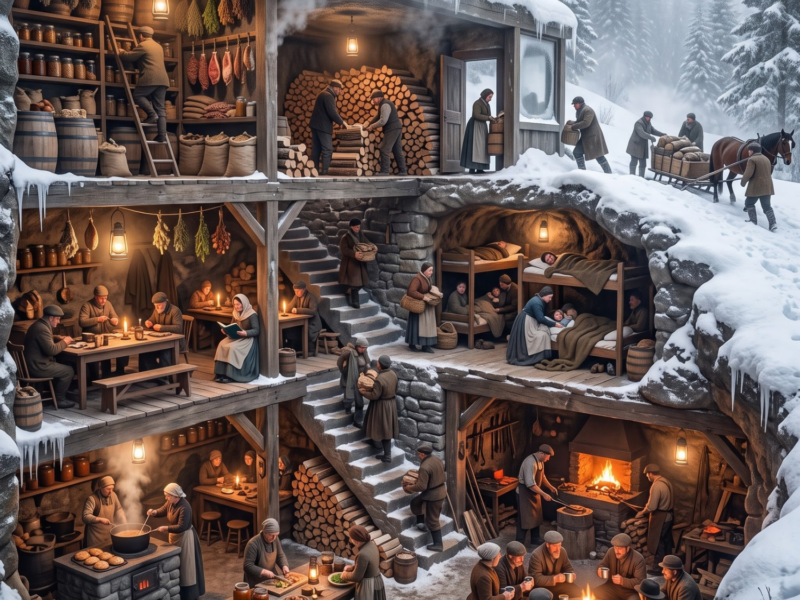
They Called Her the Doomsday Widow—Until the Deadly Freeze Proved Her Right
The Architect in the Ashen Tray
It was not a mad idea, though anyone in Bitter Creek would have called it precisely that had she dared say it aloud. It came from a very specific, cherished memory.
Her father, Elias Ashworth, had been in his quiet way a man who collected knowledge the way other men collected debts. He borrowed tattered pamphlets from traveling preachers, debated agricultural theory with visiting salesmen, and argued gently with the local schoolteacher about things neither of them could empirically prove.
One bitter winter when Varity was ten, he had become utterly fascinated by something almost nobody in the county had ever heard of: ancient Roman hypocausts. They were central heating systems nearly two thousand years old that pushed the hot exhaust smoke of a subterranean fire beneath the stone floors of a villa, warming the rooms from below before the smoke was ever allowed to escape harmlessly into the open sky.
He had explained it to Varity one cold evening by the parlor stove, speaking in the unhurried manner fathers sometimes fall into when the daughter has not quite asked a question, but the father urgently needs to hear himself say it out loud to someone who will not mock him.
“Heat wants to rise, Varity,” he had told her, sketching frantic lines in the grey ash tray with a burnt matchstick. “Everybody knows that simple fact. But if you build the path right, you can make it travel sideways first. Force it to work for you before it’s allowed to leave. Smoke that would have gone straight up a chimney and wasted itself on the open sky… you can bend it. Make it earn its keep.”
Two winters later, when Varity was twelve, he had finally tried it in miniature on their own farm: a small duct run beneath the floor of the chicken coop, fed by a modest fire he kept going nearby on the absolute coldest nights. It had worked far better than he ever expected. The exhaust, still hot enough to matter, warmed the wooden boards above the hens before finally escaping through a short, crooked flue.
Elias had grinned about it for a week, inordinately proud of an experiment that had cost him almost nothing and kept his laying birds productive through a cruel February.
Varity had been twelve years old when she watched that flue smoke curling into the cold air, and thirteen when her father was put in the ground, and now she was fifteen, walking across open grass with nine dollars and a blanket, remembering every single word of it as though he had spoken it that very morning.
If a chicken coop could hold onto stolen heat, she thought, then so could she.
She found her ground four miles from Bitter Creek—a stretch of unclaimed, windswept prairie that nobody else wanted. The soil was thin, sandy, and notoriously poor for planting wheat, which was precisely why it had remained unclaimed. It was isolated, unremarkable, forgettable… and therefore, perfect.
At fifteen, she could not legally file a homestead claim of her own. What she could do, under the rougher, older unwritten customs of the frontier, was stake a claim as an occupant and improver of vacant land. It was the kind of quiet, squatter’s arrangement that half the territory had been settled by in the first place, long before any government clerk’s signature made it official.
She would live on it. She would work it. She would make her presence undeniable, and worry about the legal paperwork when she was old enough for the paperwork to matter.
Her nine dollars became her starting capital, and she spent it like a general planning a desperate siege:
-
$2.50 bought a good, honest spade from the mercantile in town—the kind with a reinforced steel edge that wouldn’t bend or shatter against deep, root-choked prairie sod.
-
$3.00 bought twenty-three clay drainage tiles from a neighboring farmer clearing out his old barn. Each one was roughly six inches across and two feet long—ordinary agricultural tiles men used to drain water-logged fields. To anyone else, they were plumbing for a swamp. To Varity, remembering her father’s sketches in the ashtray, they were something else entirely. They were channels. They were the bones of a thermal system nobody in Bitter Creek had ever attempted to build.
-
$1.00 bought a small iron cooking grate, secondhand but structurally sound.
-
$2.50 bought cornmeal, coarse salt, a slab of salt pork, and a tin of matches—provisions calculated to keep her alive through the brutal weeks of digging that lay ahead.
She had, in total, just enough tools to begin, and enough food to last perhaps a month if she was relentlessly careful. She had no help coming. She had no one checking on her. If she failed out here on the empty flat, no one would know until the spring thaw revealed her bones.









