They Cast Her Out as a Thief—She Hid Behind a Waterfall and Survived the 9-Day Blizzard
THE ARCHITECT OF THE RIDGE
Two days south of Halpine, inside the small, cluttered study of the Stag Hollow schoolhouse, Julius Cade pushed his wire-rimmed spectacles up the bridge of his nose and stared at the camp account ledger.
As the newly hired schoolmaster for the valley, Julius was a quiet, observant man who spent his evenings tutoring loggers’ children and auditing supply bills for the freight station. He had a mind like a steel trap for numbers and a pathological aversion to injustice.
He looked at the Cinder Creek paybox receipts signed by Ambrose Thorne two weeks ago. Then he looked at the single recovered voucher—the one supposedly found in Delphine Marsh’s sewing pouch.
“That’s impossible,” Julius muttered to himself, leaning closer to the kerosene lamp.
He pulled out a magnifying glass. The voucher found in Delphine’s possession bore the serial number series 44-B. But according to the official shipping manifests, series 44-B had been retired and audited out of circulation six months ago. It was an old voucher—the kind that would sit gathering dust at the bottom of an open office safe or a manager’s bottom drawer. It was not a voucher that had been sitting securely in the newly arrived Cinder Creek paybox.
It had been planted. By someone with access to the old camp archives.
Julius stood up, his coat draped over his chair. He grabbed his woolen scarf and a heavy lantern. It was midnight, and a blizzard was howling outside the schoolhouse windows. But Julius didn’t care about the storm. He cared about the fact that a twenty-year-old girl had been cast out into a death sentence based on a blatant, sloppy fabrication.
He stepped out into the freezing night, pointing his horse north toward the timber camp of Halpine.
Back at Blackmar Falls, Delphine was already masterminding her survival.
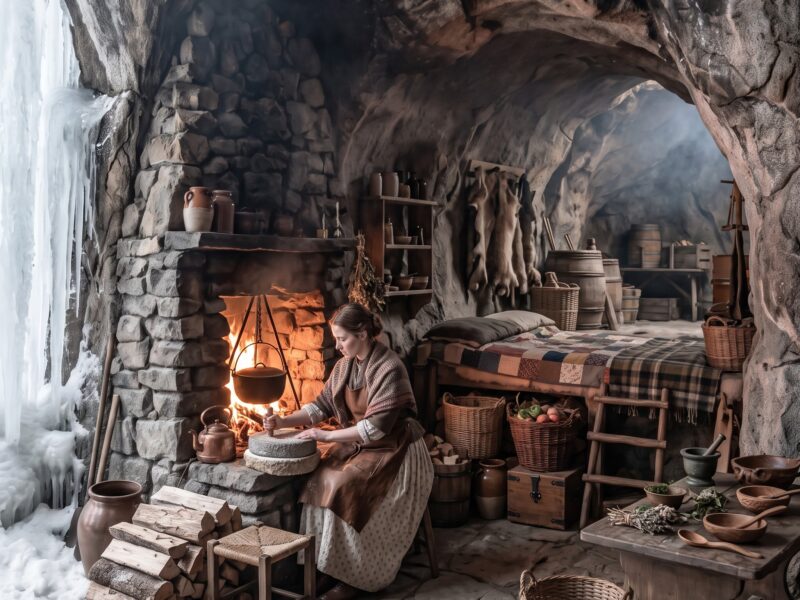
She had discovered that the fissure climbing upward into the basalt wasn’t a dead end. It was a natural ventilation shaft—a chimney flue connected to a massive subterranean stone chamber fifty feet above the water curtain.
Using her dull kitchen knife and a flat slab of shale, she had cleared the debris choking the upper vent. Now, kneeling on the packed dirt floor of the hidden chamber, she coaxed a small, steady fire to life using dry punk wood and flint flakes she found nestled in an old deerhide pouch left behind by whoever had sheltered here years before.
The smoke curled cleanly up the natural flue, venting out into the freezing mountain air without a trace.
Delphine sat back, letting the gentle, ambient heat of the stone warm her frozen hands. She looked around the chamber. It was roughly twenty feet square, dry, insulated by tons of basalt bedrock. Against the back wall stood a crude wooden shelf, holding three sealed earthenware jars and a small, oil-wrapped bundle.
She crawled over and untied the oilskin.
Inside lay a collection of astonishing artifacts: a hand-drawn deerhide map of the surrounding mountain ridges, a functional bone needle, several bundles of dried willow bark and yaro, and—most importantly—a small, brass-cased pocket thermometer. Stamped into the brass casing was the date: 1876.
Eight years old.
She picked up the thermometer. The mercury sat at forty-two degrees—the ambient temperature of the deep basalt chamber. Shielded from the wind, insulated by the earth, this room maintained a permanent, life-sustaining microclimate.
“You left a kingdom behind,” Delphine whispered, running her fingers over the carved wooden shelves.
She stood up and walked to the wall, grabbing a piece of charcoal she had snapped off a charred log. Beneath the previous occupant’s tally marks, she drew her own single, clean vertical stroke.
Day One.
She measured her rations: half a loaf of barley bread, a pocketful of dried pine nuts, and a canteen of water filled from a pure underground spring bubbling out of a side seam in the cavern wall.
She was dry. She was warm. She was fed.
And miles away, entirely unaware that she was breathing, Rowan Thorne was sitting in the camp office, pouring himself a glass of whiskey, entirely convinced that the winter had buried his dirty little secret forever.
He was about to find out just how wrong he was.









