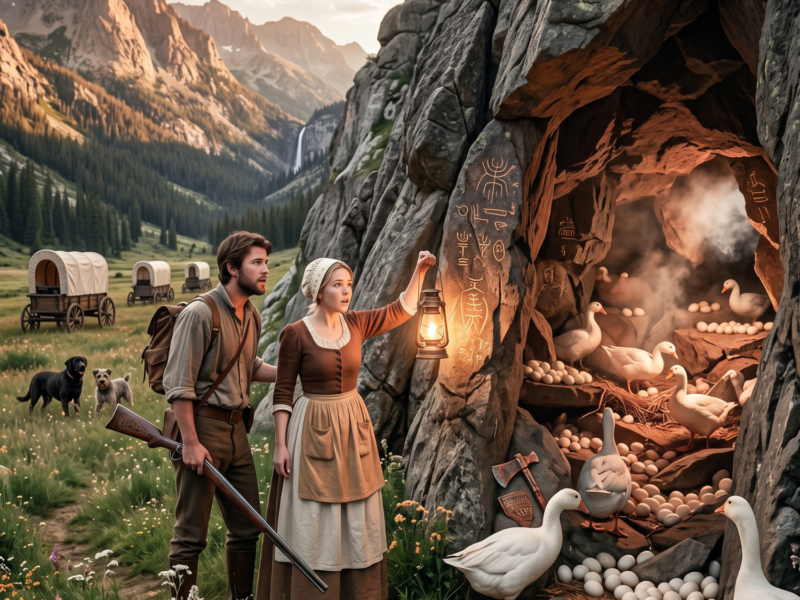
They Followed Their Geese Into a Cliffside Crack—Then Discovered a Hidden Cave Full of Eggs
The Testimony of Aldis Pratt
They went up the slope as a procession. Webb squeezed through the crack, Elias and Pratt behind him.
When Webb stood in the massive chamber, his lantern held high, the words died in his throat. The geese moved around his polished boots, unbothered, ancient, and serene. He looked at the vast accumulation of eggs, the careful pathways, the thermal vents that kept the air perfectly balanced.
“How many families did this feed?” Webb asked.
“Six,” Ruth answered. “Two hundred and eleven eggs. The flock’s nesting rate has not declined.”
Webb walked to the north wall. He stared at the ancient Shoshone marks. Before he could ask, Aldis Pratt stepped forward, his voice echoing in the cavern.
“Those marks were made by the Shoshone, Marshal. They used this chamber for agricultural storage for generations before the first settler signed a piece of paper. The Cranes haven’t excavated a mine. They have simply restored an ancient, working farm.”
Webb looked at Pratt, then at the marks, then at Ruth. He recognized the legal trap she had laid for him months ago. A natural geological feature, improved for agricultural storage, utilized by the community.
Webb closed his notebook with a sharp snap.
“It appears,” Webb said, his voice formally polite, “that this falls within the existing definitions of productive use under the Homestead Act. I will file my report approving the claim.”
They stepped back out into the bright, blinding light of the March morning. The sky was a thin, piercing blue. The mountain stood exactly where it always stood—close, immense, and asking nothing of anyone.
Pratt paused at the entrance, touching the juniper bark. “My wife would have had something sensible to say about a place like this,” he murmured. “I wish she could have seen it.”
“I think she just did,” Ruth said softly.
Epilogue: What the Geese Knew
The summer light in the high country was long and golden, making even ordinary things look as though they had been arranged by a master painter.
Ruth sat at the kitchen table, the ledger open before her. She wrote the final tallies of the winter, the names of the families, the estimates for the coming frost. Then, she closed the book.
Elias stepped into the cabin, carrying the scent of fresh hay and warm earth. He walked to the table, poured two cups of coffee, and sat beside her. He placed his large, calloused hand over hers.
It was the same gesture he had made on the sled, in the freezing snow. But now, in the warmth of the evening, it meant something different. It meant we survived. It meant we belong here.
They had arrived in Wyoming with forty-three dollars, two mules, and a flock of geese. They had found a mountain that had been storing abundance against scarcity since long before they were born. They hadn’t conquered the land. They had simply paid attention. They had listened to the geese, and the geese had shown them how to live.
Outside, the flock moved through the meadow grass, their low murmurs drifting on the wind. The mountain’s ledger was balanced. The evening light lay across the table, and for Elias and Ruth Crane, it was exactly what they had come west to find.
It was enough.









