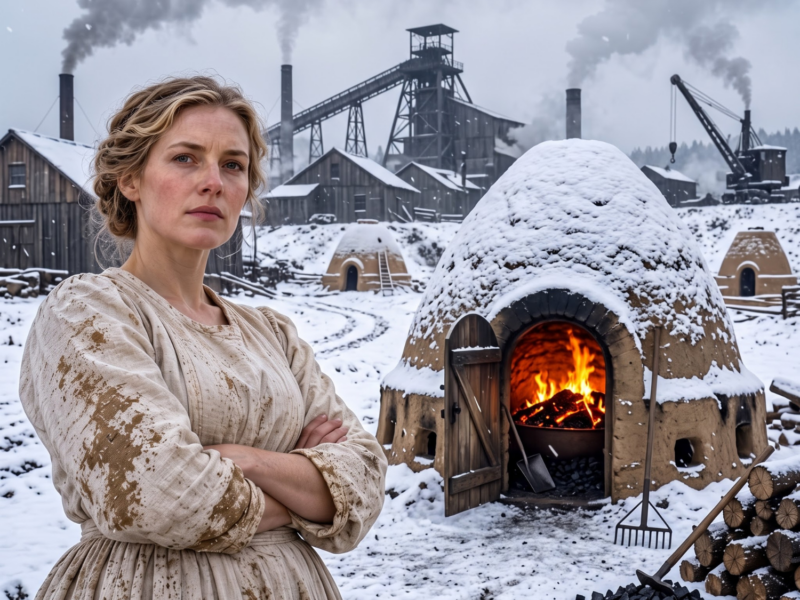
They Laughed at Her Beehive Mud House—Then Winter Came and Their Cabins Stayed Cold
THE ANATOMY OF COLD
That night, inside the drafty, company-rented cabin, the temperature hovered just above freezing.
Margarite sat by the iron stove, watching the coal burn. Her husband, Harlon, sat across the small room, his face smeared with coal dust that never quite washed out of his pores. He was carving a small wooden horse for their seven-year-old son, Wesley, who was asleep on a cot, buried under three heavy wool coats.
Their ten-year-old daughter, Delia, shivered in her sleep, coughing a dry, rattling hack.
Harlon looked at the crumpled, mud-stained demolition order resting on the table.
“They won’t wait until New Year’s,” Harlon said softly. “Mordecai Bligh was talking at the tipple today. The company knows the dome is almost finished. They want it flattened before the camp sees it work.”
“If it works,” Margarite corrected, though she didn’t doubt it. She had grown up in the high desert of New Mexico, where her grandfather built adobe walls thick enough to swallow the vicious summer heat and radiate it back through the freezing nights.
When the drought took their ranch, Harlon had moved them east for the steady wages of the coal camps. But they had traded starvation for freezing. The company houses were built fast and cheap—thin pine boards that hemorrhaged heat faster than a stove could produce it. The miners burned staggering amounts of company-sold coal just to keep from freezing to death in their beds.
The cold wasn’t just a weather pattern here. It was an economy.
“It’s a geometry problem,” she had told Harlon months ago, after watching Wesley’s lips turn blue by the fire. “They build boxes. Boxes catch the wind. A dome lets the wind slip around it. And mud… mud is a battery.”
Harlon had stopped arguing with her when she laid the first course of bricks. He had seen the fire in her eyes. He spent his off-shifts mixing the heavy red clay from the creek with straw and sand, hauling it to her scaffold.
Now, sitting in the freezing cabin, Harlon set down his carving knife.
“Margarite,” he whispered. “I found something in the mine today.”
Margarite looked up. The tone of his voice made her blood run cold.
Harlon reached into his pocket and pulled out a small, jagged piece of rock. It wasn’t coal. It was pale, glittering faintly in the low lamplight.
“I was working the deep seam,” Harlon said, leaning forward. “The old eastern tunnel they boarded up five years ago. I swung my pick too wide and hit the boundary wall. A chunk came off.”
He placed the rock on the table.
Margarite picked it up. It was incredibly heavy for its size. “What is this?”
“I showed it to an old timer on the line,” Harlon said, his voice shaking slightly. “It’s silver ore. High grade.”
Margarite stared at the rock. The Marrow Creek hollow was a coal camp. There was no silver in these mountains. Unless…
“Harlon,” she breathed. “The eastern edge of the camp. The tract of land the company let us build the dome on.”
Harlon nodded slowly. “We’re building our house directly on top of the old eastern tunnel. The one they claimed collapsed.”
The pieces fell into place with terrifying speed. The county inspector’s sudden, aggressive interest. The demolition order. The ridicule from the company foremen.
They didn’t care about the building code. They didn’t care about the dome’s safety.
They cared that Margarite Ashcom was building two tons of impenetrable, permanent mud-brick directly on top of a secret, illegal silver vein that the coal company was quietly mining off the books.
And she had until December 31st before they brought the iron bars.









