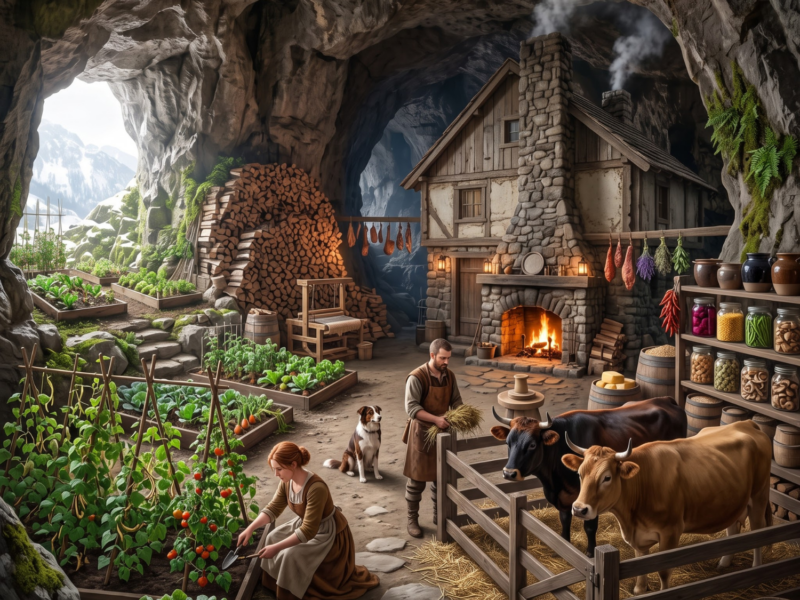
They Left Her to Freeze — She Turned a Sandstone Cave Into the Only Warm Shelter During the Blizzard
THE STONE THROAT
The storm lulled slightly past noon. Ruth removed the top board and squeezed into the outer passage. A knee-high snowdrift blocked the entrance. She kicked through it and stepped onto the ledge.
The world was gone. There was no sky, no horizon, no earth. Just an endless, churning ocean of white.
Ruth turned to the cliff face. She needed a way to vent smoke. As she brushed snow from the rock face, she noticed a vertical fissure running up the sandstone, widening as it climbed.
She ran back inside, tracing the ceiling of the inner chamber. The same fissure was visible right above a slight dip in the sandy floor.
Ruth dropped to her knees and began digging with the iron poker. Beneath the loose sand was a layer of packed clay, but as she dug deeper, the poker struck something metallic.
Clack.
Ruth froze. She dug frantically with her bare hands, unearthing a small, rusted tin lockbox.
Her heart hammered against her ribs. She pried the latch open with the poker. Inside, wrapped in oilcloth, was a chunk of raw, heavy silver ore. Beneath it lay a folded piece of paper.
Ruth opened the document. It was a geological survey of the Calder claim, stamped and dated three months before Elias died. At the bottom was a handwritten note: Vein confirmed. Transfer claim to A. Calder upon E’s removal.
Ruth stopped breathing. A. Calder. Agnes.
And E’s removal.
Elias hadn’t died of winter pneumonia. He had been murdered. Agnes and Walter had known about the silver. They had killed her husband, forged the eviction, and thrown her into a blizzard to tie up the last loose end.
A cold fury ignited in Ruth’s chest, burning far hotter than any fire. She was not going to die in this cave. She was going to survive, and she was going to make them pay.
Ruth lined the shallow pit with flat stones, placing her dry brush inside. She struck a match. The flame caught. For a terrifying second, the smoke lingered. Then, it leaned sharply toward the natural crack in the ceiling. The updraft caught it, sucking the gray plume straight up and out of the chamber.
The cliff had given her a chimney.
For the rest of the day, she hauled heavy, dark river stones, building a tight ring around the fire pit. The flames heated the stones. When the wood burned down to save fuel, the stones radiated an intense, life-saving heat for hours.
Three days passed. The temperature plummeted. Ruth survived on thimbles of cornmeal and slivers of venison. She stopped counting the days and started counting the height of her dwindling woodpile.
On the morning of the fourth day, Ruth found footprints.
They weren’t rabbit tracks. They were large, heavy boot prints, featuring a worn strike on the right heel. They led directly from the buried valley floor up to the cave entrance.
Someone was out there.
Ruth drew her hunting knife and pressed herself against the rock wall.
“Mrs. Calder?” a man’s voice called over the wind. “I’m not looking for trouble.”
A man stepped into the entrance. He looked forty-five, with graying temples and a beard caked in ice. He wore a patched wool coat. Behind him stood a massive, exhausted bay horse carrying two heavy canvas packs.
“My name is Samuel Briggs,” the man said, raising his empty hands.
“What do you want?” Ruth demanded, the knife steady.
Samuel’s eyes flicked over her defensive wall, the fire pit, the radiating stones. “My cabin roof caved in last night. Half my wood is wet. I heard someone was living up here.”
“From who?”
“Walter Calder. I passed through Musselshell two days ago. He told the general store his brother’s widow had gone mad and run into the cliffs. Said you’d come crawling back when the frostbite took your toes.”
Ruth’s grip on the bone handle tightened. “Did you believe him?”
Samuel looked at the ingenious stone-lined fire pit. “No.”
He unbuckled one of the horse packs. Inside were neatly split, perfectly dry pine boards. The second pack held coffee, potatoes, salt, and a cast-iron stovepipe elbow.
“I repair freight wagons,” Samuel said quietly. “I know how to build. I brought supplies. Nobody keeps shelter for free.”
Ruth stared at the stranger. She looked at his hands. They were calloused, yes, but not the thick, scarred hands of a wagonwright. And tucked into his waistband was a pristine Colt revolver with a filed-down sight—a gunfighter’s weapon.
“You work for your place,” Ruth said, lowering the knife. “You follow my rules. You touch nothing without asking.”
Samuel nodded once. He stepped into the inner chamber, pulling off his gloves. He pressed a hand to the sandstone wall. “It’s ten below outside. It’s above freezing in here.”
“Can you use that?” Ruth pointed to the iron elbow.
Samuel examined the natural crack in the ceiling. “If we build a stone throat and use the elbow to control the draw, you’ll double the heat output and halve your wood consumption.”
They worked until sunset. Samuel was meticulously polite, asking permission before moving a single stone. When they lit the fire, the updraft roared. The iron elbow caught the heat perfectly, radiating it into the room.
Samuel sat back, a small smile cracking his icy beard. Then, he looked toward the entrance.
The wind had returned. A second, far more violent front was slamming into the mountains.









