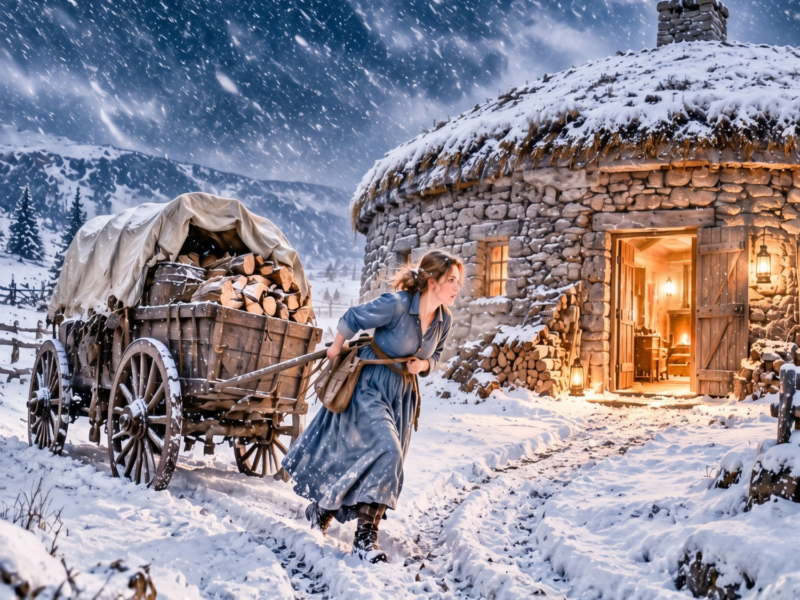
They Mocked Her Round Stone House—Then Their Thermometers Showed a 56°F Difference
THE BASIN OF CIRCLES
The building season of 1881 did not look like any year the Wyoming territory had ever witnessed.
By June, the Elorn Basin looked less like a collection of frontier claims and more like an ancient archaeological site resurrected from the old world. The square pine cabins didn’t vanish overnight—a man doesn’t tear down a roof that still keeps the rain off—but every new addition, every expansion, every outlying root cellar and workshop was built with a gentle, sweeping curve.
Silas Crane became Ingred’s most fanatical disciple. He spent his days hauling sandstone from the southern outcrop, his broad-axe abandoned in favor of a mason’s chisel and a heavy mallet.
“You’re swinging that too fast, Silas,” Ingred instructed one breezy afternoon, walking the perimeter of Silas’s new kitchen extension where a clean, graceful oval was rising from the soil. “Stone doesn’t care about your impatience. You have to listen to the grain. If a block resists the chisel, it’s telling you it wants to face outward, not inward.”
Silas adjusted his grip, wiping the sweat from his forehead with his forearm. He looked at the smooth, seamless curve of the masonry, then at Ingred, who stood nearby in her mended white dress, her sleeves pushed to the elbows.
“You know, Ingred,” Silas said, resting his mallet on a sandstone block. “Boon left the territory for good. Sold his holdings to a syndicate out of Omaha for pennies on the dollar. They tried to claim the mineral rights on your ridge, but Vance’s office reviewed the patent and threw them out. You’re officially the most secure landholder between here and the Rockies.”
“I was secure the day I laid the first course,” Ingred replied quietly, running her hand along the cool stone of the wall.
“Yeah, well,” Silas chuckled, shaking his head. “The rest of us took a bit longer to catch up.”
As if on cue, the heavy rhythmic thud of a horse’s hooves drew their attention toward the basin road.
A tall, broad-shouldered man with sawdust permanently worked into the deep creases of his hands reined in his roan gelding at Silas’s fence line. It was Anders Halt, the widower from Cedar Hollow, accompanied by his bright-eyed seven-year-old daughter, Clara.
Anders swung down from the saddle, tethered his horse, and walked over to where Ingred and Silas stood. He didn’t offer a grand speech; Anders was a man of few words, built of the same silent resilience as the timber he worked.
He held out a small, beautifully carved wooden box toward Ingred.
“What is this, Anders?” Ingred asked, taking the box with her calloused hands. She popped the brass latch. Inside rested a perfectly fitted, hand-turned oak rolling pin and a set of custom maple pastry molds—tools designed specifically for a woman who spent her winter baking bread in a roundhouse.
“I heard you were fixing your cedar larder,” Anders said, his voice rumbling deep in his chest, a slight flush rising beneath his weathered skin. “Thought you might need some tools that actually fit the shape of your workspace.”
Ingred looked down at the wooden implements, then up at Anders. For the first time since he had started riding out to the basin six months ago, she didn’t offer a deflective remark or a technical observation about thermal mass.
She simply smiled—a warm, genuine, unguarded smile that transformed her severe, tired face into something breathtakingly radiant.
“Thank you, Anders,” Ingred said softly. “It fits the room entirely.”
Little Clara leaned around her father’s leg, looking up at Ingred with wide, adoring eyes. “Can we go see the roundhouse today, Miss Vestall? Papa said you have sheepskins on the sleeping platform now.”
“We can, Clara,” Ingred said, taking the little girl’s small hand in her own. “And I’ll show you how to bake honey cakes in the central hearth.”
Silas Crane watched them from the scaffolding, a knowing, affectionate grin spreading across his weathered face. He picked up his chisel, tapped it against a sandstone block, and went back to work, leaving the two of them standing in the golden Wyoming sunlight.
EPILOGUE: THE UNBROKEN LINE
Decades later, long after the territorial government had folded into statehood and the railroads had carved twin bands of iron across the northern plains, the Elorn Basin remained an architectural anomaly that baffled travelers and fascinated historians.
To the outside world, it was known as The Valley of Circles.
Passing through on the Union Pacific line, tourists would press their faces against the soot-stained windows of the observation cars, pointing in wonder at the peculiar, graceful clusters of stone dwellings rising from the sagebrush—homes that seemed to grow organically out of the earth itself, defying the harsh prairie winds with aerodynamic grace.
Inside one of those round houses, an elderly woman sat in a comfortable rocking chair by a warm, crackling central hearth.
Her hair was stark white, pinned back in a loose, comfortable bun. Her dress was still plain, though made of fine cotton now, and her hands—though gnarled by ninety years of mountain winters—still possessed the steady, unyielding strength of a master stonecutter.
Outside the window, a gentle autumn rain pattered against the curved sandstone wall, sliding harmlessly down the masonry without finding a single crack to exploit.
The heavy oak door swung open, and a middle-aged woman walked in, shaking the dampness from her wool shawl. It was Clara, now grown, a mother and a respected schoolteacher in the basin, carrying a steaming mug of chicory tea.
“It’s turning chilly tonight, Mama,” Clara said gently, handing the mug to the old woman. “Shall I bank the hearth?”
Ingred Vestall—now ninety years old, her eyes as sharp and clear as the mountain air—sipped her tea. She looked around the round room. Every stone in it had been touched by her hands, or by the hands of the children and neighbors she had taught to build.
The square cabins of the past were long gone, rotted into the soil or torn down for firewood, remembered only as a difficult phase a frontier people went through before they learned how to truly listen to the earth.
“No, Clara,” Ingred said, her voice a low, steady hum that seemed to resonate with the stone itself. “Don’t bank it yet. Let the fire die down.”
“It’ll get cold,” Clara protested with a fond smile.
“It won’t,” Ingred replied, gazing at the massive, sun-warmed limestone wall holding the warmth of the day against the coming night. “The stone remembers. It will keep us warm through the dark. It always does.”
Clara smiled, pulled up a stool beside her mother, and sat in the quiet, unbroken circle of light and heat—a sanctuary built by a woman who refused to break, and a home that the winter could never conquer.









